This blog came into existence based on a post originally addressed to a fellow younger worker who was clueless about the "beats" of the 1950s and their stepchildren, the "hippies" of the 1960s, two movements that influenced me considerably in those days. Any and all essays, thoughts, or half-thoughts about this period in order to "enlighten" our younger co-workers and to preserve our common cultural history are welcome, very welcome.
Friday, March 1, 2013
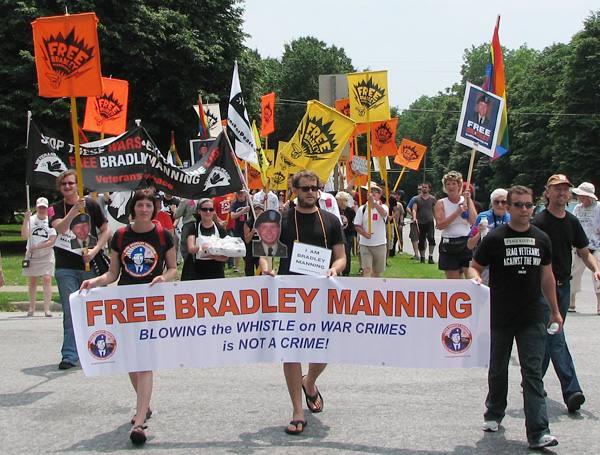
Rally for Bradley Manning. Join us at Fort Meade on June 1, 2013.
Join us at Fort Meade in support of Bradley Manning. By the time his court martial begins in June, he will have spent more then 3 years in prison. All for having done the right thing, for having exposed war crimes! Saturday, June 1, 2013 RALLY FOR BRADLEY AT FORT MEADE
By the Bradley Manning Support Network, February 25, 2013. • 1pm Gather (Reece Road and US 175, Fort Meade, Maryland) • 2pm March • 3pm Rally and Speak Out Sponsored by the Bradley Manning Support Network and the national Veterans for Peace organization, with the help of Courage to Resist, and many other groups.
After more than three years of imprisonment, including nine months of torture, Nobel Peace Prize nominee Bradley Manning’s trial is finally scheduled to begin June 3, 2013, at Fort Meade, Maryland. The outcome of this trial will determine whether a conscience-driven 25-year- old WikiLeaks whistle-blower spends the rest of his life in prison. Bradley believed that the American people have a right to know the truth about what our government does around the world in our name. We the People must send a message to the military prosecuting authority, and President Obama, that Bradley Manning is a patriot and heroic truth-teller.
June 1st is the International Day of Action to Support Bradley Manning. Join us at Fort Meade on the eve of Bradley’s court martial. Solidarity actions are welcome at bases, recruiting centers and US embassies worldwide. We ask that Veterans for Peace join us in cosponsoring these historic events.
——————————- Monday, June 3, 2013 ATTEND THE BEGINNING OF US v. BRADLEY MANNING 8:30 am, enter Fort Meade at Reece Road and US 175, Fort Meade, Maryland 9:00 am scheduled daily start of hearings at Magistrate Court 4432 Llewellyn Avenue, Fort Meade, MD. It is 2 miles from the Main Gate. The court martial is expected to last 6-12 weeks. Supporters are encouraged to attend as many days of this trial as they are able. ——————————-
Parking for Saturday, June 1, 2013. We hope to come to an understanding with local authorities regarding the best place for supporters to park for the Saturday rally. Parking is available about one mile south near Blue Water Blvd (Weis Market) and US 175. We’ll try to help shuttle folks as needed.
Portable toilets are expected to be available.
Join us in the courtroom for the trial beginning June 3, 2013. Drive (or taxi) to the Fort Meade Visitor Control Center at the Fort Meade Main Gate (all the other gates are for military ID holders only), Reece Road and US 175, Fort Meade, Maryland. We suggest arriving when the visitor center opens at 7:30am, and certainly before 8:15am. The proceedings are scheduled to begin at 9am daily. The multiple layers of security take time to navigate, and procedures often change from day to day. Each person will need a valid state or federal photo ID such as a driver’s license, state photo ID card, or passport. Foreign passports are accepted. Anyone driving on to Fort Meade will be required to submit their driver’s license, vehicle registration, and printed (not digital) proof of insurance. Your vehicle will be subject to search, and you may be required to cover over political bumper stickers on your vehicle. Consider walking on base if there are any questions at all regarding your vehicle and paperwork.
The proceedings will be held at the Magistrate Court, 4432 Llewellyn Ave, Fort Meade, MD 20755 (this is one mile from the Visitor Center). Electronic devices, including cell phones, computers, cameras, are not allowed in the courtroom, and should be left in your vehicle.
There are no pre-registration requirements for the public to attend the proceedings. However, those wishing to attend as credentialed media should contact the US Army Military District of Washington Public Affairs Office at 202-685-4645. GETTING THERE
The Fort Meade Main Gate is less than 10 miles south of the Baltimore-Washington DC International (BWI) airport. It is located between Washington DC and Baltimore MD.
Driving: From Washington, DC, take MD-295 N towards BALTIMORE to US 175 EAST, then follow 175 EAST until you come to Reece Road. From Baltimore, MD, take MD-295 S towards WASHINGTON to US 175 EAST, then take 175 EAST until you come to Reece Road.
Buses: We hope to charter buses for supporters from both downtown Washington DC and Baltimore, Maryland.
There is regional bus service from BWI Airport to the Arundel Mills Shopping Center (Bus 017). Then take the CTC K to the Main Gate. For a Google Maps public transit view of this option:
http://alturl.com/3ehis
Train: Note that the nearby Odenton MARC train station serves commuter trains only and does not run on the weekend. Amtrak does not stop at this station. WHERE TO STAY
There are many hotels serving this area just south of the BWI Airport. The closest of these are 5-6 miles from the Ft. Meade Main Gate. One option is Aloft Arundel Mills, 7520 Teague Rd, Hanover, MD, 21076 (866-539-0036), $80-$100 night. A hotels.com search of the area turns up rooms nearby starting at $60 a night. The only lodging really close to the Ft. Meade Main Gate is the White Gables Motel; however, for a number of reasons, we strongly suggest avoiding it.
Bradley Manning’s speedy trial motion denied, despite nearly three years without trial
In a pretrial hearing at Fort Meade, MD, Judge Denise Lind denied the defense’s motion to dismiss charges for lack of a speedy trial. She listened to arguments over government evidence, a written statement from Bradley, and an updated plea offer. Bradley will get a chance to explain his releases to WikiLeaks in a public discussion with the judge on Thursday.
By Nathan Fuller, Bradley Manning Support Network. February 26, 2013.
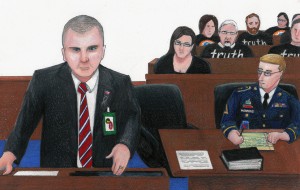
Defense lawyer David Coombs and PFC Bradley Manning, sketched by Clark Stoeckley of the Bradley Manning Support Network.
On PFC Bradley Manning’s 1,005th day in prison without trial, military judge Denise Lind ruled that the government has not deprived him of his due process right to a speedy trial. Rules for court martial require the military to arraign defendants within 120 days, and more than 600 passed before prosecutors arraigned Bradley. Judge Lind denied the defense motion to dismiss charges, ruling that the delays excluded by the Convening Authority were justifiably removed from the speedy trial clock.
Judge Lind repeatedly referenced the “complexity” of the case and the “voluminous” set of documents at issue. She did say that prosecutors mishandled discovery documents and were not justified in delaying 6 days from the speedy trial clock shortly following the Article 32 pretrial hearing in December 2011. However, those caveats didn’t outweigh her decision that the government was otherwise largely diligent.
The ruling, a verbose litany of dates, delays, and correspondence, took more than two hours to read and was virtually impossible to transcribe in full. Judge Lind refuses to make her rulings, or any filings or transcripts for that matter, publicly available, so reporters are left to scramble and summarize. Defense, Judge Lind question government’s prejudicial evidence
Judge Lind then questioned the prejudicial nature of the government’s request to submit evidence allegedly retrieved at Osama bin Laden’s raided compound in Abbottabad, Pakistan. Prosecutors said they want to prove that the United States’ enemy “received” documents that Bradley’s accused of releasing. But defense lawyer David Coombs said that the government could show evidence from anyone to prove that the documents were in fact published on the Internet, and that this move is intended to incur prejudice against Bradley, either from a potential jury or in the court of public opinion. Prosecutors have chosen bin Laden, Coombs implied, to impugn Bradley’s character in connecting him to America’s enemies.
Furthermore, Coombs said that this request contradicts the government’s previous contention that events after the fact – such as the lack of damage done to national security – are irrelevant to whether Bradley committed the offense. The defense is not allowed to show that WikiLeaks’ releases brought no harm to the U.S. on the grounds that later harm isn’t relevant. Bradley Manning to make his case on Thursday
Finally, the defense has submitted a written statement explaining Bradley’s offer to plead guilty to several lesser-included offenses and not guilty to some of the major specifications. Bradley is expected to proffer to plead guilty to lesser offenses, such as “unauthorized possession” of documents instead of “exceeds authorized access,” that would carry a maximum of 20 years in jail. The plea offer triggers an in-session colloquy between Bradley and Judge Lind, currently scheduled for Thursday, in which she’ll ask him a series of questions to ensure he understands to what he’s pleading. Bradley submitted the supplemental statement, which is at least 25 pages long, to educate Judge Lind ahead of the discussion.
The government objected to the statement, claiming many of the personal and political factors Bradley wishes to discuss are irrelevant to the charged offenses. By way of these objections, we learned that included in the statement are some of Bradley’s explanations and feelings about WikiLeaks’ releases. For instance, he wrote to Judge Lind that he’d hoped the release of the Iraq War Logs would ‘spark a domestic debate on the role of our military and foreign policy in general.’
The statement also alludes to the seminal incident in the Army in which Bradley objected to Iraqi Federal Police detaining political dissidents for distributing literature. As he told Adrian Lamo in chat logs published by Wired, Bradley reported the repressive arrests to his superiors but was told to keep quiet and continue helping Iraqi police. This stonewalling, it was implied, led Bradley to look for alternative outlets to expose this abuse.
Soldier Admits Providing Files to WikiLeaks
Alex Wong/Getty Images
Pfc. Bradley Manning pleaded guilty to 10 criminal counts in connection with the leak to WikiLeaks.
FORT MEADE, Md. — Pfc. Bradley Manning on Thursday confessed in open court to providing vast archives of military and diplomatic files to the antisecrecy group WikiLeaks, saying that he released the information to help enlighten the public about “what happens and why it happens” and to “spark a debate about foreign policy.”
Appearing before a military judge for more than an hour, Private Manning read a statement recounting how he joined the military, became an intelligence analyst in Iraq, decided that certain files should become known to the American public to prompt a wider debate about foreign policy, downloaded them from a secure computer network and then ultimately uploaded them to WikiLeaks.
“No one associated with WLO” — an abbreviation he used to refer to the WikiLeaks organization — “pressured me into sending any more information,” Private Manning said. “I take full responsibility.”
Before reading the statement, Private Manning pleaded guilty to 10 criminal counts in connection with the huge amount of material he leaked, which included videos of airstrikes in Iraq and Afghanistan in which civilians were killed, logs of military incident reports, assessment files of detainees held at Guantánamo Bay, Cuba, and a quarter-million cables from American diplomats stationed around the world.
The guilty pleas exposed him to up to 20 years in prison. But the case against Private Manning, a slightly built 25-year-old who has become a folk hero among antiwar and whistle-blower advocacy groups, is not over. The military has charged him with a far more serious set of offenses, including aiding the enemy, and multiple counts of violating federal statutes, including the Espionage Act. Prosecutors now have the option of pressing forward with proving the remaining elements of those charges.
That would involve focusing only on questions like whether the information he provided counted as the sort covered by the Espionage Act — that is, whether it was not just confidential but also could be used to injure the United States or aid a foreign nation.
Private Manning described himself as thinking carefully about the kind of information he was releasing, and taking care to make sure that none of it could cause harm if disclosed.
The only material that initially gave him pause, he said, were the diplomatic cables, which he portrayed as documenting “back-room deals and seemingly criminal activity.”
But he decided to go forward after discovering that the most sensitive cables were not in the database. He was also motivated, he said, by a book about “open diplomacy” after World War I and “how the world would be a better place if states would not make secret deals with each other.”
“I believed the public release of these cables would not damage the United States,” he said. “However, I did believe the release of the cables might be embarrassing.”
Private Manning said the first set of documents he decided to release consisted of hundreds of thousands of military incident reports from Afghanistan and Iraq. He had downloaded them onto a disk because the network connection at his base in Iraq kept failing, and he and his colleagues needed regular access to them.
Those reports added up to a history of the “day-to-day reality” in both war zones that he believed showed the flaws in the counterinsurgency policy the United States was then pursuing. The military, he said, was “obsessed with capturing or killing” people on a list, while ignoring the impact of its operations on ordinary people.
Private Manning said he put the files on a digital storage card for his camera and took it home with him on a leave in early 2010. He then decided to give the files to a newspaper.
“I believed if the public — in particular the American public — had access to the information” in the reports, “this could spark a debate about foreign policy in relation to Iraq and Afghanistan,” he said.
Private Manning said he first called The Washington Post and spoke to an unidentified reporter for about five minutes. He decided that the reporter did not seem particularly interested because she said The Post would have to review the material before making any commitment.
He said he then tried to reach out to The New York Times by calling a phone number for the newspaper’s public editor — an ombudsman who is not part of the newsroom — and leaving a voice mail message that was not returned.
In January 2010, around the time when Mr. Manning called the public editor’s line, voice mail messages were checked by Michael McElroy, the assistant to Clark Hoyt, then the public editor. Both Mr. Hoyt, now the editor at large at Bloomberg News, and Mr. McElroy, now a staff editor at The Times, said on Thursday that they had no recollection of hearing such a message.
“We got hundreds of calls a week, and I tried to go through them all,” Mr. McElroy said. “If I’d heard something like that, I certainly hope I would have flagged it immediately.”
Private Manning eventually decided to release the information by uploading it to WikiLeaks. To do it, he said, he used a broadband connection at a Barnes & Noble store because his aunt’s house in a Maryland suburb, where he was staying, had lost its Internet connection in a snowstorm.
In February 2010, after he returned to Iraq, Private Manning sent more files to WikiLeaks, including a helicopter gunship video of a 2007 episode in Iraq in which American forces killed a group of men, including two Reuters journalists, and then fired again on a van that pulled up to help the victims.
Private Manning said the video troubled him, both because of the shooting of the second group of people, who “were not a threat but merely good Samaritans,” and because of what he described as the “seemingly delightful blood lust” expressed by the airmen in the recording. He also learned that Reuters had been seeking the video without success.
Private Manning said he copied the files from the secure network onto disks, which he took back to his quarters and transferred to his personal laptop before uploading them to WikiLeaks — initially through its Web site, and later using a directory the group designated for him on a “cloud drop box” server.
One set of files, he said, described the arrest by the Iraqi police, supported by Americans, of 15 people for printing “anti-Iraqi” pamphlets. None were tied to militants, he said, and the pamphlets were “merely a scholarly critique” of government corruption. To his frustration, WikiLeaks did not publish those files.
After that episode, Private Manning said, he became interested in detainees, which led him to the Guantánamo files. He said the United States was holding detainees who were “innocent, low-level foot soldiers, or didn’t have useful intelligence and who would be released” if they were still in the war zone.
At the same time, he was increasingly engaged in online conversations with someone from WikiLeaks who he said he assumed was a senior figure like Julian Assange, its founder, whose name he mispronounced as “as-sahn-JAY.” He said he greatly valued those talks because he felt isolated in Iraq. But, in retrospect, he said the relationship was “artificial.” He did not elaborate.
The judge, Col. Denise Lind, pressed Private Manning to explain how he could admit that his actions were wrong if his motivation was the “greater good” of enlightening the public. Private Manning replied, “Your Honor, regardless of my opinion or my assessment of documents such as these, it’s beyond my pay grade — it’s not my authority to make these decisions” about releasing confidential files.
Scott Shane contributed reporting from Washington.
Lynne Stewart, a brilliant gung-ho trial attorney, has a stellar history that many attorneys would kill for. A defense attorney who truly fights for her clients. And, far more often than not, brings them home. She has battled some of the biggest cases in New York history, beating quite a few and beating the government as well. After her representation of Egyptian cleric Omar Abdel-Rahman, for daring to speak out publicly in his defense, and delivering a messaage of his thoughts to the public, she was charged with: conspiracy, providing material support to terrorists – convicted, sentenced to, after an appeal, 10 years in federal prison, and disbarred.
Lynne, 73, is a breast cancer survivor, and recently, the cancer has returned. Her treatment in federal custody is, to say the least, far from optimal. That 10 years, increased by order of the 2nd Circuit Court of Appeals, from 28 months, may prove a death sentence for a courageous, principled, and brilliant defense lawyer, who has been a bane to the state since she first walked in a courtroom.
Andrew Napolitano, former judge and conservative Fox TV contributor, has called the Stewart convinction “a perverse victory for the Justice Department, and a travesty of justice, designed to intimidate all lawyers from vigorously advocating for their clients.” To find out how you can help win justice for Lynne Stewart, contact: lynnestewart.org.
February 27th, 2013 Lynne Stewart’s defense team filed her Cert Petition – asking the Supreme Court to hear her case – on February 21, 2013. Click here to read the Cert Petition (PDF).
Excerpt:
“Freedom of speech does not exist in the abstract. It can only flourish in an effective forum. For, in reality, free speech is found in a multitude of circumstances. Not long ago it was young people, with long hair, tramping around a federal courthouse chanting, “No. No. We won’t go!” It is an American flag sewn to a pair of old blue jeans. It’s all this and much more that defy description. It is indivisible. We cannot save it for one person and deny it to another. It must exist for all of us, or there is a real risk that, someday, it may not exist for any of us. And, so, it must exist for Lynne Stewart along with everyone else because her words are entitled to the same protection from prosecution as other political speech. Under no circumstances should her words and beliefs subject her to eight more years of imprisonment.”
On January 4, a Cook County court sentenced five anti-racist
militants to prison terms of three and a half to six years on “armed violence”
charges that stem from the breaking up of a fascist meeting last spring. Plans
to convene a “White Nationalist Economic Summit” attracted a group of the scum,
some with links to the Stormfront Web site run by a former Ku Klux Klan grand
dragon, to the Ashford House restaurant in the Chicago suburb of Tinley Park on
May 19. Having gotten wind of this outrage, at least 18 anti-racists went to the
restaurant and put an end to the “summit,” sending some of the creeps to the
hospital. Shortly after, police pulled over and arrested a carload of five
anti-fascists from Bloomington, Indiana—Jason Sutherlin, Cody Lee Sutherlin,
Dylan Sutherlin, Alex Stuck and John Tucker—who have come to be known as the
Tinley Park 5. The trouncing of the “white nationalists” was a courageous act in
the interest of the working class and all the fascists’ intended victims.
Free the Tinley Park 5!
Each of the five was initially charged with 37 felony counts,
including armed violence, property damage and mob action, with bond set at
$175,000 to $250,000 apiece. The cops and prosecutors applied continuous
pressure to force them to give up names of those involved in sending the
fascists scattering, which the five have steadfastly refused to do. Unable to
meet the exorbitant bonds, they spent seven months in Cook County Jail while
legal proceedings dragged on. Facing the prospect of up to another year behind
bars to go to a trial whose outcome they could not predict, the five accepted a
non-cooperating plea bargain in which each pled guilty to three counts of armed
violence in return for guarantees of time off for good behavior.
The witchhunt against the Tinley Park 5 was part and parcel of the
hysteria whipped up against protesters at the NATO summit taking place that same
May 19-20 weekend in downtown Chicago. With the city center turned into an armed
camp, politicians, cops and the local media vilified and violence-baited the
anti-NATO protesters, particularly anarchists and those participating in Black
Bloc actions. Three anti-NATO protesters are still in jail after being set up by
a police provocateur and charged under Illinois anti-terrorism statutes, the
first time these laws were ever used (see “Defend Anti-NATO Protesters!”
WV No. 1003, 25 May 2012).
It is a good thing that the fascist “summit” was dispersed and the
Hitler-loving vermin were sent scurrying. The fascists are not simply carriers
of a genocidal worldview but deal in race terror against black people, Jews,
immigrants, gays and anyone else they perceive as “impure.” Last August, a
neo-Nazi skinhead murdered six Sikhs at a temple in Wisconsin, and in July 2011
a fascist massacred 69 people at a social-democratic youth camp in Norway. In
1999, a disciple of fascist Matthew Hale went on a racist shooting rampage in
Illinois and Indiana, killing a black former Northwestern University basketball
coach and a Korean student and wounding nine others, including six orthodox
Jews. In 2007, another Hale follower torched a black family’s home in
Joliet.
The fascists pose a deadly threat to the entire labor movement and
left. The capitalist rulers hold these shock troops in reserve so that in times
of crisis and social struggle they can be unleashed to defend the bourgeois
order. Take the example of Greece, where the fascist marauders of Golden Dawn
are today carrying out daily attacks on immigrants and leftists in collusion
with the capitalist cops and courts.
As Trotskyists, we look to the organized power of the working
class, standing at the head of all those targeted by the fascists, as the force
that can drive this scum off the streets. We have initiated labor/black
mobilizations to stop Klan provocations, including one in Springfield, Illinois,
in 1994. Such mobilizations are important in helping to make the working class
conscious of its historic interest and potential social power as the gravedigger
of the decaying capitalist system that breeds fascism.
The Partisan Defense Committee, a legal and social defense
organization associated with the Spartacist League, has donated $100 to the
defense fund for the Tinley Park 5 and their families. Donations can be made at
www.wepay.com/donations/legal-defense-fund-for-the-tinley-park-five.
The following February 13 letter by Ray Bishop, Workers
Vanguard editor, was sent to the Public Editor of the New York Times,
Margaret Sullivan, following the publication of her article “Keeping Secrets” (9
February).
You applaud the Times’ decision to finally report the
location of a U.S. drone base in Saudi Arabia while bemoaning how long it took
the Times to approve releasing the information, which had been kept
secret at the government’s request. Maureen Dowd’s column (“I’m Begging, Don’t
Hack the Hacks”) printed the same day objects to the policy of drone attacks
while raising alarm over Chinese hackers breaking into government and media
computer systems. In neither piece was any mention made of Bradley Manning, who
has suffered enormous abuse and faces a possible life sentence if a military
court finds him guilty of releasing a trove of classified documents to
WikiLeaks. That material shed welcome light on U.S. diplomatic schemes and
wartime atrocities in Iraq and Afghanistan. The omission of his case is simply
cowardice on the part of the Times, which you had earlier taken to task
for ignoring the bulk of Manning’s pretrial hearing in December.
You acknowledge that the policy of the Times is to keep
information from the public when Washington officials make the case that such
news would threaten “national security.” The other side of that coin is that,
following the September 11, 2001 attacks, then-Times reporter Judith
Miller recounted tales of Saddam Hussein’s nonexistent “weapons of mass
destruction” (the pretext for the U.S. invasion of Iraq). By contrast, making
the documents available to WikiLeaks—which were subsequently published in part
by the Times—was an act of truth-telling. If indeed it was Bradley
Manning who released the videos, reports and cables, he provided a valuable
service to humanity and now deserves the support of all who oppose the barbarity
and machinations revealed in them.
Claude McKay, a Jamaican-born poet active on the left in the U.S.
and Britain, traveled to Soviet Russia for the Fourth Congress of the Communist
International in November 1922. In his presentation at the Congress (reprinted
in “Blacks and Bolsheviks,” Black History and the Class Struggle No. 5,
February 1988), McKay stressed the centrality of black oppression to American
capitalism and criticized American Communists for not adequately addressing this
issue. It took the intervention of the Comintern to get the American Communists
to begin to actively fight for black rights.
At the time of the Congress, he drafted notes about the situation
of black people in the United States, the Caribbean and Africa. The notes are
unsigned, but McKay referred to them in other correspondence. We print below
excerpts from the sections on the black struggle in the U.S., which we obtained
from Tamiment Library at New York University. The original is in the Russian
State Archive of Socio-Political History (RGASPI) in Moscow. In his notes, McKay
refers to the African Blood Brotherhood, a Harlem-based organization, mainly
comprising Caribbean immigrants, whose leadership had recently joined the
American Communist Party.
* * *
During the World War the economic status of the Negro Race in the
New World underwent a swift transition for the better. Especially was this the
case in the United States where, on account of the giant war industries and the
shutting down of immigration, the services of Negro workers were greatly in
demand in the northern industrial zone. During this period it is estimated that
over 500,000 Negro workers left the South for jobs in the less hostile
atmosphere of the North.
Along with the improvement in their economic status came a great
wave of emotional racialism, aroused in part by the wrongs suffered by the race
and the sacrifices it was called upon to make for “World Democracy,” as well as
by the fine democratic phrases with which the Entente statesmen were gassing the
credulous liberals of their own countries and misleading the peoples of the
colonies. This racialism among the Negro workers at first took the form of a
proletariat movement but has been to a great extent perverted by subsequent
activities of opportunists and charlatans with their cowardly compromises and
surrenders and their grafting of all sorts of stock schemes upon the mass
movement....
The prey of unscrupulous leaders who glibly promised everything but
accomplished nothing save the periodical emptying of the pockets of their
credulous followers, the Negro masses are discouraged and suspicious, yet there
are organizational possibilities on a wide scale for any organization that can,
first, win their confidence and, second, push energetically the campaign of
organizing and, third, keep up interest in the organization.
The Negro masses are leavened by an increasingly large body of
race radicals and class radicals. The former are
Negroes who, while roused to thought and action by the wrongs of the race, have
not yet recognized the essential class nature of the struggle, nor the exact
cause and source of their oppression, which they blame indiscriminately upon the
entire white race. They are, however, generally inclined to side with and follow
the leadership of the class radicals who, fully cognizant of the value of race
radicalism for rousing the masses and as a natural and necessary step toward
class radicalism, have not been slow in utilizing it and even in helping in its
development.
Comparatively few Negro workers are in the unions for the reason
that, until recently, they were almost universally barred from the ranks of
Organized Labor. However, several thousand are now unionized. Some in the
regular unions, but many in segregated unions which are generally affiliated
with the national bodies.
Most of the class radicals are to be found in the ranks of the
“African Blood Brotherhood” and the “Friends of Negro Freedom”—the latter an
organization backed by the Socialist Party of America; the former said to have
Communist tendencies.
A large group of race radicals are also in the African Blood
Brotherhood (which makes a race as well as a class appeal); and a larger group
in the so-called “Garvey Movement” of “Universal Negro Improvement Association
and African Communities League.” The true race radical should not be confused,
however, with the motley crowd of fanatics, emotionalists, title and tinsel
worshippers who make up the huge mass of the Garvey organization....
The petit-bourgeoisie, with whom the race is honeycombed, find
expression chiefly in the “National Association for the Advancement of Colored
People,” in which a group of bourgeois gentlemen (colored and white) and
gentlemen who, while lacking the bourgeois gold, carry around the bourgeois
psychology, dominate a large but not compactly organized or effectively
functioning body of workers and professionals. The domination of the bourgeoisie
is here more open and complete than in the Garvey Movement which, while cursed
with petit-bourgeoisie for leaders, has a rank and file wholly made up of
workers, and the bourgeoisie in the latter movement have been accordingly forced
to resort to camouflage tactics. The compact organization of the Garvey
Movement, together with the mighty enthusiasm and blind fanaticism of most of
its membership have made it in the past more of an obstacle to the proper
prosecution of the Negro Liberation Struggle than has been the National
Association for the Advancement of Colored People....
As is well-known, the Negro workers are the most viciously
oppressed and poorly paid of any group of workers in the United States. No
matter what a Negro’s ability and fitness there are positions which he may not
fill and trades whose doors are closed to him. As a rule, only the most menial
jobs are open to him during normal times. Made to believe that the antagonistic
attitude of Organized Labor is wholly responsible for his exclusion from the
better-paid industries, he becomes a willing—and often a joyous—tool of the
Interests, and a scab in times of crisis for Organized Labor. He knows that in
numerous instances White Labor opposes his employment. He knows, too, of
frequent and widely heralded “philanthropies” to his race—by way of subsidies to
Negro colleges, etc.—on the part of the White Bourgeoisie and being at least as
backward as White Labor, which by its silly prejudices splits the ranks of
Labor, he is not able to see the facts as they really are.... His doubts are
further increased when he is shown that the white bourgeoisie controls the
press, the schools, the churches, the theatres, etc., in which race prejudice is
engendered and promoted....
And this leads naturally to a consideration of the present
aspirations of the Negro Race. The vast masses of the race in America have only
the very simplest aspirations, viz: to be permitted to live and eke out a mean
and miserable existence in peace. Of the various groups that rise above this low
level, the aspirations of some are confined to safety of life and property and
the protection of their women from insult and rape at the hands of white men.
Other groups would have political equality in addition; while the most
progressive groups demand nothing less than full equality: political, economic,
racial; and the abolition of human exploitation.
Poet’s Corner- Claude McKay-If We Must Die-In Honor Of The 94thAnniversary Of The Communist International
…they had heard that a group of White Guards, a first detachment on horse, maybe from the dreaded mercenary Czech Legion that were running amok form Siberia to the Urals or worst maybe the dreaded Cossacks who took no prisoners, none, were heading their way, heading right for their line of defense in the city ready to take back Kazan for the asking, so those Whites thought. Kazan fallen then the road to Moscow lay wide open and perhaps the end of the Soviet experiment in that dragged on second year of hellish civil war. But Commissar Vladimir and his band of comrade brothers, five in all, (and one sister, one stray Red Emma, they called her who learned of revolution and sex, young love smitten sex even in war-torn Kazan with young Zanoff, in that exact order while in their company and proved as fierce a fighter both ways, according to that same Zanoff, as any man) swore, swore a blood oath on their tattered red flag, the previous day that they would retreat no further, that here was their stand, their last stand if necessary but no more moves away from Moscow.
It had not always been that way with them, not by a long shot. They had all farmed, like their fathers eons before them, the same fruitless task (for them) land for Orlov, the richest landowner in Omsk, and never lifted their heads when the Social Revolutionaries had come with glad tidings (and before them other city radicals had spoken to their fathers and grandfathers). They just shoveled the dirt and kept their heads down. Then the war came, the bloody world war, and the Czar’s police came and “drafted” them into some vast ill-fed, ill-clad, ill-armed peasant force which proved no match for the methodical Germans as they were slaughtered by the millions in those foul trenches. And still they kept their heads bent. Kept them bent until the February revolution and in the fall of 1917 they had just followed their fellow out of the trenches and went home. Went home to farm Orlov’s land. Even when the Bolsheviks took power in November and decreed the land of Orlov’s theirs they kept their heads bent. It was not until Orlov and his agents and his White Guard friends came back and took the land, their now precious land, that they roared back. And joined one of Trotsky’s red brigades passing through.
Just then a messenger came to their line, a messenger from the river in front of Kazan. The message said that Trotsky himself had decided to fight and die before Kazan if necessary to save the revolution, to save their precious land. Vladimir and his comrades, including Red Emma, reaffirmed their blood oath. If they must die they would die in defense of Kazan, and maybe just maybe somebody would hear of their story, the story of five peasant boys and a pretty peasant girl as brave as they, and lift their heads and roar back too….
******
If We Must Die
If we must die, let it not be like hogs Hunted and penned in an inglorious spot, While round us bark the mad and hungry dogs, Making their mock at our accursèd lot. If we must die, O let us nobly die, So that our precious blood may not be shed In vain; then even the monsters we defy Shall be constrained to honor us though dead! O kinsmen! we must meet the common foe! Though far outnumbered let us show us brave, And for their thousand blows deal one death-blow! What though before us lies the open grave? Like men we'll face the murderous, cowardly pack, Pressed to the wall, dying, but fighting back!
Workers Vanguard No. 1018
22 February 2013
Black History Month
Class, Race and the Black Struggle in the U.S.
Claude McKay, 1922
Claude McKay, a Jamaican-born poet active on the left in the U.S. and Britain, traveled to Soviet Russia for the Fourth Congress of the Communist International in November 1922. In his presentation at the Congress (reprinted in “Blacks and Bolsheviks,” Black History and the Class Struggle No. 5, February 1988), McKay stressed the centrality of black oppression to American capitalism and criticized American Communists for not adequately addressing this issue. It took the intervention of the Comintern to get the American Communists to begin to actively fight for black rights.
At the time of the Congress, he drafted notes about the situation of black people in the United States, the Caribbean and Africa. The notes are unsigned, but McKay referred to them in other correspondence. We print below excerpts from the sections on the black struggle in the U.S., which we obtained from Tamiment Library at New York University. The original is in the Russian State Archive of Socio-Political History (RGASPI) in Moscow. In his notes, McKay refers to the African Blood Brotherhood, a Harlem-based organization, mainly comprising Caribbean immigrants, whose leadership had recently joined the American Communist Party.
* * *
During the World War the economic status of the Negro Race in the New World underwent a swift transition for the better. Especially was this the case in the United States where, on account of the giant war industries and the shutting down of immigration, the services of Negro workers were greatly in demand in the northern industrial zone. During this period it is estimated that over 500,000 Negro workers left the South for jobs in the less hostile atmosphere of the North.
Along with the improvement in their economic status came a great wave of emotional racialism, aroused in part by the wrongs suffered by the race and the sacrifices it was called upon to make for “World Democracy,” as well as by the fine democratic phrases with which the Entente statesmen were gassing the credulous liberals of their own countries and misleading the peoples of the colonies. This racialism among the Negro workers at first took the form of a proletariat movement but has been to a great extent perverted by subsequent activities of opportunists and charlatans with their cowardly compromises and surrenders and their grafting of all sorts of stock schemes upon the mass movement....
The prey of unscrupulous leaders who glibly promised everything but accomplished nothing save the periodical emptying of the pockets of their credulous followers, the Negro masses are discouraged and suspicious, yet there are organizational possibilities on a wide scale for any organization that can, first, win their confidence and, second, push energetically the campaign of organizing and, third, keep up interest in the organization.
The Negro masses are leavened by an increasingly large body of race radicals and class radicals. The former are Negroes who, while roused to thought and action by the wrongs of the race, have not yet recognized the essential class nature of the struggle, nor the exact cause and source of their oppression, which they blame indiscriminately upon the entire white race. They are, however, generally inclined to side with and follow the leadership of the class radicals who, fully cognizant of the value of race radicalism for rousing the masses and as a natural and necessary step toward class radicalism, have not been slow in utilizing it and even in helping in its development.
Comparatively few Negro workers are in the unions for the reason that, until recently, they were almost universally barred from the ranks of Organized Labor. However, several thousand are now unionized. Some in the regular unions, but many in segregated unions which are generally affiliated with the national bodies.
Most of the class radicals are to be found in the ranks of the “African Blood Brotherhood” and the “Friends of Negro Freedom”—the latter an organization backed by the Socialist Party of America; the former said to have Communist tendencies.
A large group of race radicals are also in the African Blood Brotherhood (which makes a race as well as a class appeal); and a larger group in the so-called “Garvey Movement” of “Universal Negro Improvement Association and African Communities League.” The true race radical should not be confused, however, with the motley crowd of fanatics, emotionalists, title and tinsel worshippers who make up the huge mass of the Garvey organization....
The petit-bourgeoisie, with whom the race is honeycombed, find expression chiefly in the “National Association for the Advancement of Colored People,” in which a group of bourgeois gentlemen (colored and white) and gentlemen who, while lacking the bourgeois gold, carry around the bourgeois psychology, dominate a large but not compactly organized or effectively functioning body of workers and professionals. The domination of the bourgeoisie is here more open and complete than in the Garvey Movement which, while cursed with petit-bourgeoisie for leaders, has a rank and file wholly made up of workers, and the bourgeoisie in the latter movement have been accordingly forced to resort to camouflage tactics. The compact organization of the Garvey Movement, together with the mighty enthusiasm and blind fanaticism of most of its membership have made it in the past more of an obstacle to the proper prosecution of the Negro Liberation Struggle than has been the National Association for the Advancement of Colored People....
As is well-known, the Negro workers are the most viciously oppressed and poorly paid of any group of workers in the United States. No matter what a Negro’s ability and fitness there are positions which he may not fill and trades whose doors are closed to him. As a rule, only the most menial jobs are open to him during normal times. Made to believe that the antagonistic attitude of Organized Labor is wholly responsible for his exclusion from the better-paid industries, he becomes a willing—and often a joyous—tool of the Interests, and a scab in times of crisis for Organized Labor. He knows that in numerous instances White Labor opposes his employment. He knows, too, of frequent and widely heralded “philanthropies” to his race—by way of subsidies to Negro colleges, etc.—on the part of the White Bourgeoisie and being at least as backward as White Labor, which by its silly prejudices splits the ranks of Labor, he is not able to see the facts as they really are.... His doubts are further increased when he is shown that the white bourgeoisie controls the press, the schools, the churches, the theatres, etc., in which race prejudice is engendered and promoted....
And this leads naturally to a consideration of the present aspirations of the Negro Race. The vast masses of the race in America have only the very simplest aspirations, viz: to be permitted to live and eke out a mean and miserable existence in peace. Of the various groups that rise above this low level, the aspirations of some are confined to safety of life and property and the protection of their women from insult and rape at the hands of white men. Other groups would have political equality in addition; while the most progressive groups demand nothing less than full equality: political, economic, racial; and the abolition of human exploitation.
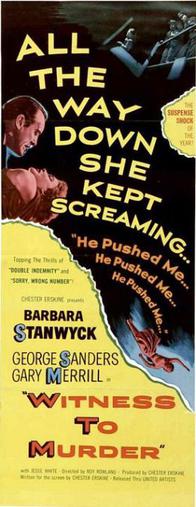
Out In The Film Noir Night- Barbara Stanwyck’s Witness
To Murder
DVD Review
Witness to Murder, Barbara
Stanwyck,Gary Merrill, George Sanders,
United Artists, 1954
The last
time the name Barbara Stanwyck appeared in this space she and Fred MacMurry
were plotting, plotting big time, to murder her husband for his life insurance
policy (and other considerations left unsaid ) in the film adaptation of James
M. Cain’s Double Indemnity. Times have
changed for Ms. Stanwyck though as here in Witness
To Murder she off-handedly witnesses what she believes is a murder of a
woman by a man in the apartment building across from her one night. And, unlike
in Double Indemnity where everybody
and their brother (and sister) KNOWS she and Fred did the deed here she cannot
get anyone to believe her. Especially when the mad man who actually did the
deed was a Svengali –like mastermind, an alleged ex-Nazi (although that de-nazificationprogram stuff after World War II didn’t seem
to take in his case), played by George Sanders.
Now the
problem with accusing someone of murder, murder most foul , who actually did
the deed is that unless and you have a
body you are in trouble trying to pin the rap on him. Moreover, yelling bloody
murder about the guy is going to, well, put him off-balance especially when he is
lined up to marry into some serious California dough. So you might as well say
Ms. Stanwyck’s life just got very complicated, very complicated in deed when
she takes a small stand for some rough justice in this wicked old world. Worst
this murderer is so smooth that the cops, the guys who are supposed to live to
solve dastardly crimes are practically taking up a collection for the poor guy
and are ready putting her in the loony bin, for good. Really. Of course one
cop, the love interest cop played by Gary Merrill is not going to let a smart,
sassy, good-looking woman go under without a fight. So you know in the end that
this case will get solved and old Mr. Smoothie will get his just desserts. But
doesn’t Ms. Stanwyck have a case for dereliction of duty or something against
those nay-saying cops.
In Honor Of The 94th Anniversary Of The Founding Of The Communist International-In The Time Of His Time
From The Pen Of Frank Jackman
Billy Casey woke up in a sweat that early March 1919 night, woke up in a once again sweat that he had earned from his experiences as a doughboy, an American doughboy in France now furloughed home to New York City, awaiting medical discharge from that mustard gas explosion that harried his breathe ever since. Yes, he had had it rough overseas, had seen some stuff and done some stuff he didn’t want to repeat to anybody, stuff that frankly no man should be forced to do, and which he believed, or he came to believe, no man would do even to an animal. He had put some of that behind him but still a little corner would flare up on nights when he was excited and he was excited this night and had been for the past few nights about big doings in Moscow coming up in a few days (or since he wasn’t sure of the dates of the conference, except early March, maybe had already occurred), about creating a new organization to right the wrongs of this wicked old world.
See, Bill Casey had gotten “religion,” no not catholicprotestantjewishmuslim religion but the good word-the socialist word , the word that all workingmen, and Bill Casey was nothing if not a working man, were brothers and that the robbers of the world were the only ones who had benefited from the damn war “to end all wars” over in Europe. And Bill had the destroyed lungs to prove it was not him who had benefited. This new language had been taught to him by a fellow soldier, a fellow doughboy, who had belonged to the American Socialist Party before the war, before he passed away from failed lungs in that French convalescent home Bill was assigned before coming back to America. So when Bill got back to New York the first thing, well maybe not the first, the first being to roll the pillows with his long-suffering girlfriend, Rosie, also nothing if not a daughter of the working class, he marched down to the American Socialist Party office in Greenwich Village (that is where his deceased comrade told him to go since that is where he had been a member) and joined right up.
Now Bill Casey had never been much for the books, and the materials that he received from the local secretary when he paid his dues and received his membership card seemed a lot more convoluted that the way his hospital pal explained it, but he plugged at it for a while, and that along with the weekly lectures helped him along. And he was going to be in full need of that knowledge because he had landed on his socialist arse (his expression) right at a time when the whole socialist movement was in turmoil. And the big event was the Russian Revolution of 1917 and the fall-out from that event. See Bill’s pal had only known the American Socialist Party before that revolution, and since most of the party had been anti-war before his pal joined up to fight he didn’t know the stuff that was going on between the different factions-basically to stick with the Socialist International or go with the new one, the one that said that the old one was done for and a new Communist International had to be formed to fight for revolutions everywhere. Heady stuff. Stuff to make Bill sweat in anticipation.
And that is where the martyred James Connolly, Bill’s hero from the Easter 1916 uprising in Dublin and a man who had been executed by the bloody British for his part in it, came into it. Or kind of came into it. See the fight over who were the real revolutionaries, the Europeans or the Russians, basically was hard to figure. That is when he met a guy, an Irish guy, a comrade, from one of the factions, Jim Cannon, who put him straight, who told him that if he wanted to get back for that dirty deal he received in France by his own government he had to go with the Russian Bolsheviks and the new international they were trying to form. And Bill Casey respected Jim Cannon, respected the big heavy-drinking Irishman from out in the sticks of Kansas and so he cast his fate with Jim and his communist brethren. And you know what else Jim said to him- he, Bill Casey, should say at meetings and out on the Union Square and Village soapboxes to one and all what he saw and did in France so people would know, know better the next time the government tried to stuff a war down their throats. Bill Casey didn’t know if he could so that, could avoid some tough night sweats thinking about doing it, but he thought if it stopped some young guy from joining up maybe he would at that…
*******
V. I. Lenin
Founding Of The Communist International
Speech At A Joint Meeting Of The All-Russia Central Executive Committee, The Moscow Soviet, The Moscow Committee Of The Russian Communist Party (Bolsheviks), The All-Russia Central Council Of Trade Unions, Moscow Trade Unions And Factory Committees To Mark The Founding Of The Communist International
March 6, 1919
Delivered: 6 March, 1919 First Published: Brief report published in Pravda No. 52, March 7, 1919; Published in full in May 1919 Published according to the verbatim report Source: Lenin’s Collected Works, 4th English Edition, Progress Publishers, Moscow, 1972 Volume 28, pages 480-484 Translated: Jim Riordan Transcription/HTML Markup: David Walters & Robert Cymbala Copyleft: V. I. Lenin Internet Archive (www.marx.org) 2002. Permission is granted to copy and/or distribute this document under the terms of the GNU Free Documentation License
(Stormy ovation.) Comrades, at the First Congress of the Communist International we did not succeed in getting representatives from all countries where this organisation has most faithful friends and where there are workers whose sympathies are entirely with us. Allow me, therefore, to begin with a short quotation which will show you that in reality we have more friends than we can see, than we know and than we were able to assemble here, in Moscow, despite all persecution, despite the entire, seemingly omnipotent, union of the bourgeoisie of the whole world. This persecution has gone to such lengths as to attempt to surround us with a sort of Great Wall of China, and to deport Bolsheviks in dozens from the freest republics of the world. They seem to be scared stiff that ten or a dozen Bolsheviks will infect the whole world. But we, of course, know that this fear is ridiculous—because they have already infected the whole world, because the Russian workers’ struggle has already convinced working people everywhere that the destiny of the world revolution is being decided here,. in Russia.
Comrades, I have here a copy of L’Humanité, a French newspaper whose policy corresponds more to that of our Mensheviks or Right Socialist-Revolutionaries. During the war, this paper was utterly ruthless in its attacks on those who supported our viewpoint. Today it is defending those who during the war went along with their own bourgeoisie. This very newspaper reports in its issue of January 13, 1919, that a mammoth meeting (as the newspaper itself admits) took place in Paris of active party and trade union members of the Seine Federation, i.e., the district nearest to Paris, the centre of the proletarian movement, the centre of all political life in France. The first speaker was Bracke, a socialist who throughout the war took the same line as our Mensheviks and Right-wing defence advocates. He was meek and mild now. Not a word about a single burning issue! He ended by saying that he was against his government’s interference in the struggle of the proletariat of other countries. His words were drowned in applause. The next speaker was a supporter of his, a certain Pierre Laval. He spoke of demobilisation, the burning issue in France today—a country which has probably borne greater sacrifices than any other country in this criminal war. And this country now sees that demobilisation is being dragged out, held up, that there is no desire to carry it through, that preparations are being made for a new war that will obviously demand new sacrifices from the French workers for the sake of settling how much more of the spoils the French or British capitalists will get. The newspaper goes on to say that the crowd listened to the speaker, Pierre Laval, but when he started running down Bolshevism, the protests and excitement stopped the meeting. After that, citizen Pierre Renaudel was refused a hearing, and the meeting ended with a brief statement by citizen Pdricat. He is one of the few people in the French labour movement who in the main is in agreement with us. And so, the newspaper has to admit that the speaker who began to attack the Bolsheviks was immediately pulled up.
Comrades, we have not been able to get even one delegate here directly from France, and only one Frenchman, Comrade Guilbeaux, arrived here, and he with great difficulty. (Stormy applause.) He will speak here today. He spent months in the prisons of that free republic, Switzerland, being accused of having contact with Lenin and preparing a revolution in Switzerland. He was escorted through Germany by gendarmes and officers, for fear, evidently, that he might drop a match that would set Germany on fire. But Germany is ablaze without this match. In France, too, as we can see, there are sympathisers with the Bolshevik movement. The French people are probably among the most experienced, most politically conscious, most active and responsive. They will not allow a speaker at a public meeting to strike a false note: he is stopped. Considering the French temperament, he was lucky not to have been dragged down from the rostrum! Therefore, when a newspaper hostile to us admits what took place at this big meeting we can safely say the French proletariat is on our side.
I am going to read another short quotation, from an Italian newspaper. The attempts to isolate us from the rest of the world are so great that we very rarely receive socialist newspapers from abroad. It is a rare thing to receive a copy of the Italian newspaper Avanti!, the organ of the Italian Socialist Party, a party which participated in Zimmerwald, fought against the war and has now resolved not to attend the yellow congress in Berne, the congress of the old International, which was to be attended by people who had helped their governments to prolong this criminal war. To this day, Avanti! is under strict censorship. But in this issue, which arrived here by chance, I read an item on party life in a small locality called Cavriago (probably a remote spot because it cannot be located on the map). It appears that the workers there adopted a resolution supporting their newspaper for its uncompromising stand and declared their approval of the German Spartacists. Then follow the words “Sovietisti russi” which, even though they are in Italian, can be understood all over the world. They sent greetings to the Russian “Sovietisti” and expressed the wish that the programme of the Russian and German revolutionaries should be adopted throughout the world and serve to carry the fight against the bourgeoisie and military domination to a conclusion. When you read a resolution like that, adopted in some Italian Poshekhonye,’82 you have every right to say to yourself that the Italian people are on our side, the Italian people understand what the Russian “Sovietisti” are, what the programme of the Russian “Sovietisti” and the German Spartacists is. Yet at that time we had no such programme! We had no common programme with the German Spartacists, but the Italian workers rejected all they had seen in their bourgeois press, which, bribed as it is by the millionaires and multimillionaires, spreads slander about us in millions of copies. It failed to deceive the Italian workers, who grasped what the Spartacists and the “Sovietisti” were and declared that they sympathised with their programme, at a time when this programme did not exist. That is why we found our task so easy at this Congress. All we had to do was to record as a programme what had already been implanted in the minds and hearts of the workers, even those cast away in some remote spot and cut off from us by police and military cordons. That is why we have been able to reach concerted decisions on all the main issues with such ease and complete unanimity. And we are fully convinced that these decisions will meet with a powerful response among workers elsewhere.
The Soviet movement, comrades, is the form which has been won in Russia, which is now spreading throughout the world and the very name of which gives the workers a complete programme. I hope that we, having had the good fortune to develop the Soviet form to victory, will not become swelled-headed about it.
We know very well that the reason we were the first to take part in a Soviet proletarian revolution was not because we were as well or better prepared than other workers, but because we were worse prepared. This is why we were faced with the most savage and decrepit enemy, and it is this that accounted for the outward scale of the revolution. But we also know that the Soviets exist here to this day, that they are grappling with gigantic difficulties which originate from an inadequate cultural level and from the burden that has weighed down on us for more than a year, on us who stand alone at our posts, at a time when we are surrounded on all sides by enemies, and when, as you know perfectly well, harrowing ordeals, the hardships of famine and terrible suffering have befallen us.
Those who directly or indirectly side with the bourgeoisie often try to appeal to the workers and provoke indignation among them by pointing to the severe sufferings of the workers today. And we tell them: yes, these sufferings are evere and we do not conceal them from you. We tell the workers that, and they know it well from their own experience. You can see we are fighting not only to win socialism for ourselves, not only to ensure that our children shall only recollect capitalists and landowners as prehistoric monsters; we are fighting to ensure that the workers of the whole world triumph together with us.
And this First Congress of the Communist International, which has made the point that throughout the world the Soviets are winning the sympathy of the workers, shows us that the victory of the world communist revolution is assured. (Applause.) The bourgeoisie will continue to vent their fury in a number of countries; the bourgeoisie there are just beginning to prepare the destruction of the best people, the best representatives of socialism, as is evident from the brutal murder of Rosa Luxemburg and Karl Liebknecht by the whiteguards. These sacrifices are inevitable. We seek no agreement with the bourgeoisie, we are marching to the final and decisive battle against them. But we know that after the ordeal, agony and distress of the war, when the people throughout the world are fighting for demobilisation, when they feel they have been betrayed and appreciate how incredibly heavy the burden of taxation is that has been placed upon them by the capitalists who killed tens of millions of people to decide who would receive more of the profits—we know that these brigands’ rule is at an end!
Now that the meaning of the word “Soviet” is understood by everybody, the victory of the communist revolution is assured. The comrades present in this hall saw the founding of the first Soviet republic; now they see the founding of the Third, Communist International (applause), and they will all see the founding of the World Federative Republic of Soviets. (Applause.)
Brief report published; in Pravda No. 52, March 7, 1919; Published in full in May 1919 Published according to the verbatim report