Wednesday, January 6, 2016

*****In The Hills And Hollows Again- With Mountain Music Man Norman Blake In Mind    


Recently in discussing Sam Lowell’s relationship with mountain music, the music from down in the hills and hollows of Kentucky where his father and his people before him had lived dirt poor, almost beyond dirt poor one they settled in and had forsaken any betterment by heading further west once the land gave out , land that they did not provide very good guardianship for since they made every mistake in the agricultural book before it turned to dust, for generations eking almost nothing out of the land that had been abandoned decades before by some going west driven spirits who played the land out and moved on, some moving on until they reached ocean edge California, Bart Webber noticed that he had concentrated a little too heavily on the music of Sam’ s father’s  Kentucky hills and hollows.

Sure a lot of the music came almost intact from the old country, old country here being some place in the British Isles, music that a guy like high Brattle Street Brahmin Francis Child collected and that if you give some serious attention to you will find that the core narratives presented there could be heard come any Saturday night Hazard red barn dance. But there were other places down south like in the Piedmont of North Carolina where a cleaner picking style had been developed by the likes of Etta Baker and exemplified more recently by Norman Blake who has revived the work of performers like Aunt Helen Alder and Pappy Sims by playing the old tunes. Some other places as well like down in the inner edges of Tennessee and Georgia where the kindred also dwelled, places as well where if the land had played out there they, the ones who stayed behind in there tacky cabins barely protected against the weathers, their lack of niceties of modern existence a result not because they distained such things but down in the hollows they did not know about them, did not seem to notice the bustling outside world.

They all, all the hills and hollows people, just kept plucking away barely making ends meet, usually not doing so in some periods, and once they had abandoned cultivating the land these sedentary heredity “master-less men” thrown out their old countries, like Bart mentioned mainly the British Isles, for any number of petty crimes, but crimes against property and so they had to go on their own or face involuntary transportation they went into the “black god” mines or sharecropping for some Mister to live short, nasty, brutish lives before the deluge.

But come Saturday night, come old Fred Brown’s worn out in need of paint red barn the hill people, the mountain people, the piedmont brethren, hell, maybe a few swamp-dwellers too, would gather up their instruments, their sweet liquor jugs, their un-scrubbed bare-foot children or their best guy or gal and play the night away as the winds came down the mountains. This DNA etched in his bones by his father and the kindred is what Sam had denied for much of his life.          

But like Bart had mentioned as well when discussing the matter with Sam one night sometimes “what goes around comes around” as the old-time expression had it. Take for example Sam Lowell’s youthful interest in folk music back in the early 1960s when it had crashed out of exotic haunts like Harvard Square, Ann Arbor, Old Town Chi Town and North Beach/Berkeley out in Frisco. Crashed out by word of mouth at first and ran into a lot of kids, a lot of kids like Sam, who got his word from Diana Nelson who got it from a cousin from North Adamsville nearer Boston who frequented the coffeehouses on Beacon Hill and Harvard Square, especially the famous "cheap date" Joy Street Club and Turk's Head on the hill and the equally "cheap date" Clue Blue and Club Nana in the Square after the Club 47 got too expensive once everybody and their brother and sister wanted to go there, who had “hipped” her to this new folk music program that he had found flipping the dial of his transistor radio one Sunday night.

See Sam and Diana were tucked away from the swirl down in Carver about thirty miles as the crow flies from Boston and Cambridge but maybe a million social miles from those locales and had picked up the thread somewhat belatedly. He, along with his corner boys, had lived in their little corner boy cocoon out in front of Jimmy Jack’s Diner figuring out ways to get next to girls like Diana but who were stuck, stuck like glue to listening to the “put to sleep” music that was finding its way to clog up Jimmy Jack’s’ hither-to-fore “boss” jukebox. Christ, stuff like Percy Faith’s Moon River that parents could swoon over, and dance to. Had picked the folk sound up belatedly when they were fed up with what was being presented on American Bandstand and WJDA the local rock station, while they were looking for something different, something that they were not sure of but that smelled, tasted, felt, and looked different from a kind of one-size-fits-all vanilla existence.

Oh sure, as Bart recognized once he thought about it for a while, every generation in their youth since the days when you could draw a distinction between youth and adulthood a century or so ago and have it count has tried to draw its own symbolic beat but this was different, this involved a big mix of things all jumbled together, political, social, economic, cultural, the whole bag of societal distinctions which would not be settled until the end of that decade, maybe the first part of the next. That big picture is what interested him. What had interested Sam then down there in in Podunk Carver about thirty miles south of Boston was the music, his interest in the other trends did not come until later, much later long after the whole thing had ebbed and they were fighting an unsuccessful rearguard action against the night-takers and he was forced to consider other issues. And Sam had been a fighter against what Che Guevara, a hero to Sam's generation and later ones too in desperate need of heroes when the night-takers went berserk, called the "the belly of the beast of the world's problems in America, ever after. 

The way Sam told it one night a few years back, according to Bart, some forty or so years after his ear changed forever that change had been a bumpy road. Sam had been at his bi-weekly book club in Plymouth where the topic selected for the next meeting was the musical influences, if any, that defined one’s tastes and he had volunteered to speak then since he had just read a book, The Mountain View, about the central place of mountain music, for lack of a better term, in the American songbook. He had along with Bart and Jack Dawson also had been around that time discussing how they had been looking for roots as kids. Musical roots which were a very big concern for a part of their  generation, a generation that was looking for roots, for rootedness not just in music but in literature, art, and even in the family tree.

Their parents’ generation no matter how long it had been since the first family immigration wave had spilled them onto these shores was in the red scare Cold War post-World War II period very consciously ignoring every trace of roots in order to be fully vanilla Americanized. So their generation had had to pick up the pieces not only of that very shaky family tree but everything else that had been downplayed during that period.

Since Sam had tired of the lazy hazy rock and roll that was being produced and which the local rock radio stations were force- feeding him and others like him looking to break out through their beloved transistor radios he had started looking elsewhere on the tiny dial for something different after Diana had clued him in about that folk music program. Although for a while he could not find that particular program or Carver was out of range for the airwaves. But like a lot of young people, as he would find out later when he would meet kindred in Harvard Square, the Village, Ann Arbor, Berkeley he fortunately had been looking for that something different at just that moment when something called folk music, roots music, actually was being played on select stations for short periods of time each week and so it was before long that he was tuned in.

His own lucky station had been a small station, an AM station, from Providence in Rhode Island which he would find out later had put the program on Monday nights from eight to eleven at the request of Brown and URI students who had picked up the folk music bug on trips to the Village (Monday a dead music night in advertising circles then, maybe now too, thus fine for talk shows, community service programs and odd-ball stuff like roots music to comply with whatever necessary FCC mandates went with the license.) That is where he first heard the likes of Bob Dylan, Joan Baez, Tom Paxton, Dave Von Ronk, a new guy named Tom Rush from Harvard whom he would hear in person many times over the years, and another guy, Eric Von Schmidt whom he would meet later in one of the Harvard Square coffeehouses that were proliferating to feed the demand to hear folk music. Those coffeehouses were manna from heaven, well, because they were cheap for guys with little money. Cheap alone or on a date, basically as Sam related to his book club listeners for a couple of bucks at most admission, the price of a cup of coffee to keep in front of you and thus your place, maybe a pastry if alone and just double that up for a date except share the pasty you had your date deal all set for the evening hearing performers perfecting their acts before hitting the A-list clubs.

He listened to it all, liked some of it, other stuff, the more protest stuff he could take or leave depending on the performer but what drew his attention, strangely then was when somebody on the radio or on stage performed mountain music, you know, the music of the hills and hollows that came out of Appalachia mainly down among the dust and weeds. Things like Bury Me Under The Weeping Willow, Gold Watch and Chain, Fair and Tender Ladies, Pretty Saro, and lots of instrumentals by guys like Buell Kazee, Hobart Smith, The Charles River Boys. Norman Blake just starting his rise along with various expert band members to bring bluegrass to the wider younger audience that did not relate to guys like Bill Monroe and his various band combinations, and some other bluegrass bands as well that had now escaped his memory.

This is where it all got jumbled up for him Sam said since he was strictly a city boy, made private fun of the farm boys, the cranberry boggers, who then made up a significant part of his high school. He furthermore had no interest in stuff like the Grand Ole Opry and that kind of thing, none. Still he always wondered about the source, about why he felt some kinship with the music of the Saturday night red barn, probably broken down, certainly in need of paint, and thus available for the dance complete with the full complement of guitars, fiddles, bass, mandolin and full complement too of Bobby Joe’s just made white lightening, playing plainsong for the folk down in the wind-swept hills and hollows.  

Then one night, a Sunday night after he had picked up the Boston folk program station on the family radio (apparently the weak transistor radio did not have the energy to pick up a Boston station) he was listening to the Carter Family’s Wildwood Flower when his father came in and began singing along. After asking Sam about whether he liked the song and Sam answered that he did but could not explain why his father told him a story that maybe put the whole thing in perspective. After Sam’s older brother, Lawrence, had been born and things looked pretty dicey for a guy from the South with no education and no skill except useless coal-mining his father decided that maybe they should go back to Kentucky and see if things were better for a guy like him there. No dice, after had been in the north, after seeing the same old tacky cabins, the played out land, the endless streams of a new generation of shoeless kids Sam’s father decided to head back north and try to eke something out in a better place. But get this while Sam’s parents were in Kentucky Sam had been conceived. Yeah, so maybe it was in the genes all along.          


Out In The 1950s L.A. Noir Night-Samuel Fuller’s The Crimson Kimono


DVD Review

From The Pen Of Zack James

The Crimson Kimono, starring Victoria Shaw, James Shigeta, Glenn Corbett

Sam Lowell, now that he had turned the day to day operations of his small law office to a younger associate, had during the previous couple of years been deep in the search for old time black and white films, mainly film noir, that he had seen as a kid growing up in Carver down in southeastern Massachusetts at the local Majestic Theater on Thornton Street. The main vehicle for igniting that interest had been through Netflix, either grabbing DVDs or by streaming, although many of the films that interested him were not available on that latter source. At some point he had run through what he called the primo classics, the ones that make the top one hundred Hollywood films of all time like Sunset Boulevard, Casablanca, To Have and Have Not, Double Indemnity,   The Big Sleep, Out Of The Past, The Maltese Falcon stuff like that. He then started going after what he, and Hollywood critics as well, would call B films, films made on a shoestring or which just didn’t have enough storyline, good acting or cinematography to make that primo list.

As usual there was plenty more B material around than classics especially from that black and white film era when the crush for double-feature films every week or so led to some cutting of corners. The film under review, Sam Fuller’s The Crimson Kimono, is just such a film although it does have a twist that you generally did not see in Hollywood films in the hard-boiled red scare Cold War 1950s night.

Usually Sam would just grab a DVD, look at it, maybe write a few hundred words about some aspect of the film that interested him, storyline, acting, camera work, or when he wanted up front and personal one and all to know he had panned had it. The Crimson Kimono though although thin on the acting by well-known B actors had a twist that he wanted his friend from high school days in Carver, Bart Webber, who also had some interest in those black and white films since he would when younger accompany Sam on Saturday afternoons to the double-feature at the Majestic. (Later, in high school, when going to the movies was the essence of a cheap “hot date” with some girl of interest each man had to fend for himself although they occasionally double-dated in the “pits,” the balconies at night so-called for obvious reasons.)

One night Bart went on one of his periodic visits from Carver where had had resided almost all of his life up to Cambridge where Sam lived to go to Jack’s and have a few drinks and talk about whatever there was to talk about. That night Sam was hot on the trail of discussing what he had thought of The Crimson Kimono. Here’ what Sam had to say when Bart told me about it later:         

How are you going to hate a movie, a film noir even, a police procedural, that was set in Los Angeles, not in the flamed out 1940s slumming streets of The Big Sleep and other Raymond Chandler classics but the 1950s when the place was starting to jump from a sleepy old town of the homegrown, Okies, Arkies and whoever else hightailed it out of wherever they were from to get to the “garden of Eden.” So you got the sprawl as backdrop but also since you were dealing with tinsel-town, Hollywood, you also got the refuge, the fates of those who did not make it up onto the big screen but still had nowhere else to go after they busted flat or else preferred to slum it than go back to Peoria or Lima, Ohio or wherever they hailed from. That too is the back-drop to the town’s seamy side. Here’s an add-on though and this is what will eventually separate this film out a bit from others for we get a look, a small but positive look, at L.A.s Japan Town. That in itself would be worthy of note because remember the Pacific War was still pretty fresh in everybody out on the West Coast’s mind and remember too most of those denizens of Japan Town also had etched into their brains that they were different-were different enough in World War II to wind up in the concentration camps set up in the West.       

Who knows where an urban ethnic enclave ends and where the low-life haunts begin. Remember when we used to come up to Boston to see the strip shows in what they rightly called the Combat Zone right next to the squabble of Chinatown. Well in L.A. the strip joints and “clip” joints, really the same thing as you know, were adjacent to Japan Town. One night one of the strippers, this Sugar Torch, a looker and with a bumps and curves shape that guys in the ‘50s were crazy for wound up, after fleeing for her life, dead, very dead, from a couple of slugs on the seamy streets of L.A.

Naturally the coppers, buddies who had been in Korea and now roomed together, in this case a white cop, played by Glenn Corbett, a good-looking guy who played cop and detective parts with a sneer, who you probably have seen in a few of these B films, and get this, a Japanese cop, played by Jimmy Shigeta, who are called on to investigate the murder ran into a few dead ends before they figured the thing out, or rather got the thing figured out for them. See this honey, this Sugar Torch, was looking for a new gimmick, a new tease to replace the one she had been doing which was getting old fast with the regular customers. So she planned to do some exotic Geisha girl strip. Of course she was clueless about anything Japanese so she went to the library where one of the librarians, a guy, Hansel, helped her get the details down right. That was our Sugar’s fatal mistake though. This Hansel’s girlfriend, a wigmaker, thought old Sugar was making a play for Hansel and got gun happy. No way but that was how the deal went down, how things played out for motive on this one.

Along the way the cops had brought in a student artist, Christine, played by Victoria Shaw who seemed too old and mature to be a student, but who knows, to make a sketch of the supposed murderer, who everybody thought was Hansel. No go-it was the girlfriend like I said. She got antsy about what Hansel might say once the cops grabbed him. She started firing away. Here’s a strange part after the Japanese cop gunned her down she laid on the seamy street just like the stripper-in a heap. I figure that was Sam Fuller going for effect.             

Here is where this one is a little different from most police procedurals, most noir too, since they usually want to hone in on the murder and mayhem part. In this though solving the murder is kind of backdrop to the main action-the triangle love affair business. See this student artist Christine was a looking, smart too, so first Glenn took a run at her, figured he had it made, then Jimmy took a run as well. That part, the racial part, which gets a big play when the two cops finally realize what was happening, is what separates this one out because in the end the Japanese guy wins the hand of the fair Wasp maiden. Go figure in the 1950s

Tuesday, January 5, 2016

From The Music Archives-Richard Thompson's Vincent Black Lightning, 1952


From The Pen Of Joshua Lawrence Breslin:

Several years ago, maybe about eight years now that I think about it, I did a series of sketches on guys, folk-singers, folk-rockers, rock-folkers or whatever you want to call those who weened us away from the stale pablum rock in the early 1960s (Bobby Vee, Rydell, Darin, et al, Sandra Dee, Brenda Lee, et al) after the gold rush dried up in what is now called the classic age of rock and roll in the mid to late 1950s when Elvis, Jerry Lee, Buddy, Chuck, Bo and their kindred made us jump. (There were gals too like Wanda Jackson but mainly it was guys in those days.) I am referring of course to the savior folk minute of the early 1960 when a lot of guys with acoustic guitars, some self-made lyrics, or stuff from old Harry Smith Anthology times gave us a reprieve. The series titled Not Bob Dylan centered on why those budding folkies like Tom Rush, Tom Paxton, Phil Ochs, Jesse Winchester and the man under review Richard Thompson to name a few did not make the leap to be the “king of folk” that had been ceded by the media to Bob Dylan and whatever happened to them once the folk minute went south after the combined assault of the British rock invasion (you know the Beatles, Stones, Kinks, hell, even Herman’s Hermits got play for a while),   and the rise of acid rock put folk in the shade (you know the Jefferson Airplane, the Dead, The Doors, The Who, hell, even the aforementioned Beatles and Stones got caught up in the fray although not to their eternal musical playlist benefit). I also did a series on Not Joan Baez, the “queen of the folk minute” asking that same question on the female side but here dealing with one Richard Thompson the male side of the question is what is of interest.

I did a couple of sketches on Richard Thompson back then, or rather sketches based on probably his most famous song, Vincent Black Lightning, 1952 which dove-tailed with some remembrances of my youth and my semi-outlaw front to the world and the role that motorcycles played in that world. Additionally, in light of the way that a number of people whom I knew back then, classmates whom I reconnected on a class reunion website responded when I posed the question of what they thought was the great working-class love song since North Adamsville was definitely a working class town driven by that self-same ethos I wrote some other sketches driving home my selection of Thompson’s song as my choice.

The latter sketches are what interest me here. See Thompson at various times packed it in, said he had no more spirit or some such and gave up the road, the music and the struggle to made that music, as least professionally. Took time to make a more religious bent to his life and other such doings. Not unlike a number of other performers from that period who tired of the road or got discourage with the small crowds, or lost the folk spirit. Probably as many reasons as individuals to give them. Then he, they had an epiphany or something, got the juices flowing again and came back on the road.  That fact is to the good for old time folk (and rock) aficionados like me.

What that fact of returning to the road by Thompson and a slew of others has meant is that my friend and I, (okay, okay my sweetie who prefers that I call her my soulmate but that is just between us so friend) now have many opportunities to see acts like Thompson’s Trio, his current band configuration, to see if we think they still “have it” (along with acts of those who never left the road like Bob Dylan who apparently is on an endless tour whether we want him to do so or not). That idea got started about a decade ago when we saw another come-back kid, Geoff Muldaur of the Jim Kweskin Jug Band, solo, who had taken something twenty years off. He had it. So we started looking for whoever was left of the old folks acts (rock and blues too) to check out that question-unfortunately the actuarial tables took their toll before we could see some of them at least one last time like Dave Von Ronk.

That brings us to Richard Thompson. Recently we got a chance to see him in a cabaret setting with tables and good views from every position, at least on in the orchestra section, at the Wilbur Theater in Boston with his trio, a big brush drummer and an all-around side guitar player (and other instruments like the mando). Thompson broke the performance up into two parts, a solo set of six or seven numbers high-lighted by Vincent Black Lightning, and Dimming Of The Day which was fine. The second part based on a new album and a bunch of his well-known rock standards left us shaking our heads. Maybe the room could not handle that much sound, although David Bromberg’s five piece band handled it well a couple of weeks before, or maybe it was the melodically sameness of the songs and the same delivery voice and style but we were frankly disappointed and not disappointed to leave at the encore.  Most tunes didn’t resonant although a few in all honesty did we walked out of the theater with our hands in our pockets. No thumbs up or down flat based on that first old time set otherwise down. However, damn it, Bob Dylan does not have to move over, now.  Our only consolation that great working-class love song, Vincent Black Lightning, still intact.

Which brings us to one of those sketches I did based on Brother Thompson’s glorious Vincent Black Lightning. When I got home I began to revise that piece which I have included below. Now on to the next act in the great quest- a reunion of the three remaining active members of the Jim Kweskin Jug Band, Jim Maria Muldaur, and of course Geoff at the Club Passim (which traces its genesis back to the folk minute’s iconic Club 47 over on Mount Auburn Street in Harvard Square. We’ll see if that gets the thumbs up.     


*****Out Of The Hills And Hollows- With The Bluegrass Band The Lally Brothers In Mind  


From The Pen Of Frank Jackman 

 
You know sometimes what goes around comes around as the old-time expression had it. Take for example Sam Lowell’s youthful interest in folk music back in the early 1960s when it crashed out of exotic haunts like Harvard Square, Ann Arbor, Old Town Chi Town and North Beach/Berkeley out in Frisco Bay Area Town and ran into a lot of kids, a lot of kids like Sam, who were looking for something different, something that they were not sure of but that smelled, tasted, felt, looked like difference from a kind of one-size-fits-all vanilla existence. Oh sure, every generation in their youth since the days when you could draw a distinction between youth and adulthood and have it count has tried to march to its own symbolic beat but this was different, this involved a big mix of things all jumbled together, political, social, economic, cultural, the whole bag of societal distinctions which would not be settled until the end of the decade, maybe the first part of the next. But what Sam was interested then down there in Carver about thirty miles south of Boston was the music, his interest in the other trends did not come until later, much later long after the whole thing had ebbed. 

The way Sam told it one night at his bi-weekly book club where the topic selected for that meeting had been the musical influences, if any, that defined one’s tastes and he had volunteered to speak since he had just read a book, The Mountain View, about the central place of mountain music, for lack of a better term, in the American songbook was that he had been looking for roots as a kid. Musical roots which were a very big concern for a part of his generation, a generation that was looking for roots, for rootedness not just in music but in literature, art, and even in the family tree. Their parents’ generation no matter how long it had been since the first family immigration wave was in the red scare Cold War post-World War II period very consciously ignoring every trace of roots in order to be fully vanilla Americanized. So his generation had to pick up the pieces not only of that very shaky family tree but everything else that had been downplayed during that period.

Since Sam had tired of the lazy hazy rock and roll that was being produced and which the local rock radio stations were force- feeding him and others like him looking to break out through their beloved transistor radios he started looking elsewhere on the tiny dial for something different. That transistor radio for those not in the know was “heaven sent” for a whole generation of kids in the 1950s who could care less, who hated the music that was being piped into the family living room big ass floor model radio which their parents grew up with since it was small, portable and could be held to the ear and the world could go by without bothering you while you were in thrall to the music. That was the start. But like a lot of young people, as he would find out later when he would meet kindred in Harvard Square, the Village, Ann Arbor, Berkeley he had been looking for that something different at just that moment when something called folk music, roots music, actually was being played on select stations for short periods of time each week.

Sam’s lucky station had been a small station, an AM station, from Providence in Rhode Island which he would find out later had put the program on Monday nights from eight to eleven at the request of Brown and URI students who had picked up the folk music bug on trips to the Village (Monday a dead music night in advertising circles then, maybe now too, thus fine for talk shows, community service programs and odd-ball stuff like roots music.) That is where he first heard the likes of Bob Dylan, Joan Baez, Tom Paxton, Dave Von Ronk, a guy named Tom Rush from Harvard whom he would hear in person many times over the years, and another guy, Eric Von Schmidt whom he would meet later in one of the Harvard Square coffeehouses that were proliferating to feed the demand to hear folk music, well, cheaply alone or on a date. Basically as he related to his listeners for a couple of bucks at most admission, the price of a cup of coffee to keep in front of you and thus your place, maybe a pastry if alone and just double that up for a date except share the pasty you had your date deal all set for the evening hearing performers perfecting their acts before hitting the A-list clubs).

He listened to it all, liked some of it, other stuff, the more protest stuff he could take or leave depending on the performer but what drew his attention, strangely then was when somebody on radio or on stage performed mountain music, you know, the music of the hills and hollows that came out of Appalachia mainly down among the dust and weeds. Things like Bury Me Under The Weeping Willow, Gold Watch and Chain, Fair and Tender Ladies, Pretty Saro, and lots of instrumentals by guys like Buell Kazee, Hobart Smith, The Muddy River Boys, and some bluegrass bands as well that had now escaped his memory.

This is where it all got jumbled up for him Sam said since he was strictly a city boy, made private fun of the farm boys, the cranberry boggers, who then made up a significant part of his high school and had no interest in stuff like the Grand Ole Opry and that kind of thing, none. Still he always wondered about the source, about why he felt some kinship with the music of the Saturday night red barn, probably broken down, certainly in need of paint, and thus available for the dance complete with the full complement of guitars, fiddles, bass, mandolin and full complement of Jimmy Joe’s just made white lightening, playing plainsong for the folk down in the wind-swept hills and hollows.                                 
As Sam warmed up to his subject he told his audience two things that might help explain his interest when he started to delve into the reasons why fifty years later the sound of that finely-tuned fiddle still beckons him home. The first was that when he had begun his freshman year at Boston University he befriended a guy, Everett Lally, the first day of orientation since he seemed to be a little uncomfortable with what was going on. See Everett was from a small town outside of Wheeling, West Virginia and this Boston trip was only the second time, the first time being when he came up for an interview, he had been to a city larger than Wheeling. So they became friends, not close, not roommate type friends, but they had some shared classes and lived in the same dorm on Bay State Road.

One night they had been studying together for an Western History exam and Everett asked Sam whether he knew anything about bluegrass music, about mountain music (Sam’s term for it Everett was Bill Monroe-like committed to calling it bluegrass). Sam said sure, and ran off the litany of his experiences at Harvard Square, the Village, listening on the radio. Everett, still a little shy, asked if Sam had ever heard of the Lally Brothers and of course Sam said yes, that he had heard them on the radio playing the Orange Blossom Express, Rocky Mountain Shakedown as well as their classic instrumentation version of The Hills of Home.  Everett perked up and admitted that he was one of the Lally Brothers, the mandolin player.

Sam was flabbergasted. After he got over his shock Everett told him that his brothers were coming up to play at the New England Bluegrass Festival to be held at Brandeis on the first weekend of October. Everett invited Sam as his guest. He accepted and when the event occurred he was not disappointed as the Lally Brothers brought the house down. For the rest of that school year Sam and Everett on occasion hung out together in Harvard Square and other haunts where folk music was played since Everett was interested in hearing other kinds of songs in the genre. After freshman year Everett did not return to BU, said his brothers needed him on the road while people were paying to hear their stuff and that he could finish school later when things died down and they lost touch, but Sam always considered that experience especially having access to Everett’s huge mountain music record collection as the lynchpin to his interest.             

Of course once the word got out that Everett Lally was in a bluegrass group, played great mando, could play a fair fiddle and the guitar the Freshman girls at BU drew a bee-line for him, some of them anyway. BU, which later in the decade would be one of the hotbeds of the anti-war movement locally and nationally but then was home to all kinds of different trends just like at campuses around the country, was filled with girls (guys too but for my purposes her the girls are what counts) from New York City, from Manhattan, from Long Island who knew a few things about folk music from forays into the Village. Once they heard Everett was a “mountain man,” or had been at Brandeis and had seen him with his brothers, they were very interested in adding this exotic plant to their collections. Everett, who really was pretty shy although he was as interested in girls as the rest of the guys at school were, told Sam that he was uncomfortable around these New York women because they really did treat him like he was from another world, and he felt that he wasn’t. Felt he was just a guy. But for a while whenever they hung out together girls would be around. Needless to say as a friend of Everett’s when there were two interested girls Sam got the overflow. Not bad, not bad at all.        

But there is something deeper at play in the Sam mountain music story as he also told the gathering that night. It was in his genes, his DNA he said. This was something that he had only found out a few years before. On his father’s side, his grandfather, Homer, whom he had never met since after his wife, Sam’s grandmother, Sara died he had left his family, all grown in any case, without leaving a forwarding address, had actually been born and lived his childhood down in Prestonsburg, Kentucky, down near the fabled Hazard of song and labor legend before moving to the North after World War I. Here is the funny part though when his father and mother Laura were young after World War II and at wits end about where his grandfather might be they travelled down to Prestonsburg in search of him. While they stayed there for a few months looking Sam had been conceived although they left after getting no results on their search, money was getting low, and there were no father jobs around so he had been born in the South Shore Hospital in Massachusetts. So yes, that mountain music just did not happen one fine night but was etched in his body, the whirlwind sounds on Saturday night down amount the hills and hollows with that sad fiddle playing one last waltz to end the evening.                  


Monday, January 4, 2016

Wasn’t That A Time-With Woody Allen’s Midnight In Paris In Mind


From The Pen Of Zack James 

Sam Lowell, who had usually an easy going guy when not preoccupied with his profession, his lawyerly profession, was frustrated. No, better, was, had been, beside himself with frustration for a fairly long time. He had, as he wound down the management of the day to day operations of the small independent law firm that he had helped start with a fellow law school student, Ben Ames, decided that finally he could begin to pursue an avocation as a writer that he had been eager to do since high school. Back then the war, the Vietnam War if anybody is asking, intervened, and had caught him up in the draft call and after his tour of duty into the counter-culture night around San Francisco which had set him back several years when he couldn’t/did not want to face the return to the “real” world for a while.

More than that Sam found as he foundered and as his new “real” world foundered that he needed to move on. Moving on in the direct sense by taking up the law career that his mother, grandfather and several others had been harping on him since his youth. But he still hankered after that idea of being a writer, being a writer maybe in Paris, San Francisco, or some other town where blossoming the written word counted, counted a lot. But time and tide had passed that idea by and it had only been the previous decade or so that he got back to writing just for the hell of it.

Fortunately the times he choose to come back in were very propitious for amateur writers, writers who were not making their livelihoods trying to eke out a living at so many words per day. He had over the course of that decade, first very sporadically then more consistently, joined several writing-oriented blog and other self-publishing enterprises.        

That return to recreational writing however was really what Sam had been frustrated by. Or rather as he took his writing more seriously he realized that he had come to a block in the road, not a writer’s block fortunately because one way or another he could still produce the words, sometimes a torrid of words, but an understanding that he would always be a first rate third rate writer as somebody back in the day had said about some public servant whom the person who said the words was trying to smear.

This is the way Sam explained it to his long-time companion Laura, Laura Perkins, who had encouraged him in his writing as best she could. He had just written a short story based on a few episodes in the current love life of his old schoolboy friend, Bart Webber, from Carver where they grew up together. Bart had had a short torrent affair with a fellow student in their class, Melinda Loring, whom he had rekindled a relationship with after their 50th anniversary class reunion. The affair, in the end, floundered on Bart’s inability to meet Melinda’s demands that they think about marriage which Bart, having suffered through three failed marriages (and more alimony, child support and college tuitions than any man should have rightly been required to do in that loveless legal world Sam inhabited along with some nasty judges),    was adamantly against, although he was open to the idea of living together or some such non-legal arrangement. Bart’s position set off a firestorm from which the relationship could never recover.

Bart, in telling Sam the details of the split up between him and Melinda, mentioned that he suddenly realized what the author Thomas Wolfe meant when he titled one of his books You Can’t Go Home Again. That idea, that hook, the notion that in some things you cannot go back stirred Sam into the thought of writing up a sketch, duly fictionalized, about Bart’s affair as some kind of cautionary tale for the generation of ‘68 now filled with plenty of regrets and sorrows about their pasts-and time to think about them as well. Bart agreed, although he was skeptical that anybody could learn anything from the exposition. In any case Sam wrote the piece up, about three thousand words, let Bart look it over and make corrections as well as check for any incidents revealed that might be tied to anything real that had happened in the Bart-Melinda relationship.

Bart satisfied, Sam sent the piece to various publishing outlets where there was a certain small interest expressed in publishing the story especially by one young female editor. It was a comment by that editor, Julie Stern, which riled Sam and set off his latest round of frustration. She said that the way he wrote the story, the way he defended his protagonist Jack Callahan, the piece as a whole read like, and this is a direct quote, “the closing argument of legal brief.”          

Initially stung by the comment Sam later, after several days’ reflection, realized that Julie was right, was right not only about that piece which she had read but after looking over some of his other earlier writings he had the same sense that she was onto something. All the years of dry legal writing had atrophied his creative writing skills, had left him thinking strictly inside the box. Had made him realize that he was a prime example of that first rate third rate writer he dreaded that he might become when he was young despite his junior and senior year English teacher, Miss Soros, at Carver High encouraging him in his creative endeavors.        

Sam thought it was funny that back in high school he had had such creative bursts, had stirred Miss Soros and his classmates with a few of his efforts mostly about the absurdities of teenage life, angst and alienation. He had fashioned himself, maybe imitated is a better word, after various heroic writers that he had read. In those days he was crazy for Ernest Hemingway’s sleek style, meaning crisp dialogue, clear short sentences yet with words that were power-packed to descript not only the action of the story but the environment in which the characters worked out their particular problems. Sam had been crazy to study about the Spanish Civil War after he had picked that event as the subject of his first term paper in high school. Along the way he found out that many Americans, not all of them communists or socialists, had supported the Republican side against the Nazi-infested Fascists and that Hemingway was one of them. Had written For Whom The Bells Toll as a result of his experiences (Sam would not find out until later that the American Communist Party and the Abraham Lincoln Battalion of the International Brigades were not at all happy about Hemingway’s work on that book, its’ what would be today called its political incorrectness. Many years later when he had run into a veteran of the Lincolns at a conference at Brandeis where the Lincoln Archives were housed he had been still incensed that Hemingway had slighted them.

Sam had not known Hemingway’s work before his efforts around his term paper except maybe some film adaptation of one of his short stories, The Killers, but he was in thrall ever after, thought everybody wherever they might end up on their literary journeys should write following his style. Naturally, something that Sam was inclined to do when he was “hot’ on a writer he would read (and re-read later several times) all Hemingway’s works that he could get his hands on. Never could then though figure out why a guy who could write like a whirling dervish, a mad monk if you don’t like the dervish description, took his own life. That was then and like in a lot of things later Sam could understand that a person with declining stamina, some form of writer’s block, and a feeling that his best work was behind him, could take that way out. Not a way Sam’s would be inclined to take for those reasons since a first rate third rate writer would only bring laughter from the crowds upon himself if he fancied himself enough of a driven writer to contemplate that.    

Jesus, Sam thought, thinking back to the time when he first heard about how guys like Hemingway and Fitzgerald abandoned the vacuity of post-World War I America for the bright lights of Paris, or France anyway. Yeah, if Hemingway gave Sam pause on style then Fitzgerald was the master of the narrative, of telling a great story letting the reader sink beneath the pauses. Like the first time he read The Great Gatsby and realized that Jay Ganz was just like a lot of guys he knew, corner boy guys who had big dreams. Except Jay driven did more than dream about what he wanted. He had had to read that famous last page about the Dutch sailors reaching the New World around New York Harbor way and seeing the possibilities of the fresh new start once they had seen that unsullied “fresh green breast.”  Yeah, Fitzgerald knew a certain milieu and worked that minefield for all it was worth.

As Sam dozed off a bit while thinking about all the great literature around, all the stuff that was worthy of being read he was dazzled by the progression of great writers who had influenced him at various time. Thomas Wolfe, Edith Wharton (even though he was not at all familiar with Brahmin life), Dorothy Parker and her Big Blonde, the max daddy detective story writers Raymond Parker and Dashiell  Hammett (who Sam swore learned their dialogue  craft from Hemingway after reading The Maltese Falcon  and the Big Sleep by them) and a whole bunch of others. And now he is to go without a bang but with a whimper, maybe better a sigh. Sighs the fate of first rate third rate writers.

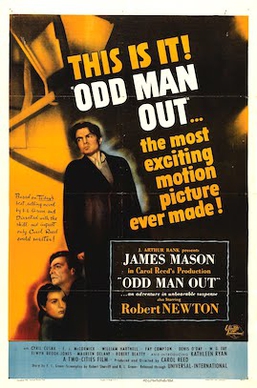
The Quare Fellow-James Mason’s Odd Man Out


The Quare Fellow-James Mason’s Odd Man Out  


DVD Review

From The Pen Of Sam Lowell

Odd Man Out, starring James Mason, directed by Carol Reed (director of the noir classic The Third Man), 1947

No question being a revolutionary in non-revolutionary times is a tough dollar, or as the case here in the film under review, Odd Man Out, being such a stout-hearted fellow in Belfast (although the city is unnamed in the film but it has the look of that city and the kicker is the Royal Constabulary swarming all over the place in the 1940s), in the North, the North of Ireland after the partition which created a two-state solution in Ireland after the deal when down in the 1920s and the 1940s Irish Republican Army (IRA) partisans were left to swing in the wind. Yeah just ask stand-up IRA partisan Johnnie McQueen (although in the film the designation is simply “the organization” everybody knows what organization), a stand-up guy who did serious time in one His Majesty’s stinking prisons. Yeah, ask Johnny and the boys what’s what when times are tough and dough is tight to fight the fight for a one-state Ireland. A lot of good men, women too, including a quare fellow like Johnny have broken their teeth on that one.            

See in hard times, in times when the general population does not give a rat’s ass about unification (or whatever political program a revolutionary might be espousing) guys like Johnny and the boys have to keep body and soul together, to speak nothing of the organization, by an occasion robbery to refill the coffers. So Johnny and the boys plot and plan (after being given the assignment by that nefarious “organization”) to rob the local mill where the payroll cash will be a very good start on continuing to keep body and soul together. Naturally with stand-up Johnny as the leader. Stand-up or not though Johnny got ground down by prison, wasn’t up to leading this caper and while they grabbed the cash after that everything went to hell in a handbasket. It didn’t help that Johnny got caught up in a battle just before the getaway with some bravo who must have thought the dough being taken was personally his and in the melee got killed, got killed dead as it turned out. Johnny took a bullet too, a bullet wound which would drive the rest of the film.      

And that tells the tale of the rest of the film as Johnny is thrown pillar to post trying to dodge the coppers and get away, far away, from Belfast and the king’s sweet sweated gallows. Capturing the tensions, the mishaps, the poignancy of the streets of the town at night, a night that was filled with forebodings for Johnny, director Carol Reed as he did in The Third Man did a masterful job of cinematography capturing the back alleys and squalor of the “wrong side of the tracks” is really what drives us on to see what happens.

Well you know Johnny could come to no good end, had to take the fall one way or the other. Here is strange beauty of this plotline though. Johnny’s love interest, fellow partisan Kathleen, knowing that her man is going down, is going down hard, on her own makes a private “death pact,” wants to share Johnny’s fate. To insure that common fate as the coppers close in on Johnny Kathleen without flinching draws a pistol from her coat pocket and starts firing. Great noir touch.      

Sunday, January 3, 2016

The Lost Treasure Of The Outback-With Burt Lancaster’s Rope Of Sand In Mind


From The Pen Of Zack James

Every once in a while Josh Breslin liked to abandon his hideaway in his old growing up hometown of Olde Saco up in coastal Maine which he had several years early returned to after living in many other places to “get the dust of that old town off his shoes” as he liked to say to his old gang and go down to Boston and join up with some old friends from Carver whom he had met back in the early 1960s through his connection with the late Pete Markin out on the hitchhike road in San Francisco. He, they, including Markin before he went over the edge in a drug deal and lost his life in the mid-1970s dealing with some serious mal hombres down south of the border who did not give a damn about some “from hunger” gringo, had spent a few years living that alternative lifestyle counter-cultural dream that was the 1960s before the night-takers pulled the hammer down and sucked all the air out of whatever small Eden they were trying to build.

They all, except Markin, one way or another read the tea leaves of the ebb tide of the 1960s and made their respective “armed truces” as Sam Lowell, one of their number from Carver, liked to call it and went back to whatever they had intended to do before the action in the 1960s caught them in its web, including Josh who spent his time as a free-lance writer for half the small and medium-sized publications in the country. Josh, Frankie Riley the schoolboy leader of the tribe in Carver although more laid back out West where being herd-riding “boss” was in bad odor, Sam, Sam Eaton, Jack Callahan, Bart Webber and the recently deceased Benny Borden known always as the Be-Bop Kid after he latched onto  Benny Goodman and went crazy for swing when the rest of us were seriously into acid-etched rock (we called that friendly enough “different strokes for different folks,” and it was just fine) kept in touch over the years and would meet periodically over drinks and dinner, although frequently as they have been retired or semi-retired mainly drinks, at the Rusty Nail in downtown Boston to reminisce over old times and tell some new lies. One such occasion a while back was the reason that Josh had come down from Maine.

Now almost like in their schoolboy days the subject matter under discussion at any of these get-togethers could range from the general rage they felt for the war policies of the current American government since they had all more or less retained their hatred for war carried over from Vietnam War days of which Sam Lowell, Frankie Riley and the Be-Bop Kid had been veterans of and the others staunch opponents of including jail-time to what was new in music or seen on YouTube, film or books. (Sam Eaton said filled in the blank for which current government it is in the now endless wars that preoccupy Washington.) Josh usually of late had been regaling the group with his reviews of various old-time black and white movies he had watched via Netflix DVDs or streamed on his T.V. now that he had time to do so. He was especially crazy over film noir or anything that smacked of that genre and the other guys usually gave him a listen since they had all seen at least some the films from the old days down in Carver at the Strand Theater where they would take in the Saturday afternoon kids’ matinee double-feature or later went at night on hot dates up into the balconies with “hot” dates at that same locale.     

On the night in question after warming up to the subject with a high shelf shot of Chivas neat (many steps up from old time Johnny Walker Black with water chaser, praise be, Josh praise be)  Josh started talking about gold, about how the gold lust in the classic Treasure of the Sierra Madre did Humphrey Bogart, Tim Holt and Walter Huston in. Got them nothing but windy graves down in old Mexico when the mal hombres came to take the gold away from them. (Everyone, including Josh, could only think after he had made that statement about what happened in the film about Markin and his unmarked potter’s field grave down there in Sonora, south of the border, and you could almost hear a collective moan, moan for man, moan for that old sainted bastard still missed and moaned over all these years later.)       

The reason Josh brought up the gold lust was that that precious mineral was not the only substance that men would fight and die over, would get that strange blood lust in their eyes to grab a fistful of. Having seen almost all the A film noirs available these days Josh had been checking out the vast array of B noirs and the one he wanted to talk about that night starred Burt Lancaster in an odd-ball noir entitled Rope of Sand. Here the lust, blooded or not, name your lust but here diamonds, diamonds found by the bags full, diamonds for the taking down in Southern Africa if you were man enough to go and grab them, and had the strength to keep them. A lesson lost on the boys in the Sierra Madre. Here’s how Josh ran to ground with the story.

“See this Davis guy, the part played by Burt Lancaster had been a hunting guide in the outback, out in Southern Africa probably South Africa but down in serious diamond country. One of his clients not only wanted to hunt animals but to seek what he was told were diamonds just waiting on the ground to be grabbed, grabbed by him as it turned out. Davis was not into that action but the client was and he took off one morning to cross the bushy savannah and serious dry rot desert to find them. He did but lacking proper hydration he was too weak to close the deal and dropped down on the ground ready for the grim reaper to take his hand.

“During this time Davis tracked him, found him seriously dehydrated, and after hiding the cache tried to get back to civilization to no avail. The client died. That was not the end of Davis’ troubles though since news of a huge diamond cache just waiting for somebody to grab set all kinds of wheels turning. Especially since those diamonds were on the private property of the main mining company in the area. The mining company security chief Vogel, played by Paul Henreid, you know he was the guy who played Victor Lazlo the escaped leader of the European anti-Nazi resistance in World War II who Rick, of Rick’s American Café in Casablanca gave up fetching Ilsa for on the theory that the love woes of three little people in this wicked old world don’t amount to a hill of beans when the night-takers are on a rampage, and he was right of course, played the heavy here and tried to torture Davis for the information about the whereabouts of the diamonds. Getting that haul would put a feather in his cap, put him in good with the mining company boss. No go, Davis wasn’t so brittle, got away to fight another day under better conditions and that is the backdrop to the action to follow.

“Davis, who despite his toughness, was strictly from hunger after he was banished from the guide trade decided he was strong enough to grab the diamonds a couple of years later. Of course Vogel would have a say about that, a big say since he controlled the most guns. But here is where Monty, played by Claude Rains who you will remember was the Vichy cop who wound up walking in the fog with Rick of Rick’s American Café once Rick played out that “hill of beans” theory and needed to get out of Casablanca fast and he was just the boy to do it, the mine owner has his own plan. After suffering a false rape scene with Suzanne, a local bar girl, maybe an independent street-walker they never made that easy rider stuff clear in those 1940s and 1950s movies expecting  that kids would get all worked up if they called women whores and men pimps that kind of stuff. For some filthy lucre she was to seduce Davis into telling her where the diamonds were, get the information and he would cut Vogel out. See how the lust works even with guys who have a ton of dough.                

“Well the seduction business doesn’t work on Davis and not because Suzanne did not have her charms but because along the way she turned out to be the whore with the golden heart and decided to side with him (after a couple of off-screen tumbles in the hay that off-screen another Hollywood play in those days). She was messing up his silk sheets for free on the side although like I say they didn’t spell that out for us then which might have helped clear up a lot of misunderstandings about sex, girls and what makes the world go round if they had but I will save that screed for another day.

“Naturally Davis went after the diamonds, has about six misadventures getting there. And of course you know that the evil Vogel had the “fix” in. But you know when you have a “from hunger” guy and a whore with a golden heart in a 1949 noir that Vogel was going down and things would  come up roses for Davis and Suzanne. They do since after wasting Vogel Davis made a deal with Monty for his life, free passage, a couple of rocks and Suzanne and Monty went for it. But see how that lust business did old Vogel in, and almost Davis.”

Everybody laughed but it was not an easy laugh since every man in that group in that bar that night had grown up “from hunger” and was probably wondering if the diamonds in Rope or the gold in Sierra Madre had been within their reach they might have wound up on the wrong side of the grave.