Friday, April 7, 2017

Hard Times In The Country Down On The Farm-With Stephen Foster’s Hard Times Come Again No More In Mind


By Bradley Fox


No one in Hazard, Hazard, down in Eastern Kentucky, Appalachia hard patch country which still has sections where the views would take your breath away just like it did those whose sense of wonder first brought them through the passes from the stuffed-up East, ever forgot the hard times in 1931, nobody. Not the coal bosses, actually coal boss since every little black-hearted patch belonged to Mister Peabody and company, who that year shut down the mines rather than accept the union, the “red union,” National Miner-Workers Union ( that “red” no euphemism since the American Communist Party was in its “ultra-left period of only working in its own “red” unions rather than as a faction of larger craft or industrial union) although Mister Peabody, given a choose, would have been under the circumstances happy to work out a sweetheart deal with John L. Lewis and his United Mine Workers. But the Hazard miners were a hard-nosed lot, certainly as hard-nosed as their more well-known cousins over in Harlan County who had songs sung and soft whispered words written about their legendary activities in taking on the coal bosses. (That cousin reference no joke since in hard times, and sometimes in good times you could not get a job in the mines if you were not vouched for.) Certainly no one in the Breslin clan ever forgot the 1931 hard times since they had lost a few wounded, a couple seriously in the skirmishes around the mine shaft openings  keeping the mines closed when the bosses, and not just Mister Peabody on that score, tried to bring in “scab” labor from West Virginia or Eastern Pennsylvania to work the mines.         

Of course the Breslin clans, the various branches gathered over the generations had been in the hills and hollows of Kentucky as far back as anybody could remember. Somebody said, some Breslin “historian,” that the first Breslin had been thrown out of England back in the early part of the 19th century for stealing sheep and told never to return under penalty of death. And so he, Ike, or Icky, nobody even the historian was not sure which was the correct name hightailed it out on the nearest ship and wound up in Baltimore before heading west, ever westward as was the habit of lots of people, the plebes shut out of the big businesses and small craft shops by those whose people had come before, had come not long after the Mayflower, back then when the seacoast fame and fortunes were already locked and there was so much land to the west that it seemed a shame to see it go to another man, or his family.

So that first Breslin headed west and settled in the hills and hollows around Hazard, raised a big family, twelve who survived childhood and over a couple of generations helped populate the area. Here was the funny part, the part that would explain why there were still Breslins in Hazard after the land had petered out, and before coal was discovered as a usable mass energy source. Some of the Breslin clan had the wanderlust like old Ike/Icky and moved on when the land went fallow. Others took after that lazy, sheep stealing stay in one place part of the Breslin gene and refused to move expecting providence, or God, or something to see them through. The coal discovery to keep families from starvation’s door  helped but that didn’t change the sluggish no account ways of those who stayed, mostly.         

No question there was a certain amount of in-breeding which didn’t help the gene pool but was to be expected when you had people living in isolated pockets, more men surviving than women after childbirth. Some of it was a certain “don’t give a damn” attitude-as long as something was on the table for supper, as long as the roof of the shack, and most of the Breslins lived in the ubiquitous shacks seen in photographs of the times by photographers like Weston and Arbus. Places, tiny places, one or two rooms, a living area, a bedroom area, no windows to speak of, not made of glass anyway maybe waxed paper, just holes on the sides to let in air, those sides of the building protected by tar paper, ditto the roof, a porch with some old pappy sitting in a rocker, a parcel of kids, half clothed, and a lifetimes worth of junk scattered around the yard. Maybe a mangy dog, maybe some poultry. Some of the problem was lack of any education, or anybody to teach them the niceties of the right way to do things. Fathers would tell their sons that they didn’t need any education to pick coal out of the ground. And for a couple of generations that worked out, nothing good, nothing but short, brutish, nasty lives but there it was.             

That was the way it was in late 1930 in the Prescott Breslin clan, the great-great grandson of that original Breslin who had gotten himself unceremoniously kicked out of England. Living from hand to mouth with eleven children to raise like weeds. Then cousin Brody Breslin, who lived over in Harlan County, and was a son from the Jerimiah Breslin branch, came to organize for the NMU, for the “reds.” Organized the Breslins, the Johnsons, the Foxes and the Bradys mostly and when Mister Peabody refused to negotiate shut the damn mines down. Closed them tight, the Breslins took casualties to prove that point. And that was a very tough year as the company almost starved everybody out. But the union held, the companies wanted the coal produced and they settled (eventually with a lot of political maneuvering which nobody ever rightly figured out the NMU later joined the Lewis UMW and came under that leadership including NMU local president Brody Breslin).       

So thereafter in the 1930s the Breslins worked the mines, mostly, mostly except when there was “too much” coal and the company stopped production for short periods to drive the price up. Young Prescott Breslin, Prescott’s youngest son (not everybody gave the first born son the father’s name down there and hence junior but the pure truth was that old Prescott and his tired-out wife couldn’t think of another name and so Prescott), in his turn at fourteen dropped out of school and went to picking coal in the mines like his forbears (remember the epitaph-“you don’t need no education to pick coal” mentioned above) in about 1933 and worked there until the war came along, until the bloody Japanese bastards attacked Pearl Harbor. Three days after, December 10, 1941, young Prescott left the mines and headed for Prestonsburg where the nearest Marine recruiting station had been hastily set up.

When his father asked him why he did such a foolish thing since there were still young Breslin mouths including sisters to be feed and since he would have been exempted from military service because there was going to be a tremendous need for coal Prescott kind of shrugged his shoulders and thought for a minute about the question. Then he answered his father this way; between fighting the Nips (Japanese) out in the Pacific and shoveling Mister Peabody’s coal he would take his changes on survival to a ripe old age with the Marines. And he never looked back with the slightest regret for doing that despite the later hardships that would dog his life including more misunderstandings with his kids than you could shake at.            

Never looked back but as Prescott was leaving to head to boot camp a few days later he thought that it had not all been bad. There were those Saturday night dances down at Fred Brown’s old red barn where anybody with any musical instrument showed up and created a band for the evening playing the old mountain music songs carried over from the old country. (Stuff that a few spirited musicologists starting with Francis Child in the 19th century collected and made more widely known.) Dancing his head off with Sarah Brown, Priscilla Breslin, a distant cousin, and Betty Shaw. As he got older  getting high on Fred’s corn liquor, remembering how sick he got the first time drinking too fast and not remembering the motto-this was Kentucky sipping whiskey, mountain style, so sip. When he came of age getting up his liquor courage to “spark” Sarah, Priscilla and Betty in that order causing real sparks when they found out that he had had his way with each of them by shyly saying they were each the first. When he thought about that predicament he began to think maybe he would be better off taking his chances fighting the Japs on that front too. But he was a man headed out into the great big world beyond the hills and hollows of home. So he left for good never to return except right after he was discharged from the Marines to pack up his few belongings not already passed on to some other siblings.           

This is the way the younger Prescott Breslin told the story to his youngest son Josh in 1966 when they were still on civil speaking terms as he was heading out into his own world leaving in the dust Olde Saco his growing up time up in Maine. (Prescott had been stationed at the Portsmouth Naval Base before being discharged, had met and married Delores LeBlanc from Olde Saco after meeting her at a USO dance in Portland and settled into that town when he returned from that brief sojourn back home.) And this is the way Josh remembered what his father said fifty years later. Yeah, those times in 1931 sure should have been hard. Hard like his father’s fate would be later. Damn, hard times come again no more.    
An Encore- Coming Of Age, Political Age, In The 1960s Night- A Baptism Of Fire-Making War On The War-Makers


From The Pen Of Frank Jackman 

He was scared. All of fourteen year old Peter Paul Markin’s body was scared. Of course he knew, knew just as well as anybody else, if anybody thought to ask, that he was really afraid not scared, but Peter Paul was scared anyway. No, not scared (or afraid for the literary correct types), not Frannie De Angelo demon neighborhood tough boy, schoolboy nemesis scared, scared that he would be kicked in the groin, bent over to the ground in pain for no reason, no reason except Frannie deep psycho hard boy reasons known only to himself. Markin was used to that kind of scared, not liking it, not liking getting used to it but he was not tough, not even close although he was wiry, but not Franny heavyweight tough, but used to it. And this certainly was not his usual girl scared-ness on the off chance that one, one girl that is, might say something to him and he would have no “cool” rejoinder. (Yes, girls scared him, not Franny scared but no social graces scared, except in the comfortable confines of a classroom where he could show off with his knowledge of two thousand arcane facts that he thought would impress them but no avail then, later he would be swarmed, well, maybe not swarmed but he didn’t have to spend many lonely weekend nights studying to get to three thousand arcane facts) This was different. This, and his handkerchief-dabbed wet palms and forehead did not lie, was an unknown scared. 

See, Peter Paul had taken a bet, a “put your money where your mouth is" bet, from best freshman high school friend Frankie, Francis Xavier Riley, if you want to know the full name. Now these guys had previously bet on everything under the sun since middle school, practically, from sports game spreads, you know Ohio State by ten over Michigan stuff like that, to how high the master pizza man and owner at Salducci’s Pizza Parlor, Tonio, would throw his pizza dough one strange night when Frankie needed dough (money dough that is) for his hot date with girlfriend Joanne. So no bet was too strange for this pair, although this proposition was probably way too solemn to be bet on. 


What got it started, the need for a bet started, this time, really had to do with school, or maybe better, the world situation in 1960. Peter Paul, a bundle of two thousand facts that he guarded like a king’s ransom, went off the deep end in 9th grade Civics class when he, during a current events discussion, exploded upon his fellow classmates with the observation that there were too many missiles, too many nuclear bomb-loaded guided missiles, in the world and that both sides in the Cold War (The United States and the Soviet Union and their respective hangers-on) should “ban the bomb.” But you have not heard the most provocative part yet, Peter Paul then argued that, as a good-will gesture and having more of them, the United States should destroy a few of its own. Unilaterally. 

Pandemonium ensued as smarts guys and gals, simps and stups also, even those who never uttered a word in class, took aim at Peter Paul’s head. The least of it was that he was called a “commie” and a "dupe" and the discussion degenerated from there. Mr. Merck was barely able to contain the class, and nobody usually stepped out line in his class, or else. Somehow order was restored by the end of class and within a few days the class was back to normal, smart guys and girls chirping away with all kinds of flutter answers and the simps and stups, well the simp and stups did their simp and stup thing, as always. 

Frankie always maintained that that particular day was one of the few that he wasn’t, and he really wasn’t, glad that Peter Paul was his friend. And during that class discussion he made a point, a big point, of not entering the fray in defense of his misbegotten friend. He thought Peter Paul was off the wall, way off the wall, on this one and let him know it after class. Of course, Peter Paul could not leave well enough alone and started badgering friend Frankie about it some more. But this was stone wall time because Frankie, irreverent, most of the time irreligious, and usually just happy to be girl-smitten in the world, and doing stuff about that, and not worried about its larger problems really believed, like the hard Roman Catholic-bred boy that he was underneath, that the evil Soviet Union should be nuclear fizzled-that very day. 

But Peter Paul kept egging the situation on. And here is the problem with a purist, a fourteen year old purist, a wet behind the ears fourteen year old purist when you think about it. Peter Paul was as Roman Catholic-bred underneath as Frankie but with this not so slight difference. Peter Paul’s grandmother, Anna, was, and everybody who came in contact with her agreed, a saint. A saint in the true-believer catholic social gospel sense and who was a fervent admirer of Dorothy Day’s Catholic Worker for social justice movement started in the 1930s. So frequently The Catholic Worker, the movement newspaper, would be lying around her house. And just as frequently Peter Paul, taking grandmother refuge from the hell-bend storms at his own house, would read the articles. And in almost every issue there would be an article bemoaning the incredible increase in nuclear weapons by both sides, the cold war freeze-out that escalated that spiral and the hard fact that the tipping point beyond no return was right around the corner. And something had to be done about it, and fast, by rational people who did not want the world blown up by someone’s ill-tempered whim. Yah, heady stuff, no question, but just the kind of thing that a certain fourteen year old boy could add to his collection of now two thousand plus facts. 

Heady stuff, yah, but also stuff that carried some contradictions. Not in grandmother Anna, not in Dorothy Day so much as in Peter Paul and through him Frankie. See, the Catholic Worker movement had no truck, not known truck, anyway with “commies" and "dupes”, although that movement too, more than once, and by fellow Catholics too, was tarred with that brush. They were as fervent in their denunciation of the atheistic Soviet Union as any 1950s red-baiter. But they also saw that that stance alone was not going to make the world safer for believers, or anybody else. And that tension between the two strands is where Frankie and Peter Paul kind of got mixed up in the world’s affairs. Especially when Peter Paul said that the Catholic Worker had an announcement in their last issue that in October (1960) they were going to help sponsor an anti-nuclear proliferation rally on the Boston Common as part of a group called SANE two weeks before the presidential elections. 

Frankie took that information as manna from heaven. See, Frankie was just as interested in knowing two thousand facts in this world as Peter Paul. Except Frankie didn’t guard them like a king’s ransom but rather used them, and then discarded them like a tissue. And old Frankie, even then, even in 1960 starting to spread his wings as the corner boy king of the North Adamsville high school class of 1964, knew how to use his stockpile of facts better than Peter Paul ever could. So one night, one fiercely debated night, when Frankie could take no more, he said “bet.” And he bet that Peter Paul would not have the courage to travel from North Adamsville to Park Street Station in Boston to attend that SANE rally by himself (who else would go from old working- class, patriotic, red-scare scared, North Adamsville anyway). And as is the nature of fourteen year old boy relationships, or was, failure to take the bet, whatever bet was social suicide. “Bet,” said Peter Paul quickly before too much thinking time would elapse and destroy the fact of the bet marred by the hint of hesitation. 

But nothing is ever just one thing in this wicked old world. Peter Paul believed, believed fervently, in the social message of the Catholic Worker movement especially on this nuclear war issue. But this was also 1960 and Irish Jack Kennedy was running, and running hard, to be President of the United States against bad man Richard Milhous Nixon and Peter Paul was crazy for Jack (really for younger brother, Bobby, the ruthless organizer behind the throne which is the way he saw his own future as a political operative). And, of course, October in election year presidential politics is crunch time, a time to be out hustling votes, out on Saturday hustling votes, especially every Irish vote, every Catholic vote, hell, every youth vote for your man. 

On top of that Jack, old Irish Jack Kennedy, war hero, good-looking guy with a good-looking wife (not Irish though not as far as anyone could tell), rich as hell, was trying to out-Cold War Nixon, a Cold War warrior of the first degree. And the way he was trying to outgun Nixon was by haranguing everyone who would listen that there was a “missile gap,” and the United was falling behind. And when one talked about a missile gap in 1960 that only meant one thing, only brooked only one solution- order up more, many more, nuclear-bomb loaded guided missiles. So there it was, one of the little quirks of life, of political life. So, Peter Paul, all fourteen year old scared Peter Paul has to make good on his bet with Frankie but in the process put a crimp into his hoped-for political career. And just for that one moment, although with some hesitation, he decided to be on the side of the “angels” and to go. 

That Saturday, that October Saturday, was a brisk, clear autumn day and so Peter Paul decided to walk the few miles from his house in North Adamsville over the Neponset Bridge to the first MTA subway station at Fields Corner rather than take the forever Eastern Mass. bus that came by his street erratically. After crossing the bridge he passed through one of the many sections of Boston that could pass for the streets of Dublin. Except on those streets he saw many young Peter Pauls holding signs at street corners for Jack Kennedy, other passing out literature, and others talking up Jack’s name. Even as he approached the subway station he saw signs everywhere proclaiming Jack’s virtues. Hell, the nearby political hang-out Eire Pub looked like a campaign headquarters. What this whole scene did not look like to Peter Paul was a stronghold place to talk to people about an anti-nuclear weapons rally. Peter Paul got even more scared as he thought about the reception likely at the Boston Commons. He pushed on, not without a certain tentative regret, but he pushed on through the turnstile, waited for the on-coming subway to stop, got on, and had an uneventful ride to the Park Street Station, the nearest stop to the Common. 

Now Park Street on any given Saturday, especially in October after the college student hordes have descended on Boston, is a madhouse of activity. College student strolling around downtown looking for goods at the shops, other are just rubber-necking, other are sunning themselves on the grass or park benches in the last late sun days before winter arrives with a fury. Beyond the mainly civilized college students (civilized on the streets in the daytime anyway) there are the perennial street people who populate any big city and who when not looking for handouts, a stray cigarette, or a stray drink are talking a mile a minute among themselves about some supposed injustice that has marred their lives and caused their unhappy decline. Lastly, and old town Boston, historic old town Boston, scene of many political battles for every cause from temperance to liberty, is defined by this, there are a motley crew of speakers, soap-box speakers whether on a real soap-box or not, who are holding forth on many subjects, although none that drew Peter Paul’s attention this day. After running that gauntlet, as he heads for the Francis Parkman Bandstand where the SANE rally was to take place he was amused by all that surrounds him putting him in a better mood, although still apprehensive of what the day will bring forth. 

Arriving at the bandstand he saw about twenty people milling around with signs, hand-made signs that showed some spunk, the most prominent being a large poster-painted sign that stated boldly, “Ban The Bomb.” He is in the right place, no question. Although he is surprised that there are not more people present he is happy, secretly happy, that those twenty are there, because, frankly, he thought there might be just about two. And among that crowd he spotted a clot of people who were wearing Catholic Worker buttons so he is now more fully at ease, and was starting to be glad that he came here on this day. He went over to the clot and introduced himself and tells them how he came to be there. He also noted that one CWer wore the collar of a priest; a surprise because at Sacred Heart, his parish church, it was nothing but “fire and brimstone” from the pulpit against the heathen communist menace. 

Get this-he also met a little old lady in tennis sneakers. For real. Now Frankie, devil’s advocate Frankie, baited Peter Paul in their arguments about nuclear disarmament by stating that the “peaceniks” were mainly little old ladies in tennis shoes-meaning, of course, batty and of no account, no main chance political account, no manly Jack Kennedy stand up to the Russians account. Peter Paul thought to himself wait until I see Frankie and tell him that this little old lady knew more about politics, and history, than even his two thousand facts. And was funny too boot. Moreover, and this was something that he had privately noticed, as the youngest person by far at the rally she, and later others, would make a fuss over him for that very reason talking about young bravery and courage and stuff like that. 

Over the course of the two hours or so of the rally the crowd may have swelled to about fifty, especially when a dynamic black speaker from the W.E.B. Dubois club at Harvard University linked up the struggle against nuclear weapons with the black struggle down South for voting rights that those in the North had been hearing more about lately. It was not until later, much later, that Peter Paul found out that this Dubois club business was really the name of the youth group of the American Communist Party (CP) at the time but by that time he was knowledgeable enough to say “so what.” And it was not until later that he found out that the little old lady with the tennis sneakers was a CPer, although she had said at the time he talked to her she was with some committee, some women’s peace committee, within the Democratic Party. Oh, well. But then he would also be able to say “so what” to that accusation in proper “family of the left” fashion. 


But forget all that later stuff, and what he knew or did not know later. See, that day, that October 1960 autumn day, Peter Paul learned something about serious politics. If you are on the right side of the angels on an issue, a central issue of the day, you are kindred. And although there were more than a few catcalls from the passers-by about “commies”, “dupes”, and “go back to Russia” he was glad, glad as hell that he came over. Although nothing turned inside him, noticeably turned inside him that day, about his politics and his determination to see Jack Kennedy and the Democrats take the White House he thought about those brave people at the bandstand and what they were standing for a lot for a long time after the event faded from memory. Oh yah, it was good to be on the side of the angels. And it didn’t hurt that he won that Frankie bet, either.

Thursday, April 6, 2017

The Woes Of Sand-Bagger Johnson….I Got Caught By The Golf Police- A Cautionary Tale


By "Sports Writer" Les Larkin

[This site very occasionally stubs its toes against the massive sport-industrial complex that has many fixated on couches from sports season to sports season with few breathers in between. The exceptions have been a few time when college football looked like it was going to be have some shoot ‘em up seasons and more recently golf, the sport of the infirm, elderly, chronically depressed and desperate after a round where those putts just would not fall in. Now that spring is here in the Northeast after a few false starts the golf season and its eternal hopes for decent rounds of golf is set to take the sting out of the winter doldrums. Les Larkin who has written various book and film reviews in this space has been dragooned into writing occasional pieces since he is the only one around who knows the different between a three wood and a three iron much less what makes these infirm, elderly, chronically depressed and desperate folk flow out onto the links only to be once again disappointed that things fell apart like the wind on them.

The other qualification that Les has for writing about golf is that he actually knows some guys who play the game seriously if not well. The person whom he knows best who he has chosen to call Sand-Bagger Johnson, not his real name in the interest of not being sued by every guy that had the silly notion that they could beat the guy once he had them over a barrel with those strokes they had to give him under the handicap rules of golf which Les will explain more fully at some point. Good luck, Les. Pete Markin]  
******   

Sand-Bagger Johnson here (and if you don’t know what golf is or give damn about it a sand-bagger is a guy, or gal, who purposefully plays badly during the week putting in scores that are not reflective of his or her true golf handicap in order to grab prizes, money prizes, on the weekend tournaments when he or she plays like a whirling dervish. I was in a bad streak once and had put in some weekday high scores which actually did reflect how badly I was playing and then suddenly for a short period played way over my head and won everything in sight. From that small grasp of luck I got the name sand-bagger and it stuck even though I haven’t won anything, nothing, inflated handicap or not, in about six years. Such is life. I hope I don’t have continue to report this sad story about how I got my moniker so if anybody asks just tell them it is something to do with golf and they can move on with their lives.) 

This is what is bothering me today.

You know the right to privacy has gone to hell in a handbasket in the age of Trump (maybe in previous administrations as well whether they were golfers or not going at least as far back as Tricky Dick Nixon, a common criminal and one time President of the United States in that order who according to reliable sources used to say he had a five on a hole when he really had a six which tells you all you need to know about the man and about the why of Watergate and who I had heard was now hanging around down in Costa Rica with some fallen woman named Corina.) On a recent Monday, a Monday after the wicked weekend of snow fast melted before our eyes opening up hope of playing I decided since Mondays are usually slow days on the golf links of the world to sneak onto the course and play in order to get a leg up on my group, my guys, my foursome come the weekend when dough will be on the line for the first time this season. I felt since I am the oldest player in the group and also the poorest player that I need every leg up I can grab. (My bad streak of not winning tournament money does not include the little side bets among my regular group of guys although even there I haven’t had a winning season in three years.)  

Fair enough I thought. Then when I was finished for the day and putting my golf clubs in the car this SUV came up to me and stopped for a moment. I didn’t recognize who was in the vehicle and thought nothing of it until a couple of minutes later this guy from the vehicle wearing a three-piece came up to me and started asking me a lot of questions. Even as he was taking off his tie to act like just another golfer I thought copper, or some kind of security guy. You know old-time guys who have been around the block, guys who have shaded the edges of what is legal at times especially when younger, can almost instinctively smell copper. He asked questions like what were the condition of the greens, was there still water on the course from the weekend winter storm that melted almost as soon the storm was over, did I play with anybody else and who, how did I putt, did I take any “mulligans” (golf is pretty rigid in its formal rules you basically play the ball no matter where it lands or how you started out the hole but an informal set of rules have been worked out among friendly foursomes where in each round if you have a bad shot off the tee you can get a reprieve and take the drive over again), stuff that showed me especially that mulligan business that he knew something about golf. Still I felt a certain apprehension.     

He asked me my name and silly me I told him. Then I asked him his. He said Keith Smith. Alarm bells went off. This wiry guy looked like the map of China so I knew something was up, something was wrong. Maybe he was American, maybe not although he had an accent but no Chinese guy I knew ever had a name like that which was something out of 1950s Golden Age America when everybody was dropping their ethnic identities to become vanilla American. Then I thought still thinking cop, hey, the President of China is coming to America this week and maybe that was what it was all about. Although why a Chinese security agent of some sort was vetting me at little Pine Point Golf Course far from where the action was down in Palm Beach at Trump’s winter home/resort made me even warier. He must have sensed that because immediately after he said that name he backed off and said his name was Chou-en-lai, something like that, like I didn’t know that they changed the transliteration rules of Chinese to English about thirty years ago. When he saw I was perplexed he said Zhou-en-lai, something like that, like I didn’t know that was the name of one of Mao’s old buddies from the Yenan days and a guy who was never on the losing side of a Chinese Communist Party  faction fight. I let it ride even though my guard was up.

Then this Zhou or whatever his real name was asked the question of questions. What was my score for the day’s outing. At first to throw him off I invoked the old priest-penitent rule of confidentiality that that information was between the MGA and myself. (The Massachusetts Golf Association which controls the handicap system that golf works under in order to allow people of different skill levels to play on something like an even playing field and the subject of much grousing when as previously mentioned handicaps are too high or low. So a ten handicap person and an eighteen handicap person could play with the better player giving the poorer player eight stokes on the round which is determined by how hard the holes are). I suppose that I could have just said it was none of his business but something about the way he had posed the question made me think it might have something to do with Chinese-American relations so I was keeping my mouth shut.

He didn’t buy that excuse so I stepped up and pleaded the 5th Amendment, you know the rule that you don’t have to in America any way and hopefully in the future as well to confess against yourself just because some governmental agent or committee decided you should spill your guts out. Zhou laughed at me and said he was not a governmental agent, an American governmental agent anyway, so that did not apply. Then I invoked the Official Secrets Act figuring that throwing some sand in his eyes that he might buy. To that reply he asked whether I had posted my score on-line. I foolishly said yes. He then laughed as he walked away and said he would check with one of his buddies at the NSA and get the score that way.                        


So if you see a wiry Chinese guy hanging around your golf course this weekend asking about your score be very, very careful. And whatever you do don’t post your score on a computer. Maybe not even on a scorecard. Enough said. 

Wednesday, April 5, 2017

The Problem With Colonialism-Nicole Kidman And Sean Penn’s “The Interpreter” (2005)-A Film Review   


DVD Review

By Sandy Salmon

The Interpreter, starring Nicole Kidman, Sean Penn, directed by Sidney Pollack, 2005

Everybody with the slightest familiarity with Africa under colonial rule, European colonial rule, knows that those powers carved up the continent to their liking, their pleasure and just as in the Middle East after World War I did not consider ethnic, tribal or any other rational arrangement when their had their wanting habits on. And basically as each colonial territory gained its freedom by hook or by crook those arbitrary lines of division were left in place. Left in place for whatever the liberation fighters could put together stable or not. That is the background for the film under review, The Interpreter, with the odd proviso that the film looked at how that carving up affected the whites, or a couple of the whites, who fought in the struggle for liberation. Or thought that was what they were doing.           

How do you get to the interpreter part, the title of the picture part? Easy. That is where Silvia, played by Nicole Kidman, a white ex-liberation fighter in a fictitious African country who eventually ahd a change of heart and laid down her weapon, comes in (she and her brother had joined the resistance, the “new” post-colonial resistance, after the President of the country had mined the rural areas and their parents and sister were blown away from one such land mine). Silvia was now an interpreter at the United Nations. Unfortunately one night in the building after an evacuation she overheard a conversation in Ku, a dialect she knew from her country so there was no mistaking that what the conversation was about was a plot to kill the President of her country of origin. The guy whose landmines had killed her family.           

This where colonialism effects and where yesterday’s freedom fighters get wrapped in tyranny and corruption. That President once the hope of the nation upon liberation has turned into another garden-variety dictator who has moreover been accused of ethnic cleansing atrocities as part of his keeping power. The International Criminal Court (which by the way in the real world the United States does not recognize, did not sign the accords establishing that body and don’t expect it to do so anytime soon) wanted to put him on trial. He was going to the United Nations to speak before the General Assembly to lay out his case, to conjure up some excuse to get off the hook.      

That is where things get tricky, where what Silvia had overheard and reported to her superiors, gets involved in international diplomacy (and intrigue). The U.S. Secret Service which has a unit charged with protecting foreign dignitaries is put on the spot. Or rather crack agent Tobin, played by Sean Penn is put on the spot.  He didn’t believe what Silvia overheard, or maybe better as he delves into her background what her agenda was in the whole matter. They go back and forth and Tobin eventually saw that what she overheard was the real thing, or what they thought was the real deal. As it turned out this nasty President and his henchmen had killed off the opposition (including Silvia’s brother who stayed in the armed struggle against the President) and had cooked up the whole assassination scheme to cover their tracks, to gain sympathy against those ICC indictments. Silvia, beside herself once she had found out that her brother had been murdered along with her lover by the President’s henchmen, was able to get into the “safe room” where the President after the bogus assassination attempt was being held in order to get her revenge. Tobin talked her out of that rash action. The President would thereafter goes before the ICC and Silvia was expelled from the United States. 


In the end no romance between the magnetic pair of Kidman and Penn but a better than average thriller centered on the problems, the serious problems, with neo-colonial Africa.       

Tuesday, April 4, 2017

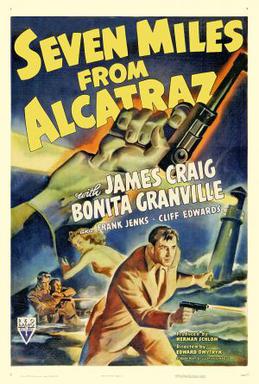
From The Rock Against The Nazi-Night Takers-Director Edward Dmytryk’s “Seven Miles From Alcatraz” (1942)-A Film Review


DVD Review

By Sandy Salmon

Seven Miles From Alcatraz, starring James Craig, Bonita Granville, directed by Edward Dmytryk, 1942

Who was it, Uncle Joe, Stalin, I think who said paper will take anything written on it. Well apparently the same thing is true for film as the film under review, a slightly-veiled World War II propaganda piece by Edward Dmytryk in the days when the Soviet Union was an American ally and all hands, American and Soviet among others, were needed in the titanic struggle to smash the Nazi-night-takers who were subjecting Europe to a thrashing. (Of course a few years later Dmytryk when the tide turned against the Soviets in the early Cold War days and all hands were needed against them   wound up being jailed as one of the Hollywood Ten who were honorably sentenced for contempt for not snitching on their fellow leftists-although he did “sing” later, sang loud to save his two bit career). The film under review was an effort in that direction although it was spiced up a bit as a third-rate thriller.        

When the deal went down that mention of “all hands against the Nazis” was no hyperbole as the two main characters of this film were escapees from “the Rock,” Alcatraz, the supposedly inescapable federal prison out in Frisco bay. Champ, played by James Craig, and Jimbo hightailed it one foggy night and wound up seeking refuge at a lighthouse out in the Japan currents. They take the residents of that lighthouse hostage, including the lighthouse keeper’s fetching wholesome daughter Ann, played by Bonita Granville, and plan their next moves (and Champ plays his hand trying to get with Ann to keep himself occupied until shipping out time).

What the fugitives did not know, nor did the residents, was that one of their number was a Nazi agent using the place to work on his nefarious plans to help blow up half of Frisco town if the opportunity presented itself. Jimbo wound up wasting that agent without knowing what his purposes had been. Those became clear when a threesome, two men and a woman, claimed they were stranded and sought refuge at the lighthouse. Their real purpose was to rendezvous with a German sub in order to get detailed plans of the layout of the city to the proper military authorities. For most of the film Champ and Jimbo could have cared less about what the Nazis were up to, it wasn’t their fight. After all they were prisoners, escaped prisoners, who were looking for a getaway. They would bargain with the devil if he could get them out. But once they became aware that the plans would have blown the Rock and them with it they began to see the light, began to see that they had to defend American right against the vermin.                
   
Jimbo said it best, “they were gangster’s but they were American gangsters” and they formed that vaunted united front with the lighthouse residents to do the Nazi scum in. Got the information to the right people to blow that damn Nazi sub out of the water too. See even fugitives, low life, could contribute to the war effort. Okay. 


Monday, April 3, 2017

Once I Was A Good Boy-With Guitarist T-Bone Walker In Mind 


By Lester Lannon 

No question Frank Jackman started out once as a good boy. Even his mother, Delores, brought up a pious Catholic and a “no tolerance” for evil type of mother admitted that up to the age of about eight he was a model child, went to school every day, got as good marks in school as he could with his limited abilities, went to church, that Roman Catholic Church thing his mother lived for, and was a star in Sunday school class. Then at about eight, maybe nine he fell in with the wrong crowd, fell in with some wrong gees as the saying went in the old neighborhood. Three of those young cronies spent many years in prison for armed something, one just finishing up a dime’s worth for armed robbery of a liquor store. Frank’s fate will be discussed further below after we figure out how he went from a good boy to bad.

A lot of people, you know, professional sociologists, criminologists and psychologists, blamed it on the neighborhood, “the projects,” where Frank and the others came of age. No question they had a point for the statistics bear out the facts of all kinds of strange pathologies among people at the bottom of the feeding chain, the hungry ones, “los olvidados” as one Spanish guy, one hip Spanish sociologist who came out of the place, called those “forgotten” hermanos (not hermanas so much) in the barrio when liberals were actually interested in trying to figure out how to make all boats rise. No question “from hunger” drove a lot of stuff back then when Frank was coming of age in the 1970s, now too although nobody is looking to closely at the subject (except to construct more jails or in the international case drop more bombs). And no question if Frank had been brought up in say leafy Forest Lawn or Glen Ellen he might not have run into those wrong gees, Ronnie, Ducky, Pistol, and Whiplash. Would maybe have found some Alfred, Harry and Bradley let us say and planned mayhem on the basketball court or something and not the local gas station which first got Frank into  trouble (unarmed robbery in the daytime). Actually that first troubled covered up in the courts so not counted was the ‘five-finger clip” at Kay’s Jewelry up in Riverdale Square. Like I said that didn’t count.        

But to Delores’ mind, to Paul his father’s too, Frank was strictly “bad seed,” although not put in such a graphic pseudo-sexual way. Bore the mark of Cain, the mark of the early banishment from Eden unto as the 1930s writer titled one of his novels –East of Eden. And they, their other three boys, Frank’s grandparents and the rest of the extended family bore down on him with those thoughts until he actually began to believe he was marked by the original sin we are all born with under high hell Catholic doctrine. Started almost the day that Frank (and Whiplash not known as Whiplash then, that came later at about age fourteen when he took a chain and nearly beat a guy to death for being on the “wrong” corner and needed to teach the guy a lesson about turf) got caught at Kay’s trying to “five-finger” a bunch of onyx with diamond chips rings to give to some girl Pistol was trying to get a blow job from. (That part, the head reason, never came out and would have freaked out the whole neighborhood, the adults anyway. To keep the record straight despite the lack of jewelry to entice the girl Pistol got his blow job anyway. She was that kind of guy-crazy girl.)       

So Frank (never Frankie, just Frank) went from bad to worse. Got sly as he grew older, got to thinking about what he didn’t have in the world, saw what his father had to grovel for to keep his family, to keep Frank, feed and clothed. The sight of the poor bedraggled man coming home always with his damn head down even when he had steady work and a reason to pull his head up for a moment made Frank swear to himself one night an oath to never be like his father, never grovel to anybody period if he could help it. As far as anybody ever knew Frank never did, but never did grow up to be half the man his father had been as he began to recognize long and too late afterward while serving an armed robbery rap for single-handedly robbing the First National Bank of Gloversville of a hundred thou (unfortunately he set off an alarm in the bank on his way out and the cops found him a few days later in New York. Lesson learned: always have another guy at your back).

But that was later, a half- dozen armed robberies and assaults later. The key one, the one that gave him that first record, on the way to a near permanent home in some state correctional institution including now at the “max” security Hammerhead joint. The first was the night he along with Fast Eddy Jones robbed at gunpoint the Cities Service gas station on Thorndike Street in Riverdale. Got away with it for a while, even got a free blow job from that girlfriend of Pistol’s she was so juiced up by what he had done, so yeah, she was that kind of girl but don’t tell Pistol that because he thinks she is still chastely waiting for him to finish up his dime at Shawshank up in Maine for robbing a grocery store when he was high as a kite on cousin cocaine. Pistol would kill her and every guy who even looked at her so please keep this to yourself.

Naturally kids of fourteen are going to brag about such an event if for no other reason than to prove their manhood out on the dangerous streets. At least naturally for Fast Eddy (Frank never bragged about nothing- his motto just do the thing-from robbery to boffing some frail who looked his way ever so slightly). So Frank and Fast Eddy took the fall, did the youth detention center, reform school, for a couple of years and that was that. (Fast Eddy would open his mouth once too often usually to some frail and wound up face down in the Merrimack River up in New Hampshire for his efforts.)

No need to list all the other felonies that Frank committed from that time to his thirty-fifth birthday because Frank was strictly an armed something guy and the only distinction between the crimes was the time served. Except that last one-that three strikes and you are out last one. The one where a bank sneeze, a bank cop at the Portland (Georgia) Trust Bank got hit between the eyes when he believed that the money he was guarding was his and got rum brave, but also got  very dead. Felony murder, murder one  and in death penalty crazy Georgia that meant the big step-off, the big kiss-off of the face of the earth. He is still waiting for the “hangman” as this written. Every once in a while his ancient mother is able to get down to Georgia to see her boy, her bad boy. And every time she says to Frank-“up to the age of about eight you were  a model child, went to school every day, got as good marks in school as you could with your limited abilities, went to church, that Roman Catholic Church thing that I lived for, and were a star in Sunday school class.” Frank just took that never-ending line in and sat in stony silence.      

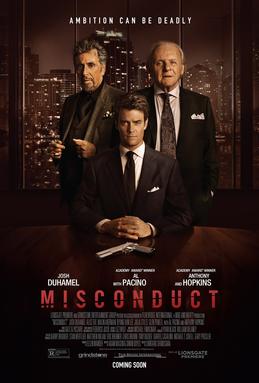
Follow The Money-Al Pacino and Anthony Hopkin’s “Misconduct” (2016)-A Film Review   


DVD Review

By Associate Film Critic Alden Riley

[Upon the retirement from the day to day duties of film review in this space of Sam Lowell (he called it drudgery not duty) and his replacement by his old friend and competitor from the American Film Gazette Sandy Salmon there was an understanding that Sandy would cover the old time movies and his associate Alden Riley would cover the modern current efforts. This is Alden’s second such effort. Pete Markin] 

Misconduct, starring Al Pacino, Anthony Hopkins, Josh Duhamel, Alice Eve, Malin Ackerman, 2016      


Ever since the Watergate revelations of the 1970s which did one American President, Richard Nixon, in and fouled up the political atmosphere for years whenever dirty tricks and cutthroat tactics have been employed the mantra has been to “follow the money.” That is the case with the plotline of the film under review, Misconduct, an apt title on several levels.  Although the action is done by private parties rather than governmental that same following the bouncing ball applies to the plotline here as well. 
Arthur Denning, played by now ancient Anthony Hopkins who seems to be chasing Michael Caine for the title of appearing in the most films in a lifetime, a billionaire Big Pharma magnate is on the carpet for doctoring up drug test results which proved fatal on a serious number of trial patients. He certainly wanted to get out from under that heavy legal problem especially the criminal liability part. Moreover he had a younger mentally unstable employee mistress Emily, played by Malin Ackeman, who had her own agenda and wanted to get out from under. She had conjured up documentary proof of Denning’s extensive knowing wrong-doings and figured to cash in on that knowledge.       

Enter young “take no prisoners” big time New Orleans law firm lawyer Ben Cahill, played by Josh Duhamel, who just happened to be an old flame of Emily’s and who is the key to Emily getting out from under via a serious class action suit against Denning using her information as the lynchpin. Of course Emily used her obvious feminine wiles in her attempt to get the eager beaver young lawyer to do her bidding-to take on the case. Problem in that romance department was that Ben was married, very married, to Charlotte, a nurse played by Alice Eve and he passed on that part. He did however approach the senior partner, Abrams, played by Al Pacino, who after a lot of hemming and hawing decided to let Ben go ahead with the suit.            


Then all hell broke loose. First Emily staged her own kidnapping to grab some dough from Denning. As far as the lawsuit went Ben was a winner after Denning “settled” out of court for a big sum but also was protected from criminal liability as part of the agreement. Then before Ben could even celebrate his victory with Charlotte Emily wound up dead, very dead, from an apparent suicide. Ben found her body and just left it there in her apartment only to have it show up in his apartment and he had to go on the run. Go on the run to find out why he was being framed although he suspected that nefarious Denning was behind the deed. Figured the “deep pockets” guy was looking for further protection against whatever fall-out might come from Emily’s distraught mind. 

He would be wrong though. Wrong because the villain of the piece is none other than Abrams his boss who despite public appearances had been Denning’s lawyer for years. Yeah, follow the money, follow it closely. But there are other agendas, other kinds of misconduct, as well. See Charlotte was miffed at the idea that Emily and Ben might be rekindling that old flame and she went to Emily’s apartment to confront her. Had an argument and Emily fell. Charlotte coldly did not help her and staged the fake suicide scene. As for Ben and Charlotte they just moved on with their lives. And so it goes.            

Sunday, April 2, 2017

The First Lady Of The Mountains-The Late Hazel Dickens


By Si Landon
    
The Hills Of Home, Hazel Dickens

Jack Callahan caught the folk minute bug when he was in high school in his hometown of Carver after having heard some songs that held him in thrall over a fugitive radio station from Rhode Island, a college station, that every Sunday night would have a two hour show called Bill Marlowe’s Hootenanny where he, Bill Marlowe, would play all kinds of songs from the latest protest songs of the likes of Bob Dylan and Phil Ochs to old country blues to Western Swing and everything in between, a fast paced glance at a very different part of the American songbook. What got to Jack, what caused him to pay attention though was the mountain music that he heard, things like East VirginiaPretty Polly and his favorite the mournful Come All You Fair And Tender Ladies sung by Linda Lane, a forgotten treasure of a singer from deep in the Tennessee hills now.

Now this adhesion to folk minute was quite by accident since most Sunday nights if Jack was listening to anything it was Be-Bop Benny’s Blues Hour out of WNAC in Chicago. Usually in those days something had gone awry or some ghost was in the air in radio wave land and he had caught that station and then the Rhode Island Station, WAFJ. Although he was becoming something of an aficionado of blues just then and would become something of a folk one as well his real love then was the be-bop classic rock and roll music that was a signature genre for his generation. He never lost the love of rock or the blues but he never went all out to discover material he had never heard before like he did with mountain music. 

One summer while he was in college he had decided rather than a summer job he would head south down to mountain country, you know West Virginia, Kentucky maybe rural Virginia and see if he could find some tunes that he had not heard before. (That “no job” decision did not set well with his parents, his poor parents who both worked in the local industry, the cranberry bogs, when that staple was the town’s claim to fame so he could go to college but that is a story for another day). Now it was not strange in those days for all kinds of people, mostly college students with time on their hands, archivists, or musicians to travel down to the southern mountains and elsewhere in search of authentic American music by the “folk.” Not professional archivists like Pete Seeger’s father, Charles, or the Lomaxes, father and son, or inspired amateurs like Harry Smith but young people looking for roots which was a great occupation of the generation that came of age in the 1960s in reaction to their parents’ generation trying might and main to favor vanilla Americanization.      

A lot of the young, and that included Jack who read the book in high school, had first been tuned into Appalachia through Michael Harrington’s The Other America which prompted them to volunteer to help their poor brethren. Jack was somewhat animated by that desire to help but his real purpose was to be a gadfly who found some hidden trove of music that others had not found. In this he was following the trail started by the Lally Brothers, a local Boston folk group who were dedicated to the preservation of mountain music and having headed south had “discovered” Buell Hobart, the lonesome fiddler and had brought him north to do shows and be acclaimed as the “max daddy” of the mountain world.     

Jack had spent a couple of weeks down in Kentucky after having spent a couple of weeks striking out West Virginia where, for a fact, most of the rural folk were either rude or suspicious of his motives when he inquired about the whereabouts of some old-time red barn musicians he had read about from outside Wheeling. Then one night, one Saturday night he found himself in Prestonsburg, down in southeast Kentucky, down in coal country where the hills and hollows extent for miles around. He had been brought to that town by a girl, a cousin of Sam Lowell’s on his father’s side from back home in Carver. Sam had told Jack to look her up if he ever got to Hazard where his father had hailed from and had lived before World War had driven him to the Marines and later to love of his mother from Carver.   

This girl, a pretty girl to boot, Nadine, had told Jack that mountain music had been played out in Hazard, that whatever legends about the coal wars and about the music had long gone from that town. She suggested that he accompany her to an old-fashioned red barn dance that was being held weekly at Fred Brown’s place on Saturday nights on the outskirts of Prestonsburg if he wanted to hear the “real deal” (Jack’s term). That night when they arrived and paid their dollar apiece jack saw a motley crew of fiddlers, guitar player, and a few what Nadine called mountain harps.


The first half of the dance went uneventfully enough but the second half, after he had been fortified with what the locals called white lightning, illegal whiskey, this woman came up to the stage after being introduced although he did not for some reason, maybe the sting of the booze and began to play the mountain harp and sing a song, The Hills of Home, that had everybody mesmerized. She sang a few other songs that night and Jack marveled at her style. When Jack asked Nadine who that woman singer was she told him a gal from “around those parts” (her expression) Hazel Dickens and wasn’t she good. When Jack got back to Boston a few weeks later (after spending more time with friendly Nadine that searching for mountain music he contacted the Lally Brothers to see if they could coax her north for college audiences to hear. And that was Jack Callahan’s small contribution to keeping the mountain music tradition alive. For her part Hazel Dickens did before she dies several years ago did much, much more to keep the flame burning.            
The First Lady Of The Mountains-The Late Hazel Dickens


By Si Landon
    
The Hills Of Home, Hazel Dickens

Jack Callahan caught the folk minute bug when he was in high school in his hometown of Carver after having heard some songs that held him in thrall over a fugitive radio station from Rhode Island, a college station, that every Sunday night would have a two hour show called Bill Marlowe’s Hootenanny where he, Bill Marlowe, would play all kinds of songs from the latest protest songs of the likes of Bob Dylan and Phil Ochs to old country blues to Western Swing and everything in between, a fast paced glance at a very different part of the American songbook. What got to Jack, what caused him to pay attention though was the mountain music that he heard, things like East VirginiaPretty Polly and his favorite the mournful Come All You Fair And Tender Ladies sung by Linda Lane, a forgotten treasure of a singer from deep in the Tennessee hills now.

Now this adhesion to folk minute was quite by accident since most Sunday nights if Jack was listening to anything it was Be-Bop Benny’s Blues Hour out of WNAC in Chicago. Usually in those days something had gone awry or some ghost was in the air in radio wave land and he had caught that station and then the Rhode Island Station, WAFJ. Although he was becoming something of an aficionado of blues just then and would become something of a folk one as well his real love then was the be-bop classic rock and roll music that was a signature genre for his generation. He never lost the love of rock or the blues but he never went all out to discover material he had never heard before like he did with mountain music. 

One summer while he was in college he had decided rather than a summer job he would head south down to mountain country, you know West Virginia, Kentucky maybe rural Virginia and see if he could find some tunes that he had not heard before. (That “no job” decision did not set well with his parents, his poor parents who both worked in the local industry, the cranberry bogs, when that staple was the town’s claim to fame so he could go to college but that is a story for another day). Now it was not strange in those days for all kinds of people, mostly college students with time on their hands, archivists, or musicians to travel down to the southern mountains and elsewhere in search of authentic American music by the “folk.” Not professional archivists like Pete Seeger’s father, Charles, or the Lomaxes, father and son, or inspired amateurs like Harry Smith but young people looking for roots which was a great occupation of the generation that came of age in the 1960s in reaction to their parents’ generation trying might and main to favor vanilla Americanization.      

A lot of the young, and that included Jack who read the book in high school, had first been tuned into Appalachia through Michael Harrington’s The Other America which prompted them to volunteer to help their poor brethren. Jack was somewhat animated by that desire to help but his real purpose was to be a gadfly who found some hidden trove of music that others had not found. In this he was following the trail started by the Lally Brothers, a local Boston folk group who were dedicated to the preservation of mountain music and having headed south had “discovered” Buell Hobart, the lonesome fiddler and had brought him north to do shows and be acclaimed as the “max daddy” of the mountain world.     

Jack had spent a couple of weeks down in Kentucky after having spent a couple of weeks striking out West Virginia where, for a fact, most of the rural folk were either rude or suspicious of his motives when he inquired about the whereabouts of some old-time red barn musicians he had read about from outside Wheeling. Then one night, one Saturday night he found himself in Prestonsburg, down in southeast Kentucky, down in coal country where the hills and hollows extent for miles around. He had been brought to that town by a girl, a cousin of Sam Lowell’s on his father’s side from back home in Carver. Sam had told Jack to look her up if he ever got to Hazard where his father had hailed from and had lived before World War had driven him to the Marines and later to love of his mother from Carver.   

This girl, a pretty girl to boot, Nadine, had told Jack that mountain music had been played out in Hazard, that whatever legends about the coal wars and about the music had long gone from that town. She suggested that he accompany her to an old-fashioned red barn dance that was being held weekly at Fred Brown’s place on Saturday nights on the outskirts of Prestonsburg if he wanted to hear the “real deal” (Jack’s term). That night when they arrived and paid their dollar apiece jack saw a motley crew of fiddlers, guitar player, and a few what Nadine called mountain harps.


The first half of the dance went uneventfully enough but the second half, after he had been fortified with what the locals called white lightning, illegal whiskey, this woman came up to the stage after being introduced although he did not for some reason, maybe the sting of the booze and began to play the mountain harp and sing a song, The Hills of Home, that had everybody mesmerized. She sang a few other songs that night and Jack marveled at her style. When Jack asked Nadine who that woman singer was she told him a gal from “around those parts” (her expression) Hazel Dickens and wasn’t she good. When Jack got back to Boston a few weeks later (after spending more time with friendly Nadine that searching for mountain music he contacted the Lally Brothers to see if they could coax her north for college audiences to hear. And that was Jack Callahan’s small contribution to keeping the mountain music tradition alive. For her part Hazel Dickens did before she dies several years ago did much, much more to keep the flame burning.            
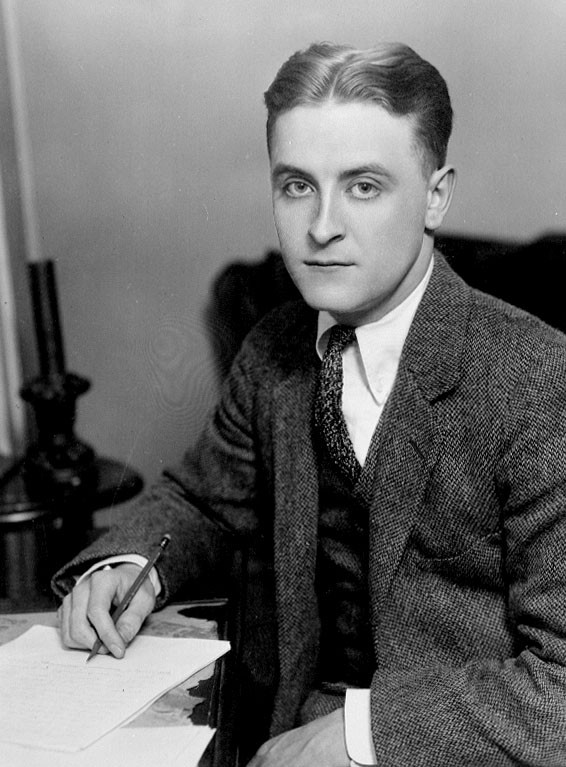
From The Jazz Age-Fitzgerald Is In The House-"The Great Gatsby" -A Book Review 


Click on the headline to link to a "Wikipedia" entry for the "Jazz Age" writer F. Scott Fitzgerald.

BOOK REVIEW

The Great Gatsby, F. Scott Fitzgerald, Random House, New York, 2002


One would have to be rather pedantic not recognize that F. Scott Fitzgerald was an important, if not the most important, novelistic voice of the Jazz Age in post World War I America. Nobody, with the possible occasional exception of Ernest Hemingway, has chronicled the end of the age of American innocence signaled by the Jazz Age better than Fitzgerald.

Fitzgerald certainly was not the only voice of that age, think Hemingway again, but the voice that best exemplified the tensions between the mores of `old wealth' and the emerging sources of `new wealth' that were produced by the huge amount of money available, mainly through government contracts, as result of the war or riches gained through the illegal liquor trade. That is the sociological underpinning that drives Fitzgerald's work.

There is no better example of those tensions than the hero (or is it anti-hero?) of this book, Jay Gatsby. If nothing else it is a dramatic enactment of the strivings of the new money to `make it' in the world of high society, one way or another. And what better way to do that than in the age old tradition of buying one's way into that society through marriage. This is the modern American version of that old story.

And the story itself? One Jay Gatsby, the former Jimmy Ganz, freshly reinventing himself after indeterminate service in the American military in World War I and loaded with cash from questionable financial resources, attempts to win, or rather re-win the affections of one Daisy Buchanan his vision of the perfect life companion and exemplar of the `old money' crowd that he wishes to crash. One little complication, however, gets in the way. She has found herself married to a brutish but very wealthy member of that `old money' crowd. Gatsby's lavish but fumbling attempts to lure her away from the high society of Long Island, then the summer watering hole of the `old money', forms the core of the story.

Gatsby's trial and tribulations on the way as narrated by Nick Carroway (and Gatsby's somewhat unwitting accomplice in the Daisy matter) keeps the story line going until the final deadly ending. The morale- the very rich are indeed very different from you or I. Moreover, someone else will always have to pick up the messes they have made for themselves. They merely move on. This may serve as a cautionary tale for that time and, possibly, today.

A word on literary merits. According to the inevitable changes in literary fashion as well as literary politics Fitzgerald, for long a leading figure in the canon of American literature, has been somewhat eclipsed by other more post-modernist trends. While I firmly believe that the Western canon is in dire need of expansion to include `third world', woman and minority voices Fitzgerald's literary merits stand on their own. His tightly- crafted story line, his sense of language and the flat-out fact that that he knew the subject matter that formed the basis of his expositions merit renewed consideration by today's reader.

Simply put, if you want to understand part of what was going on in America in the 1920's before the Great Crash of 1929 then you have to read the man. If nothing else read the last few pages of Gatsby. If there is a better literary expression of the promise of America as seem by the early Dutch settlers of New York (and the New World) as the last best hope of civilization and the failure of that promise at the hands of the later "robber barons" and their descendants I have not read it.
Déjà vu, Redux-Howard Hughes Presents “The Front Page” (1931)-A Film Review


DVD Review

By Film Critic Sandy Salmon 

The Front Page, starring Adolphe Menjou, Pat O’Brian, produced by Howard Hughes (yeah, that Howard Hughes, the airplane guy who had his fingers in film back in the day), based on the play of the same name by Ben Hecht and Charles MacArthur, 1931   

Hey, am I having a senior moment didn’t I review this film already. I know the plot of the film under review 1931s The Front Page seems very, very familiar. And I don’t mean that I have reviewed the play by Ben Hecht and Charles MacArthur, weren’t they Algonquin Roundtable guys with Dorothy Parker, on which this film is based. I am not that senior moment bound or that old to have reviewed a 1920s Broadway play.

Let me give a rundown and maybe I can refresh my memory about where I have seen this story line before. A bunch of old time police beat reporters, print reporters if you remember that dying profession in the age of 24/7 cable niche and blog citizen reporting, are doing “death watch” duty in the press room of the local law enforcement building in Chicago, Chi town so watch out. The death watch is for the execution of Walter Mitty-type cop-killer Earl Williams who is set to fry, set to be hung out to dry for the dastardly deed come midnight unless the governor grants a pardon based on him being a cuckoo who had delusions of grandeur. A run of the mill story for the cynical boys who man the crime beat desk (in those days really mostly men so “man.” Except a funny thing happens to upset that very applecart. Earl, while being examined by a shrink to see if he really was cuckoo, escaped the clutches of the law.

Now that is big news, front page news I would say even in a jaded age like today. In those days, like today as well, the reporter and newspaper of whatever ilk who can get a an angle, get the scoop on the magical realistic escape of a cop-killer, an anarchist cop-killer when the word anarchist had even more sinister implications than it does today to boot, would certainly get a boost in circulation. Enter one Hildy Johnson, played by Pat O’Brian, who had supposedly given up the racket to go find Elysian fields in an easier more regular hours line of work with a “civilian” sweetheart. Well almost given up the racket except he was there in the press room when Earl sprung himself loose. And guess where baffled cuckoo bird Earl landed in his escape. Yeah, that very press room. So Hildy, once a newspaper man always a newspaper man, cajoled by his tyrannical boss Walter Burns, played by Adolphe Menjou, “postponed” his wedding plans for just a minute to grab one last glory by-line headline.           

The whole trick for Hildy and Walter is to keep those other newshounds cut out of the scoop, and to see what makes this Earl Williams tick. Along the way Hildy found out two important pieces of news, well three really. First Earl’s escape was aided by the incompetence of the sheriff and his minions who are part of that well-known and oiled Chicago political hack machine which Burn’s newspaper was interested in getting the goods on. Second the Governor has sent one of his minions to grant Earl a pardon which that corrupt machine is set on intercepting to avoid looking stupid and even more corrupt than normal. Third Earl didn’t do any dastardly deed he was “framed” for his political views. Naturally ace reporter Hildy solved all those mysteries and tied them with bows in this screwball comedy. Meanwhile his sweetheart was getting short shrift. Oh well it will all turn out for the best.      

Hey, wait a minute, I knew I knew that plotline from somewhere. Sure except it was from the distaff side, nice word right, from Howard Hawk’s His Girl Friday where Rosalind Russell was Hildy and Cary Grant the newspaper boss. That one was classic with the added twist of a little off-hand romance since Hildy and Walter in that one had been divorced and Hildy was supposed to get re-married to some safe insurance salesman. That’s the ticket.  


(I really am losing it. Of course a remake of the film was done in the 1970s with Jack Lemmon as Hildy and Walter Matthau as Burns going back to the guy thing. Enough of this plotline. No more reviews-deju vu redux is enough