Tuesday, February 2, 2016

The Search For The Great Blue-Pink American West Night- "The Ballad Of Captain Cobb And The S.S. Blue-Pink Night"


By The Late Peter Paul Markin  


I already told you today the story about the Moline Meltdown that was part of the search in the old days for the great blue-pink American West night so I don’t have to repeat that here but I did start to think that the story of Captain Cob and the S.S. Blue-Pink Night that was part of it would be easier to tell and I would not get myself so balled up in the telling if it was done as a ballad. Shorter and more to the point, if nothing else. Also an important source for this story, or model for the story if you will, was Red Sovine’s Big Joe and Phantom 309 as translated by Tom Waits. And Big Joe was nothing but a “talking” ballad in the old Hank Williams or Woody Guthrie style. So I am in good company. Here goes:


The Ballad Of Captain Cobb And The S.S. Blue-Pink Night


Okay, let me tell this thing straight through even though I know it will sound off-kilter to you anyway I say it, hell, it will sound half off-kilter to me and I lived through it:


See, back a few years ago, yah, it was back a few years ago when I was nothing but a summer-sweltered sixteen year old high school kid, a city boy high school kid, with no dough, no way to get dough, and nobody I knew who had dough to put a touch on, I went off the deep end.


Plus, plus I had had about thirty-six beefs with Ma, around par for the course for a whole summer but way too many for a couple of weeks in, and not even Fourth of July yet.

Worst, worst, if you can believe this, I had a few, two maybe, beefs with the old man, and having a beef with him with Ma the official flak-catcher meant things were tough, too tough to stay around.


Sure, I know, how tough can it be at sixteen to stay put waiting for the summer heat to break and maybe have some clean clear wind bring in a change of fortune. But don’t forget, don’t ever forget when I’m telling you this story that we are talking about a sixteen year old guy, with no dough and plenty of dreams, always plenty of dreams, whatever color they turned out to be.


I threw a few things together in an old green, beaten to hell knapsack, you know enough to get by until things break that stuff and about three dollars, and I headed out the door like a lot of guys headed out that same kind of door before me in search of fame and fortune.


I hit the main street with a swagger and immediately start thumbing as if my life depended on it. Right away a car, I didn’t see where it had come from before it came into my view, a late model car, looked like a 1961 Ford, slowed down, the driver rolled down his passenger side window and asked where was I heading.


I said “west, I guess,” he said “I’m heading up to Maine to work. Too bad I can’t help you.” As he readied to make tracks I say, “Hey, wait a minute, I‘ll take that ride, North or West it’s all the same to me.”


This guy, if you are thinking otherwise, turned out to be pretty interesting, he wasn’t any fruit like a lot of guys who stop when they see a young guy with a dour, carrying the weight of the world on his shoulders pan like mind, and are ready to pounce on that fact.

Seems that Kenny, Kenny of a thousand ships, his name was, worked the boats, the ferries out of Portland and Bar Harbor over to Nova Scotia and filled the time we traveled with stories about different funny things that happened on the trips back and forth.


And there was this one story that I didn’t think anything about when he told it. He was going on a bit about how one time out in the misty mist his uncle, Captain Cobb, Captain Caleb Cobb, some old swamp Yankee, whom he served under in some boat saved a bunch of people off an island ferry, off of Portland Light, got them to shore, and went back out looking for more.


Well, he is telling his stories, and I am telling mine about this and that, but mainly about my love of the sea, and about going west to see the Pacific when I get tired of the Atlantic.


Suddenly, Kenny says out of the blue, “Hey, if you’re gonna bum around I’ll leave you off at Old Orchard Beach, right at the beach, there’s plenty of places to sleep without being bothered."


See, though this guy, Kenny, was so good, such a good guy, that when we get there he doesn’t just let me off on Route One and so I have to thumb another ride into town like most guys would do but takes me right down to the pier, the amusement park pier. Then he says you know it is probably better to get away from this crowded area, let me take you down Route 9 to the Saco jetty where you can set yourself up in an empty boat.


Okay, that sounds right and besides it’s won’t be dark for hours yet and it’s not dark enough for me to make my big teenage city boy moves.


I could see right away that Kenny was right, this place was quiet and there were many rows of boats just waiting to be used for housekeeping purposes. But, what got my attention was, maybe fifty yards away, the start of the longest jetty in the world, or so I thought.


Hey, I have walked a few jetties and while you have to be careful for the ill-placed boulders when you get to the end you are feeling like the king of the sea, and old Neptune better step aside. I started walking out, Christ this is tough going I must be a little tired from all the travel. Nah it’s more than that, the granite slaps are placed helter-skelter so you can’t bound from one to another and you practically have to scale them. After about a hundred yards of scraping my hands silly, and raw, I say the heck with this and head back.


But put sixteen, hunger for adventure, and hunger to beat old fellaheen king Neptune down together and you know this is not the end. I go around looking at my boat selection just exactly like I am going to rent an apartment. Except before I set up housekeeping I am going to take an old skiff out along the jetty to the end. So I push one off the sand, jump in and start rowing.


Now I am an ocean guy, no question. And I know my way around boats, a little, so I don’t think much of anything except that I will go kind of slow as I work my way out.


Of course a skiff ain’t nothing but a glorified rowboat, if that. It’s all heavy lifting and no “hi tech” like navigation stuff or stuff that tells you how far the end of jetty is. Or even that there is a heavy afternoon fog starting to roll in on the horizon. Yah, but intrepid that’s me.


Hey, I’m not going to England just to the end of the jetty. I said that as the fog, the heavy dark fog as it turned out, enveloped the boat and its new-found captain. I started rowing a little harder and a little more, I ain’t afraid to say it, panic-stricken.


See I thought I was rowing back to shore but I know, know deep somewhere in my nautical brain, that I am drifting out to sea. I’m still rowing though, as the winds pick up and rain starts slashing away at the boat.


Of course, the seas have started swelling, water cresting over the sides. Christ, so this is the way it is going to finish up for me. What seemed like a couple more hours and I just plain stopped rowing, maybe I will drift to shore but I sure as hell am not going to keep pushing out to sea. Tired, yah, tired as hell but with a little giddy feeling that old Neptune is going be seeing me soon so I decide to put my head down and rest.


Suddenly I am awakened by the distinct sound of a diesel engine, no about six diesels, and a big, flashing light coming around my bow. I yell out, “over here.” A voice answers, “I know.”


Next thing I know an old geezer, a real old geezer decked out in his captain’s gear, is putting a rope around the bow of my boat and telling me to get ready to come aboard.


After getting me a blanket, some water and asking if I wanted a nip of something (I said yes) he said I was lucky, lucky as hell that he came by. Then he asked what I was doing out here in the open sea with such a rig, and wasn’t I some kind of fool boy.


Well, I told my story, although he seemed to know it already like he made a daily habit of saving sixteen year old city boys from the sea, or themselves. So we swapped stories for a while as we headed in, and I had a nip or two more.


As we got close to Saco pier though he blurted out that he had to let me off before the dock because he had some other business on the Biddeford side.


Here is where it gets really weird though. He asked me, as we parted, did I know the name of his boat (a trawler, really). I said I couldn’t see it in all the fog and swirling sea. He told me she was the “S.S. Blue-Pink Night.”


I blurted out, “Strange name for a boat, what is it a symbol or something?”


Then he told me about how he started out long ago on land, as a kid just like me, maybe a little older, heading to California, and the warm weather and the strange blue-pink night skies and the dreams that come with them. I said how come you’re still here but he said he was pressed for time.


Here is the thing that really threw me off. He gave me a small dried sea shell, a clam shell really, that was painted on its inner surface and what was painted on it was a very intricate, subliminally beautiful scene of what could only be that blue-pink California sky.


I said, “Thanks; I’ll always remember you for this and the rescue.” He said, “Hell lad that ain’t nothing but an old clam shell. When you get over to that Saco café at the dock just show it to them and you can get a meal on it. That meal is what you’ll remember me by.”


And off he went.


Hungry, no famished, I stumbled into the Saco café, although that was not its name but some sea name, and it was nothing but a diner if you thought about it, a diner that served liquor to boot so there were plenty of guys, sea guys, nursing beers until the storm blew over, or whatever guys spend half the day in a gin mill waiting to blow over.

I stepped to the counter and told the waitress, no, I asked politely just in case this was a joke, whether this old clam shell from the captain of the “Blue-Pink Night” got me a meal, or just a call to take the air.


All of a sudden the whole place, small as it was, went quiet as guys put their heads down and pretended that they didn’t hear or else though the joint doubled up as a church.


I asked my question again and the waitress said, “What’ll you have?”


Then she said did I know anything about the captain, and how did he look, and where did he meet me, and a whole bunch of questions like this was some mystery, and I guess maybe there was at that.


Then the waitress told me this (and I think every other guy in the room by the loudness of her voice),“A few years back, yes, about six or seven years ago, there was a big storm that came through Portland Light, some say a perfect storm, I don’t know, but it was a howler. Well, one of the small ferries capsized out there and somehow someone radioed that there were survivors clinging to the boat. Well, the old captain and his first mate, I think, started up the old “Blue-Pink Night” and headed out, headed out hard, headed out full of whiskey nips, and one way or another, got to the capsized boat and brought the survivors into shore and then headed out again.


And we never saw them again.


And here is the funny part; when he was unloading his passengers he kept talking, talking up a perfect storm about seeing the blue-pink night when he was out there before and how maybe it was still there. I guess the booze got the best of him. But hear me son, old captain was square with everyone in this place, he used to own it then, and some of his kin are sitting right here now. He was square with them too. So, eat up kid, eat up on the house, ‘cause I want you to save that old clam shell and any time you’re on your uppers you can always get a meal here. Just remember how you got it.”


“Thanks, ma’am,” I said.


Then I slowly, like my soul depended on it, asked, “Oh, by the way what was that old captain’s first mate's name?” and I said it in such a way that she knew, knew just as well as I did, that I knew the answer.


“Kenny, Kenny Cobb, bless his soul.”


In The Time Of The Be-Bop Baby Boom Jail Break-Out- In The Time Of The “Boss” Car


Introduction by Zack James


Click on the headline to link to a YouTube film clip of Eddie Cochran performing Somethin' Else.


Bradley Samuel had a thing for cars, old cars, old cars when he was young in the 1960s and so ‘49 Hudsons and ‘50 Studebakers drove him crazy and a few years later when his buddy Steve Cadger had one after his father turned his in for a newer model, a ’57 Chevy. Even later he went ga-ga over Mustangs (and Mustang Sallys, listen to the song of the same name on YouTube if you want to know of what I speak). Any city, say Boston when he ran around that town in the early 1970s would find him running over to the famous Larz Anderson auto museum in Brookline to ogle those beauties. On the West Coast when he lived there in the 1980s when there was still a small audience for alternative journalism with a bit he would run down to San Diego and go crazy over the autos there but really more the motorcycles which included his favorite, the British-built very fast, very, very fast, Vincent Black Lightning (a bike that Richard Thompson, a Brit and a folk-rocker wrote about extolling bad boy outlaw James Ardie and his red-headed girl who came to a bad end-one of the great modern working-class love songs). Still out on the Coast he would occasionally wrangle an assignment to cover the elite expensive automobiles auctioned off at Pebble Beach near Carmel every year or so.            


All of this “hot car” interest, by the way, from a guy who did not get his license until he was twenty-one not because he didn’t want to get the damn thing but because he had failed the Massachusetts state driving test three times and was “ordered” to wait (and go to driver training school) before trying a fourth time.  All of this by a guy who for big chunks of his life did not even own an automobile, any, sometimes because he couldn’t afford one and sometimes he lived in cities like New York where car ownership is akin to being robbed on a daily basis. All this from a guy who needed instruction to find where the gas cap was and how to get it unscrewed in order to put gas in the damn car. Forget about any minor maintenance like changing oil or tires. So there is no accounting for tastes but I would take a big slice of what he has to say about his youthful adventures with cars-and with girls which go symbiotically together. You are forwarded.  


By Bradley Samuel 


This review will get around to be about cars, “boss” cars as we used to say in Riverdale where I grew up but let me explain what the general assignment was about and place the thing in context. I wrangled a small assignment (they seem to be getting smaller these days as the print medium is taking a beating in the digital age and the natural constituency that would read what I have to say is dying off (or following the young going to the digital age too, if not the digitalis age as well) from West Coast Automobile, a journal geared to classic cars but also to the music of the times of the classic cars since a number of its advertisers are (or maybe were) record companies who dealt with putting out nostalgia CD compilations to what in the business is called demographically-targeted niche audiences (and financially as well with some discretionary income to buy their products for those who thrown or otherwise lost their youthful purchases when buying records at places like Sidewalk Sam’s Records was considered a sacred duty). 


I had thus for several months been on a tear in reviewing individual CDs in an extensive classic rock ‘n’ roll series (now classic, then just our music). A lot of those reviews had been driven by the artwork which graced the covers of each item, both to stir ancient memories and reflect that precise moment in time, the youth time of the now very, very mature (nice sliding over the age issue, right?) baby-boomer generation who lived and died by the music. And who fit in, or did not fit in as the case may, to the themes expressed in those artwork scenes. In this review we have the latter, the not fit in part, for this reviewer anyway. The latter is the case here although the cover art was simplicity itself- the rear view of an aerodynamically-contoured rear fin (yes, fin) of a “boss” (yes, boss) 1950s automobile of unknown provenance (but we can guess, right?)


Yes, and that slight description is all that is needed for those of us who came of age in the “golden age of the automobile” in the speed and thrills-craving aftermath of World War II when restless Americans, young and old, more young as it turned out, went into spasms over the latest “boss” (yes, boss) vehicle coming out of Detroit, the motor capital of the world then. Of course the cars kind of sorted themselves out- you wouldn’t, if you were young, dream of driving something that your father drove. So if you got his hand-me-down after he decided that he needed, just absolutely needed, that much more power in his automobile in order to keep up with the Joneses, you would move might and main in order to transform that old clunky dad car into a respectable tool. A rocket-like tool to fit the age, to ride and to ride with some sweet honey at your side, on those hot sticky, sultry summer nights down by the seaside, or at the drive-in, either to see a movie or for some late night food (a whole dissertation could be written, maybe has, on onions, hamburgers, French fries, sodas, and the etiquettes of those Friday and Saturday night hot dates with some youthful Laura), your choice.


Yes, and this is why even a mainly a “not fit in no car boy” like me, from a mainly no car family, could (and maybe still could) stare his eyes out over some boss of the bosses ’57 Chevy charging down the be-bop night boulevard, or a lanky turbo-driven long-line Lincoln, or a rebuilt Cadillac or a tear-up Thunderbird. Relics from a high cubic volume engine age when your twenty-nine cents a gallon gas took you about three feet per gallon. But still, come on now, they looked, well, boss.


Oh, yes, and of course you needed to amp up that boss wagon car radio, previously set exclusively to some father business news station (jesus), booming out the latest rock and roll hits about cars, especially West Coast car legends and their chicken runs, girls (East coast or West coast, hell, even the Mid-West Coast if they have one), girls and boys in trouble, in love, out of love (ditto on that geography thing), chasing that sunset ocean-flecked dream. But mainly, when the dust settled, you had to worry about how and who was going to front that dough to get that new back chrome fender you just needed, absolutely needed, needed like crazy to keep up with the Jones’ son.


But on that boss car radio you were likely, very likely, to be cruising to (even if only riding shotgun in some buddy’s boss car cruising that boulevard looking for, what else, girls who just that moment might be in need of some seaside company, or wanted to go the drive-in, you know that movie or food thing, their choice) many of the tunes reviewed in that series. Stick-outs on this fin tail art beauty included: For Your Love, Ed Townsend; Silhouettes, The Diamonds; Somethin’ Else, Eddie Cochran (totally underrated in the classic rock scheme of things after he died in a car accident, naturally, especially his classic Summertime Blues that was a rite of passage each summer vacation); and, as always when you talk 1950s rock, the serious stuff, the serious riffing guitar stuff from the place where rock met the blues, Chuck Berry on Almost Grown, not his number one, A-list material but good in this company. Enough said. 


Break With The Two Parties Of Wall Street- A Cautionary Tale In The Age Of Bernie Sanders 
 
By Frank Jackman

Fall 2012


Bradley Fox had to laugh when he heard the news about Sam Lowell. Sam had told Bradley a few years ago, sometime in the early fall of 2012 amid the hurly-burly of that presidential election year, when they had first met at an anti-war rally on Boston Common after the very first rumblings of going to yet another war, this time in Syria, was uppermost on the Democrat Obama Administration’s mind that he continued to hold the Democratic Party responsible along with the Republicans for their continuing bi-partisan support for every war that comes along, every war opportunity as well it had seemed of late. Sam had said that while the Democrats “talk the talk” about avoiding war, or stopping the onslaught of the military budget as a drag on the possibilities of taking care of some serious domestic social questions when the deal goes down they en masse vote for the war budgets. The big general one, you know the six or seven hundred billion dollar one, AND the supplemental ones for operations like Afghanistan, Iraq, Syria or wherever else they want to throw some mud. In short, they don’t as a party, as a capitalist party the way Sam had put it to Bradley that day “walk the walk.”

That pro-imperial policy by the Democrats meant that under no conditions could Sam support any Democratic Party candidate- at the federal level anyway. Had said to Bradley during the course of their conversation that had been his position at least since the early 1970s when he had gone through hell in the Army in his opposition to the Vietnam War and saw the Democrats as complicit as the Republicans when they did not make motions to cut off the Vietnam War budget requests. Consistent anyway on both side, Sam calling for “no” votes to the war budgets and the Democrats (with few exceptions) giving up the ghost with all arms and feet.  

That was then but this was now, now being 2016 and according to Bradley’s sense of things, and what he had supposed was Sam’s, yet another bummer of presidential campaign between Democrats and Republicans in America has begun to unfold. And guess who has since the first of the year been in the thick of the campaigning supporting Bernie Sanders as he makes a bid to be the Democratic Party candidate. Not as an Independent which would have given Sanders a nod for support but as a tried and true candidate right in the heart of the beast. Yes, one Samuel Lowell. So all that business about being anti-war, forcing whoever wanted his vote, or support, having to take the pledge to vote against the war budgets as a minimum step in the right direction was so much hot air when the deal went down.

Sam’s reasoning and the pressures of politics require a little explaining though in order that others who might be thinking of breaking their opposition to the Democrats (the myriad Republicans running helter-skelter are beyond the pale) might take a little pause before leaping into the abyss. That is the idea Bradley had in mind after he had heard the news from Bart Webber when he thought about how a stand-up anti-war guy like Sam could fall down like that. They, remember, had of all things met at an anti-war rally. Bradley, considerably younger than Sam, had only in 2012 begun to feel queasy about where this country was going, queasy too about the endless wars even under an administration of a guy who won the Nobel Peace Prize and when the war cries to get knee-deep into the Syrian Civil War began to be heard he had decided that he needed express public opposition to those efforts. He had heard through the Internet grapevine that a bunch of peace organizations like Peace Action, United for Justice and Peace, the Quakers and others were planning a rally for a Saturday in later September on the Common to express their opposition.    

Bradley, not used to public demonstrations of his political views (then), was a little leery as he emerged from the depth of the Park Street subway station where there were about fifty people milling around, carrying signs mostly anti-war signs against the continuing wars in various spots in the Middle East. He had not expected a huge crowd, hadn’t since about 2002 when the war drums for Iraq had started and millions, not including him then, had marched in the streets of the world in a desperate attempt to stop a bloody senseless war there but he had been intimidated by the smallness of the rally a bit. Also by the flotsam and jetsam that pass through that historic protest area on their ways to other business or as with the homeless just hanging out. Then a guy wearing a Veterans For Peace shirt, carrying a VFP dove-emblemed flag swirling in the wind, a Socialist Alternative button on his jacket and a small stack of leaflets came up to him and asked if he was there for the demonstration. He had said “yes.”              

That was Bradley’s introduction to one Sam Lowell, although that would not be their last meeting, not by a longshot. That day though Sam had presented some important ideas to Bradley about the nature of American society, about how almost all the establishment power structure went along with the endless wars and that it was the wars among other things inherent in the inequities of the capitalist system that led to the bloodshed and led to not getting lots of more positive things done. Bradley listened with some interest because some of what Sam had to say were things that had been upsetting him of late. The fact that Sam was an actual veteran didn’t hurt either, the voice from those who served carried weight with him (although when he found out the details of Sam’s story later he had more admiration for anti-war veterans who didn’t fold). Then Sam passed Bradley a leaflet (see about) which took him aback for a moment.

The headline-“Break with the two parties of Wall Street” confused him. See Bradley had for the four pervious election cycles since he had come of voting age had voted for the Democratic candidate for President, saw that as his only option and something he had been proud of in 2008 when he cast a vote for the first black President. He had asked Sam what that meant, asked him who he would be voting for. That day Sam gave him a short explanation since he had other responsibilities day around organizing the rally about why he had broken with the two parties. Had mentioned as well why as a small gesture in the right direction he knew he would be voting for the Green Party candidate-Jill Stein. He also told Sam that the organization he supported (although he said he was not yet a member) Socialist Alternative was doing the same thing.

Sam also suggested that if Bradley wanted to know more about why he (and SA) were not voting for the Democrats (for Obama) he would be happy to meet with him and discuss that matter. Bradley gave Sam his e-mail address and Sam a few days later followed up with an e-mail inviting him to meet at his convenience. As for the rally he had been glad that he had gone, glad that he had made that small public anti-war gesture and seriously thought about meeting up with Sam.                  

A couple of weeks later Sam and Bradley met at the Blackbird Café where Sam went through his paces after Bradley had asked about Sam’s political history and about why he refused to vote for the Democrats against the beastly Republicans and why his vote for the Green Party was not wasted energy. Sam had said that he had grown up in a working-class family with very strong ties to the Democrats going back to the FDR era and that he himself had after college expected to pursue a career in politics through the Democratic Party. Had as late as 1968 been a crazed Bobby Kennedy supporter campaigning for him all over the country and after he was assassinated went to work on the Humphrey campaign (also all over the country). Reason: a classic one, a “lesser evil” one if you wanted to know the truth-one Richard M Nixon who was the number one bad ass politician that everybody rightly feared would be elected and continue the Vietnam War forever. Of course Hubert Humphrey been neck-deep in the machinations of the Lyndon Johnson escalations of the war but Sam had not seen things that way-then.   

In 1969 Sam had been drafted into the Army and that event had changed everything. He had allowed himself to be inducted which he found out after a very few days of basic training was a mistake. All the signs were that he was being trained for nothing else but to kill “commies” in Vietnam. No go. He had no quarrel with Vietnamese peasants among other reasons. Without going into all the details Sam when he had gotten orders for Vietnam after completion of Advanced Infantry Training (and that training signified only one thing because Uncle Sam only needed, desperately needed, grunts, foot soldiers, cannon-fodder in one place that year-Vietnam) decided to refuse to go. He wound up spending the better part of the next two years in the stockade, or waiting to go into the stockade, although he finally got out with an honorable discharge ordered by the federal district court in New Jersey where he was being held in detention at Fort Dix. That critical experience, and the reflection that after all the Democrats, his previously beloved Democrats had been neck-deep in the escalations as well as Nixon, was the initial crack. Further reading, thinking, association with Vietnam Veterans Against the War, associations with various independent socialist types and later in the 1980s Veterans for Peace flushed out the other reasons for breaking with the Democrats (the Republican wing of the two parties of Wall Street was so much hot air since he would then, and now, never consider supporting that group of heartless bastards).          

Sam and Bradley went back and forth that day for a couple of hours and Sam suggested that if Bradley was looking for more information that Socialist Alternative had study groups which he could join and learn more about their perspective. Bradley had attended several classes before he decided that while he would continue to be a public anti-war activist (and other issues too like the death penalty, the fight for a higher minimum wage, stopping immigrant deportations and the like) that he preferred not to belong to any organization since with three growing kids he would not have the time necessary to devote whole-heartedly to the cause. He did later run into Sam (and others as well since it is a very small cadre of those who are interested in fighting injustices in the public square these days) at many events and went out of his way to attend VFP-sponsored events.      

Bradley also took to heart what Sam had said about the two parties of Wall Street although he never really got used to that way of putting it and did not vote for President in the 2012 election cycle (he could not see the gesture of voting for the Green Party as anything but a futile gesture). He had not planned and continues to plan not to vote for President in the 2016 election cycle, although he sorely wished that Bernie Sanders had decided on an independent candidacy so he could work for him.    

As for Sam, Bradley after he had heard that Sam was working for Sanders in New Hampshire canvassing voters in that state (as was Socialist Alternative which was also neck-deep in that campaign), decided to go to Park Street Station where a weekly anti-war rally is held every Saturday (and has been since something like 1998) and where he expected to find Sam standing with his VFP flag. And he was there. When Bradley asked him what in the world had changed about the Democratic Party of Wall Street since the last election cycle he said “that is where the kids are, that is who we who are older have to get to, hell, Bernie is the only game in town, the only one who will stand up to the beasts.”  Yeah, Bradley thought “that was then but this is now” as he remembered that final paragraph from that leaflet that he still had in his home office desk drawer.  (See above and read and weep.)     


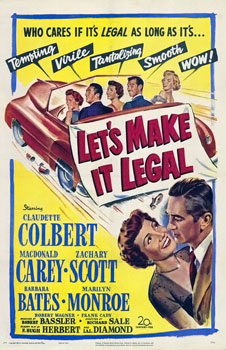
In The “Golden Age Of America” Night-Claudette Colbert’s Let’s Make It Legal


DVD Review

By Zack James

Let’s Make It Legal, starring Claudette Colbert, MacDonald Carey, Zachary Scott, 1951

There has been a lot of reflection lately in the media, on the political stump and around the water cooler by those older generations, the dwindling number of Great Depression and World War II survivors and their progeny, the Generation of ’68 about the 1950s “golden age of America,” they passed through when it looked like all boats, or a lot of them were rising. When working people had a shot at a few of the goods of life and American military might if not unchallenged could hold its own. The age when common cultural artifacts were the stable two parent family, the dream of owning one’s own house, and no troubled waters. This social vision exemplified by the television fare with its very stable (and wise) Ozzie and Harriet, Father Knows Best, and The Donna Reed Show. All taking a light-hearted look at the foibles of the modern American family. The film under review, Let’s Make It Legal, although light-hearted enough for the golden age veers off that standard a bit.              

The subject: the last throes of a divorce agreement between one long-suffering wife, played by Claudette Colbert, and one stray cat gambler husband causing that long-suffering, played by MacDonald Carey. (No hint of any hanky-panky on his part with the ladies even though Marilyn Monroe has a small part here just the gambling and hanging with the guys so maybe wifey was right to give the guy the boot, the boor.) The starling thing to my mind whatever humor was involved in the story line was the devil may care attitude toward divorce in the film. Not very Ozzie and Harriet-like but also not very  much like my growing up neighborhood where the lone divorced woman (and her child, my friend Gary) was looked upon as not quite right, not quite fitting in with the ethos of the neighborhood even though he ex-husband was something like the town drunk.

But enough of that. Let’s run through the thin gruel plot. So husband and wife are breaking up the household after twenty something years of marriage due his excessive gambling (although breaking up the household may be too strong a word since he was hovering around the house, which she got in the settlement, more than my hard-working not divorced father ever did but we will let that slide). Problem: their only child, their daughter, their adult daughter with a husband and child is crazy to see them get back together. (The daughter, hubby and child residing in the house with mother something not unusual for twenty-somethings these days but against the norm in the generation-separating 1950s where the young were dying to get out on their own). For most of the film she is unsuccessful in that attempt despite her best plans and despite father’s desire to get back into mother’s (and a grandmother to boot) good graces.               

To add fuel to the fire an old flame of the wife’s, played by Zachary Scott, now a rich eligible bachelor shows up and wants to reignite the flame. That goes on for a bit, a long bit and she almost succumbs but that bachelor has been a bachelor too long, is too set on a big governmental career appointment and so back she goes to her ex. Some funny lines here but I am still scratching my head over the poor treatment of my poor friend’s mother who was seen in the neighborhood like some fallen woman and not as just a sensible woman. Go figure. 


Monday, February 1, 2016


In Defense Of Screwball Comedy-Preston Sturgis’ Sullivan’s Travels

DVD Review

By Sam Lowell 

Sullivan’s Travels, starring Veronica Lake, Joel McCrea, directed by Preston Sturgis, 1942

It is always interesting when the point of a film gives itself as its own example. That is the case in the film under review, premier 1930s and 1940s screwball comedy director Preston Sturgis’ Sullivan’s Travels where the final point to be made is that film, whatever else it may be, can be a vehicle to chase away an audience’s blues, for a while. Then this film, not without some excess slapstick at the beginning, gives us many reasons to laugh and forget our troubles for a couple of hours. And that is these days, so you can imagine what it was like for audiences beleaguered by the seemingly never-ending Great Depression and the drums of war pounding in Europe.      

Of course it takes that couple of hours to figure out that comedic films can bolster the human spirit, as surely if not better, that some social justice drama. At least it took one John L. Sullivan, a well-regarded comedy director out in the hinterlands of Hollywood played by boy-next-door Joel McCrea, that long to figure out what he had previously been doing was all for naught. A number of characters in the play from his producer’s lawyer to his world-weary valet try to tell Sullivan that the poor, the forgotten, the misbegotten, the fellahin of the world already know they are up against it, that the cards are stacked against them, know that short of a salutary revolution, an unlikely occurrence for a lot of reasons in America, they don’t need to have their noses rubbed in that raw fact. Basically save the social concern dramas for the art houses and the intellectuals who hang there and leave the masses their moments of escape in a dark theater.        

Here’s how Brother Sullivan learned his lessons. Like I said John L. was sick unto death of comedy, wanted to do something meaty, that social drama mentioned earlier about the plight of the underclasses. Problem:  John L. was clueless about what made the working, and non-working poor, tick. How the scramble for necessities wore them out, made them too tired to pursue the finer things in life. Solution: John L. would hit the road, go among the brethren of the railroad “jungles,” breathe the same fetid air as the fellahin. New Problem: the film company knowing it has a valuable performer insisted on having him “chaperoned.” Not a good way to learn about the hobo life, and he bemoaned his plight for a while.  

Making that plight a little easier is easy on the eyes was girl-next-door Veronica Lake as a girl (the Girl) he met in a roadside diner who had busted flat in Hollywood and was heading back to  Muncie, Lima, Buffalo or where she hailed from before she got stardust in her eyes. She decided to go on the road with him, for kicks, mainly, not knowing for a while that he that he was a famous director on the bum. One thing after another lead this pair to some serious down and out places, with plenty of poignant scenes of the life of the desperate poor, before they abandon that scene for the wilds of Hollywood.

Except as a parting gesture John L. decided he would go down to the “jungle” and pass out five dollar bills to the brethren. Here is what the down and out have to deal with which he had not factored into his gesture. Among the poor are the lumpen, the criminals who feed off of plight on the poor, the main daily enemy of the poor if you think about it (and a very good reason why the Paris Communards of 1871 put a sign “death to thieves” above their headquarters at the Hotel de Ville). So one guy bopped him on the head and took whatever dough he had, among other things, after putting him on a train going east. Showing such characters wind up with no good end the robber was run down by a train. Then things got a little dicey since one of the things he took was John L.’s identification so everybody though he was dead. Worse the knock on the head left John L. punch drunk and he picked a fight with a railroad “bull,” not a good idea since he drew a six year sentence on the county and no good could come of that.                

John L. took his lumps in the prison camp getting on the wrong side of a prison guard. But it was also there that he got “religion” about what comedy could do for the downtrodden after attending a movie shown at a black church. But he didn’t want to make a career in the camp out of that knowledge so he got everybody riled up by saying that he had been the guy who killed John L. Sullivan. Presto all guns in Hollywood were headed east to retrieve the boy wonder, including that easy of the eyes girl. Yeah save the serious social and artistic stuff for the likes of Dalton Trumbo, Harold Clurman, John Steinbeck, and let boy wonder make people laugh. Got it.    
Not Born Yesterday-With William-Judy Holliday’s Born Yesterday


DVD Review

By Sam Lowell

Born Yesterday, starring Judy Holliday, Broderick Crawford, William Holden, directed by George Cukor, from a play by Garson Kanin, 1950

Some films come at you quietly, some like the film under review, the film adaptation of Garson Kanin’s Broadway play, Born Yesterday, come screaming at you, literally, and from the first scene. So once you get that idea under your belt you are able to sit back and watch some serious professional actors go about their business of making a play come alive on the screen (these adaptations don’t always have such a happy results). Watch too, maybe squinting a lot, what would today be a politically incorrect take, a very politically incorrect take, on the relationship between a power-crazed man and a salt of the earth woman. And watch too the play of forces in a power struggle, a not very far from today’s Washington political reality slice of life from the 1950s.

Here’s how this beauty, directed by the talented romantic comedy director from that period George Cukor, played out. Big-mouthed (like I say from the get-go) Harry, a no nonsense, by the school of hard knocks, never give a sucker an even break book gangster big time junk magnate from Jersey, played by Broderick Crawford, last seen in this space playing a loud-mouthed Huey Long-type politician in the successful film adaptation of Robert Penn Warren’s All The King’s Men, and his “honey,” an ex-showgirl, also loud, Billie, and supposedly dumb to boot, played to Oscar-winning perfection by Judy Holliday, encamp in Washington in order to “buy” a congressman in order to further Harry’s business interests. Fair enough, done all the time as we know now from the infinitely resourceful lobbyists who clutter up K and 14th Streets, but Harry has, as the Harrys of the world usually do, a problem with hanging around Washington with what he comes to consider, with a little help from his lawyer, a dumb cluck of a dame even if he does love her in his own caveman way (with a couple of slaps thrown in when she gets out of line-see what I mean about the politically, legally too, incorrect stuff in this one). So Harry, taking a unconscious leaf from Pygmalion, hired a journalist, Paul, played by William Holden, last seen in this space face down in Norma Desmond’s swimming pool up in the high numbers on Sunset in Sunset Boulevard to “un-dumb” her (don’t worry this is a romantic comedy so Holden will not face the gauntlet this time).                       

Earnest Paul takes his student Billie in charge and gives her some book-learning, some basic civics lessons circa the 1950s when we were all a little more naïve about the real processes of government, and a well-travelled tour of the various historical sights which dot and define the Washington landscape. And Billie, in the end, learns her lessons well, too well for power-hungry Harry. She does her part to foul up Harry’s best laid plans, aided by the idealistic Paul. Harry, well Harry finds out that even with a ton of dough Washington is a tough town to break into, to keep the power-brokers bought. Top the whole thing off with a little romance between teacher and student (improbable to me since Ms. Holliday did not seem to be Mr. Holden’s type off his previous and subsequent cinematic track record but we will let that pass) and you have a very fine 1950s production with some great, if loud, dialogue, especially Ms. Holliday’s come-backs at Harry when he is in one of his rages.         

Sunday, January 31, 2016

Hard Times In The Country Down On The Farm-With Stephen Foster’s Hard Times Come Again No More In Mind


By Bradley Fox


No one in Hazard, Hazard, down in Eastern Kentucky, Appalachia hard patch country which still has sections where the views would take your breath away just like it did those whose sense of wonder first brought them through the passes from the stuffed-up East, ever forgot the hard times in 1931, nobody. Not the coal bosses, actually coal boss since every little black-hearted patch belonged to Mister Peabody and company, who that year shut down the mines rather than accept the union, the “red union,” National Miner-Workers Union ( that “red” no euphemism since the American Communist Party was in its “ultra-left period of only working in its own “red” unions rather than as a faction of larger craft or industrial union) although Mister Peabody, given a choose, would have been under the circumstances happy to work out a sweetheart deal with John L. Lewis and his United Mine Workers. But the Hazard miners were a hard-nosed lot, certainly as hard-nosed as their more well-known cousins over in Harlan County who had songs sung and soft whispered words written about their legendary activities in taking on the coal bosses. (That cousin reference no joke since in hard times, and sometimes in good times you could not get a job in the mines if you were not vouched for.) Certainly no one in the Breslin clan ever forgot the 1931 hard times since they had lost a few wounded, a couple seriously in the skirmishes around the mine shaft openings  keeping the mines closed when the bosses, and not just Mister Peabody on that score, tried to bring in “scab” labor from West Virginia or Eastern Pennsylvania to work the mines.         

Of course the Breslin clans, the various branches gathered over the generations had been in the hills and hollows of Kentucky as far back as anybody could remember. Somebody said, some Breslin “historian,” that the first Breslin had been thrown out of England back in the early part of the 19th century for stealing sheep and told never to return under penalty of death. And so he, Ike, or Icky, nobody even the historian was not sure which was the correct name hightailed it out on the nearest ship and wound up in Baltimore before heading west, ever westward as was the habit of lots of people, the plebes shut out of the big businesses and small craft shops by those whose people had come before, had come not long after the Mayflower, back then when the seacoast fame and fortunes were already locked and there was so much land to the west that it seemed a shame to see it go to another man, or his family.

So that first Breslin headed west and settled in the hills and hollows around Hazard, raised a big family, twelve who survived childhood and over a couple of generations helped populate the area. Here was the funny part, the part that would explain why there were still Breslins in Hazard after the land had petered out, and before coal was discovered as a usable mass energy source. Some of the Breslin clan had the wanderlust like old Ike/Icky and moved on when the land went fallow. Others took after that lazy, sheep stealing stay in one place part of the Breslin gene and refused to move expecting providence, or God, or something to see them through. The coal discovery to keep families from starvation’s door  helped but that didn’t change the sluggish no account ways of those who stayed, mostly.         

No question there was a certain amount of in-breeding which didn’t help the gene pool but was to be expected when you had people living in isolated pockets, more men surviving than women after childbirth. Some of it was a certain “don’t give a damn” attitude-as long as something was on the table for supper, as long as the roof of the shack, and most of the Breslins lived in the ubiquitous shacks seen in photographs of the times by photographers like Weston and Arbus. Places, tiny places, one or two rooms, a living area, a bedroom area, no windows to speak of, not made of glass anyway maybe waxed paper, just holes on the sides to let in air, those sides of the building protected by tar paper, ditto the roof, a porch with some old pappy sitting in a rocker, a parcel of kids, half clothed, and a lifetimes worth of junk scattered around the yard. Maybe a mangy dog, maybe some poultry. Some of the problem was lack of any education, or anybody to teach them the niceties of the right way to do things. Fathers would tell their sons that they didn’t need any education to pick coal out of the ground. And for a couple of generations that worked out, nothing good, nothing but short, brutish, nasty lives but there it was.             

That was the way it was in late 1930 in the Prescott Breslin clan, the great-great grandson of that original Breslin who had gotten himself unceremoniously kicked out of England. Living from hand to mouth with eleven children to raise like weeds. Then cousin Brody Breslin, who lived over in Harlan County, and was a son from the Jerimiah Breslin branch, came to organize for the NMU, for the “reds.” Organized the Breslins, the Johnsons, the Foxes and the Bradys mostly and when Mister Peabody refused to negotiate shut the damn mines down. Closed them tight, the Breslins took casualties to prove that point. And that was a very tough year as the company almost starved everybody out. But the union held, the companies wanted the coal produced and they settled (eventually with a lot of political maneuvering which nobody ever rightly figured out the NMU later joined the Lewis UMW and came under that leadership including NMU local president Brody Breslin).       

So thereafter in the 1930s the Breslins worked the mines, mostly, mostly except when there was “too much” coal and the company stopped production for short periods to drive the price up. Young Prescott Breslin, Prescott’s youngest son (not everybody gave the first born son the father’s name down there and hence junior but the pure truth was that old Prescott and his tired-out wife couldn’t think of another name and so Prescott), in his turn at fourteen dropped out of school and went to picking coal in the mines like his forbears (remember the epitaph-“you don’t need no education to pick coal” mentioned above) in about 1933 and worked there until the war came along, until the bloody Japanese bastards attacked Pearl Harbor. Three days after, December 10, 1941, young Prescott left the mines and headed for Prestonsburg where the nearest Marine recruiting station had been hastily set up.

When his father asked him why he did such a foolish thing since there were still young Breslin mouths including sisters to be feed and since he would have been exempted from military service because there was going to be a tremendous need for coal Prescott kind of shrugged his shoulders and thought for a minute about the question. Then he answered his father this way; between fighting the Nips (Japanese) out in the Pacific and shoveling Mister Peabody’s coal he would take his changes on survival to a ripe old age with the Marines. And he never looked back with the slightest regret for doing that despite the later hardships that would dog his life including more misunderstandings with his kids than you could shake at.            

Never looked back but as Prescott was leaving to head to boot camp a few days later he thought that it had not all been bad. There were those Saturday night dances down at Fred Brown’s old red barn where anybody with any musical instrument showed up and created a band for the evening playing the old mountain music songs carried over from the old country. (Stuff that a few spirited musicologists starting with Francis Child in the 19th century collected and made more widely known.) Dancing his head off with Sarah Brown, Priscilla Breslin, a distant cousin, and Betty Shaw. As he got older  getting high on Fred’s corn liquor, remembering how sick he got the first time drinking too fast and not remembering the motto-this was Kentucky sipping whiskey, mountain style, so sip. When he came of age getting up his liquor courage to “spark” Sarah, Priscilla and Betty in that order causing real sparks when they found out that he had had his way with each of them by shyly saying they were each the first. When he thought about that predicament he began to think maybe he would be better off taking his chances fighting the Japs on that front too. But he was a man headed out into the great big world beyond the hills and hollows of home. So he left for good never to return except right after he was discharged from the Marines to pack up his few belongings not already passed on to some other siblings.           

This is the way the younger Prescott Breslin told the story to his youngest son Josh in 1966 when they were still on civil speaking terms as he was heading out into his own world leaving in the dust Olde Saco his growing up time up in Maine. (Prescott had been stationed at the Portsmouth Naval Base before being discharged, had met and married Delores LeBlanc from Olde Saco after meeting her at a USO dance in Portland and settled into that town when he returned from that brief sojourn back home.) And this is the way Josh remembered what his father said fifty years later. Yeah, those times in 1931 sure should have been hard. Hard like his father’s fate would be later. Damn, hard times come again no more.    

From The Pen Of Joshua Lawrence Breslin- When Girls Doo-Wopped In The Be-Bop 1960s Night, Take Two


I have, of late, been running back over some rock material that formed my coming of age listening music (on that ubiquitous, and very personal, iPod, oops, battery-driven transistor radio that kept those snooping parents out in the dark, clueless, and just fine, agreed), and that of my generation, the generation of ’68. Naturally one had to pay homage to the blues influences from the likes of Muddy Waters, Big Mama Thornton, and Big Joe Turner. And, of course, the rockabilly influences from Elvis, Carl Perkins, Wanda Jackson, and Jerry Lee Lewis on. Additionally, I have spent some time on the male side of the doo wop be-bop Saturday night led by Frankie Lymon and the Teenagers on Why Do Fools Fall In Love? (good question, right). I note that I have not done much with the female side of the doo wop night, the great ‘girl groups’ that had their heyday in the late 1950s and early 1960s before the British invasion, among other things, changed our tastes in popular music. I make some amends for that omission here.


One problem with the girl groups for a guy, me, a serious rock guy, me, is that the lyrics for many of the girl group songs, frankly, did not “speak to me.” After all how much empathy could a young ragamuffin of boy brought up on the wrong side of the tracks like this writer have for a girl who breaks a guy's heart after leading him on, yes, leading him on, just because her big bruiser of a boyfriend is coming back and she needs some excuse to brush the heartbroken lad off in the Angels' My Boyfriend’s Back. Or some lucky guy, some lucky Sunday guy, who breathlessly catches the eye of the singer in the Shirelles' Met Him On Sunday from a guy who, dateless Saturday night, was hunched over some misbegotten book, some study book, on Sunday feeling all dejected. And how about this, some two, or maybe, three-timing gal who berated her ever-loving boyfriend because she needs a good talking to, or worst, a politically incorrect "beating" in Joanie Sommers’ Johnny Get Angry.


So you get the idea, this stuff could not “speak to me.” Now you understand, right? Except, surprise, surprise foolish, behind the eight- ball, know-nothing youthful guy had it all wrong and should have been listening, and listening like crazy, to these lyrics because, brothers and sisters, they held the key to what was what about what was on girls’ minds back in the day, and maybe now a little too, and if I could have decoded this I would have had, well, the beginning of knowledge, girl knowledge. Damn. But that is one of the virtues, and maybe the only virtue of age. Yah, and also get this- you had better get your do-lang, do-lang, your shoop, shoop, and your best be-bop, be-bop into that good night voice out and sing along to the lyrics here. This, fellow baby-boomers, was our teen angst, teen alienation, teen love youth and now this stuff sounds great.


Saturday, January 30, 2016

When Rockabilly Rocked The Be-Bop 1950s Night- “Rock This Town-Volume 2”- A CD Review


CD Review

Rock This Town, Volume 2, various artists, Rhino Records, 1991


The bulk of this review was used to review Volume 1 as well:


The last time that I discussed rockabilly music in this space was a couple of years ago when I was featuring the work of artists like Elvis, Johnny Cash, and Jerry Lee Lewis who got their start at Sam Phillips’ famed Sun Records studio in Memphis. Part of the reason for those reviews was my effort to trace the roots of rock and rock, the music of my coming of age, and that of my generation, the generation of ’68. Clearly rockabilly was, along with country and city blues from the likes of Muddy Waters, Howlin’ Wolf, and Ike Turner and rhythm and blues from the likes of Big Joe Turner, a part of that formative process. The question then, and the question once again today, is which strand dominated the push to rock and rock, if one strand in fact did dominate.


I have gone back and forth on that question over the years. That couple of years ago mentioned above I was clearly under the influence of Big Joe Turner and Howlin’ Wolf and so I took every opportunity to stress the bluesy nature of rock. Recently though I have been listening, and listening very intently, to early Elvis Presley, Carl Perkins and Jerry Lee Lewis and I am hearing more of that be-bop rockabilly rhythm flowing into the rock night. Let me give a comparison. A ton of people have done Big Joe Turner’s classic rhythm and bluish Shake, Rattle, and Roll, including Bill Haley, Elvis, Carl Perkins, and Jerry Lee. When I listen to that song as performed in the more rockabilly style by them those versions seem closer to what evolved into rock. So for today, and today only, yes Big Joe is the big daddy, max daddy father of rock but Elvis, Jerry Lee, and Carl are the very pushy sons.


And that brings us to this treasure trove of rockabilly music presented in two volumes of which this is the second; including material by those who have revived, or kept the rockabilly genre alive over the past couple of decades. I have already done enough writing in praise of the work of Sam Phillips and Sun Records to bring that good old boy rockabilly sound out of the white southern countryside. There I noted that, for the most part, those who succeeded in rockabilly had to move on to rock to stay current and so the rockabilly sound was somewhat transient except for those who consciously decided to stay with it. Here are the examples that I used for volume one and they apply here as well:


“…the best example of that is Red Hot by Bill Riley and his Little Green Men, an extremely hot example by the way. If you listen to his other later material it stays very much in that rockabilly vein. In contrast, take High School Confidential by Jerry Lee Lewis. Jerry Lee might have started out in rockabilly but this number (and others) is nothing but the heart and soul of rock (and a song, by the way, we all prayed would be played at our middle school dances to get things moving).” Enough said.

Stick outs here on Volume 2 include: C’mon Everybody, Eddie Cochran (probably better known for his more bluesy, steamy, end of school rite of passage Summertime Blues, a very much underrated performer whose career was cut short when he was killed in a car accident; Let’s Have A Party, Wanda Jackson (one of the few famous women rockabilly artists in a very much male-dominated genre); Red Hot ( a cover of the famous one by Bill Riley featured in Volume 1), Robert Gordon and Link Wray; Rock This Town (title track from the group that probably is the best known devotee of the rockabilly revival), The Stray Cats.