Thursday, February 27, 2014

***In Honor Of Phillip Sydney Hoffman

Out In The Be-Bop 1960s Night- Rock ‘n’ Roll Will Never Die- British Style- “Pirate Radio”- A Film Review


DVD Review

Pirate Radio, Phillip Seymour Hoffman, directed by Richard Curtis, Focus Film, 2009

First Question: Who put the rock in rock ‘n’ roll? Well, of course, Bo Diddley (okay, okay others too). Second Question: Who brought rock ‘n’ roll to your double-locked bedroom, dank cellar, storage-filled garage, or other secret ear place back in old time battery-operated transistor radio (pre-iPod-MP3 times, fossil age alright) days? Well, of course, your local dee-jay who helped you while away your night, your dream-plagued rock ‘n’ roll night, with his (mainly) mile-a-minute-banter, selection of platters (records, pre-CD, DVD, iTune, YouTube, you’ve heard about them, right?-shiny black vinyl discs with grooves), and, yes, selected advertising targeted to the newly enriched (maybe) teenager with disposable dollars.

Rich enough to buy records, eat non-mother made burgers, fries, and pizza washed down with Coke or Pepsi at the Adventure Car-Hop, maybe moving up the scale your own radio, television set stuff like that. For the older set-older guys set all kinds of accessories for that souped-up Chevy that had all the girls going, well just call it going. Such names as Allan Freed, Wolfman Jack, Murry the K, and Arnie Ginsberg come quickly to mind. And although the music, praise be, outlasted the careers and remembrance of that lot this classic rock period is associated in my mind (and yours too, I bet) with that very dee-jay night. And that, my friends, is the premise behind this very nicely done trip down rock memory land- British version.

In many ways the British 1960s rock explosion paralleled the American classic rock scene, although later than that genre’s American 1950s heyday. The greatest difference, however, is the way that British audiences heard their rock- literally through the pirate radio of the title. Off-shore, out in the ocean depths, white waves splashing against some barnacled old tub of a ship, rock radio. Without getting into the ins and outs of British broadcasting traditions the battle, the age-old battle really, here is between those who wanted to listen to rock and not just in that double-locked bedroom mentioned above, and those nasty governmental officials and their hangers-on who wanted to outlaw it by shutting down this uncontrolled pirate method. That battle drives the tension and plot line to almost bizarre (by today’s cyberspace standards) ends. But what this film is about is a bunch of guys (mainly, again) who loved to play rock, who loved to present it in their own fashion, and who wanted the fame, fortune (and, incidental sex) that came with heroic dee-jay-dom.

This motley crew is ready to go down with the ship, literally, in order to keep rock freedom alive. Of course there are more than a few gag (British gag, ala Monty Python) scenes that are better left unmentioned but this is a feel good movie with plenty of drugs, sex, and rock and roll on the high seas. Jesus. You might ask what was wrong with that? Ah, come to think of it what was wrong with that? The cast includes the late Phillip Seymour Hoffman (a very versatile actor when you realize that he also played American novelist Truman Capote in the In Cold Blood execution-driven drama Tru) as the Count, the only American in the lot. But this whole mix of radio personalities is a good out in the seas rock night, late night, early morning and so on. So, here is the drill. Bo (and, yes, others) put the rock in rock ‘n’ roll but the Count and the boys put the bop in the be-bop pirate radio night. See this one.

Did you ever notice that most of those who balk at a $15 minimum wage are closer to the 1% than the 99%?-


'Zero tip,' some say if minimum wage rises

   Text Size  
Published: Thursday, 27 Feb 2014 | 9:33 AM ET
By: Ben Popken
Twitter
71
LinkedIn
5
Share
AP
A tip is left by a customer at Linda's Place Restaurant in St. Clair Shores, Mich.
There's a surprise side order of sourpuss getting served up in the national argument over raising the minimum wage: Some say they'll stop tipping when they go out to eat.
The surprise battleground is Seattle, where a movement to raise the minimum wage — at $9.32, already the highest in the country — to $15, is seen as setting the tone for the nationwide discussion. The city's effort makes President Barack Obama's push for increasing the federal minimum wage from $7.25 to $10.10 appear modest in comparison. As Washington guarantees the state's full minimum wage for servers, who would continue to make tips on top of it, the drive has pitted the lower middle class against the working class who serve them food.
"I operate heavy machinery and make that. ... How does a fry cook get that?" said Carole Holfeld, a 39-year-old forklift operator and single mother from Tacoma. Making $16 an hour at Mega Brands, where she's worked at for seven years, she doesn't think waiters deserve to make more than she does. What if the minimum wage is raised to $15? "Zero tip," she said.
(Read more: Minimum wage debate insane, says 'Mr. Wonderful')
But servers say they rely on tips to make ends meet. The federal "tipped minimum wage," the minimum wage required to be paid to tipped employees — set lower to reflect extra income from customer tips — is $2.13 per hour. A recent report by the Congressional Budget Office said that if the federal minimum wage were raised to $10.10, it would result in job losses of 0.3 percent and raise 2 percent of the population out of poverty. And according to a 2011 study by the Economic Policy Institute, a liberal think tank, 16.7 percent of tipped waiters fall below the poverty line compared with 6.3 percent of all workers.
Some customers don't think that's their problem.
Work, wages and Washington
The Congressional Budget Office reported this week that a boost to the federal minimum wage could cost the economy jobs, but would lift some 16 million people out of poverty. Is this the way to go? Citigroup Global Banking Vice Chair and former CBO Director Peter Orszag analyzes the numbers behind the CBO¿s latest report and how they¿ll impact the political debate over raising the minimum wage.
"Anybody trying to have a family on minimum wage needs to have their head examined," said Jan Fogel, a 47-year-old part-time dog sitter and print broker in Seattle. Based on her experience working in a pizza parlor when she was 18, she believes jobs waiting tables are stepping stones to the adult world and don't deserve a $15 per hour rate, plus tips.
(Read more: Obama to sign order on federal minimum wage hike Wednesday)
"This is the age of entitlement and a wake-up call is badly needed," she said.
Over 3,200 comments flooded the Facebook wall of local news station KIRO 7 after it asked, "If you knew a restaurant server was making $15/hour, what tip would you give? A - 15-20%, always B - 15-20%, unless the service was awful C - 10% or less D - No tip, ever E- Other." Viewers weighed in on all sides, but a persistent thread replied "D."
(Click here to see KIRO 7 viewers' comments on tipping)
Besides simmering class rage, the discussion exposes a quandary: Why do we tip?
Tipping customs vary by country. Some don't tip at all. Do we tip just to be nice? Are tips to make up for low wages? Are diners the deputies of busy restaurant owners, rewarding and punishing employee performance?
Fogel says she tips servers who hustle. Holfeld says she tips well at her favorite restaurants near her home. Michael Lynn, an adjunct professor at the Cornell University School of Hotel Administration and an expert on tipping, says that we tip out of guilt.
More from NBC News: Super-Sized Servings? FDA Proposes Major Food-Label Revamp
Senator Calls For Total Ban of 'Dangerous' Bitcoin
Arizona Governor Jan Brewer Wins Fans Over Anti-Gay Bill Veto
"It's expected and they don't want to risk disapproval for failure to comply with social norms," said Lynn.
That said, according to an unpublished study by Lynn analyzing state-by-state tipping patterns, customers tend to tip less in states where the tipped minimum wage is higher.
But untangling the reason why tips vary based on a state's tipped minimum wage isn't straightforward.
(Read more: There's no shame in starting at the bottom)
"Is the high tip minimum wage causing people to say, 'Hey, maybe they don't need my money so much,'" said Lynn, "or do state legislators say, 'Hey, we don't tip so much,' and then raise the tipped minimum wage?"
Low wages, however, aren't the biggest driver of big tips. Neither is service.
While you'll often hear people talk about how they vary tip percentage based on server performance — for instance, they normally give 20 percent or more for superior service, and 10 to 15 percent for poor service — Lynn's research shows there's only a 4 percent correlation between actual quality of service and tip percentage.
(Read more: Gap to raise hourly pay to $10 in 2015; Wal-Mart remains 'neutral')
"The biggest factor that influences tips is the social connection between server and customer. Doing things like squatting can make you appear closer. Smiling, calling customer by name, increase the social connection, which make the customer care more about what the server thinks about them," said Lynn. "All these variables that increase the social connection have a substantial impact on tips."
The fight over whether to tip if the minimum wage rises for waiters then comes down to a personality contest. One that some Seattle waiters might start losing if working-class and lower-middle-class customers get grumpy that their servers might make more than they do.
—By Ben Popken, NBC News.
***Out in the Crime Noir Night –Raymond Chandler’s Philip Marlowe-Take Two   


From The Pen Of Frank Jackman

Oh yah, about Raymond Chandler, about the guy who wrote the Marlowe stories. Like I said in another review he, along with Brother Dashiell Hammett turned the dreary gentile drawing-room sleuth by-the-numbers crime novels that dominated the reading market back in the day on its head and gave us tough guy blood and guts detectives we could admire, could get behind, warts and all. Thanks, guys.

[Hammett, the author of The Thin Man, and creator of The Maltese Falcon’sSam Spade, maybe the most famous tough guy detective of them all. Sam, who come to think of it like Marlowe, also had a judgment problem when it came to women, women wearing that damn perfume that stops a man, even a hard-boiled detective man cold, although not an assortment of Hollywood women but one up north in Frisco town.]

In Chandler’s case he drew strength from his startling use of language to describe Marlowe’s environment much in the way a detective would use his heightened powers of observation during an investigation, missing nothing. Marlowe was able to size up, let’s say, a sizzling blonde, as a statuesque, full-bodied and ravishing dame and then pick her apart as nothing but a low-rent gold-digger. Of course that never stopped him from taking a run at one or two of them himself and then sending them off into the night, or to the clink, to fend for themselves. He also knew how to blow off a small time chiseler, a grifter, as so much flamboyance and hot air not neglecting to notice that said grifter had moisture above his upper lip indicating that he stood in fear of something if only his shadow as he attempted to pull some caper, or tried to pull the wool over Marlowe’s eyes. Or noticing a frayed collar or a misshapen dress that indicated that a guy or gal was on cheap street and just maybe not on the level, maybe scratching like crazy for his or her coffee and cakes.

The list of such descriptive language goes on and on -sullen bartenders wiping a random whisky glass, flighty chorus girls arm in arm with wrong gee gangsters, Hollywood starlet wannabes displaying their wares a little too openly, old time geezers, toothless, melting away in some thankless no account job, guys working out of small-time airless no front cheap jack offices in rundown building s on the wrong side of town doing, well, doing the best they can. And cops, good cops, bad cops, all with that cop air about them of seen it all, done it all blasé, and by the way spill your guts before the billy- club comes down on your fragile head. (That spill your guts thing, by the way a trait that our Marlowe seems organically incapable of doing, except when it suited his purposes. No cop or gangster could force anything out of him, and they tried, believe me they tried. ) He had come from them, from the cops, from the D.A.s office in the old days, had worked with them on plenty of cases but generally he tried to treat them like one might a snake not quite sure whether it is poisonous or not.

At the same time Chandler was a master of setting the details of the space Marlowe had to work in- the high hill mansions and the back alley rooming houses (although usually not the burgeoning ranchero middle class locales since apparently that segment of society has not need of his services and therefore no need of a description of their endless sameness and faux gentility). He had a fix on the museum-like quality of the big houses, the places like General Sternwood’s in The Big Sleep or Mrs. Murdock’s in The High Window reflecting old wealth California. And he has a razor sharp sense of the arrivisite, the new blood all splash and glitter, all high-ceiling bungalow, swimming pools, and landscaped gardens.

But where Chandler made his mark was in his descriptions of the gentile seedy places, the mansions of old time Los Angeles Bunker Hill turned to rooming houses with that faint smell of urine, that strong smell of liquor, that loud noise that comes with people living too close together, too close to breath their simple dreams. Or the descriptions of the back alley offices in the rundown buildings that had seen better days populated by the failed dentists, the sly repo men, the penny- ante insurance brokers, the con artists, the flotsam and jetsam of the losers in the great American West night just trying to hang on from rent payment to rent payment. Those denizens of these quarters usually had a walk on role, or wound up with two slugs to the head, but Chandler knew the type, had the type down solid.

Nor was Chandler above putting a little social commentary in Marlowe’s mouth. Reflections on such topics as that very real change after World War II in the kind of swarms that were heading west to populate the American Western shore night. The rise of the corner boys hanging, just hanging, around blasted storefronts, a few breaking off into the cranked up hot rod hell’s highway night. The restless mobsters for broken back east looking to bake out in the southern California sun while taking over the vast crime markets. The wannabe starlets ready to settle for less than stardom for the right price. The old California money (the gold rush, gold coast, golden era money) befuddled by the all new waves coming in. And above all a strong sense of the rootlessness, the living in the moment, the grabbing while the grabbing was good mentality that offended old Marlowe’s code of honor.

And of course over a series of books Chandler expanded the Marlowe character, expanded his range of emotions, detailed his growing world-weariness, his growing wariness, his small compromises with that code of honor that he had honed back in the 1930s. Yes, Marlowe the loner, the avenging angel , the righter of wrongs, maybe little wrongs but wrongs in this wicked old world. The guy who sometimes had to dig deep in his office desk drawer to grab a shot or six of whiskey to help him think things through. Marlowe the guy of a thousand punches, the guy of a hundred knocks on the head, the guy who had taken a more than one slug for the cause, the guy who was every insurance company’s nightmare and a guy who could have used some serious Obamacare health insurance no questions asked . Yah, Marlowe.


Good News For The Cuban Five-Free The Rest

Cuban Spy Set to Be Released from U.S. Prison

collapse story

A Cuban intelligence officer convicted of spying in the United States was set to be released from federal prison on Thursday after serving around 15 years.
Fernando Gonzalez, 50, a member of the so-called Cuban Five, will be released and is expected to return to Cuba in a few days, the Spanish-language El Nuevo Herald reported.
Gonzalez and fellow members of the spy ring -- that was also known as the Miami Five -- were arrested in 1998. The Cuban government eventually acknowledged that they targeted anti-Cuban government exile groups in the United States but denied they spied on American interests. All five were convicted of spying on U.S. military installations.
 
One member of the group, Gerardo Hernandez, was charged with conspiracy to murder after he gathered information on Brothers to the Rescue, a Cuban exile group that dropped anti-government leaflets on Cuba. Four members of Brothers to the Rescue died in 1996 after their two planes were shot down by the Cuban air force. Hernandez was handed a double life sentence plus 15 years.
Rene Gonzalez, another member of the jailed group, was released in 2011. Ramon Labanino and Antonio Guerrero remain in prison.
 
F. Brinley Bruton and Mary Murray of NBC News contributed to this report.

Wednesday, February 26, 2014

Out In The Black Liberation Night- The 1960s Black Panthers And The Struggle For The Ten-Point Program-The Complete Stories


Twelve-Sacramento, 1967

…there is a famous picture of them, of the Black Panther core, Huey and the Bobbys, all black proud and black smart, not just street smart that day, but all the way smart, kind of “turn whitey’s rules back on him” smart, in May 1967 over in Sacramento at the State Capitol, arms in hand, shotguns, serious business shotguns if the occasion arose, arms and shotguns uplifted away from any thought of placing anyone in harm’s way like whitey’s law book said was okay, just fine out in the cool blue-pink American West night. It might not have worked in Cambridge or Peoria but out where the cowboy lands ended, real and faux cowboys, anything went, went with whatever small uplift proviso the local government attached to it.

That day though all black proud, armed, berets tilted slightly showing a sign of determination and not just show, black leather jackets, sharp, yah, uniform sharp and leaving that same uniform sharp impression any serious uniform brings up (soda jerks, McDonald ‘s burger flippers, and gas jockeys step back, step way backs serious uniforms are in town). That day too those brothers evoked, evoked proud black manhood, evoked memories of Africa slave-catcher revolts, evoked memories of maroon fights down in Caribe islands, evoked old Nat Turner come and gone plantation fires, evoked old Captain Brown and his brave band at Harpers Ferry fight, evoked the memory of those two hundred thousand blue-capped, blue-uniformed, yes, uniformed, sable warriors who made Johnny Reb cringe and wish he had never been born. Evoked too, Africa freedom struggles, and desperate fights to break the down presser man’s will, his fortitude, and his hunger to keep what was never his. And evoked no more turning the other cheek stuff, no more waiting on whitey, even leftie, and more, much more, the great white fear…negros with guns, jesus.

And they freaked, those whites guys freaked like they always did, like they always did when even the idea, no, even the thought of an idea of armed black men touched their radar. Hence death this and death that slave codes, hence Nat Turner brutal ashes, hence no quarter given, no respect, no black honor respect before Fort Wagner fight when black men bled red for freedom and on a hundred other battlefields, hence Robert F. Williams flights. So that day, that freaked-out day a sort of cold (soon to be hot) civil war was a-brewing. And whitey, maybe not so smart but afraid of armed black men and ready to act forthwith on that decided that maybe, just maybe, the wild west needed a little taming, just in case the brothers decided to aim those guns straight at someone.

Ten Point Program[edit]

The original "Ten Point Program" from October, 1966 was as follows:[43][44]
1. We want freedom. We want power to determine the destiny of our black Community.
We believe that black people will not be free until we are able to determine our destiny.
2. We want full employment for our people.
We believe that the federal government is responsible and obligated to give every man employment or a guaranteed income. We believe that if the white American businessmen will not give full employment, then the means of production should be taken from the businessmen and placed in the community so that the people of the community can organize and employ all of its people and give a high standard of living.
3. We want an end to the robbery by the white man of our black Community.
We believe that this racist government has robbed us and now we are demanding the overdue debt of forty acres and two mules. Forty acres and two mules was promised 100 years ago as restitution for slave labor and mass murder of black people. We will accept the payment as currency which will be distributed to our many communities. The Germans are now aiding the Jews in Israel for the genocide of the Jewish people. The Germans murdered six million Jews. The American racist has taken part in the slaughter of over 50 million black people; therefore, we feel that this is a modest demand that we make.
4. We want decent housing, fit for shelter of human beings.
We believe that if the white landlords will not give decent housing to our black community, then the housing and the land should be made into cooperatives so that our community, with government aid, can build and make decent housing for its people.
5. We want education for our people that exposes the true nature of this decadent American society. We want education that teaches us our true history and our role in the present-day society.
We believe in an educational system that will give to our people a knowledge of self. If a man does not have knowledge of himself and his position in society and the world, then he has little chance to relate to anything else.
6. We want all black men to be exempt from military service.
We believe that black people should not be forced to fight in the military service to defend a racist government that does not protect us. We will not fight and kill other people of color in the world who, like black people, are being victimized by the white racist government of America. We will protect ourselves from the force and violence of the racist police and the racist military, by whatever means necessary.
7. We want an immediate end to POLICE BRUTALITY and MURDER of black people.
We believe we can end police brutality in our black community by organizing black self-defense groups that are dedicated to defending our black community from racist police oppression and brutality. The Second Amendment to the Constitution of the United States gives a right to bear arms. We therefore believe that all black people should arm themselves for self defense.
8. We want freedom for all black men held in federal, state, county and city prisons and jails.
We believe that all black people should be released from the many jails and prisons because they have not received a fair and impartial trial.
9. We want all black people when brought to trial to be tried in court by a jury of their peer group or people from their black communities, as defined by the Constitution of the United States.
We believe that the courts should follow the United States Constitution so that black people will receive fair trials. The 14th Amendment of the U.S. Constitution gives a man a right to be tried by his peer group. A peer is a person from a similar economic, social, religious, geographical, environmental, historical and racial background. To do this the court will be forced to select a jury from the black community from which the black defendant came. We have been, and are being tried by all-white juries that have no understanding of the "average reasoning man" of the black community.
10. We want land, bread, housing, education, clothing, justice and peace. And as our major political objective, a United Nations-supervised plebiscite to be held throughout the black colony in which only black colonial subjects will be allowed to participate for the purpose of determining the will of black people as to their national destiny.
When in the course of human events, it becomes necessary for one people to dissolve the political bands which have connected them with another, and to assume, among the powers of the earth, the separate and equal station to which the laws of nature and nature's God entitle them, a decent respect to the opinions of mankind requires that they should declare the causes which impel them to the separation.
We hold these truths to be self evident, that all men are created equal; that they are endowed by their Creator with certain unalienable rights; that among these are life, liberty, and the pursuit of happiness. That, to secure these rights, governments are instituted among men, deriving their just powers from the consent of the governed; that, whenever any form of government becomes destructive of these ends, it is the right of the people to alter or to abolish it, and to institute a new government, laying its foundation on such principles, and organizing its powers in such form, as to them shall seem most likely to effect their safety and happiness. Prudence, indeed, will dictate that governments long established should not be changed for light and transient causes; and accordingly, all experience hath shown, that mankind are more disposed to suffer, while evils are sufferable, than to right themselves by abolishing the forms to which they are accustomed. But, when a long train of abuses and usurpations, pursuing invariable the same object, evinces a design to reduce them under absolute despotism, it is their right, it is their duty, to throw off such government, and to provide new guards for their future security.
 
***The Roots Is The Toots-The Music That Got The Generation Of ’68 Through The 1950s Red Scare Cold War Night-Out In The Church Hall Dance Night-The Teen Queens' Eddie My Love  
 
CD Review

The Rock ‘N’ Roll Era: 1956: various artists, Time-Life Music, 1987


I, seemingly, have endlessly gone back to my early musical roots in reviewing this Time-Life classic rock series that goes under the general title The Rock ‘n’ Roll Era. And while time and ear have eroded the sparkle of some of the lesser tunes it still seems obvious that those years, say 1955-58, really did form the musical jail break-out for my generation, the generation of ’68, who had just started to tune into music.

And we, we small-time punk in the old-fashioned sense of that word, we hardly wet behind the ears elementary school kids, and that is all we were for those who are now claiming otherwise, listened our ears off. Those were strange times indeed in that be-bop 1950s night when stuff happened, kid’s stuff, but still stuff like a friend of mine, not Billie who I will talk about later, who claimed, with a straight face to the girls, that he was Elvis’ long lost son. Did the girls do the math on that one? Or, maybe, they like us more brazen boys were hoping, hoping and praying, that it was true despite the numbers, so they too could be washed by that flamed-out night.

Well, this I know, boy and girl alike tuned in on our transistor radios (small battery- operated radios that we could put in our pockets, and hide from snooping parental ears, at will) to listen to music that from about day one, at least in my household was not considered “refined” enough for young, young pious you’ll never get to heaven listening to that devil music and you had better say about eight zillion Hail Marys to get right Catholic, ears. Ya right, Ma, like Patti Page or Bob (not Bing, not the Bing of Brother, Can You Spare A Dime? anyway) Crosby and The Bobcats were supposed to satisfy our jail break cravings.

But can you blame me, or us, for our jail-break visions and our clandestine subterranean life-transistor radio dreams of lots of girls (or boys as the case may be), lots of cars, and lots of money if we could just get out from under that parental noise. Now this Time-Life series has many compilations but as if to prove my point beyond discussion the year 1956 has two, do you hear me, two CDs to deal with that proposition that I mentioned above. And neither includes Elvis, Jerry Lee, Bo Diddley or some other stuff that I might have included. I already reviewed the other 1956 compilation previously but here are the stick outs from this selection:

Blue Suede Shoes, Carl Perkins (Elvis covered it and made millions but old Carl had a better old rockabilly back beat on his version); In The Still Of The Night, The Five Satins (a doo wop classic that I am humming right this minute, sha dot do be doo, sha dot do be doo or something like that spelling, okay); Eddie, My Love, The Teen Queens (incredible harmony, doo wop back-up, and, and “oh Eddie, please don’t make me wait too long” as part of the lyrics, Whoa!); Roll Over Beethoven, Chuck Berry ( a deservedly early break-out rock anthem. Hell I thought it was big deal just to trash Patti Page old Chuck went after the big boys.); Be-Bop-a-Lula, Gene Vincent (the guy was kind of a one hit wonder but Christ what a one hit, "ya, she’s my baby now"); Blueberry Hill, Fats Domino (that old smooth piano riffing away); Rip It Up, Little Richard (he/she wild man Richard rips it up; Young Love, Sonny James ( dreamy stuff that those giggling girls at school loved, and so you "loved" too); Why Do Fools Fall In Love?, Frankie Lymon and the Teenagers (for a minute the king be-bop, doo wop teenage angel boy. Everybody wanted to be the doo wop king or queen); See You Later, Alligator, Bill Haley and The Comets (ya, these “old guys” could rock, especially that sax man. Think about it people still use the expression “see you later alligator”); and Since I Met You Baby, Ivory Joe Hunter (every dance pray, every last dance pray, oh my god, let them play Ivory Joe at the end so I can dance close with that certain she I have been eyeing all night).

Note: I have mentioned previously the excellent album cover art that accompanies each Time-Life classic rock series compilation. Not only does it almost automatically evoke long ago memories of red hot youth, and those dreams, those steamy dance night dreams too, but has supplied this writer with more than one idea for a commentary. This 1956 compilation album cover is in that same vein. The cover shows what looks like a local cover band from the 1950s getting ready to perform at the local high school dance. Although the guys, especially the lead vocalist, look a little skittish they know they have to make a good showing because this is their small time chance at the big time. Besides there are about six thousand other guys hanging around in their fathers’ garages ready and willing to step up if the Danny and the Bluenotes fall flat.

This live band idea is actually something of a treat because, from what I recall, many times these school dance things survived on loud record playing dee-jay chatter, thus the term “record hop.” From the look of it the school auditorium is the locale (although ours were inevitably held in the school gym), complete with the obligatory crepe, other temporary school-spirit related ornaments and a mesmerized girl band groupie to give the joint a festive appearance.

More importantly, as I said before, at least for the band, as they are to be warming up for the night’s work, is that they have to make their mark here (and at other such venues) and start to get a following if they want to avoid another dreaded fate of rock life. Yes, the dreaded fate of most bands that don’t break out of the old neighborhood, the fate of having to some years down the road play at some of the students they are performing for today children’s birthday parties, bar mitzvahs, weddings and the like. That thought should be enough to keep these guys working until late in the night, jamming the night away, disturbing some old fogy Frank Sinatra fans in the neighborhood, perfecting those covers of Roll Over Beethoven, Rip It Up, Rock Around The Clock and Jailhouse Rock. Go to it boys, you bet.


Sam Adams Integrity in Intelligence Award
Private Manning Support Network

Former CIA officials award Chelsea Manning for integrity in intelligence!

award
Aaron Kirkhouse (left), a childhood friend of Chelsea Manning, accepting the Sam Adams Award for Integrity in Intelligence on her behalf. Also in photo: US Army Col. Ann Wright (ret.), Craig Murray, and former CIA analyst Ray McGovern.
Private Manning Support Network
February 26, 2014
Army whistle-blower Chelsea (formerly Bradley) Manning took a huge personal risk when she decided to show Americans the true cost of our wars in Iraq and Afghanistan, as well as other foreign policy decisions.
For her bravery, she was honored at Oxford University on February 17th, when former CIA officers chose her for the annual Sam Adams Integrity in Intelligence Award.
Chelsea Manning's acceptance statement illustrates the same strong moral principles that have led millions of people to support her worldwide:
“Since the rise of the national security apparatus… the American government has been pursuing an unprecedented amount of secrecy and power consolidation in the Executive branch, under the President and the Cabinet…
When the public lacks the ability to access what its government is doing, it ceases to be involved in the governing process. There is a distinct difference between citizens, in which people are entitled to rights and privileges protected by and from the state, and subjects, in which people are placed under the absolute authority and control of the state. In essence, this is the difference between tyranny and freedom. To echo a maxim from Milton and Foes Friedman: a society that puts secrecy – in the sense of state secrecy – ahead of transparency and accountability will end up neither secure nor free.”
She also explained her own role in attempting to hold government transparent and accountable:
“I am now accepting this award… for the release of a video and documents that ‘sparked a worldwide dialogue about the importance of government accountability for human rights abuses,’ it is becoming increasingly clear to me that the dangers of withholding documents, legal interpretations, and court jurisprudence from the public that pertain to the right to ‘life, liberty, and property’ of a state’s citizens is as fundamental and important to protecting against such human rights abuses.”
Read Chelsea's entire statement on our website here.
snowden
Last year's recipient of the Sam Adams Award NSA whistle-blower Edward Snowden participated in the ceremony via a taped statement. In congratulating Chelsea Manning, Edward Snowden noted, "It is for this extraordinary act of public service at an unbelievable personal cost for which we grant this award and our moral sanction to Chelsea Manning." (Watch the video at: privatemanning.org/press/update-22514)

Help us continue to cover 100% of
Chelsea Manning's legal fees, including upcoming appeals. Donate today.

Tuesday, February 25, 2014

Out In The Black Liberation Night- The Black Panthers And The Struggle For The Ten-Point Program-The Complete Stories


Eleven-One-In the Beginning

…they came out of the hard okie/arkie white trash Hell’s Angels- dominated mean streets of Oakland, Oakland out in sunny California at the end of the American continental line. The place where the staccato faux -Spanish style (speaking unknowingly of earlier conquistador invasions) was to close out dreams, dreams of plenty, dreams of an ocean’s worth of good times. They came out of the cop-infested army of occupation on those dark 1960s negro streets (the streets that they wanted to make black, proud black, devouring old Spanish negro alien word, and deed). They came out of the mid-1960s hard reality that while their brothers and sisters in Selma, Montgomery, Lake Charles, Albany (GA), Greenwood, and all points south, south of the American slick democracy had gained something, something worth fighting (and dying) for that they, Oakland, Watts, Harlem, Cleveland, Newark, and all points North and West, north and west of American slick democracy, had been left behind. That they too had to face down their own copper nightmare, their own ghetto-imposed wanting habits nightmare, wanting some decent sweat-less non-grinding job, wanting their own cozy bungalow (white picket fence optional in the laid-back Frisco Bay night), wanting their own take a vacation out in the high Sierras, wanting above all to stop being cop looked at every time they went onto the white streets of town, hell the black streets too, and to get rid of their own subtle (and maybe not so subtle when they started to rile up the okies and arkies) Mister James Crow.

And so they, okay, okay, Huey and Bobby they, started putting together a little group, a little group of students and the young bucks from the ‘hood (neighborhood , okay, but who else would you expect to start stuff like that, insurrection kind of stuff, out in sunny blood-stained California, even a California by that freaking fog-bound bay ), corner boys really, under a simple proposition-voting and the such might have been okay in that all point south night down in America but in land’s end that didn’t mean jack. What meant jack was to get that damn down presser man, the guys in blues, the almost totally white guys in blue off their backs, and let the brothers and sisters breath. And so they, black proud, and black smart, decided after looking at history a little, fog-bound black history as fogged as that rusted colored golden gate bridge once Mister Whitey got through with it, that the only time that Mister Whitey paid attention was when proud black warrior-savants pressed the issue, defended themselves against that slave market and jim crow night. And so they looked to the mighty 200,000 strong of the Union black army, and the mighty southern struggle Robert F. Williams over across the land in Monroe, North Carolina just a few years back and said enough. So they righteously armed themselves. And said in some small recess of the brain they knew that this too was worth dying for.

Ten Point Program[edit]

The original "Ten Point Program" from October, 1966 was as follows:[43][44]
1. We want freedom. We want power to determine the destiny of our black Community.
We believe that black people will not be free until we are able to determine our destiny.
2. We want full employment for our people.
We believe that the federal government is responsible and obligated to give every man employment or a guaranteed income. We believe that if the white American businessmen will not give full employment, then the means of production should be taken from the businessmen and placed in the community so that the people of the community can organize and employ all of its people and give a high standard of living.
3. We want an end to the robbery by the white man of our black Community.
We believe that this racist government has robbed us and now we are demanding the overdue debt of forty acres and two mules. Forty acres and two mules was promised 100 years ago as restitution for slave labor and mass murder of black people. We will accept the payment as currency which will be distributed to our many communities. The Germans are now aiding the Jews in Israel for the genocide of the Jewish people. The Germans murdered six million Jews. The American racist has taken part in the slaughter of over 50 million black people; therefore, we feel that this is a modest demand that we make.
4. We want decent housing, fit for shelter of human beings.
We believe that if the white landlords will not give decent housing to our black community, then the housing and the land should be made into cooperatives so that our community, with government aid, can build and make decent housing for its people.
5. We want education for our people that exposes the true nature of this decadent American society. We want education that teaches us our true history and our role in the present-day society.
We believe in an educational system that will give to our people a knowledge of self. If a man does not have knowledge of himself and his position in society and the world, then he has little chance to relate to anything else.
6. We want all black men to be exempt from military service.
We believe that black people should not be forced to fight in the military service to defend a racist government that does not protect us. We will not fight and kill other people of color in the world who, like black people, are being victimized by the white racist government of America. We will protect ourselves from the force and violence of the racist police and the racist military, by whatever means necessary.
7. We want an immediate end to POLICE BRUTALITY and MURDER of black people.
We believe we can end police brutality in our black community by organizing black self-defense groups that are dedicated to defending our black community from racist police oppression and brutality. The Second Amendment to the Constitution of the United States gives a right to bear arms. We therefore believe that all black people should arm themselves for self defense.
8. We want freedom for all black men held in federal, state, county and city prisons and jails.
We believe that all black people should be released from the many jails and prisons because they have not received a fair and impartial trial.
9. We want all black people when brought to trial to be tried in court by a jury of their peer group or people from their black communities, as defined by the Constitution of the United States.
We believe that the courts should follow the United States Constitution so that black people will receive fair trials. The 14th Amendment of the U.S. Constitution gives a man a right to be tried by his peer group. A peer is a person from a similar economic, social, religious, geographical, environmental, historical and racial background. To do this the court will be forced to select a jury from the black community from which the black defendant came. We have been, and are being tried by all-white juries that have no understanding of the "average reasoning man" of the black community.
10. We want land, bread, housing, education, clothing, justice and peace. And as our major political objective, a United Nations-supervised plebiscite to be held throughout the black colony in which only black colonial subjects will be allowed to participate for the purpose of determining the will of black people as to their national destiny.
When in the course of human events, it becomes necessary for one people to dissolve the political bands which have connected them with another, and to assume, among the powers of the earth, the separate and equal station to which the laws of nature and nature's God entitle them, a decent respect to the opinions of mankind requires that they should declare the causes which impel them to the separation.
We hold these truths to be self evident, that all men are created equal; that they are endowed by their Creator with certain unalienable rights; that among these are life, liberty, and the pursuit of happiness. That, to secure these rights, governments are instituted among men, deriving their just powers from the consent of the governed; that, whenever any form of government becomes destructive of these ends, it is the right of the people to alter or to abolish it, and to institute a new government, laying its foundation on such principles, and organizing its powers in such form, as to them shall seem most likely to effect their safety and happiness. Prudence, indeed, will dictate that governments long established should not be changed for light and transient causes; and accordingly, all experience hath shown, that mankind are more disposed to suffer, while evils are sufferable, than to right themselves by abolishing the forms to which they are accustomed. But, when a long train of abuses and usurpations, pursuing invariable the same object, evinces a design to reduce them under absolute despotism, it is their right, it is their duty, to throw off such government, and to provide new guards for their future security.
 
 
RainbowTimes
 
the best Lesbian, Gay, Bisexual & Transgender Newspaper in New England

It's That Time Of Year -Again 


TRT Editor | Jan 09, 2014 | Comments 1


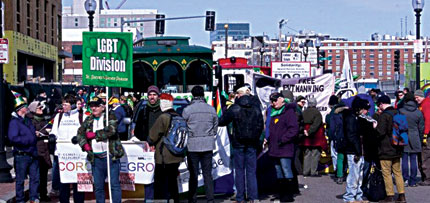
Boston St. Patrick’s Peace Parade participants lining up before parade. 
Photo: TRT Archives

By: Chuck Colbert*/ TRT Reporter—

BOSTON, Mass.—When Irish eyes are smiling, the world is bright and gay, or so go lyrics of the popular song. Except, historically, on St. Patrick’s Day in South Boston, where openly gay groups are still not permitted to participate.

For several years, the parade organizers—Allied War Veterans Council—emboldened by a 1995 U.S. Supreme Court ruling, have denied marching permission for LGBT and peace veterans groups as a matter of First Amendment, free-speech rights. However, serious efforts are underway to change that.

“This is the year we all should put pressure on politicians,” said Pat Scanlon, Vietnam veteran and coordinator of Veterans for Peace, Chapter 9, Smedley D. Butler Brigade, an organization banned from marching in the South Boston parade for several years.

Scanlon pointed to changing demographics of South Boston and a new mayor as hopeful signs the peace veterans contingent will be able to march, along with openly LGBT groups. Back in September 2013, Veterans for Peace applied to Allied War Veterans, but by December 9, 2013, when the peace-vet organization had not received a reply, Scanlon sent a follow up letter. 

“When Massachusetts is, in so many ways, a beacon of inclusion for the LGBTQ community, it is disappointing to see parade organizers continue to cultivate a climate of rejection and exclusion.” —Kara Coredini, MassEquality Director.

“The exclusion of Veterans for Peace, the LGBT community, and other peace organizations, from participating [in the parade] should come to an end,” Scanlon wrote. “It is time that there be one parade that is open, inclusive and welcoming to any group wishing to celebrate this very special day. It is Saint Patrick’s Day, a celebration of the patron saint of Ireland and Saint Patrick was a man of peace.”

Scanlon’s letter pointed not only to changing attitudes toward LGBT people in society at large, but also to cultural and social changes within South Boston.

“Many members of the LGBT community currently live, work and worship” in the neighborhood, he wrote.

In fact, two parades have trekked through the streets of South Boston since 2010 when the peace veterans first applied but were rejected. Scanlon said parade organizers used not wanting the word “peace” connected to the word “veteran” as reason enough to ban the group from marching. Last year, when the Veterans for Peace organized the second march, which took place one hour after the main event and was separated by Boston city street sweepers, the parade had more than 2,000 participants. Those who marched with the St. Patrick’s Peace Parade included six bands, trolleys, duck boats, floats, and the like—all organized into eight separate divisions under the categories of veterans, peace, LGBT, religious, environmental, labor, political, social, and economic justice.

Born on St. Patrick’s Day, Scanlon, 66, a straight Irish American who grew up Catholic in Philadelphia and attended parochial schools for 19 years, explained his motivation.

“This is an injustice,” Scanlon said. “An injustice against one is an injustice against all, and in one of the most progressive cities in the country, if not the world, to have this injustice taking place should not be tolerable.”

The father of a gay son, Scanlon does not mince words in calling out the ban on LGBT groups. 

“It’s homophobic,” he said, referring to the attitude of parade organizers. “It’s exclusion. It’s hatred. That’s what all this is about.”

In addition to applying to the Allied War Veterans Council, Scanlon said his parade group has also asked the City of Boston for its own parade permit with a 12 p.m. kick-off time, one hour before Allied War Veterans’ start time.

Michael Dowling, 59, a gay resident of South Boston for 35 years and president of the South Boston Association of Non-Profits, is taking another approach. He said the community-based non-profit association has applied to the Allied War Veterans, proposing “an inclusive unit called ‘We are South Boston.’” The application, he explained, contains “really strong, inclusive language, including LGBT language with signs that would identify participants in the parade.”

Dowling said he takes issue with Scanlon’s outsider approach.

“The efforts of Pat Scanlon have helped perpetuate the hardships of the neighborhood and how it is portrayed,” Dowling said.

He went on to explain why.

“Because when [Scanlon] calls the neighborhood bigoted and homophobic, he riles up those hatreds that are still there, and makes it more difficult for people to be out, and makes it more difficult for people to work here,” said Dowling. “So it sets us back.”

But Scanlon takes issue with Dowling’s suggestion of such name calling. The South Boston neighborhood is not the problem, said Scanlon, explaining, “The attitudes of the residents of South Boston have changed dramatically in the last 20 years.” It’s the Allied War Veterans who hold bigoted and homophobic attitudes, he said.

At the same time, both Scanlon and Dowling said they believe South Boston has indeed changed significantly in the last two decades.

“Everything in South Boston has changed,” said Scanlon. “The neighborhood has changed, the politics have changed, the culture has changed, and [Catholic] churches have closed. The only thing that has not changed is the attitude of the six guys who run the parade. That too will change.”

Dowling agreed with the changing demographics and attitudes, citing local civic groups that are inclusive of LGBT people, namely One Southie and The New Southie, both of which have Facebook pages, and the West Broadway Citizens group, which Dowling said consists predominantly of gay men who live on that thoroughfare. Dowling said South Boston Association of Non Profits is working with the neighborhood-based civic and social groups, among others, to gain permission to march.

Like Scanlon, Dowling is also seeking to gain support for their respective approaches from elected officials, including state Senator Linda Dorcena of the First Suffolk District and state Representative Nick Collins of the Fourth Suffolk District, both Democrats. South Boston falls within their respective legislative districts. Both Scanlon and Dowling have also contacted Boston’s new mayor, Martin J. Walsh, and District Two City Councilor Bill Linehan, a lifelong South Boston resident, in hopes that they can broker a deal or solution to the standoff. Linehan was also elected president of city council in early January. Scanlon has also written to the Boston Police Department and penned an open letter to residents of the city.

Dowling said he is hopeful that the neighborhood insider’s approach is the way out of the gay-ban situation, a way for the Allied War Veterans and everybody to move forward. Back in the early 90s when an openly gay group—The Irish American Gay, Lesbian, and Bisexual Group of Boston (GLIB)—marched in the parade, Dowling paid a steep price for supporting the gay group. Along the parade route, he handed out pink roses to gay, lesbian, and bisexual marchers. 

“Every window in my house was broken,” Dowling said.He added, consequently, that he had every good reason “to beat up on the neighborhood.”“But I have chosen to replace hatred of our community with service to that community,” Dowling explained.

A painter and noted artist, Dowling founded Medicine Wheels Production as a South Boston-based nonprofit organization in 2000. Its mission is “to transform communities from the inside out” through “the healing and transcendent power of public art.” Medicine Wheel’s signature event is on World AIDS Day. Another focus addresses youth drug abuse and teen suicide.

Neither Veterans for Peace nor South Boston Association of Non Profits have heard back yet from parade organizers. Both Dowling and Scanlon said they are preparing strategies if their applications are rejected. Undoubtedly, the issue will find its way to the office of Mayor Walsh, who told a reporter during the mayoral election last fall, “What needs to happen,” is a private “conversation” away from the media’s glare, with “organizers of the parade.”

“As mayor, I will sit down with them and work out a compromise so that people can feel like they can march in the parade,” Walsh explained. “This parade should be inclusive, and that goes for every other parade marching on public streets.”

Meanwhile, MassEquality, the statewide grassroots organization, has also applied to march.

“We will continue to apply every year until MassEquality is permitted to march,” said Kara S. Coredini, executive director.

Like the other two groups, MassEquality has not yet heard back from parade organizers on the status of its application. However, the parade is not among MassEquality’s highest priorities. 

Neither Veterans for Peace nor South Boston Association of Non Profits have heard back yet from parade organizers.

“The LGBTQ community in Massachusetts faces many issues more urgent than the ability to participate in a parade—youth homelessness, bullying, anti-transgender discrimination, HIV/AIDS, elder abuse, and more,” Coredini explained. “But public rejection by an established cultural institution like the St. Patrick’s Day Parade is significant in that it’s emblematic of the more life-altering rejection our community members face every day. When Massachusetts is, in so many ways, a beacon of inclusion for the LGBTQ community, it is disappointing to see parade organizers continue to cultivate a climate of rejection and exclusion. At the heart of MassEquality’s work electing pro-LGBTQ champions and advancing pro-LGBTQ legislation is changing attitudes, and each day because of that work we come closer to the day when this parade will be opened to all.”

This year’s St. Patrick Day Parade is scheduled for Sunday, March 16._______

*Chuck Colbert marched in the 1992 and 1993 South Boston St. Patrick’s Day Parade as one of 25 participants in the Irish American Gay, Lesbian, and Bisexual Group of Boston.