This blog came into existence based on a post originally addressed to a fellow younger worker who was clueless about the "beats" of the 1950s and their stepchildren, the "hippies" of the 1960s, two movements that influenced me considerably in those days. Any and all essays, thoughts, or half-thoughts about this period in order to "enlighten" our younger co-workers and to preserve our common cultural history are welcome, very welcome.
Friday, May 27, 2016
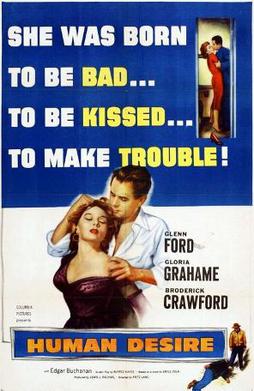
When The Screw Turns-With Fritz Lang’s Human Desire In Mind
By Zack James
I have been up against some screwy feelings in my time, thoughts of revenge for some slight, great or small, thoughts about ending it all, weary of life, wanted to strangle some dame for two-timing me, or worse three-timing meaning she was two-timing two guys me included but I never did anything about it. Although maybe on the last one I should have. I always calmed down a little and figured a way out of the dilemma, figured that tomorrow was another day and I could regroup a little, get a new start.
Not everybody is like that, not by a long shot, not everybody can rein in their emotions and do the right thing, or at least not the wrong thing. Take this film I watched the other night, Human Desire, a film I am watching as part of a series of films by the great director Fritz Lang, the guy who started everybody getting serious about film, about using film as more than entertainment, as social commentary, as commentary on the human condition, as what we would call today social networking, with that Metropolis of his. The people in that former film, a film based on a book by Emil Zola, the guy who stuck his neck out to defend Alfred Dreyfus back when it counted, are all over the place. Let things mostly get out of hand. Let human desire get a sad ass workout in a bad way, the baddest way possible, murder, murder, one when you think about it.
The funny part is that the film, maybe like life starts out just fine. A guy name Jeff, played by Glenn Ford, just back from the Korean War is getting back in harness as a railroad engineer and ready to settle down too (who knows for how long on that sweet engineer’s job given the decline in railroad traffic and usage in the “golden age of the automobile” in the 1950s). Maybe with some lady, maybe play the field for a while and then settle down who knows. Then all hell broke loose. See this roughneck, drunken railroad sot named Carl (played by Broderick Crawford a perfect roughneck and drunken sot last seen in this space playing Willie Stark to Oscar-dom in the film adaptation of Robert Penn Warren’s All The King’s Men) has this dishy tramp of a wife, Vicki, played in B-film grandeur by Gloria Grahame, a girl who goes with the highest bidder, a girl looking out for herself and her own desires, whom he suspects is running around on him. He was an older guy and she was, well, a dish and so his fears were well-founded especially when he asked her to ask to pretty please a railroad executive she used to work for to get his job back after a tiff with his yard boss who fired him. Up to her old tricks she jumped right back into bed with that railroad exec which makes you wonder, and you would not have to stretch your imagination to far what kind of work she did for him back before she married meal ticket Carl.
One thing everybody knew was that Carl saw red every time a guy even looked at Vicki so you know that nothing good was going to happen when Vicki came back late and all in a tumble, lipstick smeared, after “pretty pleasing” that railroad executive. Carl beat her up just for smiling the wrong way (poor Gloria, playing plenty of tramp parts, and playing them well, got beat up plenty of times, or worse one time in a film got hot coffee thrown in her face by a wise-guy played by Lee Marvin). Then for kicks he Carl killed that railroad executive while all three were travelling to Chi town. Yeah, Carl killed him dead, made Vicki watch the damn thing and sign a letter, a letter that would force her to stay with him. So you saw the downside of the human condition right before your eyes.
Enter Jeff who had been free-loading a ride on the train while all this murder and mayhem was going on. Enter Vicki being used to distract Jeff while Carl made his getaway. When the body was found and there is an inquest Jeff clamed up to protect Vicki. That started an affair between the two. An affair and a deranged notion by Vicki that all her cares would be over if she had that letter, had Carl six feet down in the ground too. So she recruits Jeff to do the deeded. Another ignoble example in the question of human desire. But Jeff was tired of killing, tired of being some fall guy for some off-the-wall dame’s revenge fantasies. He balked. Problem: Carl suspects that Jeff and Vicki were having an affair even though Jeff had called the whole thing off when he passed on the murder one rap he would have been facing just to make Vicki shudder with delight. He did grab the letter from Carl and gave it to her as a parting present. Carl was not as forgiving as he strangled the hapless tramp wife Vicki on the train once he knew she had the letter and he had nothing to hold over her. Jeff went on his merry way captaining the train while dastardly murder was happening in the rear. Strange nutty thing human desire when it gets twisted into a guy’s head-or a gal’s.
Thursday, May 26, 2016
Out In Waldo’s World-Every Man’s World-With The Film Laura
In Mind
By Bart Webber
My old friend Sam Lowell, a guy married three times and who
has struck out three time and now “single” (meaning he has had a long-time
companion and has given up the idea of marriage although not the idea of love after
three sets of alimony, child support and college tuitions, that latter category
which almost broke him on the wheel) had been watching an old time film noir
from the 1940s, Laura, with his own Laura,
Laura Perkins, that long-time companion parenthetically mentioned above one
night. A few days later after that viewing he called me up for our weekly
session at Jack’s Grille and mentioned the film, knowing that I had seen it
several times and consider it one of the great noirs along with Gilda, Double Indemnity, The Maltese Falcon
and a few others. He said then, and we would get into more at Jack’s, a couple
of nights later, that you could never figure what will drive a guy off the deep
end but that six, two and even ninety-nine times out of one hundred it would be
over a dame. I begged to differ with him figuring the odds more like sixty to
forty on the dame reason but that only added fuel to his fire that night (that
and a few too many high end scotches since he was not driving that night but
staying at my place in Carver, our growing up home town down in Southeastern
Massachusetts). The difference in our calculations I figured out later being
that I have been with my one wife, the lovely Betsy Binstock, now for almost
thirty-seven years.
But Sam was on his high horse that night which meant that I
was in for a regular slugfest, a regular barrage of chatter about Waldo, Waldo
the guy who went over the edge for this dame, yeah, a dame, nice, pretty,
smart, a go-getting but still a dame, this Laura, Laura Hunt in case you needed
a last name. Here’s how Sam put the case, see Sam is nothing but a good country
lawyer and so he saw the whole thing in terms of a case in a court of law like
he was arguing for mercy for Waldo or something. Like maybe he was arguing the
case for real like he would plea out Waldo on some diminished capacity
foolishness just because the guy was skirt-addled.
As Sam was talking though I was putting my own two and two
together about Waldo, Waldo Lydecker if you needed a last name for a
skirt-addled guy although they are legion. Thinking back on the plot line that
I knew well I found myself trying to figure out how did it figure that a high
society guy, a well-known and syndicated newspaper columnist and radio
personality, an older guy, an older single guy, an older single guy who seemed
“light on his feet” if you asked me, you know seemed kind of “faggy” would
tumble to this Laura from nowhere. Let this fresh breeze young thing of which
there were about six million in New York City back in the day, break him. Make
him do weird (unlawful things as Sam would put it) that would have him winding
up facing downward on Laura’s apartment floor pledging his eternal love as the
life was bleeding out of him from about six slugs of copper guns.
(Sam, by the way, who works in the court system and has to
mind his Ps &Qs on sexual and ethnical stuff doesn’t like that term, those
terms, faggy and light on his feet, but the old ways die hard with some of us
old-time corner boys who grew up on the rough streets of the Acre in Carver and
who used to while idly hanging out in front of Jack Slack’s bowling alleys fag bait each other just for kicks to enhance
our own man-hoods, so faggy.)
But maybe I should start at the beginning while Sam is
drawing circles in the air with his hands just like if he was in the courtroom,
just like he was trying the case of Waldo
Lydecker vs. The State Of New York except not for murder, murder one, which
what the bastard would be up for if he wasn’t lying face down in that pool of
blood in that dame Laura’s apartment but for being a toy for some perfidious
dame. See Waldo was like I said a big time newspaper and radio guy, knew
everybody who counted in New York and Washington high society, had “drag” in
all the right places as my old Irish grandfather would say. Also knew all the
secret vices, and some not so secret, of those in the rarified air, knew that
they had to treat him something like a rattlesnake with very proper kid gloves,
knew they would be front and center in one of his columns, page one, if they
didn’t play ball. Yes so Waldo Lydecker was not one of the world’s noblemen,
was a bitch on wheels if anybody was asking around about him of late, not
hopefully looking to give him a certified good conduct certificate. It was kind
of funny because this guy had more dough than the King of Siam, had come from
wealth, good school, good breeding the whole nine yards so you would think that
being what really was a gossip columnist, a venomous one to boot would be
beneath him. But guys, people are funny about their occupations and in any case
the job, such as it was better than him sitting at home in palatial Westchester
clipping coupons.
Like I said before this Waldo as he aged, got to middle age,
maybe a little older was nothing but a bachelor, hadn’t been seen with a real
girlfriend, nothing serious anyway. So the talk around town, very discreetly
around town out of his earshot, was that he was either asexual, which was Sam’s
take on the matter, some guys are like that, maybe so hung up on their mothers
that no young dame could ever be good enough for them. Maybe something got lost
in the genes, something about attraction to any human relationship except to
hit hard at weak points. So no women, except he obvious mixing at his lavish parties,
you know ornaments. You know my take already, my position that he was gay,
maybe unconsciously, maybe he was hiding some guy, some fag, out in some
apartment far from the high end crowd you never know. Yeah, I liked that take
although Sam in one of his more compromising moments wished I would just call
him effete and let it go at that. Like effete didn’t mean in high tone language
noting but fag. I’ll stick with my old time corner boy expression if you
please, an expression that Sam was as likely to use in the old days as I was-if
anybody is asking.
So everybody was surprised when Waldo started being seen
around the clubs, the swanky clubs like the High Hat where the jazz was be-bop,
the drinks expensive and exotic and the smoke thick and the White Note where
the younger crowd hung out where the smoke was scented, was dope no question dope,
tea, hemp, ganja, to appease this Laura twist. But you could tell he was out of
his element there in that latter place, that Jimmy Jones’ be-bop band with Milt
Rosen blowing heavenly high white notes off the cuff ruled the night not him.
No question this Laura was a looker, a long tall brunette with those bright
eyes and sulky lips that guys went big for then and guys while not going big
for now looking for thin hipless dames with sneers these day could appreciate,
could see even an effete guy taking a run at even if just to have as a trophy,
or cover against that so-called discreet talk among the high society types
about his sexual habits (like a snoop like Waldo wasn’t “connected” into that
talk by a thousand snitches looking to keep their own hijinks out of the front
page and off the air).
The story Waldo told about their meeting, their fateful
meeting, take it for what it was worth after all that really happened, after he
wound up face down and very dead, was that Laura had purposely gone to his
table at his favorite lunch place (and daytime watering hole), Matty’s on 54th
Street across from the newspaper, and “accosted” him, that was his word, had
pestered him about endorsing some product, a pen. See this Laura was nothing
but a runt one of thousands, no, what did I say before, millions, of young
women trying to get ahead in the advertising racket, any New York City racket,
which is why young women, smart young women went to New York City from Buffalo,
Cleveland, Eire, hell, maybe the wheat fields of Kansas too, to grab fame and
fortune in one of the few serious upward mobile jobs for aspiring college
graduates. Or just gals with big dreams and some talents other than hitting the
silky sheets.
This is the oddest part. He blew her off, treated less
graciously than some six year old brat for disturbing milord’s solo lunch, but
something about her got under his skin, some ancient memory of some young woman
in that long gone time when he might have thought about an affair, that fatal
disease that has taken all the gold of more than one man. The blood too.Get this, get this for a guy who treated her
like a wayward child Waldo eventually went to her advertising agency, signed on
for the endorsement of that fucking pen. Laura’s career thereafter went through
the roof, he had called in plenty of chips to get guys and gals he knew around
town to throw business her way, or else.Seeing her as a rough diamond, obviously not from his class, maybe even
then as a tramp with big “wanting habits” you never know about the Waldos of
the world and what drives them, although the smitten part is easy to explain, he
taught her a few things about style and poise, style and poise as interpreted
by high society just then. That was the fluff part, the public story.
Who knows what the real deal was. Sam’s lamo theory about mother
fixation, or mother dread is okay for okay country lawyers if they have to
defend some geek in court but that angle seems to have been worked to death and
I wouldn’t want to have to throw that to a jury but since I am merely a retired
printer and not a lawyer I don’t have to worry about that. Hell, the obvious is
that she was damn good-looking woman and that was that. Maybe it was the long
hair that always made every hat she wore in the days when women went in for
serious hats for fashion and not utility look just right, maybe it was those
sullen lips showing slightly parted pearly white teeth, hell, maybe it, like a
for a billion guys since Adam and maybe before, was the sandalwood scent she
gave off, that latter would be the downfall of more than one man. But he was
hooked on her, hooked as bad as a guy who couldn’t express such thoughts in
public could be, it was just not done in high society, could be hooked on a
dame (of course a guy like Waldo wouldn’t dream of calling a woman a dame, a
frail, a frill, a twist, names we used back in the day but like I said before
the old ways die hard with some guys like me).
Here’s the funny thing, here’s where the old guy, young dame
problem comes in, or maybe just Waldo’s whole freaking silly upbringing, he
never had sex with her, never went under the downy billows with her which is
the way Tom Wolfe put how the upper crust likes to call “hitting the satin
sheets.” The thing was strictly platonic with the unspoken proviso (Sam’s word
not mine) that she was his “property.” Waldo’s alone.
That didn’t play very well with Laura. Didn’t play well with
a young lustrous sexy woman like Laura who had big sexual appetites, liked men,
and lots of them as any young pretty woman who was grabbing lots of attention
from the young bucks would. (All the sex stuff as per usual in 1940s films was
either off the film or just implied but even a goof like Sam could read between
the lines that Laura was a sexual being. Hell, one night, no, one very early
morning, wacko Waldo in a fit “stalked” her apartment on West 56th
Street as one young buck, Jack Jacobs the well-known painter came strolling out
the front door of the building looking a little the worse for wear.) Waldo was
forever shooing guys away and as quickly as Laura, on Waldo’s fatherly, to her,
recommendation would ditch one guy another guy would pop up. That went on for a
while and Waldo, for his own nefarious reasons, thought he was home free. That
Laura was all his.
Then the roof caved in. Laura got caught up with this guy
Shelby, a ne’er do well, a guy from decayed Southern stock, meaning he was
broke and living off of women, living off of Laura’s aunt who liked the idea of
a “kept” man, liked a young stud around and could afford the freight. Problem
was Shelby like many another guy wanted to be around some young tail (ass) and
so despite his “kept” status with the aging and demanding aunt he made a run at
Laura, got her to the stage where marriage might be in the air. Got her to give
him a job at her ad agency where he actually flowered, brought some fresh light
into the office. Bad move, bad move on Laura’s part even thinking about marriage
to a gigolo like Shelby. That is when Waldo’s wheels started coming off, when his
better judgment took a back seat to his unspoken lust for Laura. He tried to
kill her, shoot her dead with a shotgun in her own apartment, the place which
would be his final resting place if he had only been prophetic rather than
blood-lustful. Problem though was Laura was not there that night of the murder,
had been upstate at a cozy country retreat thinking things through about the
possibilities of marriage to Shelby. When everything came out later, much later,
the girl who was killed had been one of Laura’s models at the ad agency, a
model whom Shelby was playing footsies with. Some guys, guys like Shelby, never
change, never get off the wagon even when easy street beckons (and that silly
aunt was still ready to move heaven and earth to get his silly ass back in her
crib under the principle that birds of a feather flock together-he was a tramp
and she was too so comingle their tainted blood.)
Well murder most foul done by gigolos, deadbeats, mass
murderers, ”hit” men or the lovelorn has to be investigated, especially in the
high rent district. Most especially in the high rent district after all what
the hell were they paying the public coppers for anyway. So they put
crackerjack homicide detective Mark, Mark McPherson, on the case. Oh yeah a
young, good-looking, didn’t miss a trick, knew the means streets as well as the
leafy streets to look closely, very closely into the Laura Hunt murder.
Naturally he got nothing but the backs of their hands from the Mayfair swells,
got nothing but grief and snide remarks from old Waldo who I will say held
himself together during the critical hours and days when McPherson was putting
the screws to the case, was giving everybody his cool modern scientific
detective shifting through all the evidence routine. Stayed cool enough and
cagey enough to throw a big shadow over Shelby as the fall guy. And why not he
had been playing footsies with that foxy model right in Laura’s apartment.
Yeah, I admit I liked him for it, liked him a lot when McPherson turned the
screws on. Didn’t like that he was two-three, who knows how many timing Laura, with
the poor dead model even the old battle ax aunt and who knows who else. Such
guys as Shelby in the old neighborhood as Sam would be the first to tell you
would be tailor-made for the big step-off and nobody except some poor old
bedraggled mother would shed tear one for such a guy. And that is a fact.
Then to break up the monotony of the run-down murder case
getting kind of cold by the minute and to ruin my theory about Shelby as the
fall guy who pops back into the picture. Laura. That’s when everybody found out
that the dead girl was the model at Laura’s agency (conveniently her face had
been blown off by the shotgun blast so the initial identification of Laura as
the victim had been based on the very important circumstantial evidence that
late at night the woman opening the door to Laura’s apartment would be, well,
Laura). Waldo held up even through all of that as Sam will admit if less than gladly
for his bogus love-addled insanity bit. Like I said before Laura was upstate
thinking stuff through around a possible marriage to Shelby and nobody thought
anything of it once she resurfaced. Still there was a murder to be solved now
that the true victim was known. McPherson was still on the case, still needed
to close out the case even if it now was a run of the mill model that was making
the case run and not some darling of the Mayfair swells.
Waldo might have held up pretty well through all of that, might
have slide through to old manhood but he flipped out when he sensed that the
tramp, Laura of his dreams, what else could you call her in his effete book,
was once again falling ofr any young guy in a suit, falling for Mark (and he
her). Yeah, Waldo again lost his judgment rather than moving on to the cocktail
circuit and forgetting about what could never be. See, and Sam in his more
sober moments would have to agree, Laura had gotten deep under his skin, as
deep as woman can a man who spent his whole life dishing it out and not taking
it. Shelby was a non-starter for Laura and Waldo could have pieced him off
easily enough but this Mark McPherson, this guy from the mean streets, from
Laura’s mean streets wasn’t going to be easy to dismiss.
Here is where Sam said Waldo made his mistake, the mistake
that would have made even a pretty good country lawyer like him have a hard
time selling a jury that Waldo was temporarily insane, needed to go to the
sicko hospital and not the death house. Waldo tempted fate one time too often
(that model murder would have hit the “cold” files soon enough now that Laura
was alive). He tried to kill Laura-again. No soap this time for the poor sap-he
was wasted in a hail of bullets by New York’s finest. Get this though-the guy
is lying face down in a pool of his own corrupted blood and his last words were
of undying devotion to Laura. What a sap. Leave it to Sam to get the last word
though and even I couldn’t say it better, although he said it more in sorrow than
anger. Waldo Lydecker was not the first guy nor will he be the last who got all
twisted around by some frail’s sandalwood scent. Maybe Sam’s 99.9 % number was not
so far off after all.
Wednesday, May 25, 2016
The Importance Of Being Earnest-With The Film Adaptation Of Oscar Wilde’s The Importance Of Being Ernest In Mind
DVD Review
By Sam Lowell
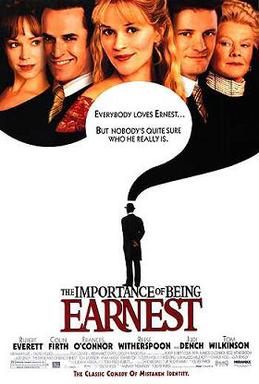
The Importance Of Being Ernest, starring Colin Firth, Judi Dench, Rupert Everett, Reese Witherspoon, from the famous play of the same name by Oscar Wilde, 2002
No question Oscar Wilde was a witty, sardonic, provocative tweaker of late Victorian English mores and morals. In the end his then over-the-top private sex life did him in as the prudish side of English life that we have all come to hate (except those few who dote on the “royal family” and their fundamentally boring pursuits) beat down this talented man in hell-bent Reading Gaol. The 2002 film adaptation, there have been early ones, of Wilde most famous play, The Importance Of Being Ernest, captures on screen part of the reason why he has endured as an astute social critic of the late Victorian pall.
What’s in a name? Well quite a bit if you follow the story line of the film. Rural bound land-owner and guardian Jack (played by Colin Firth) who yearns to escape to London as much as possible and Algy (played by Rupert Everett) who tags along with him in hothouse London are the best of friends, best of male-bonding bachelor friends. But Jack in London is going under the “war name game” of, well, Ernest as he pursues young Gwendolyn, the charge of very upper-crust Lady Bracknell (played by Dame Judi Dench) who we shall find out started out life not with a silver spoon but with a nice ass and used that hard fact to entrench herself into high society via a very convenient marriage to milord, some milord did it matter as long as the title was sound and maybe the property taxes were paid.
Of course marriage and the property settlements associated with marriage among the upper crust was a very serious proposition in those days (still is if you look beneath the “democratic” veneer of the Mayfair swells these days particularly in London) and so an easy target for Wilde’s wit. Marriage, good marriages came at a price. Hence the spoof of marriage by making such a thing as a first name, an earnest ernest first name as a requirement of marriage assent by both the young women Gwendolyn and Cecily (played by Reese Witherspoon) must have had a lively ripple effect on those London audiences who saw how cheeky Wilde was being in putting them on. In the end, naturally, romance, light-hearted romance will win out but the game here is the repartee between and among the parties until we get there. All’s well that end’s well. Nice.
Tuesday, May 24, 2016
A Different Time-Barbara Stanwyck’s My Reputation
DVD Review
By Zack James
My Reputation, starring Barbara Stanwyck, George Brent, 1946
Sometimes film, especially older films like the one under
review Barbara Stanwyck’s My Reputation
can act as a slice of social history of a time when mores were different, when
what was proper in gentile society and why were different. Take the background
issue where; what is a lovely younger widow to do with her life in society once
her husband is gone at a young age. Today with the six million possible living
arrangements and live and let live attitude among many sectors of the
population the way this film played out, maybe even the fact that the question had
even been posed would seem to be something out of a social archeological dig.
Still it is interesting to see how the situation played out
so here is the skinny. Jess, played by Barbara Stanwyck in a not very memorable
role in like say Double Indemnity, a
proper high society recent widow with two sons is expected by her social peers
and a nose-out-of-joint mother to burn herself on the pyre of her love for her
late husband who by all accounts was a good guy, a good dad too. But Jess
brought up in the straight and narrow high society world of Chicago and never
having a previous chance to blossom decided that she would step out a bit, get
a new fellow maybe but not endlessly grieve over her late husband. Eventually
through the good graces of friends who takes her with them on a vacation in ski
country she meets a Major Landis, played by George Brent, who is both charming
and unattached. The rest of the film revolves around their growing attachment,
their intentions toward each other and the fact that with a war on who knows
what will happen in this cockeyed world. That and then the kids, two young but
growing boys who are still attached to their father’s memory and who balk at
anybody else coming into their lives-sound familiar.
Of course along the way plenty of eyebrows are raised,
plenty of eyes are rolled as Jess almost escapes from the social bonds that
chain her to that leafy suburban existence that she knows too well is
suffocating her. She learns a hard lesson on who your friends are but also that
in a lot of ways she was stuck in her upbringing which meant that her boys had
to come first-and then see what would happen if the good Major got back from
the war in one piece. They called this film a ‘tear-jerker’ back then,a melodrama, but today it couldn’t be made
because nobody would believe that a young good-looking woman with kids, or not,
wouldn’t be out on the hustings looking, well, looking for something. A nice period
piece though .
The Church Of The Brethren Of All Non-Believers-The Film Adaptation Of Flannery O’Connor’s Wise Blood
DVD Review
By Sam Lowell
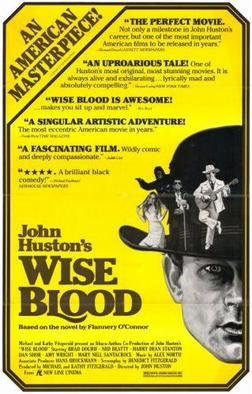
Wise Blood, starring Brad Dourif, Dan Shor, Harry Dean Stanton, directed by John Huston, based on Flannery O’Connor’s novel of the same name, 1979
Sure, religion, any religion but we will concentrate on evangelical here since that will come into play, will tie a man in knots, a woman too. Ask Hazel Motes, played by Brad Dourif, in the film adaptation of Flannery O’Connor’s Wise Blood, he’ll tell you true, he’ll give you the Word, the Word without the guff, without the big theology behind it. The fight against the word that got branded inside his head as a little child like a lot of us and it would not let him go, no question, would not let him go as a boy, or man. Got it branded in his head by a fiery old fundamentalist evangelical tent preacher of a grandfather and the experience never let him rest. Yeah, as the story line unfolds it just never let him rest and maybe that was one of the point Ms. O’Connor was trying to make in her book about the Hazels of the world. Maybe that struggle for redemption and salvation just was too embedded by that damn old tent fire and brimstone preacher. Some of us let it go, let it go a bit once we left home, got away from the hothouse effect religion played in our youths but some like Hazel went over the edge, went to war with a vengeance the religion of his youth.
Here is how it played out in the film (which followed the themes of the book fairly closely as well as the story line which had been cobbled together from four shorter stories by Ms. O’Connor published in magazines when the book was first published in 1952). Who knows what will cause a person to test the ends of his or her faith, or how one winds up scratching and clawing trying to figure out how it got broken, got pushed into the depths of hell fire and damnation. Our boy Hazel, Hazel Motes, out of some Podunk Southern town, do we really need to know its official name they were, are, legion, North and South, some small town, with small town eyes and small town mores, and if small enough one small town Christian faith, fundamental, Old Testament fundamental if the place had been “burned” over by one of the periodic “great awakenings” that have swept the country since its founding came back from war ready, willing and able to war on his old-time religion. Came back from war with a war-wounded heart and a government check for his troubles (given for some undisclosed wound suffered in real war).
(The war in the film was unmentioned but in the 1979 film it would follow that the war was Vietnam, a war to try men’s souls in and out of uniform, a war that created a whole generation of guys who had trouble coming back to the “real” world, some who wound up as “brothers under the bridge” out along the railroad track “jungles” and arroyos of Southern California and guys like Hazel to battle other inner demons. The war in the O’Connor book was World War II, a war that tried men’s souls in a different way and which would undermine the resolve of many small town boys who got a glance at the big wide world only through troop transports).
This Hazel was an odd-duck from the get-go in his struggle against his inner demons. Kind of manic in everything he attempted to do right down to the determined stride of his walk, always on the edge when he did not get the respect he thought he deserved for his wisdom about what was what in the world. Always on the edge of some psychotic event. Had had it up to his head with religion and talk of redemption and salvation. Questioned the hell out of end sin and sorrows. Wanted to bring his hard-fought for message to an indifferent world. A world filled with the need to repent for some unknown original sin like the average person had caused the world’s sorrows. Wanted the world to know that it did not need Jesus-saving. Wanted most of all for people to stop fearing to take one step forward for fear that they would fall down in sin. A beautiful religion in a lot of ways, a way forward for a candid world.
The problem for Hazel, weak vessel Hazel, was two-fold though. Old Hazel wasn’t so sure that his struggle against religion, against temptation was over, was himself always half-looking looking for somebody to lead him if necessary. Someone, if you think in Freudian terms, to replace the father figure, the grandfather, who put the mark of Cain on him. The other problem is that in the small town world he was trying to preach the “Word” in was filled with fakers, charlatans, misfits, grifters, grafters, drifters, deadbeats and midnight sifters who wanted to get their messages out (read: run their own cons). So Hazel has to not only fight off an indifferent world, but a motley of con men on the hustle, itinerant religious fast-talkers with their own scripted visions of the new day coming, a teenage nymphomaniac trying to bring him to sexy sinless sin, miscreant youth, losers, fakers, bizarre cops, even more bizarre carny artists and in the end a lonely hearts landlady.
No wonder his went over the edge at the end. Went and literally blinded himself with quick lime, self-flagellated himself with barbed wire, walked with stones in his shoes to atone for the sins of the world by my reading. Such a man could not live in this mortal world and in the end he did not. Did not leave us with a viable church of all non-believers. Watch this one-and read Ms. O’Connor’s book too if you want to think about questions of redemption, salvation and just surviving in the modern world without some overbearing creed to stifle you.
The Cantonsville Nine’s Father Daniel Berrigan Passes At 94-A Belated Tribute
By Frank Jackman
The Oakland Seven, The New York Twenty-One, The Chicago Nine (later Eight), The Harrisburg Six, The Fort Dix Twelve, The Fort Sam Houston Eleven, Free Huey, Free Angela, and of course the case I want to highlight this day after hearing on the radio a while back the passing of Father Daniel Berrigan at 94, the Cantonsville Nine, a town name down in Maryland and a cause, draft resistance, which he will be forever associated with. And forever honored for as a participant in that antiwar, anti-draft action.
Of course bringing up that litany of political defense cases that ran through the mid-1960s to the mid-1970s only brings home once again what an extraordinary time that was, a time like a few others in our checkered history to try men’s and women’s souls. A John Brown moment in the face of the relentless onslaught against people that we had no cost to attempt to obliterate (or as the saying want at the time by some major military figure “bomb them back to the Stone Age”). In those days the distance between being catch up in the government’s dragnet and placed behind walls and staying on the streets to fight another day was sometimes just a matter of luck, of happenstance. What everybody knew though, everybody who was worth their salt was that whatever you did, or didn’t do, in those days would shape your life forever. How were you to talk your children, somebody’s children, tell your grandchildren, or somebody’s grandchildren that you kept your head down, that you kept your eyes on the ground while all hell was breaking out around you? The political rock group Steppenwolf maybe put it best:
America where are you now? Don't you care about your sons and daughters? Don't you know we need you now We can't fight alone against the monster
Looking back on the times now there were actually relatively few of the older generation, of our parents’ generation, those like the Berrigans, William Sloan Coffin, Noam Chomsky, and a few others, those forged by the dregs of the 1930s Great Depression, slogged through World War II and made their peace with an unjust society during the heyday of the Cold War who stepped up to the plate, took a stand and we were mainly left on our own to make every mistake in the political book. Although when you think about the monsters we were up against those mistakes were innocent child’s play against the carnage they, the government and their hangers-on, were wreaking on foreign lands, and America cities alike. We had and HAVE nothing to regret, nothing to apologize for in that bare-knuckles tragically uneven fight against that dark night in America
Father Daniel Berrigan, his brother Phil, and others who would become Catholic “liberation theorists” later condemned in Rome did step up to the plate, did commit acts of resistance to evil. Did a very practical thing. Took out a draft board in Cantonsville, Maryland, destroyed or tries to destroy draft records, the life-blood of the draft system as a symbolic gesture of opposition to the slaughter of American boys (only boys then) in their slaughter of Vietnamese boys and girls. (Remember once again the old call the fights, they don’t do the actual fighting the young do.) And stayed around to get arrested, went to trial.
Originally I had thought that a short homage to the late Father Berrigan would do the trick placing him as one of the older generation who took the risks that we, the young, were forced into. The more I thought about it though the more my own struggles with a hard-nosed Irish Catholic upbringing and the fight to break from the more onerous tenets of that church were reflected off the efforts of that man-whatever difference we might have then, or later.
In those days when I was having my own struggles against the military, when I was trying to resist going to Vietnam after having been inducted into the Army it was good to know I had allies raising hell against the system. Good knowing that guys, good Irish Catholic brethren, Society of Jesus guys, the soldiers of the Church, guys who would give the lessons to be learned about life at Sunday school or at Boy Scout retreats were breaking ranks who under ordinary circumstances would have counseled non-resistance to civil authority were coming over to the people’s side meant a lot to me whatever I would come to later think about the value of such actions in the great scheme of things. Like I said the actions and actors in the Cantonsville Nine case will always have an honored place in the pantheon of the anti-war struggles. They did not keep their heads down. Daniel Berrigan too.
Monday, May 23, 2016
Scenes From An Ordinary 1950s Life- Billie’s, Billie The Pope Of “The Projects” Night, View
A YouTube film clip of The Shirelles performing the classic Will You Still Love Me Tomorrow?.
By Bart Webber:
This is another tongue-in-cheek commentary, the back story if you like, in the occasional entries under this headline going back to the primordial youth time of the mid to late 1950s with its bags full of classic rock songs for the ages. Of course, any such efforts have to include the views of one Billie, William James Bradley, and the schoolboy mad-hatter of the 1950s rock jailbreak out in our “the projects” neighborhood. Yah, in those days, unlike during his later fateful wrong turn trajectory days, every kid, including best friend Markin, me, lived to hear what he had to say about any song that came trumpeting over the radio, at least every one that we would recognize as our own.
Note: Billie and I spent many, many hours mainly up in his tiny bedroom, his rock heaven bedroom, walls plastered with posters of Elvis, Bo Diddley and Chuck Berry and of every new teen heartthrob singer, heartthrob to the girls that is, around, every new record Billie could get his hands on, by hook or by crook, and neatly folded piles of clothing, also gathered by that same hook or by crook, appropriate to the king hell king of the schoolboy rock scene, the elementary school rock scene between about 1956 to 1960. Much of that time was spent discussing the “meaning” of various songs, especially their sexual implications, ah, their mystery of girls-finding-out-about worthiness.
Although in early 1959 my family was beginning to start the process of moving out of the projects, and, more importantly, I had begun to move away from Billie’s orbit, his new found orbit as king hell gangster wannabe, I would still wander back to the old neighborhood until mid-1960 just to hear his take on whatever music was interesting him at the time. These commentaries, these Billie commentaries, are my recollections of his and my conversations on the song lyrics in this series. But I am not relying on memory alone. During this period we would use my father’s tape recorder, by today’s standard his big old reel to reel monstrosity of a tape recorder, to record Billie’s covers of the then current hit songs (for those who have not read previously of Billie’s “heroics” he was a pretty good budding rock singer at the time) and our conversations of those song meanings that we fretted about for hours. I have, painstakingly, had those reels transcribed so that many of these commentaries will be the actual words (somewhat edited, of course) that appear in this space. That said, Billie, king hell rock and roll king of the old neighborhood, knew how to call a lyric, and make us laugh to boot. Wherever you are Billie I’m still pulling for you. Got it.
********
Will You Still Love Me Tomorrow? Lyrics
Carole King
Will You Still Love Me Tomorrow
Tonight you're mine completely,
You give your love so sweetly,
Tonight the light of love is in your eyes,
But will you love me tomorrow?
Is this a lasting treasure,
Or just a moment's pleasure,
Can I believe the magic of your sighs,
Will you still love me tomorrow?
Tonight with words unspoken,
You said that I'm the only one,
But will my heart be broken,
When the night (When the night)
Meets the morning sun.
I'd like to know that your love,
Is love I can be sure of,
So tell me now and I won't ask again,
Will you still love me tomorrow?
Will you still love me tomorrow?
**********
Billie back again, William James Bradley, if you didn’t know. Markin’s pal, Peter Paul Markin’s pal, from over the Adamsville Elementary School and the pope of rock lyrics down here in “the projects.” The Adamsville projects, if you don’t know. Markin, who I hadn’t seen for a while since he moved “uptown” to North Adamsville, came by the other day to breathe in the fresh air of the old neighborhood and we got to talking about this latest record, Will You Still Love Me Tomorrow? by the Shirelles. They are hot.
Fair’s fair right, so I’ll give you Markin’s, Peter Paul’s, take on the lyrics, so I can come crashing down on his silly pipe dream ideas. By the way if you don’t know, and he will tell you this himself if he is honest, he was behind, way behind, in figuring out girls, and their girlish charms. I had to practically tell him everything he knows.
Where did I learn it? Hell like everybody else from the older kids, the older guys, and my older sisters too if you can believe that. So I know a lot, or at least enough to keep old Peter Paul from being a total goofball. Still, see, he thinks the main thing is that the girl in the song here is worried about her reputation because she has just given in, in a moment of passion, to her boyfriend, it’s way too late to turn back and yet she is having second thoughts, second thought regrets, about it, and about what he will think of her and whether it will get around that she “does it.”
Yah, she does it, now officially certified a woman, or at least acting like a woman can act, that is what my sister Donna says, and from the feel of the song, probably in some back seat of some “boss” convertible, a Chevy I hope. Her guy, some under-the-hood day and night guy making that baby, his real baby, hum against the in-stock store-bought standards of his father’s car, his old fogy father’s car. She was breathless weeks ago when her Chevy guy came up gunning that beast behind her walking home from school and said “Hop in.” And she did, now she's the queen bee of the high school Adventure Car-Hop night. All the other girls, friend or foe, frantic at her fortune and ready to leap, girls’ “lav” leap, all over her come Monday morning finely-tuned grapevine gossip time. So tonight was paying back time, car- hop queen bee paying back time. No turning back.
I hope, I really hope, they “did the deed” down by the seashore, big old moon out, big old laughing moon, waves splashing against the rocks and against the sounds of the night, the sounds of the be-bop moaning and groaning night. Call me a romantic but at least I hope that is where she gave it up. Or, maybe, away from coastal shoreline possibilities it was at some secluded lovers’ lane mountain top, tree-lined, dirt road, away from the city noise, some be-bop music playing on the car radio, just to keep those mountain fears away, motor humming against the autumn chill and the creaking sun ready to devour that last mountain top and face the day, and to face the music.
But see that’s where Markin has got it all wrong, all wrong on two counts, because Chevy guy’s two-timing her, or spreading the “news” about his conquest, or even that hellish girls’ lav whirlwind inferno is not really what’s bothering her. Markin has got this starry-eyed thing, and I think it is from hanging around, or being around, all those straight lace no-go Catholic girls, who do actually worry about their reputations, at least for public consumption. That is why high Catholic that I am, just like old Markin, I don’t go within twenty yards of those, well, teasers. Yah, teasers but that’s a story for another time, because right now we have only time for women, or girls who act like women.
What’s bothering moonstruck girl, number one, is that she likes it, she liked doing it with Chevy guy, and is worried that she’ll go crazy every time a boy gets within an arm’s length of her. She “heard” that once a girl starts doing it they can’t help themselves and are marks, easy marks, for every guy who gives them the eye. Jesus, where did she ever get that idea. Must have been out in the streets, although I personally never heard such an idea when I was asking around. This is what I heard, well, not from the street but from my sister Donna, she said it was okay, natural even, for girls to like sex. If the moment was right, and maybe the guy too. It wasn’t some Propagation of the Faith, do-your-sex-duty to multiply thing we heard in church. Hell, Donna said she liked it too, and believe me, old Donna doesn’t like much if you listen to her long enough. So moonstruck girl don’t worry.
But number two you do have to worry about, although I don’t know what you can do about it now. I never did ask Donna about that part. Pregnant. Yah, the dreaded word for girls and guys alike when you were just trying to have a little fun, just liking it. Now everything your mother told you about “bad” girls, about leaving school, about shot-gun weddings, or about having to go to “Aunt Bessie’s” for a few months, flood memories and as the sun comes up there is momentary panic. Like I say I don’t know what you can do. I don’t know the medical part of the thing. But Peter Paul, leave it to Peter Paul, who knows diddley about sex (except what I tell him) says do you know about “rubbers.” And he got all in a lather telling me that there is some new pill coming out, and coming out soon, so you don’t have to worry. This from a guy was practically missed the first time he kissed a girl. But if he is right, and I ain’t saying he is, then check it out and then you can still like “doing it.” And not worry.
Scenes From An Ordinary Be-Bop 1950s Life-When Be-Bop Bopped In The Doo Wop Night-Billie’s Doo-Wop Minute
A YouTube film clip of the Harptones performing Life Is But A Dream.
Sure I have plenty to say, as I mentioned in a review of Volume One of a two- volume Street Corner Serenade set, about early rock ‘n’ roll, and now called the classic rock period in the musicology hall of fame. And within that say I have spent a little time, not enough considering its effect on us, on the doo-wop branch of the genre. Part of the reason, obviously, is that back in those mid-1950s jail-breakout days I did not (and I do not believe that any other eleven and twelve year olds did either), distinguish between let’s say rockabilly-back-beat drive rock, black-based rock centered on a heavy rhythm and blues backdrop, and the almost instrument-less (or maybe a soft piano or guitar backdrop) group harmonics that drove doo-wop. All I knew was that it was not my parents’ music, not close, and that they got nervous, very nervous, anytime it was played out loud in their presence. Fortunately, some sainted, sanctified, techno-guru developed the iPod of that primitive era, the battery-driven transistor radio. No big deal, technology-wise by today’s standards, but get this, you could place it near your ear and have your own private out loud music without parental scuffling in the background no-ing you to dead, or worst with the big scowl. Yes, heaven's door sent, sainted, sanctified techno-guru. No question.
What doo-wop did though down in our old-time beat down, beat around, beat six-ways-to Sunday working class neighborhood (dependent on fading domestic, early globalized ship-building), North Adamsville, and again it was not so much by revelation as by trial and error is allow us to be in tune with the music of our generation without having to spend a lot of money on instruments or a studio or any such. Where the hell would we have gotten the dough for such things anyway when papas were out of work, or were one step away from that dreaded unemployment line, and there was trouble just keeping the wolves from the door?
Sure, some kids, some kids like my “home boy” (no, not a term we used at the time, corner boy was the common term of usage after some sociologist nailed us with that title, and jack-rollers too, since we, ah, hung around corners, you know, mom and pop variety stores, pizza parlors, arcades, donut shops, corner drugstores when all of those locations had local meaning and no “police take notice” signs to freeze the known world) elementary school boyhood friend Billie, William James Bradley, were crazy to put together cover bands with electric guitars (rented occasionally), and dreams. Or maybe go wild with a school piano a la Jerry Lee Lewis, Little Richard, or Fats Domino but those were maniac aficionados. Even Billie though, when the deal went down, especially after hearing Frankie Lymon and The Teenagers on Why Do Fools Fall In Love was mad to do the doo-wop and make his fame and fortune on the cheap.
I remember mentioning to someone when we were cutting up old torches once seeing some cover art on a doo-wopCD compilation showinga group of young black kids, black teen-agers, black guys anyway, who looked like they were doing their doo- wop on some big city street corner. (Corner boys too, okay, although they may have actually used that “homeboy” expression among themselves.) And that makes sense reflecting the New York City-sized, big city-sized derived birth of doo-wop and that the majority of doo-wop groups that we heard on AM radio were black. But the city, the poor sections of the city, white or black, was not the only place where moneyless guys and gals were harmonizing, hoping, hoping maybe beyond hope to be discovered and make more than just a 1950s rock and roll musical jail-breakout from musty old parents’ tunes. Moreover, that cover art also showed, and showed vividly, what a lot of us guys were trying to do-impress girls (and maybe visa-versa for girl doo-woppers but they can tell their own stories).
Yes, truth to tell, it was about impressing girls that drove many of us, Billie included, christ maybe Billie most of all, to mix and match harmonies. And you know you guys did too (except girls just switch around what I just said). Yah, four or five guys just hanging around the back door of the elementary school on hot summer nights, nothing better to do, no dough to do it, maybe a little feisty because of that, and start up a few tunes. Billie, who actually did have some vocal musical talent, usually sang lead, and the rest of us, well, doo-wopped. What do you think we would do? We knew nothing of keys and pauses, of time, pitch, or reading music we just improvised. (And I kept my changing to teen-ager, slightly off-key, voice on the low.)
Whether we did it well or poorly, guess what, as the hot day turned into humid night, and the old sun went down just over the hills, maybe the sea freshen up the night with a thank god breeze, first a couple of girls, kind of hesitant, kind of shy led, led usually, by some budding Billie-entranced girl too afraid to come alone, then a couple more maybe from down the street, non-Billie-entranced, but just what are guys all about wondering in that good night, and then a whole bevy (nice word, right?) of them came and got kind of swoony and moony. (Read: hoping that the lyrics doo-wopped portended romance, or whatever it was they read in those girl magazines that Doc’s Drugstore could not keep enough of in stock.) And swoony and moony was just fine. Just fine with what- are- girls- all- about Billie-led corner boys (and in Harlem, South Side Chicago, Watts, East Los Angeles and about then thousand other spots on this jail break-out ready continent too).
And we all innocent, innocent dream, innocent when we dreamed, make our virginal moves. But, mainly, we doo-wopped in the be-bop mid-1950s night. And a few of the classic songs of doo-wop like Your So Fine, In The Still Of The Night, and Could This Be Magic could be heard in that airless night.
I think, that like in other genres, there were really only so many doo-wop songs sung on those sultry nights that have withstood the test of time, the Billie-derived play list test of time : Life Is But A Dream (which with my voice really changing I kept very, very low on), The Harptones; Gloria (a little louder from me on this one), The Cadillacs; Six Nights A Week (not their best 16 Candles was but by then Billie was into other stuff), The Crests: and, A Kiss From Your Lips, The Flamingos.
Remembrances Of Things Past-With Vietnam Veteran Phil Larkin In Mind
By Bart Webber
Frank Jackman had been put the finishing touches on a short piece that he was going to present during the Veterans for Peace annual Memorial Day for Peace program down at Boston Harbor near the major hotels that dot the walkways there when a vision of his old elementary school friend Billy Bradley came into his head. The piece Frank had been working on centered on the terrible pressure by his family, especially by an old grandmother whom he loved, that had been put on a Vietnam War veteran, Phil Larkin, to forget his doubts about fighting in Vietnam and go and maintain the family honor. Frank, a Vietnam-era veteran who did not see service in Vietnam despite being like Phil an 11 Bravo, an infantryman, a grunt, cannon fodder once he got wise to what the American government had expected him to do, had chosen Phil’s story to present after all these years because Phil had been from Carver, down in cranberry country in Southeastern Massachusetts not far from his own hometown of North Adamsville. He had me Phil out in Southern California in the mid-1970s when he for non-service related reasons had found himself running into what would later be called “brothers under the bridge,” mostly veterans who had served in Vietnam and who for one reason or another could not, or would not adjust to the “real world”, once they returned from their tours of duty. Phil had told Frank his story one night along a railroad “jungle” camp outside of Westminster while they were sharing a bottle of cheapjack wine. Yeah it was that kind of time.
Rekindling that Phil story somehow set Frank to thinking about how a lot of working class kids like Phil, like Billy, hell like him, if he thought about it always drew the short end of the stick. Always got kicked around when they tried to reach for the brass ring. That was Billy, William James Bradley, to a tee. Frank was thinking about the time that Billy thought he had a shot at being the “next big thing” after Elvis lighted up the night in the mid-1950s and made all the woman sweat, made every guy from six to sixty start moving his hips in just that provocative way, start spending hours in front of the mirror perfecting that sneer that all the girls were sitting up in their rooms just waiting to take off Elvis’ face in the hopes of being the consolation prize.
Of course the most dramatic kick in the teeth for Billy, really the last straw before he decided that if the world was not on the up and up then then he wouldn’t be either and began what would be a short not so sweet life of crime and jail sentences, was when he lost a dance contest held in the gym at the high school, at North Adamsville High, one winter night where the winning couples, one from the group of twelves and under, the other thirteen to eighteen, were to get an all-expenses paid trip to Albany to compete in the Northeast regionals. Frank had been there that night in order to cheer his best friend on (or the guy whom he thought was his best friend they never did quite figure that out but if pressed both would call the other that designation at least through sixth grade).
The way the dance contest worked in those days was that the sponsors, a big radio station in Boston, WMEX probably, would put all the names of the contestants into a drum from each division, two drums, one for guys, one for girls (no same-sex or transgender stuff in those days, not for public consumption event though one of Frank’s cousins shunned by the family was well-known in Boston as a “transvestite” as cross-dressers were called then). So it was totally arbitrary who your partner would be. Thus Billy had worked like seven banshees to make sure he knew all the dance steps from fox trot to stroll and back so if he got some dippy girl who had two left feet he would not be stuck, would wow the six judges even if he wound up with a klutz.
Now in the world of competitive dancing, 1950s rock and roll competitive dancing, not some old-timey ballroom dancing, modern dance or ballet stuff you could be pretty wild by comparison to those more tutored forms but there were limits. Limits set by sponsors, radio sponsors and advertisers of stuff geared to kids, who were already under heavy pressure from the authorities, read, parents, churchmen, school administrators, and politicians to reign things in a year like 1958, the year of Billy’s demise. To rein in the “devil’s music” which is what Frank’s mother called it and would not allow it to be played on the family radio. (Frank, Billy too, hell a whole generation got around that problem with the ingenious invention of the transistor radio to keep prying parents at bay.) Billy didn’t get the message though, didn’t want to, listened to his own drummer, praise be, maybe heard something that none of the rest of the kids could hear. That is what Frank thought afterward.
So you already know what happened, or can guess. See Billy drew this young bud, this flaming red-headed girl, this Ida McCarthy who every guy had wet dreams about. He had been her partner in a couple of preliminary dance-offs on the way up to this big night. Billy saw Albany tickets or something, something about Ida that set his twelve year old heart in flames. Of course Ida knew who and what Billy was about but she had her own set of dreams and the look she gave Billy when it was announced that they would be a pair night would have killed a smarter guy, a guy not so hung up in his own stardust.
Still they did pretty well, Billy kept himself in relative check until the final pairings were announced, the two couples who would face off to win the division. Billy and Ida were one pair. A couple from Riverdale were the other pair. Maybe if the last song, the decisive song had been a slow one, maybe a Roy Orbison tune, or Elvis being all dreamy things would have worked out okay but as it turned out the last song was Dale Hawkins’ classic Susie Q, nothing but sex wrapped up in a song. Almost from the first beat Billy was wired, was off in his own world. To say that he had been sexually suggestive in his moves, to the extent that any twelve year old guy was aware that some dance moves were nothing but sublimated sex (what did Billy, Frank, the whole universe of the generation of ’68 know about such concepts then)would be an understatement. Along the way Billy took off his tie, took off his jacket, and maybe if he thought about it he might have taken off his pants. But what did him in was when he went in back of Ida and started grinding away to her motions. The kids in the crowd went crazy and even Ida seemed to get into the groove.
Needless to say Billy and Ida stayed home while that Riverdale couple went to Albany. For a few weeks afterward Billy and Ida were an “item,” were considered cool, very cool and then Ida moved away, her father got a promotion to some place in New Hampshire and Billy more and more frequently turned in on himself, began to start doing the “clip,” the five-finger discount in stores up in Adamsville Center which would lead him very far away from the limelight, more like searchlights.
Frank had thought later, once he had been broken from Billy’s spell by a couple of close call “clips” when he decided that reading books was less dangerous to his life than stealing onyx rings and such, that maybe Billy was always destined to be the fall guy, the guy who could be broken on the wheel of life with no sweat. The year before, 1957, Billy had been all hopped up to enter and win, he never was a guy who was beset by doubts unlike Frank who then was basically shy and introverted, particularly around girls unlike Billy who drew them like a magnet, a teen caravan contest. This caravan business was sponsored by record companies mainly, maybe some radio sponsorship on the side as well, usually smaller companies looking for that one “Sam Phillips finding Elvis” moment that would bring in fame and fortune.
The caravan idea was that the record company would go to various locales like North Adamsville, usually at the high school then as now, a central institution in the life of kids, of towns and have open auditions, have the winners from the regions go to Boston for a bigger version of the same thing and the winner there would get a record contract (one record and then whatever happened happened, a “one hit” wonder, or a miss usually just like now). So Billy was all amped up to enter. Between his singing and dancing skills Frank thought honestly that Billy’s singing was way ahead, he really did have a good voice, had been the guy who would lead the doo-wop songs in back of the elementary school on summer nights as the sun went down which would bring the girls around all swoony and flirty before everything was over.
Billy was prepared, super-prepared you could say that about him. Even had his poor mother who had enough to do handling Billy and four brothers make him a sport’s jacket like the one Billy Haley wore. The poor woman had to make the damn thing since they were as poor as church mice and couldn’t afford to go to Robert Hall and get a ready-made one. Billy’s old man sprang for the material and his mother made the jacket. See Billy was going to cover Haley’s Rock Around The Clock so that jacket was important to the effect he would have on the judges.
Well the big night came, Frank was there, so were Frank’s parents to cheer Billy on so you know it was a big deal. Billy was on fifth so he was a little nervous. Frank was nervous too because the third act, a group of three sisters doing doo wop, knocked the place for a home run so Billy was up against some serious competition. Billy came out looking good, starting singing up a storm, got the girls, many from school, going with him and then about half way through as he was swaying away, flailing his arms one of the sleeves of his jacket went flying into the audience. The girls went wild, then the other sleeve came flying off. Pandemonium. See the audience, the girls, thought that was part of the act, thought Billy was doing it for them not that Mrs. Bradley in a rush to get the jacket done hadn’t properly sewn the sleeves on. Needless to say Billy didn’t win, that doo wop group was just too good. Billy took it with what seemed good grace for a while and the girls at school wouldn’t leave him alone, especially the two girls who caught the sleeves. (Frank got Billy’s “cast-offs which helped him a lot in the getting to know girls department.) But after that experience Billy stopped singing, stopped leading that summer doo wop stuff that brought the girls around.
Maybe it was even before that, if you don’t want to get into the branded at birth theory, buy into the sign, the mark, of Cain and Abel stuff. In 1956 Billy despite his age, his young age, was a wrapped up in the new rock and roll thing, the Elvis flood as anybody at ten years of age. Certainly more than Frank, and most of the guys they hung around with although every guy, young or old, old being then maybe twenty to schoolboy eyes was starting to wear his sideburns just a little longer. Long enough for parents to scowl at. Billy probably had a leg up on the Elvis thing, the rock and roll thing from his older brothers and their girlfriends, especially the girlfriends who would go wild when Elvis was played on the record player down in the family room when those brothers had their teen platter (records) parties.
Somehow though Billy, maybe through some DNA thing, or maybe just the hard fact of coming up hard in a poor family with few resources, figured that just emulating Elvis was not going to get him out from under the feeling he had that things were stacked against him. Stacked against him except that overweening desire of his to break-out, to make his fame and fortune through his musical talent. Frank had already known as that early stage that Billy had a good voice because at school during recess he would croon out the latest tunes and all the girls would be around him like flies. But Billy wasn’t just depending on luck to get him through. In those days as part of the effort by parents and other authorities like the Church (in their neighborhood, in Frank and Billy’s neighborhood that “Church” was nothing but the Roman Catholic one they you hear about so much these days) to curb and control the rock and roll menace, the “sex” menace if you really wanted to know what bothered them,groups of adults would put together what today would be called “open mics,” places where kids could win prizes, maybe fifty or one hundred dollars, showing off their singing talents.
Every Friday night Father Lally, the youngest priest at Saint Thomas Roman Catholic Church, presided over the weekly singing contests sponsored by the church. The prize: a fifty dollar United States Savings Bond.A big deal then, especially to kids who thought fifty cents was a huge sum. At first Billy, like Frank had noticed as well, was as caught up in the Elvis thing as any other kid. But lots of kids were, good singers, girls too, so he figured that he had to make his mark another way. Another sound that appealed to him was the beat of Bo Diddley whose signature song Bo Diddley was a big hit at dances. So Billy decided one night that he would cover that song. What Billy, Frank, none of the younger kids knew was that Bo was black, black as the night as they later found out. See they knew Bo from the radio, the transistor radio so they didn’t know, didn’t think much about it probably what color skin Bo had.
But Billy found out that night, found out what the race question was all about in an all-white Northern working class neighborhood quickly that night. After he finished his song which was pretty well received by the kids, an older guy, a guy already out of high school, came up to Billy and said for all to hear that he did not know that Billy wanted to be a “nigger” singer. Needless to say Billy did not win that night. Needless to say that the next week he went back to covering Elvis stuff but without much heart. Needless to say too that the road ahead for Billy dreams would always be paved with pitfalls.