Monday, December 19, 2016

To Be Young Was Very Heaven-The Big Chill (1983) A Film Review


DVD Review

By Sam Lowell

The Big Chill, starring Tom Berenger, Glenn Close, Jeff Goldblum, William Hurt, Kevin Kline, Mary Kay Place, Meg Tilly, JoBeth Williams, 1983  

As a member of the generation of ’68 I have always thought those 1960s times were special-were as I put in the headline-a time when to be young was very heaven to use a phrase from the English poet Wordsworth when he was excited about the early days of the French Revolution. We made every mistake in the book, most notably underestimating the forces against us at the end of the day as we sought a “newer world” (that courtesy of Alfred Lord Tennyson). Mostly though we tried to survive, tried to eke out a space where we could do our experiments from drugs, sex, rock and roll to communal living and beyond. Then it all kind of disappeared, disappeared for those of us who did not head for the hills of old Vermont or Oregon where I hear there are still some refugees from those times. A lot of us, me too, took it with ill grace but we made our peace with the situation and moved on-moved back to the night to five world. That brings us to the film under review, The Big Chill, which chronicles that step back to the “real world” at a point in time, filmed the early 1980s, when a lot of us were full bore into jobs, family and getting ahead in the real world. Funny that 1980s look still has staying power some thirty odd years later when compared to what we are facing these days-our aging, health, our personal economies, the political  situation and above all the endless wars.

Here is the play. The Big Chill is a tribute to the idea of an ensemble cast of young up and coming actors who went through their paces here (and had staying power as they all went on to other films so no one shot Johnnies or Janies here). The ensemble cast is necessary because this one is centered on a “reunion” of eight classmates in the early 1980s from Michigan in who had been there during the uproarious 1960s. It is really seven because the eighth member, Alex, didn’t make it. Had committed suicide since he could no longer face the world that was evolving far away from his ideals. So the seven, four guys and three gals (a fourth gal, Chloe, Alex’s girlfriend brings it back to eight though-four and four in the coupling world).


So the surviving old classmates, all of them successful as to be expected from a major academic school, get themselves down to South Carolina one weekend for the funeral of the first to pass on in their group. They spent most of their time cutting up old touches, rekindling old college romances and taking a minute (but only a minute) to reflect on how far away from their youthful ideas they had come. Although that did not stop them from keeping on keeping on in their current lives. From the perspective of 2016 there are now two models of to be young was very heaven, the 1960s and the 1980s. I’ll take the former. See this one, again, if you are of a certain age.            

Sunday, December 18, 2016

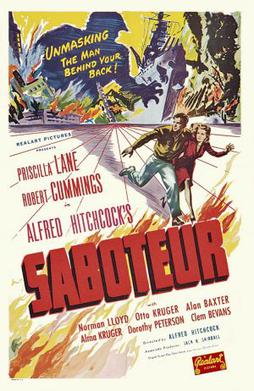
On The Anti-Fascist Front-(Sir) Alfred Hitchcock’s “Saboteur” (1942) A Film Review


DVD Review

By Sam Lowell

Saboteur, starring Robert Cumming, Norman Lloyd, Priscilla Lane, directed by Alfred Hitchcock, screenplay written along with others by Dorothy Parker, 1942

No question the late director Alfred (oops, Sir) Hitchcock knew how to direct suspenseful thrillers even if today he would be priced out of the market for lacking the now quintessential high tech whistles and bells you need to get an audience’s attention. The film under review, Saboteur, from 1942 meaning in the thick of the European War and the jump start of the Pacific War after the dastardly deeds at Pearl Harbor makes this one an add-on patriotic suspense film as well about the nefarious deeds of enemy agents (probably German-Axis foes from the way the story wind around and who the agents portrayed are but left to the imagination and the assumption that the audience didn’t have to be spoon-fed who the enemy was just then). The best thing about this patriotic push is that enemy plots are exposed not by excellent professional police work if there is such a thing but by Joe average citizen (as usual in a drama not centered on police procedurals the professionals local, state and federal are always about six steps behind the real action). There is something reassuring about that even if you have to pull a few straws, make a few escaped rather implausible to make it come out right.     

This is the way an average citizen stopped the bad guys in this one. Airplane worker Barry Kane had helped try to put out a fire in the plant but had been wrongly accused of sabotage when it was discovered that he had passed a fire extinguisher to his co-worker that was filled with gasoline. That co-worker died and the circumstances led the authorities to figure out that it was sabotage-Barry’s work. Naturally to clear himself he has to avoid the coppers, to go on the lam if you want to know. Just as naturally since he had a big target on his back as the “fall guy” for the work of enemy agents he is hounded at every stop. Even by his eventual romantic interest, Pat, played by wholesome American womanhood Priscilla Lane, who is ready to turn him at every opportunity until almost the end when she is made to realize that this guy is a serious patriot. And she is serious smitten with him to boot (smitten seems right but she sure had her guy jumping through hoops to prove something to her-any other guy, a non-smitten guy would have walked away the first time she tried to finger him.)     

So Barry the fall guy had to find out why he has a big target on his back and maybe find out what else the bad guys are up to. In the beginning the only clue he has is a guy named Fry, played by Norman Lloyd. Fry is the guy who handed Barry the bogus fire extinguisher. So the trail blows hot and cold as he follows whatever leads he can muster (and still keep a fair distance from the law-although he got grabbed a couple of times along the but that was simple stuff to get out off-remember the cloddy coppers mentioned above). In the process of finding Fry he finds out that there is a whole network of enemy agents working to blow things up. And not creepy has-been malcontents and flaky anarchist but the cream of American society (the  American Firsters is what the play is-the group that hero Charles Lindberg got egg in his face over when Pearl Harbor blew everything to bits-including isolationism).

Get this they wanted to blow the Boulder Dam to smithereens, wanted to blow up a Navy ship in Brooklyn (yeah, these rats were everywhere) and maybe who knows the Empire State Building. They never got that far because Barry stopped them cold. Stopped Fry too in one of the most famous shots in all film-dom with Fry after hot pursuit slipping away from the pursuing Barry and falling to his death at the Statute of Liberty. Yeah, that Alfred, Sir Alfred Hitchcock could keep you guessing right until the end even if you knew how the deal was going to go down. A classic.            


Sonny James Of "Young Love" 1950s Fame Passes At 87


By Seth Garth 

There was a time, a junior high school, middle school time, a time when every young boy and girl fussing with puberty, trying to figure out why that girl that last year’s “stick” girl all of a sudden was “interesting” and that guy who had been constantly taunting that girl all of a sudden had dreamy eyes Sonny James filled the airwaves with his classic song of blossoming, Young Love. Who knows what else he sang, or what happened to him later in life. What was important was that when you were at the school dance your mother forced you to go to learn some social skills (maybe “forced” is too strong once those girls became interesting and those guys had dreamy eyes) you waited, waited until perdition if you knew what the word meant but at least until that last dance, last chance time to go up in all your blushed innocence and ask for that last dance, or waited to be asked. And guess whose song you prayed to the high heavens would be played so you could hold on tight. Sonny, RIP.  And all those youthful dreams too.    


Saturday, December 17, 2016

South Of Nowhere-Claire Trevor And Fred MacMurry’s “Borderline” (1950)-A Film Review


DVD Review   

By Sam Lowell

Borderline, starring Claire Trevor, Fred MacMurry, Raymond Burr, 1950    

As long as people love their dope, their marijuana, guys will try to move heaven and earth to bring the “produce” to their doors. (Although with recent liberalized and decriminalized efforts to take that particular drug out of shadow economy in some states there will presumably be less aura of criminal lure about the thing). That is the presumption behind this 1950 film noir with a twist Borderline (the twist being some funny scenes that don’t normally make sense in a noir, seem like a send-up of serious noir like The Big Sleep and Out Of The Past where nobody is laughing-except grimly grinding their teeth).  

The plot otherwise (a B-film plot in any case) is pretty conventional for this kind of off-beat police procedural. The people want their dope, it is illegal, and guys will take great risks and great profits to satisfy that market down in sunny Mexico where the stuff was produced in huge quantities. Still is. So a guy like Pete Ritchie, played by Raymond Burr last seen as Perry Mason-a good guy lawyer-but here as a low down dope dealer, will go to any lengths to keep the profits flowing south and the product flowing north. And of course various local, state and federal law enforcement agencies want to rain on guys like Ritchie’s parade. But drug lords don’t get to be drug lords without a serious security system and the coppers are stymied until they can get agents working on the inside-presuming that they can keep out of each other’s way.      

That last remark applies double here since two agencies try to get inside Pete’s operation at the same time. One, Johnny, played by Fred MacMurry last seen here sweating out a gunshot wound after playing with fire, playing with a deadly femme in Double Indemnity and the other Madeleine, played by Claire Trevor last seen in these precincts putting a few slugs in Moose Malloy in the classic Murder, My Sweet (Farewell, My Lovely when Raymond Chandler wrote the crime novel). Neither know that the other is a drug agent working to get dear Pete off the streets and into the nearest cell. They go through their paces, through their comedy of errors as both try to get the other (and the dope) to the border for the collar. Along the way a lot of goofy stuff happens and a lot of danger but they see it through. Oh yeah and like in any such story they fall for each other not knowing that the other shoe is going to drop on one of them. Not to worry old Pete gets snagged in Mexico and the kingpin of the whole operation gets bagged in L.A. –and the dope agents go about their love business. A quirky film.    

Friday, December 16, 2016

A Town Without Pity-Spencer Tracy’s Bad Day At Bad Rock (1955)-A Film Review  


DVD Review

By Sam Lowell

Bad Day At Bad Rock, starring Spenser Tracy, Robert Ryan, 1955

No question the internment of every Japanese person who could be found on the West Coast during the early days of World War II whatever their beliefs, whatever their loyalty to America, aided by the highest court in the land, the U.S. Supreme Court rubber-stamping that executive decision, was a dark day for the vaunted American values and adherence to a belief in civil liberties. (And if anybody wants to say that the governmental action then was an aberration look at the plight of most Moslems here these days in post-9/11 America.) Despite that injustice one would not assume that those actions would be the backdrop for a 1955 film, Bad Day At Bad Rock, which obliquely addresses the whole question in a dramatic way.

John MacCreedy, played by Spenser Tracy, is a man on a mission, an undisclosed mission through most of the film, as he gets off the train in some Podunk town in the Southwest. This town, like a lot of towns which are isolated out in the sticks, and insulated too, had citizens very unfriendly to our man. All he wants is to be able to contact a resident of the town, a Japanese-American, in the immediate post-World War II period. This fact sets off a train of events that by the end will make it very dicey about whether MacCreedy will get out of the town alive. But before that he stirs up some hidden past that many of the townspeople are trying to forget-or at least not rake up again. The leader of this town, a large ranch owner named Reno Smith, played by Robert Ryan, orchestrates the negative attitude that MacCreedy finds at every turn as he doggedly looks for that missing Japanese man whom he wants to find. At the beginning everybody, standing in fear of Reno, or indifferent to MacCreedy fate, stonewalls him at every point. Then slowly as the injustices to his person mount up and the citizens get tired of Reno’s overweening antics a few brave souls help MacCreedy. But in Reno’s eyes MacCreedy is a loose cannon, has to be gotten rid of-and fast. 


The attempts to murder MacCreedy, there is no other way to put the matter, naturally failed as Reno went down, literally, in a blaze of fire. You might ask why Reno and his accomplices were so adamant about kicking MacCreedy out of town. After Pearl Harbor Reno’s hatred of “Japs” was uncontrollable (especially after he was turned down when he tried to enlist) and after a drunken spree he had killed the “Jap.” That madness known to the residents either through direct knowledge or fear, was why the townspeople were so suspicious of MacCreedy. And Mac’s mission-to give a Japanese father the posthumous medal his son had won saving MacCreedy’s life in Italy where laid down his head as an American soldier (there actually was a famous Japanese unit that fought all the battles in Italy and grabbed a ton of medals and commendations. Nice plot-line to make that point-a point that bears repeating today.            

Thursday, December 15, 2016

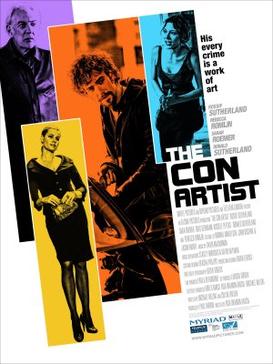
Con Or Artist?-Donald Sutherland’s “The Con Artist” (2011)-A Film Review  


DVD Review

By Sam Lowell

The Con Artist, Rossif Sutherland, Donald Sutherland, Rebecca Ronijn, Sarah Roemer, 2011

Sometimes you grab a film just on a hunch, maybe an educated hunch but a hunch nevertheless. Sometimes they meet expectations, sometimes not. The latter was the case with the film under review The Con Artist. First off in my reasons for taking a chance on the film ever since he was in the film version of M.A.S.H. I have admired Donald Sutherland’s work and I figured the add-on of one of his sons might be interesting. Secondly I figured the plotline might have something to do with con artists, a subject which since childhood when I hung around with my fair share of them (and took a short spin in that milieu myself) has intrigued me. Checking out what is new in conning.         

Instead the con artist of the title is an angry, kind of surly young man, Vince, played by Donald’s son Rossif who had indeed just gotten out of stir after five years as the fall guy for a car heist gone wrong but who also was some kind of mad monk artist-sculptor. Hence con artist. The problem with Vince when he gets out is that he still owes the head of his criminal syndicate, Kranski, played by the old man, a ton of dough for losses in the botched heist. To get out from under he will have to go back to the old auto theft hustle that got him in trouble in the first place. In his spare time he also fools around with making sculpture-something out of the Louise Nevelson “school” of taking waste materials and creating something which people will declare is great art (and others will purchase).


Where Vince’s big break comes in is when he rams into a high-pressure art gallery owner’s car and low on dough talks her, Brenda, played by   Rebecca Romijn, into doing the repairs at Kranski’s car shop (where legal and illegal things go on). When she see his sculpture sitting in the back of the shop she sees nothing but dollar signs. And so the running battle between a life of crime and high art for Vince gets played out. Along the way Vince falls for Brenda’s assistant, Kristen, played by Sarah Roemer, after they play cat and mouse about having an affair when from about minute one anyone watching could see they had eyes for each other-big time eyes. After a few falls and a couple of breaks in helping bust up a major car ring heist Vince heads for the high art life-and Kristen. Donald Sutherland wound up with a bunch of slugs in him sitting on his butt on a docked freighter waiting to take his own turn in stir. Maybe he will take up art. Just a so-so film here.          

Wednesday, December 14, 2016

President Obama Pardon Chelsea Manning-She Must Not Die In Jail-A 
Story Goes With It-Observe Her Birthday December 17th  


https://petitions.whitehouse.gov/petition/commute-chelsea-mannings-sentence-time-served-1

President Obama Pardon Chelsea Manning-She Must Not Die In Jail-A Story Goes With It-Observe Her Birthday December 17th      

By Fritz Taylor 

[The organization that the two men, Ralph Morse and Bartlett Webber, in the story below belong to, Veterans for Peace, has been a long-time supporter of the struggle for freedom for heroic whistle-blower Chelsea Manning. Veterans for Peace has supported Chelsea since the organization found out in the summer of 2010 through Courage to Resist, an organization dedicated to publicizing the plight of military resisters, that she had been arrested and through a long process wound up in solitary confinement down at the Quantico Marine Base south of Washington in Virginia. She had been charged with releasing hundreds of thousands of documents via Wiki-leaks to a candid world. Many of them documenting the cover-up at all levels of military atrocities by American soldiers, mercenaries under contract to the American government or within the American-led coalition. The most graphic and infamous piece of evidence of such actions was a tape of a helicopter crew gunning down unarmed civilians in Iraq which is available on YouTube under the title Collateral Murder and laughing about it afterwards. (That tape, the entire tape, all thirty-nine minutes is permanently part of the record in the Manning case placed there at trial by the defense team. No one ever challenged the veracity of the tape although no one was ever charged with any crimes either.)

Chelsea was held in pre-trial confinement for over three years (opening an appeal question about constitutional speedy trial rights-applicable even in the military courts. Her solitary confinement (for her own good either because she was then a suicide risk by one account or because her fellow soldiers would be so outraged by her whistle-blowing that they feared for her safety by another-take your pick) at Quantico lasted almost a year before she was due in part at least to a public outcry and rallies of hundreds at the gates of Quantico for her release she was placed in Fort Leavenworth. (Here is the military logic tough-every time she had to appear for some matter before the court at Fort Meade she would be flown back and forth after the conclusion of whatever had transpired.) Ms. Manning (Private if you prefer her rank) has after an over two month trial been convicted of a number of charges including several counts of espionage under a law going back to World War I and sentenced to a thirty-five year sentence as a result of being court-martialed in the summer of 2013 and is currently being held in the all-male barracks at Fort Leavenworth out on the prairies of Kansas.      

Ralph and Bart first heard about the details of the case in the fall of 2010 when they received an e-mail from the American Civil Liberties Union announcing a forum to be held at Boston University to publicize the case. (Bart was not sure that he had not seen something about the matter earlier on Boston Indy Media where Anonymous, a radical underground group, had places news about the case and of course the leaks would have been by then public knowledge but this forum was the first active part they played in the case.) They both attended that forum and as a result have been ever since involved one way or another in Chelsea’s defense. Their first action was to “pony up,” these are working-class guys so pony up is right, some money for the defense. (Courage To Resist was/is the repository for raising and accounting for all legal defense monies since the beginning. As stated above that organization has had a long history of supporting military resisters-for military whistle-blowers as well.)          

There were many reasons why this case had appealed to them personally but the strongest reason was that they were “paying their dues” as Bart put it while speaking about the case one Saturday afternoon at a vigil for Chelsea at historic Park Street Station on the Boston Common for not having had the courage during their own military service during the Vietnam War to “buck the system.” For a long time, actually since the last days of the Vietnam War when they supported an anti-war G.I. coffeehouse near Fort Devens about forty miles outside of Boston, they had no opportunity to get involved in a military resister case so once this case surfaced they were “all in.” (After they “got religion” on the war issue they had done their respective peace activist works through various mostly ad hoc organizations and for the past several years through VFP. The last time I checked they were still “all in.” That will tell you something about them, about how razor sharp that military service had made them  about the folly of war and about the importance of the Chelsea Manning case, especially as now as the long drag of her sentence and her environment has worn her down and she has attempted suicide twice in the past few months. (Google the Chelsea Manning Support Network for details.) So Frank Jackman’s phrase “she must not die in jail” in the headline is not a rhetorical flourish. Not at all. F.T.]       
******

“You know it is a crying shame that the Chelsea Manning case has fallen beneath the cracks, that her plight as the only woman prisoner in an all-male prison out there in the wheat fields of Kansas, out at Leavenworth has been ignored except for an occasional news note or yet another petition for President Obama to do the right thing like he has with the draconian drug cases and pardon her, to commute her sentence to time served, to the six plus years she has already been tossed away behind the walls,” yelled Ralph Morse over to Bart Webber while they were preparing to set up a banner proclaiming that very idea as part of a birthday vigil for Chelsea on her 29th birthday on this cold December day. The banner “President Obama Pardon-Chelsea Manning-“We Will Not Leave Our Sister Behind” with two copies of a photograph of her as some friendly artist had drawn of an image her as she might look like if she could express her full sexual identity (see above) and not the Army’s hard-ass male version since she had “come out” as a transgender woman shortly after her sentencing in 2013 had been inspired, the last part anyway by their fellow VFPer Frank Jackman. Frank had had his own very personal “war” against the military during his war, again Vietnam, and had served time in an Army stockade for refusing to go to that war. He always said that the one thing the Army did teach him was that you did not leave your fellow soldiers behind, and sometimes that might be the only reason left to fight. He thought it appropriate that peaceful veterans could express that same sentiment about a political prisoner who once the notoriety of the case faded could use plenty of that sentiment.  

(Ralph thought to himself while he was yelling over to Bart and cutting some wind holes in the banner to cut the sometimes fierce winds that passed through the Boston Common that he would never get over those basic training drill sergeants during his time in the military during the Vietnam War, never get over being spooked by them that if you did not toe the mark you would wind up in Leavenworth and here he was supporting a young transgender whistleblower who wound up in that very place after having done what he should have done-resist- but he cowered to those redneck drill sergeants. Well even 60-somethings can learn a thing or two from the younger crowd.) 

“Yeah, between the fact that she had to in order to protect herself against maltreatment from a bunch of goddam threatening guards who told her to “man up” at Leavenworth after she was convicted and sentenced to those hard thirty-five years in 2013 “come out” as a transgender woman and the overriding blow-up over the Snowden revelations which took all the air out of any other whistle-blower case Chelsea got the short end of the stick,” replied Bart also yelling his comment across to Ralph against both the windy day and the constant stream of loonies, crazies and con men and women who populated the environs around the Park Street subway station at Boston Common on any given Saturday of while both men could tell a million zany stories about between the hours of one and two in the afternoon when the space, or part of it, was given over to  peace action groups and other left-wing political organizations. 

(That business about formerly Bradley having to reveal her true sexual identity the day after her sentencing had been a personal safety necessity against the taunts of the guards out in Leavenworth as both men had been told by a man from Courage To Resist who knew the inside story when they asked why she had “come out” so soon after the sentencing which threw a lot of supporters off-center who had not been privy to the sexual politics involved although some stuff had come out courtesy of the Army about her sexual identity in order to diminish her heroic actions.)    

Oddly, or maybe not so oddly at that, Bart, as he told Ralph later that day when they were sitting in a bar having a couple of drinks to warm themselves up against the coldness of the day thinking about the day’s action that he too had been thinking about how incongruous it would have been in his old working class neighborhood in Riverdale to be supporting a transgender soldier condemned to Leavenworth, a “transvestite,” a drag queen they would have called her not then making the subtle distinctions that have evolved on questions of sexual identity. Had that day thought about the time that he and his corner boys, that is what they called each other back then when there were corners for dough-less guys to hang around on, that one summer they had travelled down to Provincetown, even then a gay and other odd-ball Mecca for the specific purpose of baiting the drag queens, faggots and dykes along with getting the usual drunk to gather courage. Jesus.                    

Ralph thought to himself as he continued to cut a few wind holes in the banner proclaiming the need for President Obama to grant Chelsea her pardon that he had come a long way (and Bart too) since the fall of 2010 when they learned that Chelsea (then using her birth name Bradley but here we will use her chosen now legal name and assume everybody understands that this is the same person we are talking about) was being held essentially incommunicado down at the Quantico Marine Base (strange location since Chelsea was in the Army and the various branches of the services jealously guard their prerogatives) in solitary and their organization, Veterans for Peace, had called for demonstrations to have her released even then, or at least taken have her taken out of solitary and stop being tortured (not some  small “peacenik” charge or propaganda super-charged to gain sympathy for the victim of government repression since the appropriate United Nations rapporteur had made such a finding in her case concerning her pre-trial treatment). Ralph and Bart had been among the very first to set up a rally (not at Park Street but in Davis Square over in Somerville where Bart had lived for the previous decade) and they had been committed to her defense ever since. The weekly shout-out on Friday afternoons is the place where Ralph not known a as a public speaker but more as a “Jimmy Higgins” figure (a rank and filer who did the odd chores to insure the success of the event) began get his “voice,” get his political facts in a row with at first maybe a minute speech. By the end of that series of vigils which were switched the busier intersection at Central Square in Cambridge you could hardly get the “mic” out of his hand. Bart who had some college behind him where he had to take a debating class as a requirement his freshman year tended to give the pitches about what people could to support Chelsea, usually a set five minute speech.    

(That shout-out designation was simply current usage for such events in the wake of the Occupy movement where the term took on an almost religious mantra quality. Also acceptable and used at other times including the event that Brad and Ralph were helping stage this day- vigil, rally or whatever other appropriate name you want to call an event where people were free to express their opinions about Chelsea’s case and other causes which made sense to speak of and a few times budding folk singers who also hung out in the space would come by and sing some song, especially David Rovacs tribute to Chelsea’s heroic action.) 

Both men freely admitted and it bears repeating here that what was driving them on this case more fervently that other peace and progressive actions they had been involved with over the decades had been their own admittedly sorry response to “their” war, Vietnam. In Ralph’s case joining the Army, meaning volunteering for three years   and in Bart’s case by accepting induction into that same Army for the mandatory two years had caused then after the fact, after their military service to “get religion” on the questions of war and peace. Ralph had gone out of his way to join up as soon after high school as he could. Had bought in hook, line and sinker all the admittedly paper-thin anti-communist domino theory reasons provided by the government any given week to justify their actions. Hell, the hard truth and Ralph was hardly alone in this a young man was looked down at in his old Forsythe Street section of Troy if he waited for the draft board to come calling for him to get on the ball. Most of the guys he knew were already in or getting ready to. The neighborhood had already lost a few guys over in Vietnam, a few more had come back as shells of their former selves. Ralph in any case like his class had done his “tour” in Vietnam without a peep although already he knew that he had to do something to let people know what really was going on-mostly straight out murder and mayhem against people that he had no quarrel with-after he got out if he survived to calm the horrible pit that never left his stomach one he got “in country.” 

Bart had had more qualms about the war, had seen no way though that he could escape the draft once the draft board tagged him. Like Ralph most of his friends and neighbors supported the war, the guys doing their service, a few not coming back as in all wars. While he made a few more noises about his feelings about the war while he was in uniform he had kept quiet mostly, kept the drill sergeant-driven “you don’t want to wind up in Leavenworth” quiet. He did not wind up going to Vietnam as after Tet in 1968 when all hell broke loose which signaled either endless war or an ordered retreat the military authorities were beginning to pull back the troops during his time. He often wondered though if he had gotten orders for Vietnam what he would have done. Probably gone quietly like his wife, his very patriotic wife whose two brothers were doing second tours in ‘Nam wanted him too when the deal went down. No Canada or jail for him. To his shame as he told the military resister one night at a VFP general meeting after hearing about what Frank had done during his time (this is about Chelsea but Frank had done time in the Army stockade for refusing to go to Vietnam).          

They saw the Chelsea case as pay-back to a real hero, maybe the only hero of the Iraq War and had worked like seven dervishes on the case. More importantly had kept the faith even after the case inevitably went off the front pages and became a cypher to the general population. The case like all high publicity and high stakes political prisoner cases had been front and center for a while, say from the time of the Wikileaks exposes with their endless documentation of the nefarious activities of the American and other governments in covering up everything that could be covered up in order as both Ralph and Bart knew from their short Army experiences to “cover your ass” to the verdict and sentence at trial. After that unfortunately even some supporters drift away and the thing becomes yesterday’s news in the welter of some new case (here the Snowden case took a lot of the air out since his revelations were current unlike Chelsea’s which dealt with pass atrocities and had personal effects on almost everybody in the cyberspace universe meaning almost everybody). Yesterday’s news to everybody but the defendant who has to do the hard time while the attorneys sniff around for issues on the long drawn out appeal. That is the hard reality of political prisoner cases, especially when it seems the trial was “fair” and the defendant had been convicted of a crime after all.

Not doing what was right at the time of your confrontation with your own war a very powerful now lifelong impetus to push on in the face of indifference and hostility among the general public these days. Both men had agreed once the fanfare had died down that along with keeping the case in the public eye as best they could they would commemorate two milestones in Chelsea’s life yearly-the anniversary of her incarceration by the government now over six years in May and her birthday in December (her 29th). That was why Ralph and Bart were struggling with the downtown winds to put their banner in place. These days they were not taking the overall lead in setting up such events but had responded to a call by the Queer Strike Force to do so and they were following that organization’s lead to rally and to make one last desperate push to get Chelsea a pardon. They had urged everybody who had not done so to sign the on-line petition to President Obama (see link above) to commute her sentence to “time served.” That on-line petition needed one hundred thousand signatures in order to get an official response from the White House about the matter (it also had to be done in a thirty day period). They were still short so hence the urgency of their calls. Everybody agreed, willingly or not, that under the impending Dump the Trump regime that Chelsea’s chances of a pardon were about zero, maybe less. So the rally. And so too the desperation in Ralph and Bart’s own minds that the slogan their fellow VFPer Frank Jackman had coined-“we will not leave our sister behind” would now fall on deaf ears, that she would face at least four, maybe eight years of hard ass prison time-time to be served as a man in a woman’s body when the deal went down. Worse that Chelsea had already attempted twice earlier in the year to commit suicide and the hard fact emblazoned in the added sentence on their banner-“she must not die in jail” had added urgency. (She had as well under some bizarre Army logic been “sentenced” to fourteen days in solidarity for the first attempt-Jesus, figures both men had blurred out when they heard that news earlier in the fall.)         

Ralph and Bart had met down in Washington in 1971 after both had been discharged from the Army and had gotten up some courage, with some prompting from their respective very anti-war girlfriends (Bart had divorced that gung-ho wife as soon as he got out of the Army, or maybe she divorced him but the parting was in any case acrimonious and threats had emanated from those two lifer brother after he had been arrested in Cambridge at the draft board along with a bunch of Quakers and other angry gentle people), to go down and get arrested during the May Day actions. Bart’s anti-war girlfriend, Josie, a lovely gentle woman from, if you can believe this, Manhattan although she like a lot of NYC kids went west to Wisconsin for college, had been met at the Morning Report coffeehouse located just outside of Fort Devens about forty miles west of Boston when they were part of an action to distribute Daniel Ellsberg’s “hot” Pentagon Papers. Pretty good credentials to start an affair in those days. (Ironically forty years later Daniel Ellsberg would be one of Chelsea Manning’s most fervent public supporters raising a ton of money so that she could have a complete transcript of all the pre-trial and trial work. A very expensive proposition without “angels” gathered by Ellsberg to fund the effort of what would become the longest trial and number of volumes of transcripts in Army history.) 

Ralph’s girlfriend, Sarah, had been a woman who he had known in high school in Troy but who after leaving the town and heading to Skidmore blossomed into a fervent anti-war activist. He had met her in Albany when the local Vietnam Veterans Against The War (VVAW) whichhe had joined was staging a silent march through the streets of that city and she had helped plan the event. The lived together for a few years before she got weary once again of Troy and headed west. He would even now run into her when several years ago she returned from the Wet after her husband had passed away among the small diehard crowd of peace activists who could be counted on to show up at events in that section of upstate New York.         

That 1971 May Day event which was in some ways decisive in both men’s understanding of how hard the struggle against the American war machine was going to be. In those desperate times when it seemed like the Vietnam War would never end (seemed endless although now with Afghanistan entering its sixteenth year the record for endless had definitely been extended) they tried to help shut down the government if it would not shut down the war-the Vietnam War. All they got was tear gas, police batons and several days in RFK stadium for their efforts. Totally unprepared for the vicious governmental response when under threat. Ralph and Bart had met on the floor of the stadium when Ralph had noticed that Bart had his VVAW pin on and had asked where he was from (where he “hailed from” was the way Ralph put it) and had become fast friends over the years-with the usual periods of absence from each other’s lives when family commitments got too heavy. They had been through a lot over the years in the struggle to keep the peace message alive and well despite the endless wars, and despite the near zero visibility on the subject over the previous ten plus years. 

Both had grown up in very working class neighborhood respectively as previously mentioned Troy in upstate New York and Riverdale out about thirty miles west of Boston and had followed the neighborhood crowds unthinkingly in accepting their war and participating in the war machine when it came their time. So no way in 1968,1969 say could either have projected that they would hit their sixties standing out in the lonesome corners of the American public square defending an Army private who in many quarters was considered a traitor and who moreover was gay. That was Chelsea’s public persona then before she came out as a transgender woman. 

In the old days they had also gone along with the “better dead that red,” “if your mommy is a commie turn her in” red scare dark age Cold War night, “the night of the night-takers” Ralph had called that time one night when told Bart how he had stood shoulder to shoulder with his father trying to get some poor bedraggled family out of the Forsythe Street neighborhood because they were some kind of “reds” (he later had also stood shoulder to should with his father and neighbor when blacks tried to move into the neighborhood in the mid-1960s). As far as the sexual preference-sexual identity stuff went in the old days the best term they could think of to describe their respective attitudes toward gays was “faggot and dyke”-Jesus. Trans-genders did not compute didn’t come up on the radar and were dismissed as transvestites and weirdos whenever Bart would see them strutting their stuff around the Boston Common on Saturday nights. One time he and his boys had gone to Provincetown, P-town then as now the summer Mecca in New England for LGBTQers, dressed in drag just to “lure” the guys down there (and who knows for  what non-drunken reason-could have been insecurities about their own sexual identities they after all were only late teenagers so who knows)   

(That whole Chelsea gay-transgender issue was already well known to them from some information provided by agents of Courage to Resist, the organization which was the main conduit for publicity about the case and in charge of handling the financing Chelsea’s legal defenses. They also were aware through those same agents about Chelsea’s sexual identity which all partisans and Chelsea herself had agreed to keep on the “low” in order not get that issue confused with her heroic whistle-blower actions during trial and only later revealed by her publicly as a matter of self-defense as mentioned above.)     

Later that night after the birthday vigil was over and Ralph and Bart were sitting at Jack’s over in Cambridge near where Bart lives (Ralph still lived in Troy) having a few shots to ward away the cold of the day’s events both had been a bit morose. The event had gone as well as could be expected on a political prisoner case that was three years removed from the serious public eye. The usual small coterie of “peace activists” had shown up and a few who were supporting Chelsea as a fellow transgender and there had been the usual speeches and pleas to sign the on-line petition to the White House to trigger a response from the President on the question of a pardon (see link above). (That lack of response by the greater LGBTQ community to Chelsea’s desperate plight all through the case had had Ralph and Bart shaking their heads in disgust as the usual reason given was that all energies had to be expended on getting gay marriage recognized. The twice divorced Ralph and three times divorced mumbled to themselves over that one). 
Ralph and Bart were in melancholy mood no question since they had long ago given up any illusion that the struggle against war and for some kind of social justice was going to be easy but the prospects ahead, what Ralph had called the coming “cold civil war” under the tutelage of one Donald Trump had them reeling as it related to Chelsea’s case. They bantered back and forth about how many actions they had participated in since they got the news of the case that a young whistle-blower was being held for telling the world about the cover-up of countless atrocities committed by American forces in Iraq and Afghanistan (via Wiki-leaks, not the mainstream media who would not touch making the information that Chelsea had gleaned for love or money). 

There were the trips to Quantico down in hostile Virginia in order to get Chelsea out of the “hole,” get her out of Marine base solitary (and where they faced an incredible array of cops and military personnel all to “monitor” a few hundred supporters). The trips to the White House to proclaim their message. The several trips during the trial down at Fort Meade in Maryland where they had to laugh about being on a military base for the first time in decades (they had been barred many years back for demonstrations on a military base against the Reagan administrations war against Central America). The weekly vigils before the case went to trial and over the previous three years the fight to keep the case in the public eye.          

As they finished up their last shots of whiskey against the cold night both agreed though that come May they would be out commemorating Chelsea’s seventh year in the jug if Obama did not do the right thing beforehand. They both yelled as they went their separate ways (Ralph was staying with his daughter in Arlington) old Frank Jackman’s coined phrase-“we will not leave our sister behind.” No way.    


Love For Sale-The Film Adaptation Of Truman Capote’s Breakfast At Tiffany’s (1961)-A Film Review 


DVD Review     

By Sam Lowell 

Breakfast At Tiffany’s, starring Audrey Hepburn, George Peppard, based loosely on Truman Capote’s novel of the same name, 1961

Okay, okay in the interest of full disclosure I will admit that I was smitten as a teenager by Audrey Hepburn in the role of Holly Golightly in the film under review, Breakfast at Tiffany’s. Okay, okay as well that some fifty plus years later I am still smitten by Ms. Hepburn in re-watching this film. There is something beyond the storyline here which after all is pretty much a variation of the small town girl trying to avoid being swallowed up by the big city, but also casting her fate with surviving by one means or another in that same big city. Something about a certain dewy freshness that transcends the ambiguous way that she was trying to make her way in the big city. (Under a less restrictive interpretation Holly’s “profession” today would be called outright a call girl or at least a mistress-in-waiting but back then that dewy freshness created by a coded Hollywood would not tolerate such designations). So the thing plays out as a traditional boy meets girl love story of which about a billion filsm have now been made in all forms and in all languages.       
   
Here is how a small girl in the big city and a down at the heels young writer with promise played out in 1961. Holly, Hepburn’s role, had been dazzled by the bright light of New York (unlike most small town girls with the itch to get famous who headed west to the Pacific Ocean to be washed clean by Hollywood). As the film begins it is obvious that the stylishly dressed and sophisticated Holly has worked out some compromise with the big city (and on those days when she was losing in the compromise department there was always Tiffany’s to shelter her from life’s storms), has more suitors and admirers than she can shake a stick at. A party girl no question. Enter Paul Varjak, played by George Peppard, a budding writer who is the “protégé” of a wealthy socialite who is footing his bills until he strikes gold in the literary world who moves into Holly’s apartment building. (On this reading those who claim Holly is a call girl would be forced to concede that Paul is a gigolo making for an interesting “pairing”-but in the double standard of the time he is merely a “protege” and leave it at that). From about minute one they are attracted to each other. 


No question if the film were produced today they would have already been under the satin sheets but then it had to play out as a game of cat and mouse (complete with “Cat” as the cat) because he had no dough and Holly was looking for the bright lights. So the film goes round and round with them in and out of romance. Mostly longingly out. But then fate comes into play. Holly who in the meantime during one of those out periods had taken up with a rich Brazilian to get married and have everything her small town dreams wanted, craved. Problem was that somebody fingered her place, her as a conduit for drugs (she had a weird “companionship” relationship with a “godfather” who doing time up in Sing Sing whom she visited every week for “pay.”). The proper Brazilian dropped her like a hot potato. Re-enter Paul and in the rain they have all their sins washed away by true love (but still no satin sheets). Yeah, I had a crush on dear Audrey and I got that hard facts re-confirmed in this one. Classic early 1960s film if not exactly what Capote was getting at.        

Sunday, December 11, 2016

Wall Street Versus Main Street-Oliver Stone’s “Wall Street: Money Never Sleeps” (2010)-A Film Review      


DVD Review 

By Sam Lowell 

Wall Street: Money Never Sleeps, starring Michael Douglas, Shia LeBeouf, Cary Mulligan, directed by Oliver Stone, 2010      

Yeah, Wall Street versus Main Street those kids from Occupy down the street from the august brokerage and financial towers of American business were on to something. Something that their grandparents called back in the Great Depression of the 1930s the economic royalists and today the one percent (1%-actually much less than that if you cut out the mere millionaires who are walking around with nothing but chump change these days when a billion is the starting point for anybody taking notice of your good fortune). Of course in the post-meltdown period since 2008 that idea has been played out many ways-not all to the benefit of Main Street in fact mostly not to the benefit of the great unwashed. 
Still it is a little hard to understand why in 2010 the director Oliver Stone felt compelled to revisit his 1987 production of Wall Street from the days when half of America was in love with the Street and the other half wishing that they had some dough to throw at their dreams with his second coming of that classic-Wall Street-Two or to follow form Money Never Sleeps (true enough). In other words did we need to see a chastised Gordon Grekko giving his take on what ailed the Street in those bummer days after 2008 when one half of America got wiped out and the other half got conked with “under water” debt? Probably not but here were are so a few comments on the story-line seem warranted.      
For those who remember Gordon Grekko, played by Michael Douglas, from the first film he was the consummate insider. A couple of decades and some serious stir time later he is a wiser man-sees where things are heading on the Street and like Cassandra wants to warn a candid world. A wiser man he may be but as the sub-theme notes money never sleeps and so our boy Gordon has seemingly lost a step or two since he was king of the hill. The big boys grabbling all the dough are now seen as heroes not bums of the month. But their day is coming.    
This one takes a few big curves away from the machinations of the Street and tries to deal with things on a more personal level. It seems that Gordon’s estranged daughter Winnie, played by Cary Mulligan, has a boyfriend/fiancé who is an up and coming, well, Gordon Grekko, working his ass off in a big investment house that is going under because it is carrying too much bad paper (and being undermined by a competitor investment house partner with a grudge). The boyfriend Jacob Moore, played by Shia LeBeouf,  is a go-getter for sure and winds up meeting Gordon on a book tour (Gordon has written a gloom and doom book portending the impending financial meltdown) and they strike up a bargain. Jacob tries to work to get Winnie to meet him and he will see what he can do to push Jacob up the Wall Street food chain (and especially get some traction for his clean energy project-the wave of the future).          
For a while it was no soap-Winnie is still resentful about how Gordon let her brother fall through the cracks with a drug addiction problem that took his life. But eventually she softens (as well as being proudly pregnant). Then Gordon pulls a classic Grekko-proving that an old con will always be an old con (artist or vict). He has a cool one hundred million stashed in Switzerland just waiting for Winnie to grab it. She doesn’t want it until Jacob talks her into using the dough to help finance the clean energy research. She does and signs for technical reasons the dough over to dear old dad. And he runs off and turns that nothing big one hundred million into a billion. Yeah, Gordon Grekko is back, the bad ass is in the saddle once again. But here is where the stir time or something plays-Gordon is worried about seeing his grandchild so he anonymously dumps the nothing big one hundred million on that research project. Nice touch. And they say Wall Street is just a big Ponzi scheme. Shame on them. But here is the big picture-those Grekkos are still in the saddle and who knows what they are up to now-no good for Main Street. Like I said I am not quite sure why Stone felt an urge to run this storyline again. What is needed is a plan to get rid of the bums.          

Saturday, December 10, 2016

Out In The Big Bubble- Valerie Plame and Joe Wilson’s Fair Game (2010)-A Film Review 


DVD Review 

By Sam Lowell 

Fair Game, starring Naomi Waits, Sean Penn, based on the writings of Valerie Plame and Joe Wilson, 2010  

It is a rather odd circumstance when I am rooting for a CIA agent to win, or at least get out from under what burden he or she is facing. Not that I wish any particular harm but the agency as a whole is usually in my sights for criticism for its nefarious activities. Those activities, as highlighted in the film under review Fair Game about the “outing” of CIA operative Valerie Plame over her assessments about the rationale for the Iraq War (the one started officially in 2003 not the earlier one in 1991 although there is a connection about the fate of the Saddam’s weapons of mass destruction, WMD, that link the two together) including some very shady dealings around the lead-up to the war in 2002. Although that agency was hardly the prime culprit for that disastrous war policy that we are still paying for in cash, lives, including innocent Iraqi citizen lives, and for arbitrary use of military power that had made the world cringe before and has since the initial phase of the military campaign was completed.    
Valerie Plame Wilson was a career CIA operative whose tasks included checking up on the bad guys who were looking to get nuclear weapons for jihad or whatever purpose bad guys were looking for powerful weapons. In the post-9/11 world that task took on greater importance as the American government under President Bush was looking for a rationale to blast Iraq’s dictator and nemesis Saddam off the map as part of the overall national security plan to thwart the international terrorist cabals. The Bush administration (Cheney, Rumsfeld, Rice, Powell, et al) were looking for any evidence that Saddam had his WMD program still intact after 1991. So even the slightest evidence that would physically prove that he was still pursuing his program was welcome-they would “spin” whatever tidbits they had once they got a bite.     
One big piece of “evidence” that was making the rounds, the thing that got Valerie, played by Naomi Waits, and her ex-ambassador husband, Joe Wilson, played by Sean Penn was “yellowcake” uranium, lots of it, allegedly being sought by the Iraqis from Niger in Africa. During the lead-up to the war the CIA “hired” Joe, who had contacts in the area, in Niger, to verify if possible that trail. Joe’s conclusion: the “purchase” didn’t exist, nada, nothing of the kind. Of course that conclusion when the CIA kicked it upstairs died a quiet death. Lost amount a million other things in the welter of war. The administration had buried the information deep in some hole and had spun a whole different unture tale and Joe was ticked off about it.      

As the disastrous policy in Iraq unfolded Joe Wilson, who had connections in the press, wrote an op-ed article about his true findings in Niger concerning the yellowcake. Then all hell broke loose. Administration officials were running for cover, guys like Karl Rove and Scooter Libby in particular. A little trick they played to get even was to “out” Valerie Plume. A no-no. A no-no as far as federal law went and a no-no as far as Joe Wilson was concerned. While Valerie was the “good soldier” keeping quiet despite her being kicked out of the agency Joe was determined to find the culprits who did his wife and her career in. And he succeeded, or at least had the satisfaction to see somebody take the fall (Scooter Libby who was subsequently sentenced and pardoned for his crimes). A small victory against the big boys by an average citizen. That part is to the good. Still I am a little uneasy about having had to raise my fist and say well done Joe and Valerie. An interesting topical movie in the age of serious “disinformation” and “false” news.

Friday, December 9, 2016

Eve’s Rib-Katharine Hepburn And Spencer Tracy’s “Adams Rib” (1949)-A Film Review 


DVD Review 

By Sam Lowell 

Adam’s Rib, starring Katharine Hepburn, Spencer Tracy, Judy Holliday, directed by George Cukor, written by Ruth Gordon and Garson Kanin 1949   

Now that we are deep into the “third wave” of women’s liberation (except mostly noticeably these days that glass ceiling still hovering over the White House) it is a nice touch to see that even if in a comic way the question of woman’s equality before the law, before society norms was being addressed after the “first wave” early in the century (women getting the vote and other legal rights like owning property in their own name). Although we today might cringe a little at some of the dialogue and some of the social expectations no matter how high-minded this film, Adam’s Rib, starring Katharine Hepburn and Spencer Tracy two unmarried off-screen lovers in an age when that status was frowned upon, is a rather nice for the time look at the double standard between men and women (of which there is still plenty of residue.)  

Here’s the premise being worked out. Then if a guy cheated on his wife with some floozy that was “not nice” but if a wife decided to do something about the matter-say, as here, take a rooty-toot-toot gun and blast the creep (and take shots at his floozy as well) that was terrible. Hang her, hang her high. That double standard implied that the guy could get away with anything while the poor wife has to suffer and grin and bear it. Of course in Adam’s Rib where the two main characters, Adam, played by Spencer Tracy, and Amanda, played by Katharine Hepburn are both married and lawyers (by the way then woman lawyers were unlike today sparse, very sparse on the ground) you know from minute one that they will be locking horns with each other over their respective views of what was right in the case. So married to each other writers Ruth Gordon and Garson Kanin have set the stage for a battle royal between the two views on display- Adam’s stern if blind-eyed justice demanding a conviction against Amanda’s fight against the double standard and an acquittal.          

As the gloves come off-you know of course that Adam, a crack prosecutor, and Amanda who has wangled her way into defending the scorned woman, Doris, played by Judy Holliday are going to go for broke to win the case. The law, the stern law would seem to be on Adam’s side since Doris freely confessed that she plotted to pop her man for his infidelities. But Amanda throws plenty of monkey wrenches into the mix, including ticking Adam off when she brings in a female weight-lifter who lifts him over her head to prove the general point that a woman can do what a man can do. Needless to say Amanda wins the day.


But that is not the whole story-not a 1940s whole story which is moreover billed as a romantic comedy even if it is now a proto-feminist classic. The wrangling between Adam and Amanda in the court case had frayed their own marriage and Adam decided he had had it and flew the coop-was looking for the divorce court. Maybe by his lights he was right to blow town once Amanda bested him but when the deal went down he and Amanda loved each other and so that was that. After all this was Hollywood-first wave or not. The film’s plot-line would make little sense today but as a snapshot about the battle between the sexes and the social mores of the time before the “second wave” of the 1970s changed many things it is worth a view. And to see Hepburn and Tracy go through their paces too.    

Wednesday, December 7, 2016

Down And Dirty In The America Night-With Fred McMurray and Barbara Stanwyck’s 1944 Film Adaptation Of James M. Cain’s “Double Indemnity” In Mind 


By Lance Lawrence 

Steve Roberts admittedly was a quirky guy, a guy known for an ironic turn of phrase but also for his eclectic taste in all things cultural, if his love of movies, old time black and white movies could qualify as cultural, a term he himself would not have used to describe his interests being an old working-class guy who would eschew such fancy terms of art. He just liked them, didn’t need a guy like Professor Jameson, a guy he read about recently in the newspaper, see I told you he was an old-fashioned working-class guy, who wrote a book of observations about the great crime novelist Raymond Chandler which went way overboard with the sociological and critical jargon. Tried to place his work in some high culture academic frame-work instead of just accepting the stuff as good story-telling about a time and place that was worthy of some play. Chandler himself would have roasted Jameson alive for his quirky interpretations of his work.  

Here’s is how that quirky fit played out recently to give the reader an idea of how Steve’s mind works when he gets an enflamed idea. He and his lovely wife Lana had gone to their local movie theater, the Majestic, in Riverdale to see Brad Pitt’s latest film, Allied, where Bard as a Canadian British Intelligence Officer during early World War II is in the thick of espionage and counter-espionage as well as in the thick of an off-hand romance that had all the signs of nothing but trouble for him-and anguish too in the end. Lana’s reason for going was simplicity itself. She wanted to see Brad’s female co-star, Marion Cottillard, who plays a French Resistance fighter aiding Brad in his work and his heartache romantic interest but more importantly had been involved in a swirl of rumors about being the reason that Brad and his paramour Angelina Jolie had split up. Steve’s reasons were more pedestrian once he found out from Lana who had heard a review on NPR one afternoon which included a chat with the film’s director that part of the storyline was set in wartime Casablanca (World War II in case you forgot to clarify which war we are talking about in an age of endless wars). That reference made him automatically think about Rick, Rick’s Café, Ilsa, Victor Lazlo, Louie the Vichy-loyal local gendarme, Bogie, Ingrid Bergman,  Claude Rains, Paul Henreid,  Play It Again, Sam and a million other off the top of his head thoughts about the classic black and while film from the 1940s, Casablanca.               

 After viewing Allied Lana had asked Steve the inevitable question about what he thought of the film and naturally he mentioned that while he liked it Casablanca would kick the thing down the road and have time for lunch as a saga of wartime romance. Lana accepted that answer although as usual without good grace since she was thrilled by the whole period piece and begged the opinion that this Cottillard woman looked like a home-wrecker and had the full blush lips that Brad seemed to go for but such were their different takes on movies (and music) that she just let it go. (Although Steve would never know when his opinion might come back in haunt him in some future more serious argument as an example of how they were too different to breathe but he, they had been through enough of those spats they called them that he had long ago given up trying to curb his real opinion just to keep peace in the household.) 

Steve that night though having a fitful night as always when he sees a current film that provoked some serious thoughts unlike the vast bulk which he would be glad to inform that Professor Jameson are just plebian entertainment, harmless and not worthy of the high culture treatment. Were written, directed, produced acted in strictly for the cash nexus-end of story. So he ran through the film in his mind again-and as he did he mixed in his tenth at least re-run through the plot of Casablanca. Something was gnawing at him and he could not quite figure out what. Finally he went to sleep with visions of Bogie telling Claude Rains not to do anything foolish like the Nazi officer had done trying to stop Victor Lazlo-Ilsa in tow-from leaving on the last plane out of Casablanca that night.      

The next afternoon he went on to his computer to Google any reviews of Allied. Most of them were laudatory which would be his own estimate if for no other reason that the feel of the film as a 1940s period piece, including a party hosted by Max and Marianne in bombed out London with Benny Goodman, the king of swing, holding forth in the background as the partiers jitterbugged away the night (before being curtailed by the inevitable German bombing raids) but one stuck out which caught the feeling that he was having about the town of Casablanca as backdrop for romances. 
Sam Lowell, one of the fairly well-known reviewers for the American Film History blog whom Steve had read reviews by before although usually not current films but classics where they had a mutual interest, had mentioned that Casablanca was a tough town to have a romance blossom in. Maybe something about the desert air, maybe the decadent of the Casbah, hell, maybe the colonial atmosphere of the place in those days. That phrase that idea got Steve thinking back to the film Casablanca and how thwarted love was a big theme there when it came right down to it. Maybe the fate of three high-strung people didn’t mean much against all the craziness of the world at war, didn’t as Bogie said mean a hill of beans but he had let he go because a guy like Victor Lazlo whatever personal bravery he had could not face the nights alone and because Ilsa was made to keep such men intact.

He had written down a little something about the plotline and how things played out for his own purposes after finishing reading the other reviews which didn’t quite speak to his concerns the way Sam Lowell did, to show Jack Davis his friend that night when they would have a couple of drinks and catch up on each other’s week. That write-up trying figure out what in Casablanca made things go awry in turn got him thinking about other classic love thwarted classics from the 1940s and that led inevitably to a humdinger of love thwarted, Billy Wilder’s film adaptation of James M. Cain’s potboiler Double Indemnity. Quirky guy, right.             

Steve believed almost without question that the Billy Wilder-directed Double Indemnity was the greatest noir produced in the 1940s, better by far than Casablanca even in the romance department since it got down to the real nitty-gritty that mattered a hill of beans to the two twisted lovers. The grift in Double Indemnity is pure unbridled, unhinged passion gone amok leading to, well, pure murder, murder my sweet when you got right down to cases. Watch this one unfold from minute one when the gunshot gutted insurance man grabs a Dictaphone to “confess” his crimes just for the record, just to get thing straight. But our man had had sunnier days, did not always have the mark of Cain on his forehead. 

Okay here’s the play, take a hustling insurance salesman Walter, played by Fred McMurray, out in the sunny slumming streets of pre-war Los Angeles before the hordes came out to infest the land looking for defense jobs, sunny weather, the end of the frontier and to get the damn dust out of their throats from the Okie dust storms (by the way the war is World War II again), looking to close an insurance deal walked right into lonely housewife man-trap Phyllis, played by alluring Barbara Stanwyck, with his eyes wide open, very wide. Wide open from that first moment he took his hat off as he feasted his eyes on her after sunbathing and moments later as she came walking down the stairs all sexy and swagger with an ankle bracelet he would not soon forget. And the smell of jasmine, honeysuckle, something like that which goes deep into a man’s sexual instincts honed over a millions years or however a man has hungered at the sight of good-looking if dangerous woman. Almost immediately they did the dance around each other for who knows what purpose she all coy and he all resistance, fast fading resistance. (There was great foreplay with her talking about the speed limit in the state as he rushed her and he countered with, well, false contriteness. The unbridled passion took hold of each of them (at least he thought so and he after all is telling the story into that damn jittery Dictaphone) so quickly that they lost their moorings, or at least he did. She, a classic femme fatale to rival Jane Greer in Out Of The Past although not as handy with a gun when it came right down to it, as will be found out later had the morals of a great white shark. That is to say none but she kept him driving her chariot anyway.                

So Walter, egged on by that jasmine, hell, maybe the ankle bracelet, maybe frontier fever, or strictly lust, in any case being led by the nose, or some such organ, with his great insurance man instincts for the main chance put together a “fool-proof” plan to murder her husband after getting his to unknowingly sign an accident policy with the fatal double indemnity clause of the title. Fatal for hubby  meaning if he died of an accident the claimant would double up, or double down maybe a better way to put this delicate matter. He was a goner any way you cut it once that signature got inked on that contract (and the check handed over). Beautiful. Walter’s plan was simplicity itself, although it required too many moving parts in the end. Get her subsequently injured boorish stingy husband (the original plan assumed that he would be healthy) to board the train to Palo Alto for his class reunion-or to appear like he was on the train and had due to his injury had fallen off the back of the train. Accident-go straight to the cashier’s desk. The real deal was that Walter was going to be in the back seat of their sedan when Phyllis drove her husband to the station for his well-deserved rest at his reunion, Walter would kill him there, dump the body and crutches along the railroad track after he had replaced the husband as the man with crutches on the train. Hey, I like it in theory, a little off-beat, shows a nice knowledge of the inside of the insurance scam. Our Walter on his good days with that scent driving him crazy was still a pretty smart guy. What Steve and his boys in the old hang-out days called “street smart,” which were the only kind of smarts that mattered around his way. Book smart got you pushed around and punched out for simply reading some freaking book (Steve something of a bookworm survived by doing the other guys’ homework and besides had a older brother who looked after him.) Probably Walter’s too.          

Recently in a review of a film, Cassandra’ Dream, which Steve had read where two brothers wound up killing a guy who was ready to jam up the works for their rich uncle who had requested they do the deed so he could avoid jail (and go on providing very nicely for the family) Sam Lowell, as already mentioned the fairly well-known reviewer for the American Film History blog, noted there is a strong reason why most civilized societies put murder, murder most foul, beyond the pale and subject the act to harsh penalties. That little pearl of wisdom can be repeated here to advantage. This deed, this well-laid out plan even if expertly executed could have no happy ending. Helping that inevitable bad end is one Keyes, played by Edward G. Robinson, the chief fraudulent claims guy for Walter’s insurance company. Although it took him a while to figure something was not right in the end his tenacity made him believe that something was amiss-Phyllis’ husband had been murdered. The question was who beside the obvious murderous wife had aided her in the dastardly deed.        

That is when the panic and bad blood set in. After the deed was done, after the insurance company was ready to pay out Keyes put the brakes on the whole scam with his, what did he call it, oh yeah, his “little man” gnawing at him suspicions. That meant that our two confederate had to keep away from each other, keep their torrid affair under wraps. And that hard fact, that no dough situation, amounted to the kiss of death for somebody-hell, for our boy Walter. See after the split up Walter started getting some small, very small doubts, about his paramour. Seems sweet sexy tantalizing Phyllis had been her late husband’s first wife’s nurse who died under some seemingly mysterious circumstances. Mysterious to her step-daughter, Lola who gave Walter a chilling earful one afternoon. He had to clam her up about that, about her suspicions which she wanted to take to the cops so lover boy Walter started taking Lola around town for a good time to keep an eye or three on her. This worked out okay for a while since she had broken up with her volatile boyfriend Nino.         

Here is where any guy smitten or not, under the sway of that honeysuckle, jasmine or whatever the scent or not had to take stock for a minute anyway. When you run up a real femme fatale or the on the screen kind watch your back, watch all of you if it comes to it. Keyes had what he thought was the whole thing wrapped up after all-the dame, the so-called grieving widow no doubt was the mastermind but through his snooping he found out that sweet Phyllis was keeping time with, get this, Nino. Lola’s ex-beau. And the only reason that she was keeping company with her step-daughter’s ex-beau. Well you know why, who is kidding who here. Walter had become a loose cannon, had to take a fall. And if our Phyllis could wrap up a mature guy like Walter for cold-blooded murder with a simple ankle bracelet and a few whiffs of random perfume then it would be like taking candy from a baby to put the blast, the full court press on Nino. Then she would have had to gather up some poor sap to do the deed to Nino. It would never end. 

Fortunately Walter got wind that Phyllis had been seeing Nino and Walter saw he had to put an end to the madness. So in their last go-round he left her with some famous last words when they met and she tried one last lie, one last lie plus a few gunshots aimed at him, just to keep in practice-no dice. He wasn’t buying, had gotten wised-up fast. “Good-bye baby,” were the final words she would ever hear as he put two in her right where it would hurt. Nice work Walter, nice work and Steve hoped they would not hang him too high. Steve had had to laugh though when he thought Casablanca was not the only town that was tough on the love racket.