Wednesday, September 27, 2017

Once Again-The Summer Of Love, 1967-Postcards From A Lost Planet-When Butterfly Swirl Swirled


By Jeffrey Thorne

The times were out of sort, the times were frankly a mess and in that little window of time, the time of Josh Breslin’s Summer of Love, 1967 he saw a little chance to jailbreak out of his humdrum existence, to skip the nine to five world that his parents thrived in and expected him to follow like a lemming to the sea for a while anyhow. We will skip all his thinking that got him there, got him to act on his jailbreak impulses, he had done enough thinking on lonely desolate roads heading west in placed like Neola, Iowa, Grand Island, Nebraska, Winnemucca, Nevada and a whole slew of nameless Main Street pass-through towns to last a lifetime. Let’s get him to Summer of Love epicenter Frisco and into the whole thing, the passion thing, with Butterfly Swirl and the Prince of Love.

For those who are already confused by the today strange monikers  that latter one was Josh Breslin’s self-anointed moniker once he hit Russian Hill in that Bagdad of a city. In those days, in that little window of time when the world was turned upside down, or a small segment of society, mainly young, when you looked back from a fifty year view, everybody was try to “reinvent” themselves, making a new washed clean beginning and so an epidemic of name-changing rushed the land. Josh a very good looking guy with some ego, a lot of ego for a working class kid from up in ocean-side Maine, Olde Saco to be exact, decided that he was royalty or something and so tagged himself with that moniker. (The Scribe, whom we will get to in a moment, used to kid him that he was really the Prince of Lvov, a Podunk town in Poland just to tweak his ego a bit.)        


So Josh Breslin just out of high school hit Frisco town, hit first stop Russian Hill after being told by some holy goof, that term no put down but a real live Yippie freak who called attention to himself using that idea, in Golden Gate Park, the epicenter of the epicenter at a certain point, that righteous dope could be had up that hill. As he walked up the long drawn out hill in a city with a fistful of hills he stopped near a park when he saw this amazing sight, amazing to him then but common to the emerging scene as he would find out later, a converted yellow school bus. The bus transformed on the outside into some fantastic psychedelic moving art show and inside a cheap travelling home after the seats had been ripped out and mattresses completely covered the floor and in the back boxes filled with spare clothes, food, and utensils. Topped off by a big sound speaker system just then blaring out some unheard of by him music from he thought maybe India or something (music which turned out to the Jefferson Airplane as they moved into the acid rock music world which took a spin as the rock genre of choice among the dope aficionados of the time like cool jazz had sustained the tea head beats a half generation before.

More importantly for our tale as he approached the bus he noticed a young guy, a guy who looked a few years older than him but still young with a long beard and long hair (Josh was beardless and had only let his hair start to grow after he fled staid bi-weekly barber shop Olde Saco and got on the road) sitting on the sidewalk beside this monster of a bus. Without hesitating Josh walked up to the guy and asked if he had a joint. The guy, the Scribe, Peter Paul Markin, also without hesitation, reached into his denim jacket pocket and passed Josh a big old joint, a blunt in the dope world language of the day, and that began the friendship, a little rocky at times, but a lasting time until the Scribe’s untimely and mysterious early death several years later.       

What that converted yellow school bus was about to give an idea of the times was that the owner, although don’t make a today’s assumption about the owner part, Captain Crunch (real name Jack Shepard, Yale, Class of 1958) had bought it or traded for it that never was clear to Josh as he heard different stories from different sources for a bag of dope in order to roam up and down the West Coast ocean-side highways picking up and letting people off along the way. The Scribe, who had quit college in Boston to head west once he heard about the Summer of Love stuff happening. Stuff which had confirmed for him his long time prediction that a new breeze was about to hit the land, to hit youth nation in particular had met Captain Crunch in Golden Gate Park and had already taken one trip up and down the coast to San Diego and back. It was on that trip back up the coast in Carlsbad about forty miles north of San Diego that Kathy Callahan, Carlsbad High School Class of 1968, the Butterfly Swirl of this scenario comes into the picture.     

Kathy, let’s call her Butterfly Swirl to keep with the times and her time, had been nothing but a Southern California surfer girl meaning in those days that she looked beautiful, tanned and curvaceous on the beach while her golden-haired surfer boyfriend went hunting for the perfect wave. It was along the Pacific Coast Highway one late afternoon as it passed through Carlsbad where the yellow brick road bus had stopped to see the breath-taking ocean view that the Scribe spied Butterfly Swirl sunning herself waiting for her by then pruned surfer boy to come ashore for the day. The Scribe went up to her and started asking questions about surfers, surfing, a subject he knew nothing about having come from the East where such a sport did not have any cache then. They talked for a while and during that time the Scribe found out that Butterfly was kind of restless going into her senior year of high school, was intrigued by what she heard was happening up in youth nation San Francisco. 
Yeah, the times were like that. You would expect a guy like the Scribe to head west once he got the message. Maybe even expect a guy like Josh before heading on to other things to head west and see what was what. What was extraordinary was the jail breakout of a gal like Butterfly Swirl who if she was a few years older would have been totally immersed in the surfer culture and could have given a damn about some weirdos up north where the weirdos congregated and had done so for a couple of generations. The long and short of it was that a couple of days later Butterfly Swirl after the Scribe’s coaxing was “on the bus” heading north.

One of the things that guys like the Scribe was trying to break out of was the old girl-guy one and only thing although breaking through that barrier had been easier said than done. For a few weeks though as the bus headed to Xanadu, Big Sur, Carmel, Monterrey and up through Pacifica before landing once again in Golden Gate Park the Scribe and Butterfly Swirl were lovers. The Scribe gave Butterfly Swirl her first experiences with dope mostly marijuana, peyote buttons and mescaline, the LSD, the Kool-aid acid test would come later with Josh. And Butterfly being an easy-going young woman began to fit in with the travelling band of gyspys who populated the bus.        

Then the same day Josh met the Scribe on Russian Hill after he had brought Josh on board the bus Butterfly Swirl who had been out pan-handling to get some provisions for the bus saw him and that was that. Something happened between them from minute one but it was not until later that night that the big switch happened after they were all stoned. The Scribe who had taken a half-lover, half-fatherly interest in Butterfly Swirl once he saw that she was not very intellectually curious (although very sexually curious and inventive) saw the writing on the wall and “blessed” the union, became head of that little trio family. A couple of weeks later at a Grateful Dead concert at the Fillmore Butterfly Swirl and the Prince of Love had their first Kool-aid acid test and the Scribe, satanic love preacher “married” them. Yeah, like I said the times were like that, exactly like that.      

[As mentioned above the Scribe and Josh would be friends until the Scribe’s untimely death in the mid-1970s. As for Butterfly Swirl by summer’s end she had had enough of roaming and cavorting and returned to her golden-haired surfer boy still looking for that perfect wave. Not everybody was built to go the distance even in the Summer of Love. J.T. ]   


Tuesday, September 26, 2017

“You, You Who Were On The Road- The Band’s “The Last Waltz” (1978)-A Film Review


DVD Review

By Film Editor Sandy Salmon

The Last Waltz, starring The Band, Neil Young, Joni Mitchell, Neil Diamond, Ronny Hawkins, Bob Dylan, and many other acts, directed by Martin Scorsese, 1978 

Without boring regular readers of the articles in this space (and of the on-line version of The American Film Gazette since it gave up its hard copy existence several years ago) I would like to mention a little interoffice “squabble” that has placed me in the position of doing this review. A review which I had already done almost forty years ago for the old hard copy version of The American Film Gazette when this music documentary The Last Waltz first came out in 1978. Maybe I had better say I want to put paid to the squabble. Recently my new hire Associate Film Editor Alden Riley complained here in cyberspace about having to do a review of a documentary The Monterey Pops Festival about the inaugural event as “punishment” for not knowing who Janis Joplin was. Maybe better stated as we used to say in the old neighborhood, the working class Riverbank section of Riverdale down in New Jersey he could have given a “rat’s ass” about doing projects connected with my on-going commemoration of the Summer of Love, 1967 which is having its 50th anniversary this year.

The idea had been hatched after Sam Lowell the now retired film editor in this space high school friend Alex James had gone out to San Francisco on a lark and had gone to the de Young Art Museum there to view an exhibition honoring that seminal year in the raging 1960s calendar. To not ruffle Alden’s feathers and keep him happy until he in the near future upon my own retirement takes on the film editor’s job himself anything even vaguely related to the Summer of Love, 1967 will be in my bailiwick.    

While the average citizen these days may not know (or give that rat’s ass I used to love to say back in the days) about the various musical acts in this film they are all intertwined with the 1960s even though the concert, The Last Waltz took place in 1976 at the run-down Winterland Theater in San Francisco long after the Summer of Love, and long after the new world a-borning ethos of the 1960s had begun to ebb. The Band had been if not an intricial part of the San Francisco scene certainly had been marked by and in turn left its mark on the 1960s. First through its association with Bob Dylan as his band when he began to stretch the parameters of folk into folk rock by the introduction of the electric guitar into that formerly staid milieu and then for several years on their own when they produced a number of classic rock-etched songs from that period.             

The reason for the Winterland concert (other than having it there as the first place they had given a concert) was to celebrate their collective retirement from the road, from the grind of the road after sixteen years of ups and downs. (Individual members would go their own ways musically and to other interests.) That is the real importance and what sets this Martin Scorsese production apart from other musical documentaries. Many time all you get is the performances but here Scorsese teases out the toll that constant touring takes on a band. Robbie Robinson the acknowledged leader of the group, was very emphatic about the travails of the road (and the good stuff too like the swarming girls and the dope). For those who long for a musical career this very informative film will chart the hard struggle from unknown small time band to a major force in the music industry. As the old neighborhood priest used to say to us Sunday sinners-many are called, but few are chosen.

Naturally a top band over a long stretch works with many other groups and individuals and they are on display here. Especially good are Joni Mitchell, Neil Young, and Neil Diamond and a wild man performance by Ronnie Hawkins the band’s first boss. But the top performances are clearly by The Band who go through their litany of classics and display an incredible ability to play many instruments not necessarily associated with rock and roll and to sing harmonies as they say-“spot on.” Watch to see once again what it was like when women and men played rock and roll for keeps.      


Monday, September 25, 2017

Once Again-The Summer Of Love, 1967-Postcards From A Lost Planet-Buddha Swings-Jack Kerouac Wings  


For Jack's month Ocotber in the sweating rains  


By Jeffrey Thorne

Beat down, beat around, beat sound, beat to the ground. Fuck it Jack just jumped into it from his beautified beatified skull, maybe thinking of youthful skull behind some bushes or out on some back road highway jumping the bones of some friend’s only, but really and truly jumped from some river of life, mill town life like a million guys before him and now in foreign lands a million guys after him, the river flowing to steam up some engine to grind the fabric that will clothe the world. Ha, like we who come naked into this holy coil can take solace from that low catholic trip it took him, and not just him but lots of others who broke the square habit at least for a time, for the youth duration. Damn beatitude in the end when all the shouting was over and Jack in some drunken grave why couldn’t he have listened to that guy out in Frisco town, the guy, a kid really, who all nervous on bennie nevertheless blew that high white note that was in his DNA, provide by grandma like everything else out to the fucking China seas. But that was at the end. At the beginning hell no said Jack.

The world wasn’t big enough to hold all his desperations, keep them in check, keep those wanting habits every poor boy has inside him talk about DNA. Even rama jamma Buddha didn’t have no cure for that except maybe some jimson and jetsam and mystical balm for a shattered world. Like I say that was at the end though. At the beginning our boy took off as fast as he could from that mill town river and never looked back (except to take the dust off his shoes and bow down before our Lady of the river when luck ran out, the booze ran out, hell, the sweet tea sticks ran out). Took it on the lam, went west east south north (I think on that last direction maybe back to the homeland, back to the stinking big river up north that some earlier Jack crossed to get to that fucking mill river, Jesus, looking for the holy grail, looking for about six ways to get out of that beat down, beat around, beat sound, beat to the ground bitch stuff. Took up with some fat fast mad monk who spouted stuff about negro streets, crazies and Moloch devouring the land, the land of milk and honey, rama rama, went to the mat (secret in more ways than one with that loose bastard who couldn’t keep his mouth shut or cock in his pants -and that was that-for a time (no, not then that street wise New Jack City gangster poet taking liberties with the language and ladies’ pocketbooks or that highbrow junkie hanging around New Orleans looking for quick fixes although they qualified if it came to that).

For a time no question since the pull of fast fat monks could wear off fast under the sun of boze, booze, bennies and grand simon. Took his hat off and let the world slip in-thought maybe the way was the way. Startled guys like desolation angels and dharma bums into thinking they could do what had never been done like some lead pipe cinch. Ran up the mountain (no Prometheus Adonis more likely who was to know) to place incense in the fatted calf body singing, singing, singing some cross between the stations of the cross and plastic nirvana (just to be cute, cute as a nine thieves). Saw Siva run the river gauntlet and leave satiated beyond compare, saw Rama too walking down Post Street in his nightshirt. Then fame got in his way, this is poor boy wanting habits Jack we are talking about remember in case you have lost the drift. Make him surly and brazen wondering why the hell if fame was fame didn’t it jump out at him when he started on his Calvary Road road, started out in dirty sneakers and crusted blue jeans, and when he jumped out of his skull and fled that mountebank river town. Fools and jesters following his every move, hiding in bushes and make that fat monk look like some holy fool, like a goof (again remember please not that street-wise New Jack City gangster poet taking liberties with language and ladies’ pocketbooks). Ah, sullen lost planet life.         


How was he to know, how was Jack to blessed know that his illegitimate children, not child, children would abandon their flea-etched sins and follow the pied piper. Follow the brethren saint mad man with the wooly beard and the incense announcing his arrival at the table singing, singing, singing and it wasn’t hosannas but some odd unspoken tune which ripped across the land for a while. Drew magnetic forces around themselves and expected the kingdom to last until end times. Hah, Jack could have given them the word on that little mistake. I am the light Jack thought and then he faded from the scene into utter darkness those unwashed, unloved, unspoken for illegitimate children to lay waste to the desert for forty years. Jesus         
She Came Out Of The Karoo-The Music Of Tony Bird-A Review


CD Review

By Zack James

Sorry Africa, Tony Bird, 1986

During the 1980s Seth Garth had been taking on more and more purely political assignments for the New Times Gazette, a successor newspaper to the old alternative The Eye for which he had gotten his first jumps in journalism as the film and music critic. It wasn’t that he had lost interest in covering the happenings in the world of independent cinema and the edges of popular music but that in that period there were political trends around the struggles for liberation in Central and South America and Southern Africa that for the first time since the slowdown of the Vietnam War back in the early 1970s required attention. And so Benny Gold, his editor from back in The Eye days who had moved on with the Gazette assigned him more and more of those political assignments with the idea that he would weave those in with some off-beat cultural pieces.    

One night he had been in the Open Space, a new music club in the Village [Greenwich Village]that had previous been a coffeehouse, a popular one, the Unicorn, to hear a new guy out of Africa who Seth was told had an interesting beat, had combined the sounds of Mother Africa with more popular Western music. This was the kind of off-beat combination that he was sure Benny Gold would go for. As the MC for the evening announced the performer, Tony Bird, he was surprised that out came on the stage a young white man backed up by an all black group of sidemen. Seth had known that there were some, not enough, white youth who were supporting the various black liberation struggles in Southern Africa, particularly in South Africa but he was not prepared for a white musician to surface who supported those struggles although he should have known that fact going in.    

Tony Bird let everybody in the place know where he was coming from when he started singing a very heartfelt and upbeat song, Sorry Africa, taking on the burden on his shoulders of expressing sorrow at the way the white man, the way his people had treated the ones they had conquered one way or another. Very moving. 


What had gotten to Seth that night though and he was as surprised at this as he was that Tony Bird was a white African man was a song that he finished up with, She Came From The Karoo. The Karoo being the outback in the country he came from. What was strange about the song was that except that the locale was Africa it could have been a song of love and lost in America. More to the point was the vision that Seth had of the woman Tony was speaking of, a woman who came out of the mist with a red sundress on and effected all around her with her bright Botticelli smile and demeanor. Seth thought that little idea, the idea that a woman could spark such imagination out in the bush was the hook that he would use in his article. That and that Tony Bird, a black liberation  struggle fighter in his own right had no apology to give to Africa.     
Yeah, Talk To Me Of Mendocino-The Voices From Up North The Music Of The McGarrigle Sisters   


By Zack James

“Jesus, Seth did you hear that Kate McGarrigle of the McGarrigle Sisters had passed away,” lamented Jack Callahan to his old-time high school friend and fellow folk music aficionado Seth Garth. Seth replied that since he no longer wrote music reviews for anybody, hadn’t since The Eye the newspaper that he had written for had gone out of business that he did not always keep up with the back stories of those who were still left standing in the ever decreasing old-time folk performer world. Jack’s sad information though got Seth to thinking about the times back in the early 1970s when he and Jack had gone out to Saratoga Springs to visit a cousin of Sam Lowell, also an old time friend and part-time folk aficionado, who lived in nearby Ballston Spa and had invited them to go to the Caffe Lena to listen to a couple of young gals from Canada who would make the angels weep for their inadequate singing voices by comparison. In those days Seth was free-lancing for The Eye so he had called Oakland, California where the newspaper then had its offices to see if they would spring for a review, a paid review of the performance. They agreed although there was the usual haggling over money and whether they would actually use the sketch.            

That night after Lena’s introduction (Lena the legendary, now legendary owner and operator of the coffeehouse) the McGarrigle Sisters did two sparking sets, a few songs in French, since they were steeped in the increasing bilingual Quebec culture which was demanding French language equality in the heated nationalist period when many Frecnh-speakers were looking for independence. They also did a wonderful cover of their  Heart Like A Wheel, a song that Linda Rhonstadt had had a hit with. But the song that Seth found his hook on, the one that he would center on to insure that his piece was published (and paid for) was Talk To Me Of Mendocino, their homage to Lena who desired to go out and see the place along the rocky ledges of Northern California, land’s end. (Whether Lena ever went out there subsequently Seth was not sure but he rather thought not since she was totally committed to the club in those days, was something of a homebody and perhaps wanted the memory more than the actual experience.)    


Seth mentioned to Jack that night that the sisters had evoked just the right mournful tone in presenting the song, and recalled how majestic they had thought they place was when they and their wives (Seth’s first  wife, first of three, all failed, Martha, and Jack’s one and only Kathy) had gone from San Francisco up the Pacific Coast Highway and basically stumbled on the place with its sheer rock formations, fierce ocean waves beating against the rocks and the then quaint and unadorned town that sat just off the rocks then. So Seth was able to close his eyes and envision travelling from the overheated, over-crowded over-wrought East and pinpoint a map to head out West “where the rocks remain.” The rocks, the ocean, our mother and some solitude in world gone mad with having to run away from what it had built. Seth was sorry that he had not been back there in many years. Hoped that Lena did get to go out to the rocks and glad that Kate and Anna McGarrigle spoke of the place, made it immortal in song.    
The 60th Anniversary Of The Struggle To Desegregate Little Rock, Arkansas Central High School-Honor The “Little Rock Nine”


By Frank Jackman  


The 1950s in America, in the American South especially, were a time, like today it seems, when black people and their allies were amping up the struggle for black civil rights. First more publically and graphically in the South and then in the North as a result of the landmark United States Supreme Court  decision in 1954 in Brown v. Topeka Board Of Education (Kansas). (A legal decision that very well may have not been decided the same way by today’s court given its current composition) One of the first big tests of that decision concerning public school desegregation was the attempt to desegregate Little Rock’s Central High School. That as it turned out was no easy task between then Governor Faubus’ attempts via the Arkansas National Guard to prohibit that attempt to the vicious violent reactions of whites, including a large majority of their fellow students, to President Eisenhower’s federalizing of the National Guard and sending in the 101st Airborne to insure their safety. Yes, no question we today should continue to honor the bravery and tenacity of the Little Rock Nine (eight of whom are still alive to commemorate their brave actions).        


Of course everybody recognizes, to some degree, that race relations in America are not the same as back in the 1950s (although the bar is pretty low if that is the benchmark) but here is a cause for pause. Increasingly public school in the cities, including in Little Rock, are becoming “re-segregated. The struggle continues but thanks Little Rock Nine you led the way.   
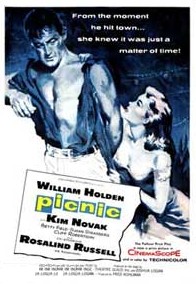
What’s The Matter With Kansas-1950s Style?-With Kim Novak
And William Holden’s “Picnic” (1955) In Mind


DVD Review

By Guest Writer Bartlett Webber

Picnic, starring Kim Novak, William Holden, Rosalind Russell, Susan Strasberg, from the play by William Inge, 1955

Maybe it was the first scene where Hal, played by William Holden, jumps off the hobo freight train that set me up to like this film under review, the film adaptation of William Inge’s play Picnic. Ever since my old time growing up days in North Adamsville whenever the trains came by and some dusty local hoboes, tramps or bum (and there are distinctions between them recognized by the whole wandering nation) or passers-through hopped the skids I have been entranced by this whole scene. Spent back in Summer of Love days when I (and an assortment of guys who I hung around with in high school) headed west to see what was up in San Francisco many a night myself on the rattlers (well-named when the hours passed and all you heard out in the prairie was that freaking rattling). So I saw Hal as a wild-eyed spirited forbear.     

I set the headline up the way I did, asking rhetorically what the matter of Kansas was, for a purpose. No, not today’s more political purpose when many are asking what happened to convert one of the reddest states in the nation back in the day (“red” then meaning socialist red) to today’ Republican conservative red but why is everybody in this film ready to heave-ho the old time prairie small town values to get the hell to somewhere else (even if only the next town or next state over).       
  
Here’s the play and you figure out why, okay? That first scene Hal, the muscular brawny hobo saint who shows plenty of 1950s “beefsteak” to an appreciative 1950s female audience), when he lands in this small Podunk town was no accident. He, long weary and without current prospects, expects an old rich father college buddy, Alan, to help him out, get him a fresh start. (Hal obviously had been on hard times since the days when he flunked out of college for lack of study even though he had had it made as the college football hero.) At first it looked his reconnection with that college buddy idea was going to get him back on his feet. But then he spied her. Spied Madge, played by a young and fetching Kim Novak. Moreover Madge spied him and then the dance of dances began. 

All of this taking peeks got its big workout at the town’s annual Labor Day picnic where Madge, know universally for her good looks and apparently not much else, was to under Alan’s guidance be crowned Queen of the May. Hal and Madge are still looking though as they all, Alan, Hal, Madge, Madge’s brainy younger sister Millie, played by a young Susan Strasberg, Madge’s mother and an older neighbor woman head to the picnic and the fun-filled activities that usually go along with such small town festivities, maybe a big town’s too. Then the night falls and the stars seem to be aligned. And for anybody who doesn’t get that idea then you have missed probably the closest thing a 1950s film gets to the act of intimate sexual attraction, of an explicit sexual scene except unlike now with clothes on, when to the strains of Moonglow they dance the dance most of us have all been through.

From there though as can be expected of a guy like Hal who was all fire and motion things go downhill. Alan, as expected, was in a rage that Hal stole his girl and put the rich father-friendly local cops on him for “stealing” his car. Hall gets into a beef with the coppers so we know why he will be on lam (to next state Tulsa). Millie who is eternally humiliated for being a “plain jane” compared to big sister Madge swears she is going to New York and become a great writer once she gets the dust of small town Kansas out of her system. In a side story an “old maid” schoolteacher, played by Rosalind Russell,   desperate to get married and flee her fate gets hitched and blows the burg. And Madge? Well Madge despite those golden prospects with Alan, despite her mother’s admonitions that she can do better than hobo Hal and with little sister’s blessing blows that small town as well (to next state Tulsa as well).           


See this film if only for that “dance” scene which will make you sit up and take notice even in today’s jaded explosive screen sex world. Oh yeah, if you are a guy start practicing those jazzy hip William Holden dance moves. If a gal check out Kim Novak’s “come hither” moves that had even an old guy like me thinking funny thoughts.    
The “Cold Civil War” In America Deepens, Widens-Support The Pro Football Players (And Now Other Athletes) Protest-Build The Resistance  


By Political Commentator Frank Jackman

As I have noted on a number of occasions, many more time lately, over the past decade that I have been associated with this blog all the ingredients for a classic civil have been brewing in this country, in America. The social tinder created by the very unequal class-war that the rich and very rich have been winning for the past few decades has reached its symbolic fruition in the personage of one Donald J. Trump, POTUS  in tweet speak. The widening gap between rich and poor the most obvious manifestation of that brewing conflict has now been joined by other events like Charlottesville where an armed right-wing demonstration expressed for all who cared to notice that the cold civil war has begun to get hot. Now we are witnessing protests of a very different sort from an unexpected quarter. Usually in the past when dealing with professional athletics it was question of supporting a job action, a strike or protesting a lock-out but today I am defending the right to free expression-and welcoming other potential allies to the growing resistance.   

A look at history, a look at American history from the 19th century the last time this country had a civil shows that beyond the main political disputes (over slavery and its extension or abolition) that lines were being drawn on all sorts of other segments of the population which further divided the two sides. For example, the split between various mainly Protestant religious organizations between Northern and Southern brethren. And drew in parties, like musicians, one would not expect to see take a side or get involved.    

That is the import of the recent wave of protest actions (and reactions by one Donald J. Trump, POTUS in tweet speak, and his dwindling crowd of supporters) by of all people a lot of professional football players (and as I write other athletes in other sports are making moves into the protest arena. Now that football has clearly replaced baseball of the epitome of “American as apple pie” it is almost shocking that this segment of society would rear up and take a stand.  Great. Every serious person needs to support these intrepid protesters. That is the ABCs of knowing which side you are on when the deal goes down. Support and defend the righteous players.    

More later as the repercussions of this struggle play themselves out.
I will finish with an ominous observation. Right now the 15th POTUS (in tweet speak), one James Buchanan, has been holding down the fort at the bottom of the dung heap of American President (although my candidate was, and is, Millard Fillmore for the heap). He can now begin to rest easy in his grave as one Donald J. Trump stumbles down to take his place (hopefully not taking the rest of us down with him which is not as unlikely as it sounds). The ominous observation? James Buchanan was the last POTUS before the Civil War and one who did a fair amount of work helping push that conflict front and center. Enough said.   


Sunday, September 24, 2017

It Do Not Mean A Thing If You Ain’t Got That Swing-With Swing-master Benny Goodman In Mind

It Do Not Mean A Thing If You Ain’t Got That Swing-With Swing-master Benny Goodman In Mind


CD Review

By Zack James

[This is an on-going conversation between several aging males who back in the day were corner boys together growing up in the poor working class Acre section of Riverdale some miles outside of Boston. The theme of the remembrances is related to rock and roll and other musical influences and the exact date, place and scenario where certain seminal experiences occurred-Listen in- Z. J.]

“Jesus, now that you mentioned Mr. Lawrence, our seventh grade music teacher, I am starting to remember some other stuff about the guy, about what a creep he was trying to break us from our unbreakable bond with rock and roll,” Seth Garth said to Jack Callahan as they both hoisted their three, or was it fourth, double scotch with water chaser, an old habit for both of them since the chaser made the drink last longer in the old days when they were short of dough and were sipping their drinks to stretch out the evening. The gist of what Seth had told Jack was in response to Jack’s remembering the very first time that they had heard Woody Guthrie and what song they had learned first. That gist of talk was based on Seth, an old time folk music critic, mainly for The Eye out on the West Coast having recently seen in a folk magazine the announcement that the Smithsonian/Folkway operation was finally putting out a treasure trove in four CDs of some Woody Guthrie songs recorded by Moses Asch during World War II. Seth for the life of him could not remember what song he had heard and when of Guthrie’s and so he had called upon Jack to meet him at their favorite watering hole the Erie Grille in Riverdale where they both were now residing (and after varying absences had grown up in the town). Jack had answered that it had been in Mr. Lawrence’s seventh grade music class and the song had been the alternative national anthem-This Land Is Your Land. 

The method to Mr. Lawrence’s madness, to ween the kids off of rock and roll, had gone beyond trying to foist silly folk music off on them but to drown them in any other kind of music he could think to distract, or attempt to distract them with, especially during lunch when they played their transistor radios and drove him crazy with their rock and roll. A few times, if you could believe this he tried to get them interested in jazz, in swing music, what each and every one of them considered the music that their parents listen to and which had driven them to the transistors in the first place. Worse, worse of all he had tried to get his charges interested in the music of Benny Goodman, the so-called “king of swing.” That was all Seth needed to hear as he blurted out in front of the class “My mother and father dance to that pokey stuff on Saturday nights and they are barely moving when they dance. I am not going to listen to that here.” Needless to say Seth stayed after school a number of afternoons for his transgression. But he felt vindicated in what he had uttered and took the punishment like a soldier.
Still it did no good as Mr. Lawrence played something called Blue Skies which was his parents’ “their song.” Something else by a guy named Cole Porter that Benny Goodman made famous. It got no better when Mr. Lawrence played stuff with Peggy Lee because to his mother’s chagrin his father had “crush” on old Peggy and Seth had to secretly admit that she was kind of sexy looking at that.  


But that was then. A few nights after Seth and Jack were cutting up old touches, after drinking themselves to melancholia, Seth went to the library and picked up an old Benny Goodman CD with plenty of American Songbook stuff on it. Guess what old Seth, old rock and roll devotee Seth with an overhang of folk, blues, and a little mountain music started to pop his fingers to the beat, started laughing to himself that he know knew what they meant when they said “it don’t mean a thing if you ain’t got that swing.” And they were right. Just ask Benny,       

Thursday, September 21, 2017

When Old Pete Ruled The House-With Banjo Man Pete Seeger In Mind  


CD Review

By Zack James

Pete Seeger: headlines, footnotes and-a collection of topical songs, Pete Seeger, Smithsonian/Folkways, 1999
“You know you are wrong Seth about that first time we heard folk music, Woody Guthrie folk music in Mr. Lawrence’s music class back in seventh grade at old Jeramiah Holton Junior High,” Phil Larkin told one Seth Garth former old time music critic for the now long gone The Eye. Paid music critic a not unimportant point back in the day when alternative newspapers like The Eye survived and flopped on the sweat of unpaid unrequited volunteer labor and today too when the social media are flooded with citizen critics by the barrelful and everybody claims some expertise. Paid or not though Seth had called up Phil to verify what his fellow folk aficionado Jack Callahan and more recently drinking partner at the Erie Grille had told him when he had called upon Jack to refresh his memory about the first time he/they had heard a Woody Guthrie song. Jack had told Seth about the time that Mr. Lawrence had tried to unsuccessfully ween the class away from their undying devotion to the jail-break rock and roll music that was sweeping up youth nation just then. Then being the late 1950s. Seth had accepted what Jack said because he was after all a fellow aficionado, even if Seth had had to shoehorn him into the genre at the beginning and because he knew that Jack would not spread word around that Seth was not totally on top of every bit of arcane folk music lore around.  

So it was a reputation thing Seth was worried about even these many years later. He had mentioned Jack and his conversation at the Eire to Phil in passing one afternoon and Phil had said he would think about any possible earlier listening. This was important since Seth had become very cautious about using any information not fully verified ever since early on in his journalistic career he had made the cardinal error of not checking out hearsay and rumor fully. He was berated by his tough editor for that mishap. Never again. So he was using his double check method on this question since he had been asked to write an unpaid article about the old folk days for the prestigious American Folk Song Review.    

Phil continued the conversation by telling Seth, “Tell that jackass Jack Callahan didn’t he remember that in fourth grade Miss (now Ms.) Winot had played This Land Is Your Land  on that old cranky record player of hers in order to teach us some kind of  civics lesson, taught us that we were part of a great continental experiment. Remember that she had played the Weavers’ cover of that song with Pete Seeger doing that big bass voice thing and some other guy whose name I don’t remember was booming out the baritone and Ronnie Gilbert who just passed away was doing a big time soprano thing.” Jesus, Seth thought to himself Phil was right, right as rain. The two spoke of a few other non-music issues and then they both hung up.           

That was not the end of it for Seth though, not for his article anyway. See Phil’s mentioning of the name Pete Seeger had sent a chill down his spine. Pete Seeger, and only Pete Seeger had been the reason that he had been ever cautious about sources. Back in 1965 he (and Jack and Jack’s then girlfriend now wife, Kathy, and he thought Mary Shea was his date) had attended the Newport Folk Festival that summer. That was the summer that Bob Dylan exploded the traditional folk universe by introducing the electric guitar into some of his songs. Did so on the stage the final night of the festival to boos and applause. Seth had been working his very first job as a free-lancer for the East Coast Other, another of the million small publications starting up and falling trying to find a niche in the print universe (free-lancer by the way since the usually cash-stripped publication had nobody else going to the concert so Seth got the assignment).   

Here is where Seth had gotten into trouble though. He had a friend, a sound man friend who worked at the Club 47 in Cambridge who was doing duty at that job for the festival. A couple of days later he had run into the guy in Harvard Square and had asked Seth if he knew what had happened on the stage the night Dylan went electric. The guy swore that Pete Seeger had at some point pulled the plug on Dylan in disgust at taking folk music out into the common trough of rock and roll. Seth could hardly believe his ears-this was the hook that he would run his story on. In the event he put this hearsay into his article. No big deal, right. Just something to spice up the piece. The article was published with that information in it. No problem for a while. About a month later he was called into Larry Jeffers office, the editor of the East Coast Other then and shown a personal letter to the publication from Pete Seeger disclaiming the whole story about pulling the plug on Dylan and was looking for a retraction. Seth immediately went to the Club 47 to check with the sound man. It turned out that the sound man had not actually seen Pete pull the plug but had heard about the story from one of Dylan’s sidemen. The newspaper issued a retraction and Seth had egg all over his face.          


The whole story of whether Pete Seeger pulled the plug or not on Dylan became part of the urban legend of the folk scene and still has devotees on both sides of the dispute long after Pete is dead and Dylan in out on another leg of his never-ending tour. But you can bet six two and even that one Seth Garth will be checking sources to see if Miss (now Ms.) Winot was the original proponent of Woody Guthrie’s music. Enough said.     
When Mister Beethoven Got Rolled Over-With The Music Of Mister Chuck Berry In Mind


CD Review

By Zack James

Chuck Berry: The Definitive Collection, Chuck Berry, Chess Records, 2006 

You never know when two or more old guys, two or more mature forget the old unless you seek peril gals too but this one is about guys, will gather down memory lane or what will trigger that big cloudburst. Seth Garth and Jack Callahan two old time friends from high school in Riverdale had an abiding interest in music successively rock and roll, the blues and folk music (never losing interest in any in the process just that one would wax and wane at any given time). Seth had eventually become as an early part of his journalistic career a music critic for the now long defunct The Eye, an alternative newspaper out in the Bay Area in the days when he, Jack and a few other guys like Phil Larkin headed out there to see what everything was all about in the intriguing Summer of Love, 1967.

Recently though Seth and Jack, and occasionally Phil would get together and talk music shop at the Erie Grille where they would down a few scotches to level out (their expression). One night they had been at Seth request discussing the first time they had heard the legendary Woody Guthrie sing his songs, or one of them anyway. As it turned out Seth had drawn a blank on when that might have occurred and he begged Jack to think the matter through since he was preparing an article, an unpaid article, for the American Folk Music Review and needed a frame of reference. Jack had come up with the answer-in Mr. Lawrence’s seventh grade music class when he put on Woody and a bunch of other stuff to try to ween them off rock and roll which the man hated (and which they loved, loved to perdition). Seth had accepted that answer (although later he contacted Phil again about the matter and Phil reminded him about the song This Land Is Your Land covered by the Weavers with Pete Seeger in Miss Winot’s fourth grade class on her cranky old record player and he would use that source in the article).     


All this talk of that fateful seventh grade music class, and Mr. Lawrence, is probably what solidified everybody in the class in their devotion to rock and roll. But that was a hard fought and paid for devotion. A few days after the night with Jack at the Erie Grille Seth woke up from a nap thinking about the time in Mister Lawrence’s class when he was being crazy about Beethoven, wanted the class to appreciate classical music.  Seth, Jack and Phil had had enough and started in one class singing Chuck Berry’s throwing down the gauntlet Roll Over Beethoven and the class cheered them on. Of course in this penalty-ridden world Mr. Lawrence took his revenge and the trio spent several afternoons after school since they refused to apologize for their outbursts. Seth smiled to himself-Yeah, rock and roll will never die. To prove that assumption just listen to Mister Chuck Berry’s gold star compilation here. And be prepared to do something rash.     
The 50th Anniversary Of The Anti-Vietnam War March On The Pentagon (1967)-With Norman Mailer’s “Armies Of The Night” In Mind (1968)  


By Political Commentator Frank Jackman  
  
Earlier this year driven by my old corner boys, Alex James and Sam Lowell, I had begun to write some pieces in this space about things that happened in a key 1960s year, 1967. The genesis of this work has been based on of all things a business trip that Alex took to San Francisco early this spring. While there he noted on one of the ubiquitous mass transit buses that crisscross the city an advertisement for an exhibition at the de Young Art Museum located in Golden Gate Park. That exhibition The Summer of Love, 1967 had him cutting short a meeting one afternoon in order to see what it was all about. See if he was just having a “flashback” (not uncommon back the day for those who did not take their Kool-Aid straight but laced with mysterious chemical imbalances). What it was all about aside the nostalgia effect for members of the now ragtag Generation of ‘68 (an AARP-worthy generation but I prefer the less commercial Generation of ’68 to tag that crowd, my crowd) an entire floor’s worth of concert poster art, hippy fashion, music and photographs of that noteworthy year in the lives of some of those who came of age in the turbulent 1960s. The reason for Alex playing hooky from his important business meeting was that he had actually been out there that year, had been out in Haight-Ashbury-etched 1967) and had stayed and imbibed deeply of the counter-culture for a couple of years after that. (Imbibed not in running out of steam fast Frisco but on a magical mystery tour yellow brick road former school bus courtesy of Captain Crunch which went up and down the West Coast searching, hell, just searching.)

Alex had not been the only one who had been smitten by the Summer of Love revival bug because when he returned to Riverdale outside of Boston where he now lives he gathered up all of the corner boys from growing up North Adamsville still standing to talk about, and do something about, commemorating the event. His first contact was with Sam Lowell the old film critic who also happened to have gone out there and spent I think about a year, maybe a little more. As had most of the old corner boys for various lengths of time usually a few months. Except me which I will explain in a minute. Alex’s idea when he gathered all of us together was to put up a small commemoration book in honor of the late Peter Paul Markin with memory pieces by each of us. See Markin, always known as “Scribe” after he was dubbed that by our leader Frankie Riley (now a big time lawyer with a swanky office in downtown Boston but then poor as a church mouse and nothing but a serious con artist), was the first guy to go out there when he sensed that the winds of change he kept yakking about around the corner on desolate Friday and Saturday nights when we had no dough, no girls, no cars and no chance of getting any of those quickly were coming west to east.

Once everybody agreed to do the book Alex contacted his youngest brother Zack, the fairly well known writer, to edit and organize the project. I had agreed to help as well. The reason I had refused to go to San Francisco then had been that I was in the throes of trying to put together a career as a political operative by attempting to get Robert Kennedy to run against that naked sneak thief of a sitting President, Lyndon Baines Johnson, who had us neck deep in the big muddy of Vietnam and so I had no truck with hippies, druggies or “music is the revolution” types like those who filled the desperate streets around Haight-Ashbury. Then.  Zack did a very good job and we are proud of tribute to the not forgotten still lamented late Scribe who really was a mad man character and maybe if he had not got caught up in the Army, in being drafted, in being sent to Vietnam which threw him off kilter when he got back to the real world he might still be around to tell us what the next big trend will be.              

[I should mention here for the young or clueless something about corner boy culture since you no longer see guys hanging around corners at variety stores, pizza parlors, bowling alleys and the like as that scene has successively been replaced by mall “rat-dom” and now “don’t look up from the fucking phone” social media. (Don’t see gals either for the same reasons although back in the day the gals hanging around corners were with guys, glued to guys, otherwise they generally were inside say Doc’s Drugstore soda fountain or the pizza parlor spending their who knows where they got it discretionary money throwing dimes and quarters into the jukebox to play the latest heartthrob tunes). Corner boy-dom was a rite of passage in working class neighborhoods like the Acre section of North Adamsville where we grew up having certain corners passed on to you as you grew older like our progression from Harry’s Variety in elementary school to Doc’s Drugstore in junior high to Tonio Pizza Parlor in high school and beyond.

You, we, I hung on the corner for a very simple reason in those days- no dough. No serious dough although everybody had some scam from roughing up younger siblings for coin or a back door sneak at mother’s pocketbook to the midnight creep which best be left at that since who knows if the statute of limitations has run out on those high crimes and misdemeanors. No dough meant no car, meant nowhere in golden age of the automobile America where any guy with a car, handsome or ugly, had some young thing sitting very close in the front seat of his Chevy something. Meant even if you could find a girl who didn’t mind taking the bus or walking you had no money for dates even for a cheapjack movie date much less say hitting a drive-n restaurant. And no dates meant no girls hovering around which meant the corner with that cohort of guys in the same condition as you. Meant having a bunch of sullen surly guys with time on their hands, lust and larceny in their hearts, and an overweening desire to fall outside the law. That most of us survived is amazing but it was a close thing, very close.]

That initial impetus to think about 1967 at a time when I was in love with Robert Kennedy and that kind of grass-roots progressive politics of which we see very little now led me to do a piece about the first Monterrey International Pops Festival held at the beginning of that summer and where revered names for the Generation of ’68 like Janis Joplin, Jimi Hendrix and Ravi Shankar (he, additionally the papa of today’s Norah Jones) had made their first big splashes. I always loved the music, always loved to go to concerts, generally free or cheap concerts if you can believe that in these days of nostalgia high-priced tickets for groups and singles well beyond their primes on Boston Common and elsewhere and hear what was what. Those were the days when I heard the first stirrings, and maybe half wanted to believe it was true, that “the music was the revolution.” That somehow new sounds and the emerging lifestyle, the hippie lifestyle of communal sharing, good vibes and easy going would be the impetus for a new ethos. That some idea of “dropping out” of bourgeois society (not a term I would have used then but which now kind of fits what I am getting at) would bring the new utopia onto our doorsteps. The Scribe and the others at the time having been through the initial stages of the Summer of Love out in the West were filled with such ideas to the extent that they could articulate such a vision. (The Scribe was able to and did at the time and carried the others with him.) I was having none of it, or very little, since at that time I neither believed in any kind of revolution nor did I think that society needed anything more than tweaking (with me helping the throw the tweak switch.) I argued against and I believe, unfortunately, that those who professed the “music is the revolution” idea have been shown to have been totally over their heads and left no serious mark on the social fabric.                        

There was another trend, another 50th anniversary trend which I would argue was counter-posed to the above mentioned theory. This event is the 50th anniversary of the famous, or infamous, March on the Pentagon in October of that year. The one that the late writer Norman Mailer wrote about in his well-received and highly honored The Armies Of The Night a review of which I have reposted elsewhere on this blog. That event was not the first massive Washington anti-Vietnam War demonstration (the first had been in New York in 1965) nor the first to feature acts of civil disobedience but it was the first threshing out, the first understanding that something big was going to be needed to stop the fucking war. That the government was not going to stop the madness on its own hook. Moreover that despite whatever residue remained from the intoxicating Summer of Love “dropping out” under the rubric of the “music is the revolution” mantra was not going to create the “newer world” in the words of the English poet Alfred Lord Tennyson those of us from supporters of Robert Kennedy to the left were seeking.         

Of course as described in detail including an overabundance of detail about his own part, his own arrest in the melee by Mailer this effort was very much a helter-skelter thing with mixed results. The key idea to be taken by any serious anti-war militants that the government (run by either major party as it later turned) was going to viciously thwart any such people’s efforts to bring an end to the damn thing. There would be a parting of the ways essentially not only between “drop out” and “confrontation” partisans but within the confrontationists camp a split over peaceful mass marches and more vigorous actions. The March on the Pentagon was the laboratory for all those ideas from “levitating” the place to a guerilla warfare-type actions to shut the place down.    

Of course today I am commemorating an event, not for the first time, that at the time I was adamantly opposed to, saw as very disruptive to the attempts by first Senator Eugene McCarthy and his insurgent run at Lyndon Baines Johnson and later after Johnson’s withdrawal from candidacy by Robert Kennedy to solve this problem through parliamentary means. In short while I was vaguely anti-war, or thought I was only at that level, I did not participate in or honor such efforts. The turning point would be later, the next year as it turned out, when I was drafted by my “friends and neighbors” at the Draft Board in North Adamsville (that greeting was how the letter of induction actually started) and accepted induction even if half-heartedly in the U.S. Army. I have written, and others have written as well, about my complete turnaround once I was inducted and of my two year struggle including serious stockade time for refusing to go to Vietnam. One of the books I read during that time was Mailer’s The Armies Of The Night taking to heart some of the lessons from that experience (although still a bit put off by the centrality of Mailer’s ego in the whole process).


Here is the payoff though. In the spring of 1971 shortly after I had been released from the Army I started hanging around with a bunch of Cambridge radicals. The big idea at the time was to have a massive May Day civil disobedience action in Washington around the theme-“if the government does not shut down the war, we will shut down the government.” I did not even think twice about not going, of not getting arrested and of thinking that such as action was desperately necessary. Although I drew some other conclusions about how to end war from that aborted experience I saw it as a continuation of that struggle at the Pentagon in 1967. And whatever else I never regretted my actions in 1971 and I hope those who were at the Pentagon in 1967 have not either, not in these desperate times.