This blog came into existence based on a post originally addressed to a fellow younger worker who was clueless about the "beats" of the 1950s and their stepchildren, the "hippies" of the 1960s, two movements that influenced me considerably in those days. Any and all essays, thoughts, or half-thoughts about this period in order to "enlighten" our younger co-workers and to preserve our common cultural history are welcome, very welcome.
Sunday, April 22, 2018
On The 100th Anniversary Of American Entry In World War I (1917)-The Golden Age Of The Musical-Judy Garland And Gene Kelly’s “For Me And My Gal” (1942)-A Film Review
DVD Review
By Si Lannon
[Although a few regular readers has asked when this bracketed insert below the name of the writer will be curtailed we feel that given the dramatic internal shake up at American Left History with the ouster of the now gone missing Allan Jackson (who used the moniker Peter Paul Markin which Zack James explained in a recent film review of Paris When It Sizzles see April 2018 archives) we should continue to do so as long as we are giving each writer full sway to discuss his or her take on the matter. So as mentioned previously as of December 1, 2017 under the new regime of Greg Green, formerly of the on-line American Film Gazette website (and through that on-line site linked to theAmerican Folk Digest, Progressive American and Modern Book Library sites), brought in to shake things up a bit.
This shake-up, a major earthquake here given his longevity, after a vote of no confidence in the previous site administrator Peter Markin was taken among all the writers at the request of some of the younger writers abetted by one key older writer, Sam Lowell, means the habit, Markin’s habit of assigning writers to specific topics like film, books, political commentary, and culture is over. Also over is the designation of writers in this space, young or old, by job title like senior or associate which Markin instituted over the past few years as he brought in desperately needed younger blood as a “firewall” between him and anyone who might try to tip the increasingly bizarre balance of coverage to the narrow sphere of the turbulent 1960s. After a short-lived experiment designating everybody as “writer” suggested by a clot of older writers seemingly seeing the recent struggle as off-shoot, as an emulation of the French Revolution’s “citizen” or more to the point given the political personal histories of some of the clot member, the Bolshevik Revolution’s “comrade” all posts will be “signed” with given names only. The Editorial Board]
“For Me And My Gal,” starring Judy Garland, Gene Kelly, George Murphy, 1942
[A number of reviews, commentaries and opinion pieces of late at this American Left History blog site have been prefaced like I am doing with the writer’s take on the recent shake-up at this site with the sudden ouster of the now missing Allan Jackson (aka Peter Paul Markin) at the direction of the newly installed Editorial Board and new day to day site administrator Greg Green. I don’t wish to belabor the points already made by both older and younger writers except as an old-time high school friend I am sure that Allan, as has been his nature since about fourth grade, as far as I know is off on a sulk and neither in forced exile in Siberia or its equivalent Utah (although if it had been rumored that it was Alabama I would get out my old history book on the internal struggle in the Bolshevik party between “Uncle Joe” Stalin and torch-carrier Leon Trotsky). He will be back as always. See Allan lived in the shadow of the real Markin, who passed away many years ago and which we have written extensively about in this space, and never really felt he was as good as Markin which led to many problems back then. And now too I suppose.
But enough of that since what I want to write about since I am reviewing this Judy Garland-Gene Kelly dominated musical is that Allan hated musicals or I should say musicals that were not from the 1960s. If you wanted to do a retro-review on Hair, Tommy, Jesus Christ, Superstar be his guest. Otherwise say you wanted to review Chicago forget it. Look at the archives, almost nothing earlier or later. The only way to get such a review through was as a re-post from say American Film Gazette and he had to honor our common commitment on publishing. My feeling, my gut feeling, since we are being candid here is that he did not like musicals because, well, because the real Markin hated them which I will go into a little when I actually get to the review. The only serious exception Allan would make was for Fred Astaire vehicles because of the dancing not because of the music even though that was created by the likes of Cole Porter, the Gershwins, Jerome Kern, Irving Berlin all of whom he loved as part of the American songbook. (By the way the real Markin loved them too so maybe I am on to something).
Allan did let up a little of late but really only for Gene Kelly vehicles to demonstrate how much better a dancer Fred was against Gene. And truth to tell because he confided this to me while the internal struggle was going on since I supported his retention he relented a little to throw a bone to the younger writers. Enough for now.]
*****
When Allan, the real Markin ( I will just use Markin hereafter), and I were just out of high school, maybe the summer after graduation we went down to Provincetown to see what was up with what we heard was a swarm of faggots, fairies, sissies, light on their feet guys, whatever, you know gays today. (Provincetown then and today as well Mecca for gays and lesbians mixing it up with the dwindling surplus of native Portuguese heritage fisherman.) Walking down the street we saw a poster-board or whatever they call them in front of Lazy Daisy’s which may still be their although the original owners must have long passed since they were old then announcing a talent night. Since it was getting dark we figured we would go inside and see what there was to see. Jesus, what we saw were “drag queens,” transvestites, cross-dressers, trans-genders although I know that was not a term of usage then. Whatever you called this scene and we settled on “drag queens” the talent in front was everything from Miss Patti Page, Miss Peggy Lee, and this is why I have started this review this way Miss Judy Garland. Christ half the acts were doing some song of hers starting from that old rubbish Somewhere Over The Rainbow from the Wizard Of Oz. Markin was in full grim after that one as much as I said he loved that part of the American songbook. So Allan was in full grim too. I think, and the archives will bear me out, there is not one reference to Judy Garland in all the years this publication has been around. It might, at least I suspect that it might, have something to do with Markin’s own sexual ambivalence and thus Allan’s, but I will let the pyscho-scholars figure that one out.
So it is actually for me a breath of fresh air to review a Judy Garland effort as here with For Me And My Gal although since it has a significant portion of the film extolling American entry into World War I with everything from war songs to war bonds to war-mongering which although I am not anywhere an American Firster like I was when I was a kid I retroactively have opposed as just another bum American government blunder. Since this year is the 100th anniversary of American entry into that war it has a sense of poignancy which explains a lot of the naiveté about war that we one hundred years later have come to distrust with a vengeance.
At bottom like half the film ever made, if not more, and many of the novels as well this is just another “boy meets girl” saga set to music and dance with the lead actors, Judy and Gene, bursting into song and/or dance every chance they get before realizing they were, ah, in love and chaise get ready to do something about the matter-get married. Let me back up a little to give some background. This one is set in the days just before World War I when the main way to give the masses some entertainment out in the prairies, small towns and such were vaudeville shows. That’s is where “from hunger” Harry, Kelly’s role, is ready to do anything from stealing songs to ditching professional partners to get to the big white way, to get to Broadway and the real deal and Jo, dear sensibly warm-hearted Jo, played by Judy Garland meet and hate/love each other before the deal goes down.
The deal being that just before they are as a professional team ready to hit the bright lights WWI gets in the way when Harry is drafted. Being a “main chance” guy he tries the old honored draft dodger special which guys have been doing since governments have been impressing soldiers for their needs-fakes and injury bad enough to get him out of the draft. That does not sit well with Jo whose younger brother had been killed in France early in the American intervention. She calls the whole thing off with this bum of the month and heads to Europe to entertain the troops with a YMCA troupe. Forget that bastard Harry and sing every possible WWI song that Tin Pan Alley could produce for the war effort from sentimental to super-patriotic. Remorseful Harry finally gets on that patriotic bandwagon and they meet again (don’t know where, don’t know when, oops that’s a Dame Vera Lynn WWII song) via the YMCA circuit. And love again.
Like I said boy meets girl out of uniform and in. Two points as hard as it to believe Judy out-dances Gene by a mile and you know now I see why all those “drag queens” were so crazy to do Judy Garland stuff. Sometimes you can learn like that something in this wicked old world.
“The Hardest Working Man In Show Business”- “Mr. Dynamite”-The James, Please, Please, Please Brown Story (2014)-A Documentary Review Of Sorts
DVD Review
By Josh Breslin
Mr. Dynamite: The Rise Of James Brown, starring James Brown, the Famous Flames, and others, 2014
No question I wanted to do this documentary evaluation of the life and times of the “godfather of soul” James Brown who came all surly and cocky out of Augusta, Ga around the middle third of the 20th century and had to fight off Sam Lowell, the former chief film editor here and now something of an emeritus although such designations are frowned upon under the new dispensation of one site manager Greg Green. The reason that I wanted to do this review though is probably not exactly what the reader would think-the place of a man, a black man in the history of rock and roll, of soulful rock, and his effect on young white guys who came up dirt poor in places like North Adamsville and Carver, Ma and Olde Saco up in Maine without the racial harassment part that James suffered growing up in the redneck, white supremacist Southern non-hospitality. Maybe say three or four years ago I might have centered on those points and only made some pointed but passing reference to his shameful treatment of women throughout his life.
But in the age of #MeToo that is hardly an adequate way to treat his life. The problem, a problem Sam Lowell first brought up a couple of years ago when he did an Alfred Hitchcock film review is exactly what one, no, what a male reviewer, or maybe any reviewer is supposed to do about some kind of balance between whatever cultural meaning any performer from acting to painting and everything in between has on society and the personal life factors where the power balance is askew. I cannot help but in the back of my mind in the case of James Brown be aware that his art, however much honored and historically relevant, is decisively marred by his personal hostilities and actions toward women.
James Brown came up from the dirt down in Augusta, Ga from a family setting that was not good. He “escaped” via music first through the gospel traditions which a number of musicians from his generation and a little later were grounded in. Later moving “uptown” to rhythm and blue he latched onto various groups which would evolve into the Famous Flames and form the core of back-up bands under various names for most of his early career. The big breakthrough hit was Please, Please, Please in 1956 which had enough sexual energy and innuendo to become something like an anthem for the post-World War II baby boomer generation which was in many ways trying to break out of the many-sided box they had been raised in from sex to patriotism. After that it was more a question of refining his music to ride with the times for a while as long as rock and roll had some energy left. Subsequently he moved on to become, well, the Godfather of Soul, the precursor of funk that had its heyday before hip hop nation emerged in the 1980s, No question James Brown on a professional musical basis deserved all the awards and honors he received all the way up to induction in the Rock and Roll Hall of Fame.
To show how the contradictions worked James Brown also created many songs headed by I’m Black and Proud which became something of an anthem itself although he disclaimed the publicly accepted militant sense of the song. He also went against the black stream politically hanging out with weirdo Republicans like Nixon and Reagan. He fired band members for using drugs yet he had his own drug jones, was practically a junkie. The list of number of allegations of domestic violence is staggering and in the end would do him in. His claim to fame that he chilled the crowd at a concert in Boston when Doctor Martin Luther King was assassinated seems rather an exception to his life although no question he did keep violence epidemic elsewhere down in that town. Maybe it is best to say today in 2018 that like a lot of other men whose cultural talents are unquestioned James Brown carries the sins of his times heavily on his back. That is the best I can do here since he will be among the exhibits of how primitive we were when societies evolve beyond sexism, sexual abuse, domestic abuse, racism, classism and all the other oppressions which hold back humankind.
Saturday, April 21, 2018
The Roots Is The Toots: The Music That Got The Generation Of ’68 Through The 1950s Red Scare Cold War Night-As The 50th Anniversary Year Of The High School Class Of 1968 Rolls Along… “Forever Young” (Magical Realism 101)-With Ritchie Valen’s Oh, Donna In Mind
By Allan Jackson
A Story As Told To Frank Jackman
[As I have mentioned previously a lot of the throwback to this series got its start via modern technology specifically around the now fabulous ability to “connect” with people from back in the day, at least the people who want to be connected with and have not left “no forwarding address” on their personal lives by keeping under the radar of modern conveniences and ways to grab information. (I won’t even speak here of NSA-type overreaching or social media platform privacy matters although I could. I know I was able to connect with a number of my corner boys still standing via such methods, and was able to connect with those from my high school graduation class when it came time for a too high a number class reunion celebration. That process similar to the story here told to Frank Jackman who as some may know was originally used in this series as a “front.” As the guy who did the modern introductions to the series.
A lot of this use of technology to connect with the past I think can be attributed to members of our generation of ’68 having time on our hands to think about the various roads that were, or could have been, taken. To wonder, wonder like we wondered when we were young and the world was fresh, Fitzgerald’s wonder at the fresh green breast of the new world of those ancient Dutch sailors who came up Long Island Sound before everything began to get spoiled and seek to find some answers while we are still standing and the question still has some urgency before we fall under the earth and face the big sleep which makes such inquiries irrelevant. I take special interest in this rather short sketch because, for one flickering moment, all those dreams, what did the teller call them, yes, puff-cloud dreams came back to the ground and made some sense. The wisdom of age might be overrated but not the dream of those puff-cloud dreams. Allan Jackson]
Forever Young-lyrics by Bob Dylan May God bless and keep you always May your wishes all come true May you always do for others And let others do for you May you build a ladder to the stars And climb on every rung May you stay forever young Forever young, forever young May you stay forever young
May you grow up to be righteous May you grow up to be true May you always know the truth And see the lights surrounding you May you always be courageous Stand upright and be strong May you stay forever young Forever young, forever young May you stay forever young
May your hands always be busy May your feet always be swift May you have a strong foundation When the winds of changes shift May your heart always be joyful May your song always be sung May you stay forever young Forever young, forever young May you stay forever young
Whee, Am I glad that my own 50th anniversary reunion at North Adamsville High in Massachusetts is over, done, complete and that the “magic” year 1964 has slipped into 1965 and I, no one, has to worry about an odd-ball 51st anniversary celebration. Of course in all the hoopla over the 50th anniversary reunion with some classmates setting up a reunion committee (which I assisted around the edges doing odds and ends chores), setting up a big bang class website to draw everybody still around and computer savvy enough to find the Internet, finding a super place to have the event, and setting up the thing on the fall weekend when it occurred I actually, didn’t, couldn’t go to the event. That is a long story, a story about old time teen angst and alienation, about trying to retrace what could not be retraced in a hundred lifetimes, and about how in words taken from a title of one of Thomas Wolfe’s novels-you can’t go home again.
Nevertheless before I could understand the import of those last words, understand that it was better not tempt the fates an angle that developed in the process of helping the reunion committee I wrote a number of small memory-etched sketches for the class website reflecting specific events like high school dances and football rallies, reflecting on various local customs and places like “watching the submarine races” and corner boy hanging out times, that kind of stuff some specific to the town and class, others more broad-based. The following sketch is a reworking of one from the latter category which is “forever” appropriate as long as somebody, some cohort of people make it to 50th anniversary reunion time. I hope that if you want to go to your 50th nothing stands in the way of you doing that, that no dragons from the mist of time come up to bite you for thinking you could do so.
******* …an old man bundled up against the December weathers, dark blue navy skull cap pulled down almost to his eyes , brown cotton gloves because his hands sweat which they conveniently absorb when he has built up a head of steam, black windbreaker complete with fold-away hood in case of rains or snows zippered up to his neck, long, too long for his body blue all-weather jogging pants, topped off, or better bottomed off with the signature of the AARP set New Balance running shoes which he purchases by the half dozen pairs up in the Kittery, Maine outlet malls begins to run, no, better, jog/shuffle along the Causeway end of Adamsville Beach. For those who have not been in the old town for a while that is by the lights across from the 24hour CVS, formerly the First National supermarket back in the day, the old town being North Adamsville not too far outside of Boston if you want to know. But the old man could have been anywhere where old men try to cheat time, or at least slowdown that race to the end by keeping themselves as fit as circumstances and the ten thousand aches of age allow, could have been trundling along congested city streets consumed by traffic smoke and every other treachery, along soothing rivers flowing to the sea like some later day easy rider looking for the next town, out west in the mountains like some pioneer spirit read in history book, along the plains easier to navigate although in the old hitchhike west days if you were left off there by some kindly driver just going up the road but the old man was ocean born and declared to anyone who would listen one time that he would ocean pass away. And spent the in between time within a stone’s throw.
The old man trying to build up a painfully constructed stride, huffing and puffing, head down and this day full of thoughts triggered by his up-coming 50th anniversary class reunion to held in the fall in this very town. Thinking just then of the irony of running along a section of his old high school cross-country course that he had not run since back then and thinking too as he moved along the boardwalk running parallel to that beach of those mist of times Adamsville Beach days when he longingly looked out at the sea, its mucks, its marshes, hell, even it fetid smells and mephitic stinks, as if it could solve some riddle of existence. Thinking too as he trudged along of times when he was young and flexible, when each step did not require an army of support, salves, pills, knee braces, to move forward, to a time when he could “run in pain,” could fall and jump up, dust off his knees and shake it off and if not fast then able to run the distance in about half the time it would take him on this day (his fast running friend back then, a friend from back in the old projects elementary school days and best friend through high school now lost in the mist of time if he were still alive, Brad Badger, said he had "the slows," well okay Brad had a point).
As he settled into a pace (he always liked to run early, unlike this day when he on other business which necessitated him passing near the old town when he did not start off until almost noon, when there was little traffic, or run on beach sand, or run on soft felt tracks so that he could hear the pitter-patter of his shoes, could hear the sound of his breathe as it steadied) he began thinking about hanging out around places around town, places like Harry’s Variety over on Sagamore that he had passed by on the way to the beach trying to cadge pin-ball games from the rough and tumble corner boys half hero-worship, half fear and a close thing thinking about putting his well-shod boot on the wall holding up the corner bricks with them; hanging out at Salducci’s Pizza Parlor begging girls to play some latest song that he just had to hear on the jukebox like Oh, Donna the name of his current love, or he wanted to be love, and he needed the repetition so he could learn all the words and sing them to her; and, hanging out on sweaty summer nights on the front steps of North, no money in pocket, no car between them, no girl to sit on those forlorn steps with that same Brad Badger, also penniless, speaking of dreams, small dreams of escape and big puffed-ball cloud dreams of success.
Remembering, an old man’s harmless flash remembering, of standing in corridors between classes day-dreaming of, well, you know, certain now nameless girls and of giving furtive glances to a few which they totally ignored (that furtive glance an accepted acknowledgement of interest as against the dweeb flat-out stare that got nothing but girlish scorn). But that was another story. And remembrances too of sitting in classes, maybe some dank seventh period study hall, wondering about what would happen Friday night when he and his corner boys from Jack Slack’s bowling alleys cruised Adamsville Beach in Digger Jones’ rebuilt Chevy. HoJo’s, the big orange roof operation ice cream place a must stop on hot summer nights, make his cherry vanilla, the Southern Artery well past the other end of the beach, Marley’s, Pisa’s Tower of Pizza, Adventure Car-Hop, some not the real names but memory fails) , and in a pinch going “up the Downs” to Doc’s Drugstore, looking, looking for adventure, looking for some magic formula to wipe away the teen angst and alienation blues that crept up on him more than was good for him...
...an old woman (Jesus, better not say that in this day in age, maybe never not if you want to avoid that still potent girlish scorn preserved intact since about fifth grade in elementary school, yes, better make that a mature woman) also bundled up, thick woolen scarf providing protection for her head, another scarf almost as thick wrapped around her neck, ear muff against that nagging sound in her ears when the wind was up like that day, a full-length goose down coat against fashion but warm, showing underneath the telltale all-weather running pants with their comfortable strings again against fashion, big almost catcher’s mitt mittens, topped off, or better bottomed off with the signature of the AARP set New Balance running shoes which she had recently purchased at City Sports against the December weathers, begins to walk, haltingly, but with head up (proper posture just like her mother taught her long ago along with that proper girlish scorn preserved intact taught in that same fifth grade), along Adamsville Beach from the Adams Shore end (having parked her Toyota around what is now Creely Park named after some fallen Marine, although she remembered the place as Treasure Island when her family took their obligatory weekly summer Friday night ventures there for barbecues so Mother did not have to cook in the nasty heat) thinking thoughts triggered by her up-coming 50th class reunion as well.
Thinking thoughts about old flames, about all those young men who had practically tripped over each other to give her that telltale furtive glance in the corridors that spoke of interest (and too of the fools like Frank Jackman who stared, stared if you could believe that, at her in the hallways like they had just gotten off the boat, or something and she laser-eyed her well know look of scorn to freeze them up). Laughed, or rather tittered about how she had half the boys in the class convinced that she was “unapproachable” once she put the freeze on the heroic captain of the football team and all the girls could not believe he came begging for more. Thought about what had happened to them and as she walked toward the old Clam Shack she began to get creeping in thoughts about that first kiss sitting in the back seat of her girlfriend's boyfriend's car with him right across from that establishment, some old flame now un-nameable, at this very beach and about, she blushed as she thought of it, that first French kiss and how she had felt awkward about it. (Felt awkward about lots of things sexual since while her mother had been an excellent teacher of the fine art of freeze-outs and girlish scorn she never said word one about sex, about the feelings, about what to do, or not do about it, and had learned about sex like every other girl she knew from the experienced girls in the girls’ locker or really from some boy fumbling with her until they figured stuff out.
Later in her walk thoughts flashed by, funny thoughts, emerged about all the lies she told about those same steamy nights just to keep up with the other girls at talkfest time -the mandatory Monday morning before school girls '"lav" talkfest, boys had theirs' too she found out from a later flame after high school. Laughing now but then not knowing until much later that the other girls too were lying just to keep up with her. And of all the committees she had been on; the senior dance committee which planned the prom, The North Star the school newspaper that she wrote for and which had made her blush when she had recently gone up into the attic looking for her old articles in anticipation of the reunion, Magnet, the class yearbook also found in that same attic, whatever would keep her busy and make her a social butterfly.
Then a mishmash of thoughts flooded her mind as she passed Kent Park near the now vanished Jack Slack’s bowling alleys of the girls’ bowling team and wondering, now wondering, why they kept the boys’ team separate; of reading in that cranky old Thomas Crane Public Library up the Square where she first learned to love books and saw them as a way to make a success of herself and had done so; and, of hot sweltering summer afternoons with the girls down at the beach trying to look, what did Harry call it, “beautiful” for the guys.
Somewhere between the Adamsville Yacht Club and the North Adamsville Boat Club the old man and the mature woman crossed paths on that wide boardwalk. He, she, they gave a quick nod of generational solidarity to each other and both thought despite their bundled up conditions they knew the other from some place but couldn’t quite place where. After they passed each other the old man’s pace quickened for a moment as he heard some phantom starter’s gun sounding the last lap and the mature woman’s walk became less halting as she thought once again about that first kiss (whether it was the French kiss that stirred her we will leave to the reader’s imagination) as each reflected back to a time when the world was fresh and all those puffed-cloud dreams of youth lay ahead of them.
The Roots Is The Toots: The Music That Got The Generation Of ’68 Through The 1950s Red Scare Cold War Night-“You Are On The Bus Or Off The Bus”-With The Chiffons Performing Their Classic Sweet Talkin’ Guy In Mind
By Allan Jackson
[A lot of this rock and roll series of which I am what Greg Green calls giving modern introductions to although the series only got completed six or seven years ago got a big push as I, we, entered some 50th anniversary milestones, particularly upcoming high school class reunions. Something about the 50th anniversary of anything in human experience draws us like lemmings to the sea to reflection which let us say the 100th anniversary which most of us would not be around to commemorate does not. At least fifty has something to commend itself for those who have survived the long march, have not fallen as a look at any high school class yearbook will disclose that a number, maybe ten to fifteen per cent, did not make and wonder about what happened to this or that person who you swore eternal allegiance to and then let disappear off your map the day you graduated.
Things like that and things like in my, our case how the Tonio’s Pizza Parlor corner boys whom everybody expected to spent serious time in some forlorn prison didn’t do so badly in the aggregate (a few did fall down the prison rat hole and a few fell down in Vietnam and wound up etched in a black granite wall down in Washington and beloved Scribe was wasted early by his own hubris and those damn wanting habits that burned away at his heart, our hearts, still do). So we wanted to “show the colors,” stick a finger up and you can guess which one at the sullen jocks, social whirl butterflies who would not give us the time of day and assorted other clichés who made a big turn whenever they saw us coming. In the end all of that was not as important maybe as I found the hard way in 2017 as what Scribe inspired us to do later, to break out of some predetermined mold and breathe our own airs.
All of this to say one simple thing, or one simple thing that drove me to distraction while I was nursing the series along, about rock and roll music getting us through the rough parts, about every good and bad thing of our youth cutting across the hard fact that rock and roll was our salvation music, was our very own gospel music. And if I mention the ill-fated beloved Scribe too much for a guy who fell under the wagon early and whose actual influence lasted only a few years then it because all that he taught us, all we learned via that mad monk came tied with a ow called rock and roll which we would have never appreciated so much without his driving cadence to see us through some rough spots as much as we bitched and moaned about the stuff he tried to fill our heads with at the time. Amen Allan Jackson]
Sweet talking guy, talking sweet kinda lies Don't you believe in him, if you do he'll make you cry He'll send you flowers And paint the town with another guy
He's a sweet talkin' guy (Sweet talkin' guy) But he's my kind of guy (Sweet talkin' guy)
Sweeter than sugar, kisses like wine (Oh, he's so fine) Don't let him under your skin, 'cause you'll never win (No, you'll never win)
Don't give him love today, tomorrow he's on his way He's a sweet talkin' guy (Sweet talkin' guy) But he's my kind of guy (Sweet talkin' guy)
Why do I love him like I do
He's a sweet talkin', sweet talkin' (Sweet talkin', sweet talkin') Guy
Stay away from him, stay away from him Don't believe his lyin' No you'll never win, no you'll never win Loser's in for cryin'
Don't give him love today, tomorrow he's on his way He's a sweet talkin', sweet talkin' (Sweet talkin', sweet talkin') Sweet talkin', sweet talkin' (Sweet talkin')
(Sweet talkin') Guy
Stay away from him (Sweet, sweet, sweet talkin' guy) No, no, no you'll never win (Sweet, sweet, sweet talkin' guy)
Songwriters MORRIS, DOUG/GREENBERG, ELIOT/BAER, BARBARA J / SCHWARTZ, ROBERT MICHAEL
A while back, a couple years ago now I guess, Sam Lowell the recently semi-retired Boston lawyer from our high school class looking for some things to fill up his spare time and to respond to the nostalgic feelings that he had been having once he reconnected with a couple of his old corner boys from our North Adamsville High days in the early 1960s, Frankie Riley and Josh Breslin, started writing little sketches about “what was what” back in the day. That “what was what” could have been anything from the local meaning of “submarine races” (that is simple, this was just an expression to denote what those who, boyfriends and girlfriends, were doing who went by midnight automobile down to Adamsville Beach and eventually came up for air and you can figure out what they were doing that required such a motion without any further comment); the grooming habits of working-class guys like Sam before the big school dance (plenty of Listerine, plenty of Old Spice, plenty of Right Guard, plenty of Wild Root hair oil, and new shirt and pants from the “Bargie,” a local pre-Wal-Mart institution for the chronically poor to look good for one night); the midnight “chicken run” down the back roads of Adamsville (self-explanatory for any brethren who craved a fast “boss” car, the ’57 Chevy being the prize of prizes or had seen Rebel Without A Cause which enflamed the hunger), or the nefarious way to get six to eight males and females into the local drive-in for the price of two (easy, a snap, just load up that big old trunk and have said occupants stop breathing at the admissions booth, yeah real easy and then you could spent the collective “savings” on the cardboard hot dogs, the over-salted, over-buttered popcorn not quite popped to perfection, the leathery hamburgers in wanted of a barrelful of ketchup and a big pickle to get through, and the heavy-ice flat soda, then in New England called “tonic”).
Sam made a few people laugh beside Frankie and Josh when they placed his stuff on their Facebook pages and got a response from several of our old high school classmates asking for some more sketches (and other “friends,” you know the way that social network explodes once you take the ticket,take the ride and click on, who came of age in the early 1960s and had similar stories to tell and get a chuckle over as well). Sam felt “compelled” to reply.
A lot of what helped Sam remember various events from those days was going to the local library, the main Cambridge Public Library, and check out materials from their extensive holding of classic (ouch!) rock and roll compilations. One commercial series which covered the time period from about 1955 to 1968 in many volumes also had time-appropriate artwork designs on the cover of each CD. Those covers brought to Sam’s mind the phenomenon that he wanted to write about. In this case, this 1966 case, the cover art detailed the then almost ubiquitous merry prankster-edged converted yellow brick road school bus, complete with assorted vagabond minstrel/ road warrior/ah, hippies, that “ruled” the mid-1960s highway and by-ways in search of the great American freedom night. The “merry prankster” expression taken from the king hell king “hippie” philosopher-king of the time author Ken Kesey and his comrades who Tom Wolfe immortalized in his “new journalism” book The Electric Kool-Aid Acid Test. That cover triggered memories of his own merry prankster moments with another corner boy from high school that he went west with in that year, Phil Larkin, and what happened to Phil when he “got on the bus” looking, well, “looking for the garden,” the Garden of Eden is what they called the adventure between themselves then. Sam said wistfully after he had finished the sketch that “We never found it in the end, but the search was worth it then, and still worth it now.” That is about right brother, just about right. But let Sam explain why he said that.
*****
A rickety, ticky-tack, bounce over every bump in the road to high heaven, gear-shrieking school bus. But not just any yellow brick road school bus that you rode to various educationally “good for you” locations like movie houses, half yawn, science museums, yawn, art museums, yawn, yawn, or wind-swept picnic areas for some fool weenie roast, two yawns there too, when you were a school kid. Two yawns because the teachers were trying to piece you off with some cheapjack sawdust hot dog with a Wonder Bread air-holes bun, some grizzled hamburger, ditto on the bun, maybe a little potato salad from Kennedy’s Deli for filler, and tonic (a New England localism meaning soda) not your own individual bottle but served from gallons jugs into dinky Dixie cups. [Sam not knowing until much later that the teachers had pitched in to buy the provisions from their own pockets, so belated thanks.] And certainly not your hour to get home daily grind school bus, complete with surly driver (male or female, although truth to tell the females were worst since they acted just like your mother, and maybe were acting on orders from her) that got you through K-12 in one piece, and you even got to not notice the bounces to high heaven over every bump of burp in the road. No, my friends, my comrades, my brethren this is god’s own bus commandeered to navigate the highways and by-ways of the 1960s come flame or flash-out.
Yes, it is rickety, and all those other descriptive words mentioned above in regard to school day buses. That is the nature of such ill-meant mechanical contraptions after all. But this one is custom-ordered, no, maybe that is the wrong way to put it, this is “karma” ordered to take a motley crew of free-spirits on the roads to seek a “newer world,” to seek the meaning of what one persistent blogger on the subject has described as "the search for the great blue-pink American Western night." [Sam an inveterate blogger since the first days he found out about that medium.]
Naturally to keep its first purpose intact this heaven-bound vehicle is left with its mustard yellow body surface underneath but over that “primer” the surface has been transformed by generations (generations here signifying not twenty-year cycles but numbers of trips west, and east) of, well, folk art, said folk art being heavily weighted toward graffiti, toward psychedelic day-glo hotpinkorangelemonlime splashes and zodiacally meaningful symbols. Mushroomy exploding flowers, medieval crosses, sphinxlike animals, ancient Pharaoh’s pyramids, never-ending geometric figures, new religion splashes whatever came into a “connected” head.
And the interior. Most of those hardback seats that captured every bounce of childhood have been ripped out and discarded to who knows where and replaced by mattresses, many layers of mattresses for this bus is not merely for travel but for home. To complete the “homey” effect there are stored, helter-skelter, in the back coolers, assorted pots and pans, mismatched dishware, nobody’s idea of the family heirloom china, boxes of dried foods and condiments, duffle bags full of clothes, clean and unclean, blankets, sheets, and pillows, again clean and unclean.
Let’s put it this way, if someone wants to make a family hell-broth stew there is nothing in the way to stop them. But also know this, and know it now, as we start to focus on this journey that food, the preparation of food, and the desire, except in the wee hours when the body craves something inside, is a very distant concern for these “campers.” If food is what you desired in the foreboding 1960s be-bop night take a cruise ship to nowhere or a train (if you can find one), some southern pacific, great northern, union pacific, and work out your dilemma in the dining car. Of course, no heaven-send, merry prankster-ish yellow brick road school bus would be complete without a high-grade stereo system to blast the now obligatory “acid rock” coming through the radiator practically, although just now, as a goof, it has to be a goof, right, one can hear Nancy Sinatra, christ, Frank’s daughter, how square is that, churning out These Boots Are Made For Walkin.’
And the driver. No, not mother-sent, mother-agent, old Mrs. Henderson, who prattled on about keep in your seats and be quiet while she is driving (maybe that, subconsciously, is why the seats were ripped out long ago on the very first “voyage” west). No way, but a very, very close imitation of the god-like prince-driver of the road, the "on the road” pioneer, Neal Cassady, shifting those gears very gently but also very sure-handedly so no one notices those bumps (or else is so stoned, drug or music stoned, that those things pass like so much wind). His name: Cruising Casey (real name, Charles Kendall, Harverford College Class of ’64, but just this minute, Cruising Casey, mad man searching for the great American be-bop night under the extreme influence of one Ken Kesey, the max-daddy mad man of the great search just then). And just now over that jerry-rigged big boom sound system, again as if to mock the newer world abrewin’ The Vogues’ Five O’ Clock World.
And the passengers. Well, no one is exactly sure, as the bus approaches the outskirts of Denver, because this is strictly a revolving cast of characters depending on who was hitchhiking on that desolate back road State Route 5 in Iowa, or County Road 16 in Nebraska, and desperately needed to be picked up, or face time, and not nice time with a buzz on, in some small town pokey. Or it might depend on who decided to pull up stakes at some outback campsite and get on the bus for a spell, and decide if they were, or were not, on the bus. After all even all-day highs, all-night sex, and 24/7 just hanging around listening to the music, especially when you are ready to scratch a blackboard over the selections like the one on now, James and Bobby Purify’s I’m Your Puppet, is not for everyone.
We do know for sure that Casey is driving, and still driving effortlessly so the harsh realities of his massive drug intake have not hit yet, or maybe he really is superman. And, well, that the “leader” here is Captain Crunch since it is “his” bus paid for out of some murky deal, probably a youthful drug deal, (real name, Samuel Jackman, Columbia, Class of 1958, who long ago gave up searching, searching for anything, and just hooked into the idea of "taking the ride"), Mustang Sally (Susan Stein, Michigan, Class of 1959, ditto on the searching thing), his girlfriend, (although not exclusively, not exclusively by her choice , not his, and he is not happy about it for lots of reasons which need not detain us here). Most of the rest of the “passengers” have monikers like Silver City Slim, Luscious Lois (and she really is), Penny Pot (guess why), Moon Man, Flash Gordon (from out in space somewhere, literally, as he tells it), Denver Dennis (from New York City, go figure), and the like. They also have real names that indicate that they are from somewhere that has nothing to do with public housing projects, ghettos or barrios. And they are also, or almost all are, twenty-somethings that have some highly-rated college years after their names, graduated or not). And they are all either searching or, like the Captain, at a stage where they are just hooked into taking the ride.
One young man, however, sticks out, well, not sticks out, since he is dressed in de rigeur bell-bottomed blue jeans, olive green World War II surplus army jacket (against the mountain colds, smart boy), Chuck Taylor sneakers, long, flowing hair and beard (well, wisp of a beard) and on his head a rakish tam just to be a little different, “Far Out” Phil (real name Phillip Larkin, North Adamsville High School Class of 1964). And why Far Out sticks out is not only that he has no college year after his name, for one thing, but more importantly, that he is nothing but a old-time working-class neighborhood corner boy from in front of Salducci’s Pizza Parlor back in North Adamsville, a close-by suburb of Boston.
Of course back then in town Far Out Phil was known, and rightly so as any girl, self-respecting or not, could tell you as “Foul-Mouth” Phil, the world champion swearer of the 1960s North Adamsville (and Adamsville Beach) be-bop night. And right now Far Out, having just ingested a capsule of some illegal substance (not LSD, probably mescaline) is talking to Luscious Lois, talking up a storm without one swear word in use, and she is listening, gleam in her eye listening, as ironically, perhaps, The Chiffons Sweet Talkin’ Guy is beaming forth out of his little battery-powered transistor radio (look it up on Wikipedia if you don’t know about primitive musical technology) that he has carried with him since junior high school. The winds of change do shift, do shift indeed.
[Sam and Phil were on that hell-broth road about a year, maybe a little more, until Phil faced an ugly draft notice from his “friends and neighbors” in Adamsville and figuring no other course, no jail, no Canada, no conscientious objector application came on the horizon to move this son of the working class from his fateful decision to accept his draft induction. Sam, another son of the working-class with a congenial heart problem (which his then drug intake could not have helped but we were young then and expected to live forever) and therefore 4-F decided to apply for law school and spent the next three years tied down to law books, court decisions, memoranda, and how to survive the bar exam.]
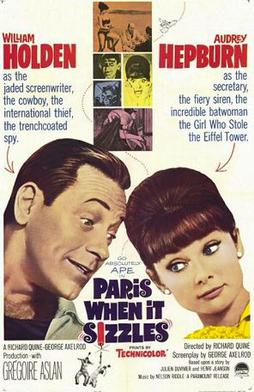
Scene One, Take Twenty-Two-Audrey Hepburn and William Holden’s “Paris When It Sizzles” (1952)-A Film Review
DVD Review
By Zack James
[As of December 1, 2017 under the new regime of Greg Green, formerly of the on-line American Film Gazette website, brought in to shake things up a bit after a vote of no confidence in the previous site administrator Peter Markin was taken among all the writers at the request of some of the younger writers abetted by one key older writer, Sam Lowell, the habit of assigning writers to specific topics like film, books, political commentary, and culture is over. Also over is the designation of writers in this space, young or old, by job title like senior or associate. After a short-lived experiment designating everybody as “writer” seemingly in emulation of the French Revolution’s “citizen” or the Bolshevik Revolution’s “comrade” all posts will be “signed” with given names only. The Editorial Board]
Paris When It Sizzles, starring Audrey Hepburn, William Holden, Noel Coward, 1952
[Maybe there is something to this change of leadership on this site. I will not go through the details of the change-over from the now disappeared Allan Jackson, who went by the moniker Peter Paul Markin, to Greg Green since Josh Breslin in his introduction to a film review on the original version of The Front Page (dated December 15, 2017) went over that in detail including the how and why of that moniker choose by Mr. Jackson. What I will say in the interest of transparency was that I was among the leaders of what became around the office known as the “Young Turks” who were in varying degrees fed up with Markin/Jackson’s concentration over the last year or so on the turbulent 1960s, the time of his coming of age and that of a number of the older writers dubbed “the old-timers” in the dispute rather than the wider look at politics, culture, society, history which was the original intention when this operation got up and running on-line some fifteen years ago.
What I will also say and leave it at that for now is that I am happy that I have been able to finally do a film review rather than being pigeon-holed solely doing book reviews. Markin/Jackson, strangely given his coming of age at a time when among certain elements, especially the young, increasing thwarted any attempts by any writers, young or old, to write outside their specialties and within those specialties to create ranks for example when I started here several years ago I was designated associate book critic and Frank Jackman had the senior position (everybody else then was a stringer, a free-lancer) and when he moved over to Senior Political Commentator I moved into his spot and Brad Fox and Lance Lawrence became associates. Greg has, after a short unsuccessful experiment designating everybody including himself as “writer,” changed to just using everybody’s name alone in their byline identification spot. Maybe when Jackson was younger he would have bought into that idea but not recently so early on I have tip my hat to Greg on this one. Zack]
*********
I read somewhere or maybe some English literature professor in college mentioned it but when you break down every story it fits into one of about ten major themes, at least in Western literature. That same observation can be used to cover Hollywood films which after all are in their basic frameworks based on words, on written scripts except the few, very few directors who ad lib their efforts. Hollywood may follow that pattern but when it comes taking a look at itself as a cultural transmission belt it has had a love-hate relationship with films which deal with the film industry. The film under review Paris When It Sizzles (frankly an odd title although the action does take place in Paris although it could have been set anywhere the important thing being that it lampoons every Hollywood trope along the way and so maybe Hollywood where the long knives would be at the ready probably rightly should have been passed over.
Follow me if you can. Boozy, lazy, out of ideas or having too many ideas screen-writer Richard Benson with a ton of films under his belt, played by William Holden. Holden last seen in this space as a screenwriter turned “kept pet, kept man, floating face down in silent screen seen better days mentally ill Norma Desmond’s high number Sunset Boulevard mansion swimming pool after she put the rooty-toot-toot to him when he tried to leave her is under the gun from his producer played by noted playwright Noel Coward to get on with a script he has been procrastinating about until almost the end of his contract. (That film where Holden was last seen Billy Wilder’s Sunset Boulevard not a paean to the industry that nurtured him either was an example of the hate part of the equation.) Enter Gaby, played by dewy-eyed, magic eyed fetching Audrey Hepburn who even younger guys like me have a crush on the minute they see her on screen and hope against hope of finding their own Ms. Hepburn lookalike, as a American ex-pat typist who is to do that duty while Benson rattles out the story-line before that two days ahead deadline.
This is the beautiful part of the film (beyond some very funny and a few not so funny sent-ups of writers and the film industry) is that Benson with an assist or two by Gaby goes through every possible film genre once he/they establish the initial idea of having two young people meet in a production he has working- titled The Girl Who Stole the Eiffel Tower. They try the standard boy meets girl thing, suspense, intrigue, thriller, spy, horror, gangster, hell, even an old fashioned stand-by the barroom brawl before they are done. Here is the other beautiful part. This is really a story within a story, a boy meets girl story within a story since along the way, surprise, surprise one beat-up screen-writer and one typist fall head over heels in love. So maybe that thing I read or some English literature college professor was wrong, maybe there is only one major theme in Western literature and Hollywood-boy meets girl (and the modern same sex and transgender variation of late).
(Thanks Greg for letting me spread my wings and I hope you assign me more film reviews. This is fun. Zack)
Monday, April 16, 2018
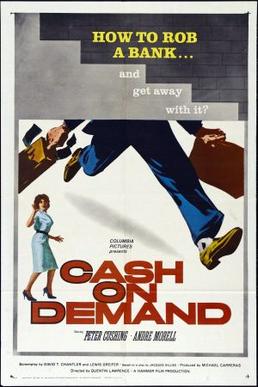
When Hammer Productions Pulled The Hammer Down-Cushing And Merill’s “Cash On Demand” (1961)-A Film Review
DVD Review
By Sarah Lemoyne
Cash On Demand, starring Peter Cushing, Andre Merill, 1961
[Unlike some of the other writers, film reviewers at this publication who use this space, according to site manager Greg Green, to go off on tangents discussing everything but the film they are supposed to be reviewing I am using it to introduce myself. Hi-Sarah Lemoyne is my name and this is my first serious job in journalism after several years doing a little of this and of that while keeping myself alive as a barista at Starbucks. Greg hired me for now as a stringer which he, and all the older writers, tell me is the way that things work in this business. Leslie Dumont told me that when she was hired by Allan Jackson, the former site manager when this publication was a hard copy edition, a number of years ago before she got her by-line in Women Today she had not only been a stringer, meaning then that she got paid by the word but had written half of the film reviews that Sam Lowell got credit for in his by-line when he was drunk, doped up or off chasing some woman. Funny meeting him after what Leslie told me he seemed nice and certainly not a guy who would pilfer somebody else’s work but I still have a lot to learn.
That is really what I want to talk about, about learning things, as I work on my first assignment which Greg says will help broaden my horizons. I have been given the chance to review a block of six films, six black and white films from the 1950s and early 1960s put out through the Hammer Production Company in England and distributed in America by Columbia Pictures. I will admit that before this assignment came up I had never seen a black and white film (Greg told me to include this point). Since I started here Seth Garth has sat with me when we watched what he called a classic black and white film worthy of note from a period later than the 1940s and 1950s The Last Picture Show starring Jeff Bridges whom I did know from the movie Crazy Hearts. I am not sure I like black and white film as a way to create a certain mood but like Greg says it will broaden my horizons and reviewing older films will allow me to learn from my mistakes without causing a whole lot of problems for him. Sarah Lemoyne]
Seth Garth mentioned to me when I told him that my assignment was this Hammer Production series and that I had never seen a black and white film since I was born in 1988 that the Hammer operation was based on a low budget schedule using unknown British actors who would work on the cheap and getting the guys who wrote books to do the screenplay to save money on writing and production time. Still he seemed to think that dollar for dollar they have held up. His experience had been reviewing the monster and ghoul movies Hammer was famous for and an important film noir series which he had reviewed in this space a few years ago. With that advice, and mention that I should take it easy and not go crazy trying to think up some “cinematic studies” stuff to what he called “padding” the review, I worked my way through the first film Cash on Demand, I don’t think they spent much money on figuring snappy titles, which seemed a little weird a couple of times to make sure I got the plot right. (Seth also said if you are in trouble with a review just go heavy on the plot and characters which is what most readers want anyway which seemed like good advice.)
Seth also said that everybody loves a con man, everybody except the person being conned and although I don’t agree with him the con man, the bank robber here seems to be what had Seth all in a dither when I told him the plot and was looking for advice about what everybody around here calls “the hook,” what you want the reader get out of your considered judgment of the merits of the film. This con man, a Colonel played by Andre Morell, posing as an insurance investigator has the uptight and strait-laced branch manager of a London bank, Harry Fordyce, played by Peter Cushing beside himself just before Christmas when he descended on the bank supposedly for an audit. Once the scene get reduced to a battle of wits between the two the Colonel lays out his plan, or rather his intention to rob the bank without firepower or visible accomplices. Lays it out so that Harry has no choice but to go along. The Colonel has buffaloed Harry with the idea, complete with telephone conversation (which turned out to be tapes when the whole scam was exposed later), that his unseen accomplices were holding Harry’s wife and son hostage and would do them grievous bodily harm if he did not comply to the letter with the instruction being laid out to him.
The Colonel’s “hook” was that Harry only and solely cared about his wife and child and despite every instinct he had learned as a banker and as an uptight person he went grudgingly along with the con, with the robbery of some 93, 000 pounds sterling which seems like a lot of money for the times and even today when I would be glad to have such a sum to get out from under my college tuition debt hanging over me. The Colonel had Harry in a box until it comes time to depart with the dough. Then everything broke loose although not to Harry’s liking because one of his employees has called the coppers when things didn’t seem to add up. The London coppers apparently so clever on the pursuit brought that the Colonel was brought back in handcuffs to confront his “confederate”-the perplexed Harry.
After a bit of sleight of hand Harry was angled into going to the police station to answer a lot of questions about why he shouldn’t be sitting in the cell next to the Colonel at Dartmoor prison. Chastised by the experience we are left with the implication that hereafter Harry will be better toward his fellows and a more stand-up man. I hope everybody is okay with the synopsis and that this little tale has some meaning about being less uptight in the world and filled a bit more with the milk of human kindness. First review done and hopefully accepted.
The Great Art Heist Caper-Carmen Diaz and Colin Firth’s “ Gambit” (2012)- A Film Review
DVD Review
By Sam Lowell
Gambit, starring Colin Firth, Cameron Diaz, Allan Rickman, 2012
Willie Sutton the great and legendary bank robber was reputed to have said (I assume when he was in police custody although who knows maybe he gave free-lance interviews on the fly) when asked why he robbed banks answered truly enough “that was where the money was.” Okay, but dear sweet Willie was an old-fashioned boy and while in his time that was the place to go to earn his daily living that mode of employment is now rather dangerous filled with sensors, wires and the 3rd Marine Division, or so it seems. Moreover as the film under review The Gambit amply demonstrates there are more ways to heaven through guile, and through a choice piece in the international art market. That guile is important since there are basically two ways to acquire art and amass your fortune. That aforementioned guile which will drive the action in this film and a straight out heist into some museum overriding the security systems and such which is the stuff of more than one cinematic storyline. I like the second way quite a bit since I have been around long enough to have seen the masters of the profession at work in the famous, or infamous your choice, big rip-off at the Gardner Museum in Boston which to this day has the frames of the ripped off art work as painful reminders that those objects have never been recovered and the police and others are still scratching their heads on that one.
The guile strategy does have its good points though especially if you have a ready buyer and you have an enflamed unscrupulous individual wealthy, wealthy these days meaning a billionaire or one who has access to billions. Especially when it is an inside job, a comeuppance inside job. The average person probably does not know it since the very rich in Scotty Fitzgerald’s famous aphorism are different, very different from you and me but high end art collectors can put art experts on their payrolls without thinking about it. A wise investment when you think about it guarding against fakes and frauds and tax deductible too. That is the case here with hired gun art expert Deane, played by Colin Firth who is out to bamboozle an ugly rich and nude everyman billionaire do we really need to know names, played by the villainous late British actor Alan Rickman.
This is how this caper played out and you really have to admire it even if your heart is with those Gardner master thieves. Claude Monet, the max daddy Impressionist, painted a couple of haystacks out in the French countryside in the 1890s, one at dawn the other at dusk. The “at dawn” one money bags already has but the other “at dusk” had a long and troubled history including being part of German Nazi Goring’s private collection and supposedly subsequently when the Reich fell down in poor Podunk, Texas in the hands of the guy who grabbed it when the Nazi went down. Or rather to complete the key ensemble, his granddaughter PJ now, played by Cameron Diaz, a true cowgirl in the sand.
Deane’s play is to convince the dear Lord that the Texas Monet is legitimate and enlists PJ in the caper to add the final touch to the also lecherous Lord. The caper goes through a bunch of perhaps unnecessary pratfalls once PJ hits London in order to get her claws into the Lord, get them in good so he buys the story, takes the bait. Which he does. This is the beauty of the play though. Deane had his confederate master art forger paint two Monets-dawn and dusk and through a series of flimflam maneuvers is able to substitute a fake “dawn” for the real one in the Lord’s possession while claiming the dusk one is a fake (which it is of course). Deane sells the real “dawn” to a Japanese competitor of the Lord’s for a cool ten million-pounds (pre-Brexit). Nice play-and PJ gets a big cut too before heading back to Podunk, Texas. I wonder if the dear Lord is interested in a Rembrandt self-portrait–cheap at the price.
The Roots Is The Toots: The Music That Got The Generation Of ’68 Through The 1950s Red Scare Cold War Night-Lost In The Rain-With The Rolling Stones’ Gimme Shelter In Mind
By Allan Jackson
[All roads lead back to Markin, Peter Paul Markin, a guy from the old growing up neighborhood back in the working class, that fact is important, Acre section of North Adamsville. Lead back from my having taken his name as my moniker when I was the site manager of this publication all the way to his being an important bell weather for what went on in our generation our Generation of ’68 as it has been characterized here and elsewhere, the vaunted baby-boomer generation just now starting to pass the baton to younger generations hoping they are up to the tasks of this wonderful, weird, treacherous century as it gathers some steam. Markin whom we always called Scribe from very early on since he always had a pencil or pen and notebook at the ready in his shirt pocket to write something down and bore us with it later. Always had pen or pencil ready when our acknowledged leader of the corner Frankie Riley had something to say which I think is the original way Markin got the name. Yeah, Scribe was a piece of work and if I live to be one hundred something I am not sure now that a am on the short side of that possibility I want to make I will always think of something the bastard did or said in his short sweet sad life.
The Scribe was no generational Everyman, no way, but he did represent a certain aspect of that generation, a certain aspect of what went into making the 1960s a wasn’t that a time moment and the scourge of the night-takers who to this day have been fighting a frontal assault on whatever dreams we thought we could create. Of course certain things lead you to think about the old days when you are old enough to have old days and for me it had been a haunting and hollow feeling in the back of my brain ever since the Fall of 2017 when I was watching Ken Burns ten part-eighteen hour Vietnam War series on Public Television. What has got me thinking about that series is how many of the experiences mainly by guys just like the guys in our Acre neighborhood paralleled Scribe’s (and my own). How we got patriotically bamboozled into serving in the military in that war. I especially related to Tim O’Brian, a guy who has written many good pieces of literature about those times, about how he too got snookered into the service by everything that he knew or felt. Every minute I watched I couldn’t help but think of Scribe, help think that if not Everyman his life story-better his dreams-were part of the mix and not the worst part either.
I don’t know about “red diaper’ babies, sons and daughters of radicals and communists when that was okay in the 1930s and early 1940s before the hammer came down and everybody had to put their heads down-or else-in that red scare Cold War night that forms part of the title to this series. I don’t know about kids from our generation who grew up in the leafy suburbs and mother had a Volkswagen or some such car to talk the kids to and fro (we, and this included Scribe’s family as well only have private transportation when there was enough money for a car otherwise we were captives of the slow-death public transportation). For that matter I don’t know about what were then called the ghettos where black people, people who later would be kindred, were huddled and abused. Didn’t know about the barrio a much lesser ethnic group then or about how the Indians, Native Americans, indigenous peoples now, survived. Or what went on, except at second hand, down in the hills and hollows of poor white Appalachia. Neither did Scribe although lightning rod that he was he actually studied up on such stuff, took an interest when all the rest of us cared about was cars, girls, and having sex with the same, with the girls. He did too but not with our desperate intensity.
What Scribe knew about, what we corner boys knew about was white working poor Northern stuff, although we probably unlike to day when identity politics of all types and were are in a cold civil war according to writer Frank Jackman shared plenty of common customs, dreams, commitments and myths with the other aforementioned groupings. What Scribe knew about was “from hunger,” our from hunger world (funny I remember he told me once he did not realize that he and his family was poor because in “the projects” where he grew up, grew up early in, everybody was poor, white poor in the golden age of up and coming for whites after World War II and it was not until sixth or seventh grade in school when kids outside the projects attended the same school that he was painfully and thoughtlessly made very aware that he was poor-from girls who scorned him for his poverty as well as other indignities. So “from hunger” fits.
That is one part Scribe but the part the part that made him that bell weather was some kind of instinct, maybe dream instinct, that something new was coming along in our times and we had better grab it with all hands since it might not last (later as it faded with the ebbing of the 1960s cultural shifts he refused to believe the fury of the times was fading, the newer world was dying, which I believe, and not just me believe, was part of his untethering, of his early death down in fucking dust-strewn back streets Sonora, Mexico dead by his own overweening from hunger appetites). I didn’t, nobody did except maybe Frankie Riley and he only because he thought it would provide him with the main chance, realize that a “new breeze” was blowing through the land. Scribe was on it from the sense he had that beatnik thing that we were just too young to have sensed was our thing although that didn’t stop Scribe from on lonely Friday nights on the corner spouting forth with verses from “fag” Allen Ginsberg’s “faggy” negro streets avenging angels Howl which we couldn’t get him to stop yakking about.
More of our time the time which none of us patriotic working stuff boys understood when he went with the freaking Quakers and other commies to call for nuclear disarmament or walk the sidewalks in front of Woolworth’s on Washington Street in Boston for the “n----rs” (you figure it out but that was what we called then in the Acre including Scribe early on) down South who wanted to eat lunch in the place but couldn’t by custom and threat. More sensible (to me) since he took me there were the trips to Harvard Square when beatnik turned to folkie which would turn to hippie to listen to songs and poems which were totally different from our heaven-sent rock and roll that had sustained us in the dark days of the 1950s when we didn’t know we were from hunger but knew something was missing-at least I hope we did.
But the biggest thing and it was epidemic so I don’t know how we missed it especially since Scribe endlessly harped on was when he got all of us, almost all of us except a couple of guys from the corner Ricky Rizzo and Jimmy James who had already enlisted and would perish in Vietnam and have a place of honor down on black granite in Washington, D.C., to head out to California after he came back from there and got us in the Summer of Love, 1967. That set us on a different course, set me on a different course for sure. Then the “shit hit the fan.” Scribe had decided that fateful 1967 to drop out of college, a bad mistake since was drafted the next year and sent to Vietnam. I went there too but later after I finished college and was drafted. This is where our white working class beginnings and ethos left us without a compass. Where, as Tim O’Brian in that Ken Burns series eloquently put it, was there space in small town, neighborhood but it might as well have been a small town since the ethos was the same to rebel against induction. Who including patriotic World War II serving parents would have supported us. And so Scribe’s fate was cast, cast in a very different way than we would have expected earlier in the decade. After ‘Nam he never was the same although he wrote some great stuff, did some great politic work but the “real” world was getting nastier and nastier and not where he expected it to go. So a “lost boy.” Still fifty years later all roads lead back to Markin. Allan Jackson]
*********
Peter Paul Markin, but after this introduction just Markin, at least that is what I have always called him ever since we first met down in my hometown of Hullsville in the summer of 1964 was for a long time out of step with his generation. Or at least I, Jimmy Jenkins, have always liked to think that he was out of step with the best part of our generation, the generation of ’68 name so by me and others later to reflect that ebb-tide year when all hell broke loose and many things were possible, the part of our generation that tried to turn the world upside down, tried the great decade boxed in jail-break out. It was not that Markin did not have appetites, in fact after many talks with him I found like many working-class kids from hunger like the two of us he had huge appetites, for changing the world, a world that neither he nor I created but which we each on our own way had wanted to spin on a different axis. To include us in the day to day calculations. My story was rather simple as I simply went with the flow as it drifted toward a counter-cultural expression but Markin, well, Markin’s is something else again.
But enough of trying to tease out an explanation and let’s get to the skinny, the story. Hullsville is about twenty miles south of Markin’s hometown of North Adamsville which meant that ordinarily the chances of us meeting were slim seeing that after graduation from high school he was going off to college in Boston and I was getting ready to go to work in Jim Snyder’s Auto Body Shop over on Route 3A on the Hingham line to make some money and maybe after a while go into the service and then to college on the GI Bill since our family did not have dollar one to send me to college. Moreover while the teachers in school called me smart, some said too smart and one old-time History teacher who looked like he might have participated on the White side in the Russia civil wars after the revolution in 1917 called me a “Bolshevik” once for giving a snarly answer to one of his silly questions about some date in history, I was too much into being a corner boy to keep up my grades enough to get some scholarship help like Markin got. Nobody called him a Bolshevik then as far as I know and he never mentioned anything like that after I told him one time the History teacher story, and how he had kept me after school a few days running when I did not give him what he considered an appropriate answer to why I was acting like Bolshevik in his class.
What is remarkable, remarkable when you think about how possessive and cut-throats guys were in those days about girls and girlfriends and we were no exceptions, was the way we met one night shortly after we had graduated from our respective high schools at the Sea ‘n’ Surf Ballroom in my hometown. This locally famous dance hall, now long gone to condominiums, had been located right at the start of the ocean end of Hullsville, an oceanfront which extended the length of the town right up to the Daley Point Lighthouse. The place catered to those from eighteen to twenty-one who could not legally drink liquor and only served soft drinks and snacks. That oceanfront had been a draw in its own right for those moments during dance hall intermission when guys and gals went out to for smoke, a cigarette smoke then as far as I know although I had heard rumors that in California people were smoking other stuff, marijuana, and Markin had told me that he had read about the “beats” who came a little before us, you know Jack Kerouac, Alan Ginsberg, Neal Cassady, guys like that in the Village, out in North Beach places like that who were high all the time on bennies and marijuana so there could have been some of that going on too. Maybe the guys and gals, and this I know from my own frayed nerves especially around girls then, girls who I might try to pick up, fed up with the soda inside stepped out to gain “liquid courage” with some cheapjack low-end Johnny Walker whiskey to calm the nerves, and later in the evening, those midnight hours, that oceanfront acted as a local lovers’ lane complete with some car window-fogging action for those who got lucky, or were horny.
The Sea ‘n’ Surf in those days held a weekly rock ‘n’ roll dance in the main ballroom all year-round on Friday and Saturday nights, Sunday afternoons were left to real ballroom dancing by those like our parents who did not know fast-dancing or anything like that and the rest of the week the place stood empty. Back then the main ballroom featured a live cover band, the famous Rockin’ Ramrods, locally famous anyway, who went on to front at many concerts like when the Stones and Grateful Dead were in Boston although they never quite had enough of whatever it took to make it big on their own.
See that night we both, Markin and I, had our eyes set on the same girl, same young woman, if we were talking about her now, Laura McCarthy, who was nothing but a heart-breaker. Heart-breaker in a lot of ways but mainly, which both of us were clueless about at the time since we had been nothing but grinds and narrowly- focused guys, because she, an absolutely ethereal beauty all wispy and dreamy like some Botticelli model was maybe a step ahead of her time in her sense of sexual liberation (or at least wanting to break the mold of that prevalent mores of working one’s way steadily toward the marriage altar), of being her own woman and of being into the very closed “new dope” scene, meaning LSD, mescaline, peyote buttons, and the like not the junkie nose candy or H stuff like some Nelson Algren junkie man with a golden arm Frank Sinatra thing in the movies and he trying go cold turkey all for Kim Novak and making a mess of it. (I did not know until a few years later that a Botticelli model is what Laura should have been compared too since I had never been to an art museum and Markin only mentioned it later after he had taken some required Art Appreciation course and I had seen a photograph of one of his paintings, and after he had showed it to me and we both immediately thought of that little long gone heart-breaker)
So yes we became friends out of trying to make the same girl who played us like we were on yo-yo strings, and subsequently dumped both of us in succession, me last, and left plenty of lovelorn scars on our psyches. We had heard back then that Laura had subsequently drifted to a commune out in Taos, New Mexico and she might still be there for all we know as improbable as that sounds. But in the ins and outs of that competition for her favors is a whole other story, a boy-girl story that has been told since Adam and Eve time, maybe before, and not knowing that information does not add to the story I want to tell you about what was taking place with Markin in the mid-1960s. A time when we were trying to figure out all the implications of that new wave blowing across America, a generic youth wave which included Markin and me too, a wave away from almost everything our parents, all those in charge, and other interested parties were into as we sought the newer world that we expected was just around the corner where we would finally be free to express ourselves in a world that we had created, or at least had a say in. But I will fill you in on the general outlines of that big picture quest as I go along. Right now this is about Markin’s long journey on that road, longer that one would have thought when the dust finally settled later but once you knew everything that drove him back then it makes sense that it would be nothing but a long journey, and a close thing in the making at that when all is said and done.
Now that we have it straight on the Markin moniker part, the name part which I said before I have always called him and not just me since that is what everybody in old North Adamsville except his dear mother, Delores, well, maybe not so dear but his mother anyway, and later his first frenetic ex-wife, Joyce, which explains a lot about why she was an ex-wife called him we can try to fit the pieces together that made up Markin then (strangely Joyce had been another woman that we both lusted after but I did mine in secret, or a little subtly, since she always had eyes for Markin from the first and my only hope was that she would fall off his train but she never did, damn, she never did, and when they split she headed to Frisco so I never had a proper shot at her. Markin when we talked about it much later after many other affairs fell through for both of us gave me plenty of reason to be glad that she never got her hooks into me, although I still think I would not have minded taking the ticket, taking the ride back then). Markin never could figure out then what the attraction was for all those desperate children of the light camped out, rain or shine, on the Boston Common in that summer of love year, 1967. (That desperate part strictly in Markin’s head, maybe the “children of light” part too but the “desperate” part tells a lot about the way that Markin saw the new wave coming, knew it was coming but was totally out of synch with what was coming down like I say driven by his own life’s trajectory and his outsized dreams). This was not some abstract question since a number of his old time friends, his corner boys, a couple of whom I met before they headed west, headed west physically and in their minds to a very different place than they had talked about on those lonely Friday nights in front of their bowling alley hang-out.
A lot of what went on back then, a lot of the questioning, a lot of things that were pulling people every which way was associated with the west just like out forbears, including our immediate spiritual forbears, the “beats” who through their writing, through their life-style and through the sheer fact that they themselves were always physically heading west in those broken-down, stolen, or hitch-hiked cars and trucks drove us that way. (Strangely as far removed from the “beat” scene as Markin was he was fascinated by their writings, especially Kerouac’s, a working-class former football hero who he said “spoke” to him in some literary way. What he hated was the dope, “fag,” hey that’s the word we used, midnight sunglasses part tied in with a little plebian anti-intellectualism carried over from those North Adamsville streets where “street smart” trumped “book smart.”) Those old corner boys from the old town had “gone over to the other side” as Markin saw the matter when he heard where they had gone, gone to ground on that very Common with the other desperate children, saw them turning seemingly in a minute from stolid old corner boys holding up walls in front of Doc’s Drugstore, Salducci’s Pizza Parlor or the Jack Slack’s Bowling Alleys (along with him) to drug addicts, ne’er do wells and vagabonds. No question in those days no matter what else was going through his mind Markin was a man out of sorts with his generation, out of sorts with the wave, out of sorts about what I thought although I had been a little slow to pick up on the wave myself being stuck in that garage job in Podunk.
Funny that “drug addict” business, Markin actually used that word when talking about all the new smells in the air when we went to rock concerts and dances in those days say in 1965, 1966, reflected Markin’s old-timey notion picked up from some black and white 1930s morality play film or cautionary tale about those who went off the straight and narrow that “smokin’ a bone,” having a marijuana joint, a few puffs to ease the burdens of life would inevitably lead to life of crime, rapine, debauchery and about sixteen other social evils. Or maybe he got it from reading Nelson Algren’s Man With The Golden Arm (which he told me about after he had read the book, filled in the story for me since my take had been based on the film adaptation with Sinatra and Novak which I vaguely remembered my parents had taken us in tow to see since there was no money for baby-sitters and young kids got in free with an adult) or from one of Algren’s haunting short stories about people on the edge, doper-related short stories where the parties were led into the rude life of junkies and spiraled down from there.
A lasting image of the time for me, an image picked up now in retro-1960s “hippie” nostalgia exhibitions, movies, memoirs and from folk tales sputtered out by the now aging remnant, was of dazed kids in all kinds of exotic regalia, some carefully crafted to give a certain look for the cameras that were swirling around at the time when everybody, every journalist too, was looking to see what the “scene” was about. Others just thrown together haphazardly with whatever was at hand, at hand being from the nearest “free” box, the latest offering from some skid row Army and Navy store or whatever somebody straight people had donated for resale at the Sally’s (Salvation Army), who obviously had been at the hash pipe, the joint or had swallowed something not on Doc’s Drugstore list.
All harmless, mostly. That ne’er-do-well business reflected, including the use of the term, the moral pounding that Markin had taken as a child and teenager from Grandmother Riley about the dangers of drink, about laying around and becoming a wastrel, worse a charge on the state like her own brother before they found him in a dark alley in Boston’s South End and put him in a potter’s grave before the family could find out about what happened. (Markin’s first drink had come via that same grandmother who having had a crippling accident at some time earlier in her life had been house-bound for years and would ask him to go get her prescriptions from Doc’s Drugstore, real name of the place, and so Doc got used to seeing him for her orders. On occasion she would also order a small flask, a pint of whiskey, to have when her sisters came to visit. Although underage Doc would just place the bottle in the same bag as the pills and lotions. One time when he was about sixteen he decided that he wanted to taste what liquor was like and so when he went to Doc’s for the order he added a bottle in. No questions asked. He said that when he drank the stuff, drank the whole bottle with a friend down at Adamsville Beach he was sick for days after). But that was the start of the ne’r-do-well campaign for him although many nights including the night not long along when we were talking about the “1960s wave” that he was befuddled by at first we were sitting in Rummy Jacks’ over in Cambridge sipping whiskeys and scotches. That vagabond thing was something he thought about, maybe more when he saw photographs which looked like something out of John Steinbeck’s Grapes of Wrath with rootless people, old Okie tramps, toothless hags, not well put together, just picking up stakes and heading west. So no Markin was not at all sympathetic to the new migration, to the new consciousness, to that new wave that was sneaking up on us.
Where did it all come from, why was he so adamant about hating that whole scene with a vengeance, of seeing it as a threat even, more importantly, going out of his way to belittle those who were seeking a different way of doing their life’s business, of chilling out before being burned out, including more than one go around with me causing a rift between us for certain short periods. A lot of it had to do with his grandmother, Grandmother Riley (the one who he used to get the medications at Doc’s for) and her worldview. See Markin’s home life was hell (as was mine as well), his mother always on his case, always trying to cramp his style, always saying no to any project he expressed interest in, any request for a couple of bucks, anything, okay and so he sought refuge at grandmother’s house a few blocks away (although he told me once it was more like ten thousand miles away with the quiet and the food that she would provide him, well-made food unlike at home where his hard-pressed mother was an indifferent cook serving indifferent food). The price he paid for that refuge though was an indoctrination in the small-minded house-bound views of his grandmother. So as the hippie movement surfaced in the media old grandmother would go into her take on the matter for his edification, his edification about drug addicts, ne’er-do-wells, and vagabonds.
In short as his sainted grandmother, sainted for putting up with a crotchety old grandfather if nothing else, would say the “queer people” and not for their sexual orientation as now because everybody in the old neighborhood knew those kind of queers as “fags,” “light on their feet” or “different” but in the old Irish sense, the sense in which the playwright Brendan Behan used it in one of his plays, the sense instilled in him as well by his mother (nee Riley), she too of the “different” usage passed on from grandmother (to give a true case of that being “different” a guy from the house across from his own, Johnny was “different” since, although thirty-five years old, he still lives with his mother, does not have a girlfriend, expresses no interest in having a girlfriend much less marriage, drinks his drinks at the all men’s tavern across the road and is always when not in the pub going into the South End in Boston to the clubs there. It did not take much even for naïve Markin when told these facts how Johnny was different, the “fag”) Meaning more broadly that those who did not profess their faith as often as possible (that faith being the true church Roman Catholic faith and not some heathen Protestant or worse Christ-killer Jewish faith which formed something like the cycle of life around which Markins and Rileys did their daily business. The Sunday masses, the holy days loaded with sweet-smelling incense, the dreaded Saturday confessions, the first communion/confirmation/six other sacraments and a damper around anything that smacked of idolatry), those who did not stay away from the drink, keep clear of the ever-present taverns that dotted the neighborhood landscape more numerous in number than the churches that dotted the neighborhood tempting many a man to part with his hard-earned paycheck before he got home to his wife and her weekly bill-paying envelopes. (Many a wife stood guard at many a tavern door on payday, usually Thursday when the shipyard was running strong provided many jobs in the area, in order to fill those desperate envelopes although many a husband got wise and would head out of town to do his Thursday night drinking until many a wife got wise and stood guard at the bank to cut many a husband off at the pass. Some husbands though nevertheless spent the paycheck and so every once in a while you would see a neighbor’s apartment in a triple-decker tenement vacated in the middle of the night with everything packed up and gone, including some Jimmy who had become your best friend now gone with no forwarding address.)
Drugs, marijuana or whatever you called it in your neighborhood, cocaine, you know cousin, junk, you know heroin, were beyond mother and grandmother comprehension, were so far from their home tragedies that bringing that up as something to “stay away from” in order to live the good life never would have occurred to them in a thousand years then. That scourge would come later and hit them and the neighborhood with full force, as night time robberies, jack-rolling, and auto theft became rampart as the need for a “fix” moved from the movie screen or a clever book by the likes of Nelson Algren to next door and all subject to some God forsaken whim of some dope feign, those who did not work hard (and often, unlike some transient skid row bums working for daily pay and be quick about it in order to get their hands on a vagrant bottle of booze, taking whatever brainless damn work was available if necessary especially po’boy father’s like Markin’s to the coals mines of Kentucky born and thus in the razzle-dazzle of the greater Boston labor market reduced to last hired, first fired work where he could get it mainly in some outfit loosely affiliated with the old town’s declining shipbuilding industry), or did not sanctify their lusts with marriage were odd, were outsiders in their own community (and lustful girls too although every boy, every man wanted to touch their satin sheets, hell, their good Catholic linen sheets damned to hell and called whore, whore of Babylon for those who had read their scripture and lustful boys called perverts, called Onan, call seed-spillers and succumbers to wretched linen sheets after some rabid priest called them calamites from the pulpit on high).
So when Markin heard the news, presumably from mother and grandmother, that old junior high school fellow corner boy Timmy Kiley (the star quarterback on the black and red Red Raider high school football team although not considered bright enough to do much more than toss balls, well or poorly, and so reduced to clerkship in his uncle’s downtown North Adamsville clothing store after his high school heroics went silently to some local newspaper grave), high school corner boy Red Kelly (fresh from two years with Uncle seeing hazardous duty in red scare Cold War Germany and not in hellhole hot war Vietnam but the service broke him from that knee-jerk patriotism, that easy-going Fourth of July and salute the flag that had been handed down from generation to generation since sometime before the Spanish-American war, Teddy’s splendid war, and so when the wave broke, broke in New York City and out in Frisco town first he grabbed onto the damn thing, the wave as we are calling it now and a guy, well, a journalist like Hunter Thompson called it then, called it, sadly, when he saw its ebb and flow hit the ebb tide, damn, like a man struggling for a life-preserver), ditto corner boy Sean Murphy (the pretty boy on the stoop, out in the corner boy night, who got married right out of high school to the belle of the ball, Sarah Bennett, the senior prom queen until she, and then they, discovered that their projected parent-trap endorsed by Good Housekeeping and expectant grandparents went to an all-night party and got stoned and liked it , liked the idea that they could be close but free of bourgeois convention, a term that was beginning to make the rounds as a sign of disenchantment) and sometime corner boy Bob Stone (heady Bob who had gone out to California in the summer of 1965 after dropping out of college and fully partaking of what was out there after finding a waif woman named Magic Sunshine, high as a kite on mary jane but also high on life, high on folk wisdom that would later turn into a huge industry when the new age turned into the New Age, on Fillmore Street one late night who had actually been to one of Ken Kesey’s acid blow-outs in La Honda, knew the long-running sagas of the magical mystery tour yellow brick road school bus that Tom Wolfe would eulogize in his sociological treasure-trove The Electric Kool-Aid Acid Test and turned him around, or better as I resurrect the language of the time “turned him on”) had taken up the “queer” life he could not understand why, or what made such things attractive to them.
Couldn’t understand why the discontent, why the infernal searching, why the need to blast the church, and remember which church in case you forgot, and remember too that blasphemous Markin even then had quietly slipped away from church, had taken to spending his Sunday mornings with some heathen for a night woman, thankfully, messing up the sheets and causing any number of hers, since he was still hell-bent on Irish Catholic women, to miss Mass. Forget confession or anything exotic like that but he still hung to the basic feeling of the faith, the basic square-ness of the faith in a faithless world even if only because his future plans, his political plans required at least lip service to the old pieties, could understand why blast the education system for allegedly making them helpless against the big modern current that was ready to crash down on their heads, their parents who did not understand why they were rebelling against the golden American age, against the steel, iron, aluminum world that had bequeathed to them, why it had turned to ashes in their mouths, and worse, worse because he represented the social glue that held the society together, the President of the United States. And for Markin, Markin the born in the manger rising from the ashes guy who expected to ride the political rails to his own worthy future drew the line in the sand at that proposition. Could not see the point, whatever one thought of the war in Vietnam that was also causing his generation to kick up some dust, and he was not quite sure what he thought about that war although he knew when his time came if he was drafted and the war was still on as appeared more and more likely that he would to go just like generations before had done since Markins and Rileys had come to the American shores from the old countries.
See just then worthy college student Markin had it all mapped out, had it figured that he would ride the political whirlwind to get as he said to anything who would listen to him on the corner “get his while doing good in the world,” that first coming from his from hunger existence, from his huge unabated, unquenched wanting habits, the second from some home-spun god Catholic Worker stuff he had read about in school and that his Aunt May would talk to him about when he went over her house (her house more of a journey and so used less frequently as a refuge since she lived across town in Adamsville proper and that required taking the damn private line bus which never seemed to come when he needed it and so the less frequently) when the whirlwind at home was too fierce for him to combat (and when Grandmother Riley was firmly taking her daughter’s side on those few occasions when that event occurred). So, truth to tell he would rock no boats, would not try to turn over the fig leaf that was holding society together, and decidedly would not call the President of the United States a whoremonger, a baby-killer or oversized baboon with the brain of an amoeba who needed to be castrated, or worse. No, up and coming junior politicians on the make just did not do that in 1965, 1966 maybe forever. Markin already had his mind made up in the summer of love of 1967 when all the social glues were coming undone, when kids his age were shedding good sense, good taste, good lives to become vagabonds in some ill-defined lustful night he fully intended to support the President against the main scourge of the age, one Richard Milhous Nixon who was beginning to rear his ugly head once again. Once again Nixon acting like the beast with five claws ready to do muck to everything it touched. So Markin had no time for fallen corner boys, for dreaming guys who used to have their heads on right, who wanted to say “fuck you” to all that he liked about his America.
And it was not for lack of asking that Markin could not understand his old-time corner boys (who at some down-the-road point he expected to form the initial cadre for any political operation he was going to run but he was damned if he was going to have dope-addled, long-haired unwashed, what were they starting to call them, oh yeah, hippies and their caravans and love trains ruin his beautiful dream, no sir). A dutiful son of the working-class (and just plain street smart hustler if you thought about the matter), working his way through college by driving a truck on a route through downtown Boston he would after making a delivery at one of his stops on Beacon Street walk across to the tent-festooned Common to search his old corner boys out when possible and try to reason with them (those attempts to reach them, not the reason for doing it part, were done always assuming that he could get a parking spot rather than double-park as was his usual habit but was considered ,well, not good form for longer than the time it took to deliver his goods and he had a couple of traffic citations to verify the truth of that “not good form”).
Their arguments however seemed ridiculous to him, or at least did not seem worth the effort, the effort they called “creating the counter-culture” or that was the expression that Sean Murphy, the most intelligent of the tribe and the one that Markin respected the most used to defend the new life-style that Sean and the others and their brethren were embarked upon. The life-style including a new-found disinterest in keeping their hair groomed (which would have shocked Tonio, the barber “up the Downs,” who specialized in one cut, boys’ regular, and had even looked askew at Markin when he, in order not to be completely outside the new generational norm wore his sideburns a little longer like some second-coming of Elvis), growing mustaches and beards (Timmy looking nothing but a scraggly muppet with his chin whiskers which he kept solely because some chick had told him he looked cool that way), wearing what Markin could only describe as second-hand “Bargie” (a pre-Wal-Mart-type store that sold low-priced, and odd-ball merchandise out of fashion at best), stuff that he, and formerly they, were required out of poverty to wear when they got, or rather their mothers got them their twice-yearly new clothing at the beginning of school and at Easter). The “in” wardrobe stripped pants, frilly-cuffed shirts, holey bell-bottom blue jeans, threadbare sandals, all guaranteed not to hold up for the length of time it would take to become hand-me-downs for younger brothers and outer garments from Jay’s Army and Navy Store, things like World War II army jackets (Markin had to laugh at that one since all his old corner boys with the exception of Red who had already done his military service and so could justifiably wear such garb were committed to opposition to LBJ’s war front, were instinctively anti-military, although all their now befuddled fathers had been through hellhole World War II and yet reached out in desperation to be part of an army, if only Gideon’s), Eisenhower, Jesus, Eisenhower jackets, used (Markin, and they did too, used to run home at noon break in elementary school to watch Big Brother salute old man Ike with a glass of milk, didn’t these guys remember or were the drugs and the life so corrosive that they had lost their memory banks), navy skullcaps (last used one night when they were hungry for dough and had heard about a big house with nobody home had taken what they wanted under such cover), dog soldier army black leather boots (with some poor GIs’ shine so sarge could see himself reflected in the boot’s glory long gone, long gone to rain-pelted muds, wore-out heels from walking as much as hitching out on the great American highway west, long-gone to kicking out the jams if it came to that come some midnight fire festival with magic elixirs, magic bongos, magic kazoos in a pinch, the works).
But the clothing regalia would not end there for everything in the new dispensation had to reflex the new color world explosion, the mauves, violet purples, magentas, tangerines, white blacks, you name it, and in Day-Glo the pigment for the new age a-dawning. The exploded world seen through LSD or mescaline lenses if one could explain to the square or hip alike the colors bleeding in their chemical heads. The mushroom cloud of the new reality splintering visions about twelve different ways (hey, only an estimate could have been fifty or a hundred who knows) so exploding purple apples, orange bananas, magenta pears, and that was just the fruits and even Markin knew they were not fruits like you though just like they were not queer like you and your Irish South Boston/Dorchester/North Adamsville brethren kept harping on but that didn’t save Timmy, Sean and the boys from going under it spell. After a few months, he stopped going over to the national encampment (the guys were tired too of his noise they had once collectively said to him half in jest half in rancor). See he had met down in Falmouth during that summer of love July a young woman, Jewel Diamond. (Jesus he was tired of all the name changes like changing a name would do the trick to produce a new identity. He respected, at least he thought he respected, those blacks who during this time, those who came out of the extreme end of the black liberation struggle, called the black civil rights movement then but they are both the same thing, who wanted no part of their old slave names and so were X this and X that but white- breads had no such history to eradicate) Jewel wanted to show her new boy a trip around the world in her bedroom, wanted in too on his soft-shell political dreams (thinking she would be some latter day Jackie O, some White House princess) wanted just like him to have that white picket fence complete with white shingled house, couple of kids, and a dog and wanted to be a step or two ahead of where their parents had left off and so she dreamed with him, while taking her daddy around the world (yeah, she was that kind of girl half-virgin mary, half-whore and half her mother’s daughter), yes, dreaming that dream.
Now Markin was not so square, or better to say in those days, un-cool, as not to appreciate that young guys might want to get high, get laid (he could certainly understand that since half, no, nine-tenth of corner boy life was about getting some easy sex from some fox and if not some fox then some young thing who wanted no commitments just like him, better yet get some head, you know, the “toot the root” that a guy could talk a chick into in lieu of having vaginal intercourse with all its dangers, some head like that Jewel from down the Cape could be talked into if you gave her a couple of drinks or if she had taken her medication and had those same drinks which made her speedy), and lay around all day philosophizing about the world and never get beyond cleaning up their tents, if that. (Not that Markin was above a marathon philosophy talk spending many a night talking of Jeremy Bentham and John Stuart Mill like they were second cousins but would give the air to Baba Ram Dass, Timothy Leary or even Eric Hoffer when those names came up, pure hippie words in the night madness)
Also Markin could appreciate guys getting out from under mother’s and/or grandmother’s apron strings as he himself had done just the previous year since he and his mother had had their twelve-hundredth argument about when he got home, who he was hanging with, what he was intending to do with this or that girl (no, not the sex thing, Jesus, no, the word was obliterated from the Markin household vocabulary and he had learned whatever he had learned about sex in the streets and on the corners just like his former corner boys who were boffing every girl in sight, and, get this, them, the girls starting things up, starting with that come hither look and their own sexual vocabulary learned in their streets), was he going to settle down and get married right after college, stuff like that. So no he was no square like that and truth be known, although not to mother or grandmother who would have flipped out, gone wiggy if they knew that he had been with a heathen women, a bloody Protestant girl who he had run into one night at Jack’s, Jacks’ over in Cambridge where some musical infusions were starting to roar up and take the sails out of stogy old folk music that had died years before but if you went into some of the coffeehouses still existed there (although only in that town in homage to some worthy past) you would still get twenty-seven varieties of Bob Dylan covers done off-key (if that was possible with that gravelly voice) or Joan Baez ironing-board haired princesses calling for the world to kumbaya, kumbaya until the next century from what the scene looked like.
Some called it acid rock, some called it flamingo for all he knew but that night high on his Irish whiskey sots she was sitting at the bar, all ethereal, all feathers and fandangos and no bra (no bra a victory for every shy boy who ever tried to unhook some strange virginal girl and get it all wrong and, damn, she had to unhook the damn thing herself), a tent-like dress worn just so, what did she call it when he asked about it, oh yeah, hippie chic. She just in from Fargo just out in the Dakotas having fled some scene that he was not privy to but which made Boston seem like Frisco town thought he, slightly side-burned, lean, with a wicked Boston accent (really filtered neighborhood North Adamsville Irish-flecked accent but to the rubes from Fargo wicked Boston), she having no experience bought his line of patter, gave him some speed and they stayed up all night at his place making love and talking like two magpies. But even Markin knew he was just slumming around the edges of the new dispensation that night since she was there, she was available and she thought he was nice so that hippie chic business should not be weighed heavily in the Markin argument. Who knows she could have, like a later Angelica, Angelica from out in Muncie just been tasting the wares before going back to whatever the Great Society was offering in its turn.
See that is where Markin was really at, really just another in a long line of Irish guys, Irish on the cookie-cutter machine guys, guys on the hustle except the hustle played out with him getting his while he was helping the brethren. (Old Aunt May invoked at every turn.) He would eat much crow, eat many words as each new treachery wended its way around his brain but he was young, was committed to the easy life of an “on the make” politician who would not sell his mother to the highest bidder so he had his virtues since most of the previous generation’s “pols” had done just that. Yeah, the map was set, maybe not in every detail but set. He had already that summer of love although he heard war cry rumblings from the likes of Eugene McCarthy’s tribe and that of his own gangster saint Robert Kennedy hero that they might oppose the President on the war issue, make him pay hell at the polls if he listened to the never-ending requests for men and materials from the generals, committed to LBJ in that eternal fight against the impeding dirty nasty fight that was coming. Had lined up Jewel Diamond (she would have to get rid of that moniker and go back to being Joyell but he would humor her for now, especially since she was quite inventive in bed and had the heart of a princess-warrior then). All he needed as he headed into 1968, all he thought he had to do was get that degree, do his military service if he was drafted, get married (in the church of course, no one would countenance the simple civil ceremony he would have personally preferred) and ride LBJ’s wave into some cushy Washington job and that white picket fence was a sure thing.
…And then came the notice from his friends and neighbors at the draft board in North Adamsville. Having exhausted his college deferment and with the recent withdrawal of exemptions for law students which would have been his obvious shelter had that route been available he was prime material for induction. Although Markin had softened somewhat on his stand of emphasizing the good parts of the Vietnam War in the fight against world-wide communism and his former adherence to the “domino” theory that if one nation in Southeast Asia fell all would fall which drove all thinking the death of Jack “Bone-Crusher” Maloney who lived down the at the end of his street, a guy with whom he had been a corner boy in junior high school with shook him a little. Still, although no way in hell had he intended to volunteer, enlist as regular Army, given his career plans that were tied up with doing one’s public duty would accept induction if drafted. In those days, now too probably although it no longer has the same cache, military service still counted for guys who aspire to public service careers. In early 1969 while all hell was going on in the country, while people including me were being “chicken shit” busted for opposing the war, or smoking dope, or other random acts of “being free” Markin headed south down to South Carolina for boot camp. (As for me a couple of serious leg problems derived from childhood illnesses gave me a 4-F status, although it is still an open question whether I would have accepted induction or not since down in Hullsville whatever else they thought or cared about guy did their military service when called so despite the dope and counter-culture the pull of that would have been a factor.)
Truth. About three or four days after he got down there I got a call from Markin, collect, at my girlfriend’s apartment in Allston where I was staying at the time which I accepted not knowing what the hell was going on. I thought poor clumsy Markin might have hurt himself or something. The gist of the call though had bene that Markin said he had made a mistake, that the whole military thing appalled him and that he, and I quote “was starting to get ‘religion’” about the war, was going back to some deep recess Aunt May Catholic Worker, social consciousness thing inherited through her from some forbears, or something. That night I thought he may have been sincere as far as he had thought it out to that point, although all those endless conversations pointed the other way.
If Markin was sincere what to do about it was another question since he was down south a long way from home and support (support he could have gotten in Boston, one of the true hotbeds of anti-war activity where many were willing to help entrapped GIs figure out a way out. But for the period of basic training and then when he was assigned to Advanced Infantry Training (AIT) he merely refined his sentiments in letters that he would sent to me every few days. That AIT designation meant only one thing-they were training him to be as he put it a “grunt,” or as I put it then “cannon-fodder” and the only place where that “skill” was needed just then was on the China Sea, in Vietnam.
Among the things that Markin asked me to do in those long ago letters was to get in touch with some Quakers over in Cambridge to see what they thought he could do if he got orders for Vietnam. I did so, hoping against hope that he would not have to go. But at the end of AIT he did receive his orders to report to Fort Lewis out in Washington for transit to Southeast Asia. He was to have a month’s leave before then so he came home and I met him at the airport. He was leaner than when I had seen him last carrying that tell-tale duffle bag over his shoulder. But here is where I realized that he had done some serious thinking, had come part way, so I thought, over to the side of the angels. He was sporting a very busy mustache which Army regulations allowed then (although his unkempt one surely could not have passed muster) AND wearing a new pair of bell-bottomed jeans, a sign of the times.
But that was the exterior, the look to fit in. Here was his plan. He was the next day going to Cambridge to get some advice from the Quakers about what to do, about how to forestall going to ‘Nam as he now called the place under the influence of those nasty drill sergeants he would tell me about. But that was the surface, the paper chase. Almost before we got out of the airport he made it very plain that he was not going to ‘Nam, no way. Although a look in his eyes told me he knew that there was a long road ahead.
Here is how that road unfolded. The Quakers at that meeting in their counselling center in Cambridge gave him several options, mainly about filing for conscientious objector status through the military. Although possible to apply for that was a very hard road then once you had actually been inducted and made doubly so because the basis of his objection would had to have been centered on his faith, his formal faith, Roman Catholicism which was mired in “just war theory,” and not a basis for discharge. (That “just war theory” was in fact his own position although without the Catholic trimmings, a position that he still holds today, sometimes there is no way around fighting the oppressor except by picking up the gun and that was that with all its contradictions.) But the application was merely a holding action, forlorn as that was. Another part of that option, advised informally, by one of the counsellors and not official policy was to go Absent Without Leave (AWOL) for more than thirty day, or until he had been “dropped from the rolls” at Fort Lewis and then turn himself in at Fort Devens out in central Massachusetts where he could make his CO application. Tactically, and here I admit I pushed him toward that idea, it made sense to work things out close to home and also where GI resistance support work was becoming a central focus to opposing the war. (He felt in tough moments that like those nasty drill instructors told him and his fellow recruits if you got out of line he was bound for some stockade anyway, or at least he recognized from other cases he had read and heard about that place was a possible endpoint) And so he did, did go AWOL for a while, turned himself in at Fort Devens and put in his application which held him there. Held him there until his application was denied, summarily denied on those above-mentioned grounds of not being an absolute objector to war like the Quakers, Mennonites and such. And given orders once again to report to Fort Lewis for transit to Vietnam.
Even today the rest of the Markin Army story is a little hazy, and anytime it comes up as when the latest American war puts “grunts” at risk for some unknown, maybe unknowable reason, he will dismiss further talk with a simple “I did what I had to do, and I have no regrets about it.” Part of that haziness is that his case bent a little heavy on the legal side since I was not privy to those maneuvers but that decision to stay in the Boston area helped Markin since some people got him in touch with a lawyer and one way or another that lawyer’s work held him at Fort Devens until the legal proceedings in the civilian courts had worked its way to the end. Hazy too though because of the actions Markin had taken while those legal proceedings were working their slow way through the system. Actions done without counseling me but when I tell you what he did you will understand.
All during this period of waiting, and getting a foreboding feeling for where things would lead, lead to some stockade time that he had avoided by being contrite on the AWOL charges Markin was getting more and more serious about his anti-war position and about doing something about it. Something symbolic. Well, he sure did something, something out of the ordinary. The way I heard the story from him later went like this. One Monday morning in the late fall of 1969 when the whole fort, the whole of Fort Devens, was on the main parade grounds for what is called the morning report, basically to see who is and who is not present, not AWOL, after the weekend, Markin walked out onto the field in civilian clothes, those now not new bell-bottomed jeans included, carrying a fairly large hand-made sign-“Bring The Troops Home” for all to see. Needless to say he was quickly pounced on by some lifer-sergeants and eventually taken to the stockade for questioning and to await charges. To make a long story short, Markin spent the rest of time in the Army in that stockade, spent almost two years there, including some time in solitary (not for doing anything wrong but the Army officials were so freaked by his actions, so fearful his actions might spread, that they did not want him mixing in with the rest of the stockade population). He eventually did get out though those slow legal proceedings in civilian court otherwise as he always kids me, he might still be there.
I was on the West Coast, in San Jose, when I heard that Markin had been released for the stockade in 1971. A couple of weeks later when I came back East and I went over to Cambridge where he was staying with some young Quaker gal whom had taken a fancy to him and he to her (and who I took a fancy to as well, living with her off and on for about a year after Markin left her for Joyce, who would be that frenetic first wife of his, since that Quaker gal was a different breathe of fresh air for both of us but in the end too good and kind for old- time rough and tumble corner boys no matter how we had changed) there he was, a little pale and smelling that faint indescribable smell of prison, growing the first remnants of a beard, letting his hair grow longer, wearing those now fading bell-bottomed denims and a leather jacket somebody had given him.
As we talked one night a few weeks later about the future both sensing that the effect of trying to turn the world upside down had been ebbing of late I told him this when he tried to dismiss what he had done in the Army to slow the machine down. “But get this, and get it right, Peter Paul Markin has gotten in synch with his generation, in synch with the best of his generation, no, with the very best of that generation.” Enough said.