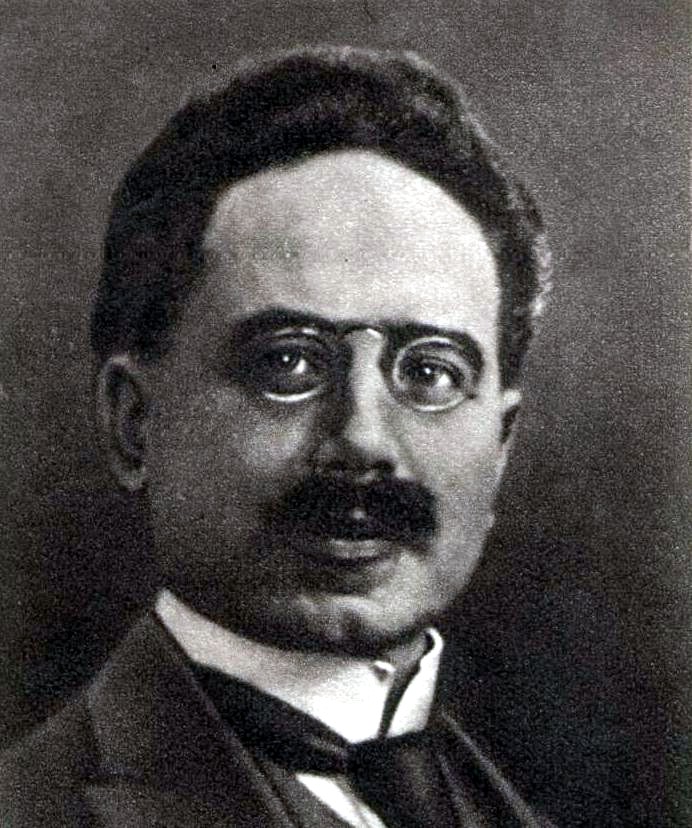
Showing posts with label karl liebknecht. Show all posts

Saturday, January 26, 2013

Karl Liebknecht's Anti-War May Day Manifesto (1916)--Down With The American Afghan War (2013)


Markin comment:
Every time you and I, we, get weary of rolling that big old rock up the hill, Prometheus –style, in fighting against the American imperium’s endless wars, now centrally focused on getting U.S/Allied (whatever is left in that dwindling pack) troops out of Afghanistan and its environs think about revolutionary German Social-Democrat leader (and later Spartacist leader and Communist Party founder)    Karl Liebknecht and his trials and tribulations fighting against German imperialism in the heat of World War I at a time in Germany, and not just in Germany but on all sides,  when opposition  to war could get you shot, or thrown in the bastinado for good. Very few of us today in the anti-war struggle of the past dozen years (with the exception of Private Bradley Manning and precious few others) have faced that kind of decision to make a life or death statement. So every time you are standing alone, or in a small crowd, with your handmade hand-held poster, being ignored or worst laughed at remember that name, Karl Liebknecht. Oh yah, and remember we still have a fight on our hands right now- President Obama- Immediate Unconditional Withdrawal Of All American Troops From Afghanistan .            


Karl Liebknecht-The Future Belongs to the People

Liebknecht's May Day Manifesto


THIS May Day Manifesto called the people of Berlin to the May Day Demonstration of 1916. He was sentenced to jail for expressions in this May Day Speech.

"Poverty and misery, need and starvation, are ruling in Germany, Belgium, Poland and Servia, whose blood the vampire of imperialism is sucking and which resemble vast cemeteries. The entire world, the much-praised European civilization, is falling into ruins through the anarchy which has been let loose by the world war.

"Those who profit from the war want war with the United States. To-morrow, perhaps, they may order us to aim lethal weapons against new groups of brethren, against our fellow-workers in the United States, and fight America, too. Consider well this fact: As long as the German people does not arise and use force directed by its own will, the assassination of the people will continue. Let thousands of voices shout 'Down with the shameless extermination of nations! Down with those responsible for these crimes!' Our enemy is not the English, French, nor Russian people, but the great German landed proprietors, the German capitalists and their executive committee.

"Forward, let us fight the government; let us fight these mortal enemies of all freedom. Let us fight for everything which means the future triumph of the working-classes, the future of humanity and civilization.

"Workers, comrades, and you, women of the people, let not this festival of May, the second during the war, pass without protest against the Imperialist Slaughter. On the first of May let millions of voices cry, 'Down with the shameful crime of the extermination of peoples! Down with those responsible for the War!' "

***********

Karl Liebknecht
The Future Belongs to the People

Liebknecht's May Day, 1916, Speech


Delivered at the Potsdamerplatz, Berlin, May 1, 1916

(Report by one present at the demonstration)

BERLIN, May 1. Very early in the morning, with three other comrades, I reached Hortensienstrasse, where Comrade Liebknecht lives. We enter No. 14, climb up the stairs, ring his bell. Comrade Liebknecht opens the door himself. He is thin, his hair looks unusually black and his face is deathly pale. He walks like a dead man, walking with grim steps. He leaves us and soon returns with his wife; she is a Russian. She nods welcome to us all. Suddenly a terrible fear comes to me. No one has spoken a word, yet we all feel that we are in the presence of a supreme moment. From Comrade Liebknecht's grim silence we judge that he is about to hurl prudence to the four winds and defy the Government.

He hands out, one to each of us, a copy of the speech which he will deliver. So far not one word has been spoken. While we are hurriedly reading his speech, which is to be delivered within a few hours, he remarks, "I have several thousand of these printed."

We have finished reading the prospectus which will make history and send him to prison. Then we go into conference. We have been with him just an hour. We leave him.

Shortly after 2 P.M. of the same May day, I have taken a hasty lunch at the Central Hotel. As I near the door I hear the footsteps of the great multitudes. As far as I can see, all the streets and side streets are full of surging, silently moving human beings; all moving in the direction where the May Day demonstration is to take place. These are men and women, mostly women. The men among them are mostly over fifty. Suddenly it becomes apparent to me that there are more children in the crowds than men and women together. As they march I notice that I cannot see one in the crowd who has a smile on her or his face. Along the route no one is cheering them. I had never seen such immense crowds in the streets of Berlin. Not even during the Agadir crisis had the streets of Berlin held such multitudes. The crowds move as though they are part of a funeral procession. They are all sad, very sad. I recognize a group of comrades in the crowd. I rush in and join them. Mund halten (keep your mouth shut) is the unwritten rule, and every one seems to observe it strictly.

Some one has turned the head of the procession into Unter den Linden. We do not know why; very few of us have noticed it, anyhow. We suddenly see a platoon of mounted guards dashing through the crowd, but they are riding on the sidewalk. The part of the procession that had been marching on the sidewalk rushes to the middle of the street in order to escape being trampled upon by the mounted guards. Another group of mounted guards rides past hurriedly, and still another follows. The people in the procession all about me do not seem to notice them. Not even a whisper one hears. On reaching the palace grounds I see in the distance five persons. From their elbows up they tower over the heads of the multitude surrounding them. I leave my friends and elbow my way through the thick crowd. I explain my impolite advance on the ground that I am a reporter on a party (Socialist) paper. I finally reach the spot where Comrade Liebknecht and other comrades are standing. The crowds are close where they are standing, and I cannot make out whether they are standing on a raised platform or in a motor car. I am about twenty or twenty-five feet from the doctor.

Suddenly one of the comrades near Dr. Liebknecht raises his hand and at once proceeds to speak. The multitude is anxious to hear him. Every one is sounding "Hush" in order to obtain silence and thus making more noise. Dr. Liebknecht uncovers his head; some one near by offers to relieve him of his hat. Deathly silence reigns all about the grounds. The interior of a cathedral cannot be more silent. The doctor begins: "Comrades and friends." They start to cheer him. He holds up his hand forbiddingly, then he resumes: "Some years ago a witty Socialist observed that in Prussia we Germans have three cardinal rights, which are: we can be soldiers, we can pay taxes and we can keep our tongues between our teeth. The Socialist who made this observation made it with a grim humor, but to-day the humor of it must be disconnected from it – it is all too grim. Especially in these days this observation is too true. To-day we are sharing these three great Prussian State privileges in full. Every German citizen is given the full privilege to carry a rifle in any manner. Even the Boy Scout has been incited to play the ridiculous role of a soldier. They have thus planted the spirit of hate deep in his youthful soul. Meanwhile the old Landsturmer is forced to perform forced labor in invaded countries, in spite of the fact that under the laws of the Imperial Constitution he cannot be called out for any other purpose than for the defense of the Fatherland.

"As for his second privilege – his right to pay taxes – in this respect the German citizen is, up to the present time, far ahead of his brothers in foreign lands whom he is engaged in exterminating. And yet more privileges of this kind are awaiting him in the days to come – after the end of the war. The high taxes which the German people have so far paid are insignificant compared to the great burdens which they must carry after the war, and for which their masters are daily preparing them with such touching delicacy of patriotic sentiment through the medium of the official press.

"The new Germany has the unquestionable right to hold its tongue between its teeth. Recently our official press has been flooded by authoritative and pharisaic exhortations to soldiers' wives that they must, for God's sake, not complain so much about the scarcity of food. Keep your mouth shut tight when hungry. Keep your mouth shut tight when your children are hungry, keep your mouth shut when your children want milk, keep your mouth shut when your children cry for bread, keep your mouth shut and write no letters to the front."

Outside of Germany these phrases might sound like the stock phrases of a professional agitator, but not so in Germany, at least not in those days. I carefully watched for the effect of these remarks all about me, and I saw no dry eyes.

Amid tense silence the doctor continued: "In a recent issue the mouthpiece of the Pharisees, the "Muenchener Neueste Nachrichten," complains thus (reading from a clipping)

" 'Our soldiers do not always receive from their dear ones at home the best encouragement to hold on. A soldier on furlough who, before obtaining leave, had performed for his Fatherland unflinchingly, went through many hardships with good humor, but after a visit home returned to the front with a sad face, worrying day and night about his dear ones and the pretended scarcity at home.'

" 'Pretended' scarcity certainly is palatable, especially when one is reminded of the fact that our police is weighing the bread, that butter is out of the market, that fat, meat and margarine have reached a price that is beyond the probable reach of the workingman!

"Another well-nourished Pharisee exhorts in the columns of the Norddeutsche Allgemeine Zeitung by asking, 'Where is scarcity to be found?' and no doubt after having partaken of a good dinner he preaches with these words: 'We must teach ourselves at home how to manage to get along in our homes with as little as possible. But of course in large families with children the small earnings of the breadwinner being now totally absent, this sum must be replaced by the creation of a relief fund so that there may not be any serious want.' Exactly, but under no circumstances must the people complain of hunger. It annoys the soldier terribly and cripples his fighting power. Therefore do not write complaining letters to the front. In other words, you wives of soldiers, hide the truth from your husbands; in fact, lie to them. "The old proverb says, `The mouth speaketh out of the fullness of the heart,' and if her children's stomach is empty it is hard for the wife not to mention to her far-away soldier husband that it is hard to provide for his children with food while he is offering his life for his country. But if it is not found possible for your masters to prevail upon you to 'keep your tongue between your teeth,' then they resort to a more practical means. They have a very simple means of stopping these annoying complaints. The Prussian censor is now supervising these letters of wives at home to their husbands at the front. They simply do not allow this objectionable correspondence to go through. Poor and unfortunate German soldier! He deserves pity! At the command of the militarist Government he has gone into the enemy country, and at the command of the Government he must steal from other nations. He is required to perform difficult services. The sufferings that he endures are past description. About him everywhere shells and bombs sow death and destruction. His wife and children at home are suffering want and hardship; she looks about her and finds her children crying for bread. She is desperate, but she must not appeal or complain to any one. She must hold her tongue and suffer inwardly. But how can she silence her children? She must not even share the sympathy of her husband at the front, because that cripples her soldier husband's fighting powers. Her soldier husband must `hold on' and 'steal' in the land of her neighbors. He must hold on and 'suffer' because the capitalists, the hurrah patriots and the armor-plate kings have willed it so. Every one must keep his or her tongue between the teeth, for the war profiteers must make money out of the want and misery of the wives and their husband soldiers at the front.

"By a lie the German workingman was forced into the war, and by like lies they expect to induce him to go on with war!" A mighty shout went up from a thousand throats – "Hurrah for Liebknecht."

Liebknecht raised his hand for silence. Then steadily, though knowing the cost, he said: "Do not shout for me, shout rather 'We will have no more war. We will have peace – now!' "
Scarcely had he finished speaking when, as if by magic, a tremendous tumult arose. Near the spot where the doctor and his friends had been standing the crowds surged back and forth. The great multitudes in the palace grounds had the appearance of an immense sea whose surface was every inch covered with human heads, those of men and women. The children became terrified. The shouts of the grown-ups and the terrified shrieks of the children added vehemence to the scene. The next moment I see Comrade Liebknecht pulled down from the stand. His friends also follow. Then I see fists raised. I suddenly discover that the jostling of the crowds about me has carried me further away from the spot where a riot is in progress. I again elbow my way toward where the doctor and his companions have been pulled down from the stand. I had made some progress when suddenly I find myself being swept backward by a huge human wave.

In spite of my wish to see what is going on behind me I am being carried away further and further. Several hundred thousand panic-stricken souls are rushing towards the streets and avenues that lead to the grounds. The scene is frightful. Every one is shouting. I steal a glimpse of the spot which is now the center of the sudden panic. I gasp with fright. I see numberless mounted soldiers with large black whips in their hands lashing the crowds. Their mounts are so close to the struggling and frightened men and women, yea, even children, that it is a miracle that thousands are not pinned to the ground. I cannot tell whether they are killed or whether they fainted. But there are many of them. I myself was forced to step over several persons. I tried to lift up a body, but in the next moment I was carried away. . . .

May Day evening. Twenty-five or thirty meet secretly at the home of a comrade in ---------- street. We all know what the report is. Herr Doctor is arrested. We are all sad, very sad. We have met to exchange views as to what step to take next. Every one is laboring with heavy thoughts within himself. The silence is sickening. With the exception of four the men who come together to exchange views are all soldiers in the active army. Not all of them are privates. We have spent the entire night, sometimes in heavy silence and again in deliberation. It is decided that we ---------- ---------- ----------.
Are the German workingmen thinking? Their present thoughts are tragic. They hurt.

Friday, January 11, 2013

Those Who Fought For Our Communist Future Are Kindred Spirits-Every January We Honor Lenin, Luxemburg, And Liebknecht-The Three Ls- Liebknecht’s’” The Future Belongs to the People-(Speeches made since the beginning of the World War I)”


Markin comment


EVERY JANUARY WE HONOR LENIN OF RUSSIA, ROSA LUXEMBURG OF POLAND, AND KARL LIEBKNECHT OF GERMANY AS THREE LEADERS OF THE INTERNATIONAL WORKING CLASS MOVEMENT.


Biography

The son of Wilhelm Liebknecht, one of the founders of the SPD, Karl Liebknecht trained to be a lawyer and defended many Social Democrats in political trials. He was also a leading figure in the socialist youth movement and thus became a leading figure in the struggle against militarism.

As a deputy in the Reichstag he was one of the first SPD representatives to break party discipline and vote against war credits in December 1914. He became a figurehead for the struggle against the war. His opposition was so successful that his parliamentary immunity was removed and he was improsoned.

Freed by the November revolution he immediately threw himself into the struggle and became with Rosa Luxemburg one of the founders of the new Communist Party (KPD). Along with Luxemburg he was murdered by military officers with the tacit approval of the leaders of the SPD after the suppression of the so-called “Spartacist Uprising” in January 1919.
**********

Liebknecht's May Day Manifesto


THIS May Day Manifesto called the people of Berlin to the May Day Demonstration of 1916. He was sentenced to jail for expressions in this May Day Speech.

"Poverty and misery, need and starvation, are ruling in Germany, Belgium, Poland and Servia, whose blood the vampire of imperialism is sucking and which resemble vast cemeteries. The entire world, the much-praised European civilization, is falling into ruins through the anarchy which has been let loose by the world war.
"Those who profit from the war want war with the United States. To-morrow, perhaps, they may order us to aim lethal weapons against new groups of brethren, against our fellow-workers in the United States, and fight America, too. Consider well this fact: As long as the German people does not arise and use force directed by its own will, the assassination of the people will continue. Let thousands of voices shout 'Down with the shameless extermination of nations! Down with those responsible for these crimes!' Our enemy is not the English, French, nor Russian people, but the great German landed proprietors, the German capitalists and their executive committee.
"Forward, let us fight the government; let us fight these mortal enemies of all freedom. Let us fight for everything which means the future triumph of the working-classes, the future of humanity and civilization.
"Workers, comrades, and you, women of the people, let not this festival of May, the second during the war, pass without protest against the Imperialist Slaughter. On the first of May let millions of voices cry, 'Down with the shameful crime of the extermination of peoples! Down with those responsible for the War!' "

Liebknecht's May Day, 1916, Speech


Delivered at the Potsdamerplatz, Berlin, May 1, 1916
(Report by one present at the demonstration)
BERLIN, May 1. Very early in the morning, with three other comrades, I reached Hortensienstrasse, where Comrade Liebknecht lives. We enter No. 14, climb up the stairs, ring his bell. Comrade Liebknecht opens the door himself. He is thin, his hair looks unusually black and his face is deathly pale. He walks like a dead man, walking with grim steps. He leaves us and soon returns with his wife; she is a Russian. She nods welcome to us all. Suddenly a terrible fear comes to me. No one has spoken a word, yet we all feel that we are in the presence of a supreme moment. From Comrade Liebknecht's grim silence we judge that he is about to hurl prudence to the four winds and defy the Government.
He hands out, one to each of us, a copy of the speech which he will deliver. So far not one word has been spoken. While we are hurriedly reading his speech, which is to be delivered within a few hours, he remarks, "I have several thousand of these printed."
We have finished reading the prospectus which will make history and send him to prison. Then we go into conference. We have been with him just an hour. We leave him.
Shortly after 2 P.M. of the same May day, I have taken a hasty lunch at the Central Hotel. As I near the door I hear the footsteps of the great multitudes. As far as I can see, all the streets and side streets are full of surging, silently moving human beings; all moving in the direction where the May Day demonstration is to take place. These are men and women, mostly women. The men among them are mostly over fifty. Suddenly it becomes apparent to me that there are more children in the crowds than men and women together. As they march I notice that I cannot see one in the crowd who has a smile on her or his face. Along the route no one is cheering them. I had never seen such immense crowds in the streets of Berlin. Not even during the Agadir crisis had the streets of Berlin held such multitudes. The crowds move as though they are part of a funeral procession. They are all sad, very sad. I recognize a group of comrades in the crowd. I rush in and join them. Mund halten (keep your mouth shut) is the unwritten rule, and every one seems to observe it strictly.
Some one has turned the head of the procession into Unter den Linden. We do not know why; very few of us have noticed it, anyhow. We suddenly see a platoon of mounted guards dashing through the crowd, but they are riding on the sidewalk. The part of the procession that had been marching on the sidewalk rushes to the middle of the street in order to escape being trampled upon by the mounted guards. Another group of mounted guards rides past hurriedly, and still another follows. The people in the procession all about me do not seem to notice them. Not even a whisper one hears. On reaching the palace grounds I see in the distance five persons. From their elbows up they tower over the heads of the multitude surrounding them. I leave my friends and elbow my way through the thick crowd. I explain my impolite advance on the ground that I am a reporter on a party (Socialist) paper. I finally reach the spot where Comrade Liebknecht and other comrades are standing. The crowds are close where they are standing, and I cannot make out whether they are standing on a raised platform or in a motor car. I am about twenty or twenty-five feet from the doctor.
Suddenly one of the comrades near Dr. Liebknecht raises his hand and at once proceeds to speak. The multitude is anxious to hear him. Every one is sounding "Hush" in order to obtain silence and thus making more noise. Dr. Liebknecht uncovers his head; some one near by offers to relieve him of his hat. Deathly silence reigns all about the grounds. The interior of a cathedral cannot be more silent. The doctor begins: "Comrades and friends." They start to cheer him. He holds up his hand forbiddingly, then he resumes: "Some years ago a witty Socialist observed that in Prussia we Germans have three cardinal rights, which are: we can be soldiers, we can pay taxes and we can keep our tongues between our teeth. The Socialist who made this observation made it with a grim humor, but to-day the humor of it must be disconnected from it – it is all too grim. Especially in these days this observation is too true. To-day we are sharing these three great Prussian State privileges in full. Every German citizen is given the full privilege to carry a rifle in any manner. Even the Boy Scout has been incited to play the ridiculous role of a soldier. They have thus planted the spirit of hate deep in his youthful soul. Meanwhile the old Landsturmer is forced to perform forced labor in invaded countries, in spite of the fact that under the laws of the Imperial Constitution he cannot be called out for any other purpose than for the defense of the Fatherland.
"As for his second privilege – his right to pay taxes – in this respect the German citizen is, up to the present time, far ahead of his brothers in foreign lands whom he is engaged in exterminating. And yet more privileges of this kind are awaiting him in the days to come – after the end of the war. The high taxes which the German people have so far paid are insignificant compared to the great burdens which they must carry after the war, and for which their masters are daily preparing them with such touching delicacy of patriotic sentiment through the medium of the official press.
"The new Germany has the unquestionable right to hold its tongue between its teeth. Recently our official press has been flooded by authoritative and pharisaic exhortations to soldiers' wives that they must, for God's sake, not complain so much about the scarcity of food. Keep your mouth shut tight when hungry. Keep your mouth shut tight when your children are hungry, keep your mouth shut when your children want milk, keep your mouth shut when your children cry for bread, keep your mouth shut and write no letters to the front."
Outside of Germany these phrases might sound like the stock phrases of a professional agitator, but not so in Germany, at least not in those days. I carefully watched for the effect of these remarks all about me, and I saw no dry eyes.
Amid tense silence the doctor continued: "In a recent issue the mouthpiece of the Pharisees, the "Muenchener Neueste Nachrichten," complains thus (reading from a clipping)
" 'Our soldiers do not always receive from their dear ones at home the best encouragement to hold on. A soldier on furlough who, before obtaining leave, had performed for his Fatherland unflinchingly, went through many hardships with good humor, but after a visit home returned to the front with a sad face, worrying day and night about his dear ones and the pretended scarcity at home.'
" 'Pretended' scarcity certainly is palatable, especially when one is reminded of the fact that our police is weighing the bread, that butter is out of the market, that fat, meat and margarine have reached a price that is beyond the probable reach of the workingman!
"Another well-nourished Pharisee exhorts in the columns of the Norddeutsche Allgemeine Zeitung by asking, 'Where is scarcity to be found?' and no doubt after having partaken of a good dinner he preaches with these words: 'We must teach ourselves at home how to manage to get along in our homes with as little as possible. But of course in large families with children the small earnings of the breadwinner being now totally absent, this sum must be replaced by the creation of a relief fund so that there may not be any serious want.' Exactly, but under no circumstances must the people complain of hunger. It annoys the soldier terribly and cripples his fighting power. Therefore do not write complaining letters to the front. In other words, you wives of soldiers, hide the truth from your husbands; in fact, lie to them. "The old proverb says, `The mouth speaketh out of the fullness of the heart,' and if her children's stomach is empty it is hard for the wife not to mention to her far-away soldier husband that it is hard to provide for his children with food while he is offering his life for his country. But if it is not found possible for your masters to prevail upon you to 'keep your tongue between your teeth,' then they resort to a more practical means. They have a very simple means of stopping these annoying complaints. The Prussian censor is now supervising these letters of wives at home to their husbands at the front. They simply do not allow this objectionable correspondence to go through. Poor and unfortunate German soldier! He deserves pity! At the command of the militarist Government he has gone into the enemy country, and at the command of the Government he must steal from other nations. He is required to perform difficult services. The sufferings that he endures are past description. About him everywhere shells and bombs sow death and destruction. His wife and children at home are suffering want and hardship; she looks about her and finds her children crying for bread. She is desperate, but she must not appeal or complain to any one. She must hold her tongue and suffer inwardly. But how can she silence her children? She must not even share the sympathy of her husband at the front, because that cripples her soldier husband's fighting powers. Her soldier husband must `hold on' and 'steal' in the land of her neighbors. He must hold on and 'suffer' because the capitalists, the hurrah patriots and the armor-plate kings have willed it so. Every one must keep his or her tongue between the teeth, for the war profiteers must make money out of the want and misery of the wives and their husband soldiers at the front.
"By a lie the German workingman was forced into the war, and by like lies they expect to induce him to go on with war!" A mighty shout went up from a thousand throats – "Hurrah for Liebknecht." Liebknecht raised his hand for silence. Then steadily, though knowing the cost, he said: "Do not shout for me, shout rather 'We will have no more war. We will have peace – now!' "
Scarcely had he finished speaking when, as if by magic, a tremendous tumult arose. Near the spot where the doctor and his friends had been standing the crowds surged back and forth. The great multitudes in the palace grounds had the appearance of an immense sea whose surface was every inch covered with human heads, those of men and women. The children became terrified. The shouts of the grown-ups and the terrified shrieks of the children added vehemence to the scene. The next moment I see Comrade Liebknecht pulled down from the stand. His friends also follow. Then I see fists raised. I suddenly discover that the jostling of the crowds about me has carried me further away from the spot where a riot is in progress. I again elbow my way toward where the doctor and his companions have been pulled down from the stand. I had made some progress when suddenly I find myself being swept backward by a huge human wave.
In spite of my wish to see what is going on behind me I am being carried away further and further. Several hundred thousand panic-stricken souls are rushing towards the streets and avenues that lead to the grounds. The scene is frightful. Every one is shouting. I steal a glimpse of the spot which is now the center of the sudden panic. I gasp with fright. I see numberless mounted soldiers with large black whips in their hands lashing the crowds. Their mounts are so close to the struggling and frightened men and women, yea, even children, that it is a miracle that thousands are not pinned to the ground. I cannot tell whether they are killed or whether they fainted. But there are many of them. I myself was forced to step over several persons. I tried to lift up a body, but in the next moment I was carried away. . . .
May Day evening. Twenty-five or thirty meet secretly at the home of a comrade in ---------- street. We all know what the report is. Herr Doctor is arrested. We are all sad, very sad. We have met to exchange views as to what step to take next. Every one is laboring with heavy thoughts within himself. The silence is sickening. With the exception of four the men who come together to exchange views are all soldiers in the active army. Not all of them are privates. We have spent the entire night, sometimes in heavy silence and again in deliberation. It is decided that we ---------- ---------- ----------. Are the German workingmen thinking? Their present thoughts are tragic. They hurt.


Liebknecht's Reply to his Judges


WHILE in prison Dr. Liebknecht sent two letters to the military court handling his case, in which he explained his position. It was Dr. Liebknecht's hope that these letters would be read to the Reichstag and in that way reach the German people. But this was not the case. The letters were put before the Parliamentary Committee, which investigated Liebknecht's case and on whose recommendation the Reichstag, by a vote of 229 to 111, refused to ask for his release. A copy of one of these letters was smuggled out of prison and sent out of Germany.

Berlin, May 3rd, 1916.
To the Royal Military Court, Berlin:
In the investigation of the case against me, the records of remarks need the following elucidation:
I. The German Government is in its social and historical character an instrument for the crushing down and exploitation of the laboring classes; at home and abroad it serves the interests of junkerism, of capitalism, and of imperialism.
The German Government is a reckless champion of expansion in world politics, the most ardent promoter in the competition of armaments, and accordingly one of the most powerful influences in developing the causes of the present war.
In partnership with the Austrian Government the German Government contrived to bring about this war and so burdened itself with the greatest responsibility for the immediate outbreak of the war.
The German Government started the war under cover of deception practiced upon the common people and even upon the Reichstag (compare, among other things, the concealment of the ultimatum to Belgium, the make-up of the German White Book, the elimination of the Czar's dispatch of July 29, 1914) , and it tries by reprehensible means to keep up the war spirit among the people.
It carries on the war with methods that, judged even by standards hitherto conventional, are monstrous. The invasion of Belgium and Luxemburg, poisonous gases, which in the meantime have become of common use by all the belligerents, and then. look at the Zeppelin bombs, which outdo everything and which are intended to kill all that live, combatants or non-combatants, within a wide region; submarine commerce warfare; the torpedoing of the Lusitania, etc.; the system of hostages and forced contributions at the beginning, especially in Belgium; the systematic entrapping of Ukrainian, Georgian, Baltic Provincials, Polish, Irish, Mohammedan, and other prisoners of war in the German prison camps for the purpose of having them do treasonable war service and treasonable spying for the Central Powers; Under-Secretary Zimmerman's agreement with Sir Roger Casement in December, 1914, regarding the organization, equipment, and training in the German prison camps of the "Irish Brigade," composed of captured British soldiers; the attempts by means of threats of forcible interment to compel Christians of a hostile nationality found in Germany to do treasonable war service against their countries, and so forth. (Necessity knows no law!)
The German Government has, through the establishment of martial law, enormously increased the political lawlessness and economic exploitations of the people; it refuses all serious political and social reforms, while at the same time it tries to hold the people docile for the imperialistic war policy, by means of rhetorical phrases about equal rights accorded to all parties, about alleged discontinuation of discriminations in social and political matters, about an alleged readjustment and new direction of political matters, and so on.
The German Government because of its consideration for agrarian and capitalists' interests has completely failed to care for the economic welfare of the people during the war, to guard against misery and the practice of revolting extortion upon the people.
The German Government is still holding fast to its war aims and so constitutes the chief obstacle in the way of immediate peace negotiations upon the basis of renunciation of annexations and oppressions of all sorts: Through the maintenance – in itself illegal – of martial law (censorship, etc.) it prevents the public from learning unpleasant facts and prevents Socialist criticism of its measures. The German Government thereby reveals its system of seeming legality and sham popularity as a system of actual force, of genuine hostility to the people and bad faith as regards the masses.
The cry of "Down with the Government!" is meant to brand this entire policy of the Government as fatal to the masses of the people.
This cry also indicates that it is the duty of every representative of the welfare of the proletariat to wage a struggle of the most strenuous character – the class struggle – against the Government.
II. The present war is not a war for the defense of the national integrity, not for the liberation of oppressed peoples, not for the welfare of the masses.
From the standpoint of the proletariat this war only signifies the most extreme concentration and extension of political suppression, of economic exploitation, and of military slaughtering of the working-class body and soul for the benefit of capitalism and of absolutism.
To all this the working-class of all countries can give but one answer: a harder struggle, the international class struggle against the capitalist Governments and the ruling classes of all countries for the abolition of all oppression and exploitation by the institution of a peace conceived in the Socialist spirit. In this class struggle the Socialist, whose Fatherland is the International, finds included the defense of everything that he, as a Socialist, is bound to defend. The cry of "Down with war" signifies that I thoroughly condemn and oppose the present war because of its historical nature, because of its general social causes and specific way in which it originated (developed), and because of the way it is being carried on and the objects for which it is being waged. That cry signifies that it is the duty of every representative of proletarian interests to take part in the international class struggle for the purpose of ending the war.
III. As a Socialist I am fundamentally opposed to the existing military system as well as of this war, and I always supported with all my power the fight against Militarism as an especially important task and a matter of life and death for the working-class of all countries. (Compare my book "Militarism & Anti-Militarism" and my reports to the International Young People's Conferences at Stuttgart, 1907, and Copenhagen, 1910.) The war demands that we carry on the struggle against Militarism with redoubled energy.
IV. Since 1889 May 1st has been consecrated to manifestations and propaganda in favor of the great basic principles of Socialism, against all exploitation, oppression, and violence; dedicated to propaganda for the solidarity of workers of all countries – a solidarity which the war has not abolished, but strengthened – against the workers' fratricidal strife, for peace and against war.
During the war the manifestation and propaganda of these principles is a doubly sacred duty imposed upon every Socialist.
V. The policy advocated by me was outlined in the resolution adopted by the International Socialist Congress held in Stuttgart (1907), which pledged Socialists of all countries – after they should have failed to prevent a war – to work with all their energies towards its quick ending, and to take advantage of the conditions created by the war for hastening the abolition of the capitalist order of society.
This Socialist policy is meant to be international, even in its ultimate consequences. It imposes upon the Socialists of other countries the same obligation with reference to their Governments and ruling classes that I with others in Germany followed against the Government and ruling classes of Germany.
This Socialist policy has an international effect, by spreading reciprocal encouragement from nation to nation; it promotes the international class struggle against war.
Since the beginning of the war I, together with others, have defended in every possible way and upheld in the most public manner this Socialist policy, and besides, so far as possible, have entered into connections with those who shared my sentiments in other countries.
(I may mention, for example, my journey to Belgium and Holland in September, 1914; my Christmas letter in 1914 to the Labor Leader; the International Socialist Meetings in Switzerland, in which, I regret to say, I was unable to participate personally, being prevented by superior powers, etc.)
VI. This policy to which, cost it what it may, I shall hold fast, is not mine alone, but it is also the policy of an ever-increasing proportion of the people in Germany and of the other belligerent and neutral States. It will soon become, as I hope – and to this end I am resolved to toil on – the policy of the working-class of all countries, which will then possess the power to break the imperialistic will of the ruling classes, and to shape as may seem best the mutual relations and conditions of the people for the benefit of all mankind.
KARL LIEBKNECHT,
Armierungssoldat.
 

Liebknecht's Trial and Release


ON June 28th, 1916, Karl Liebknecht was sentenced at secret trial to thirty months' penal servitude. When the public prosecutor asked for this secrecy, Liebknecht exclaimed:
"It is cowardice on your part, gentlemen. Yes, I repeat, that you are cowards if you close these doors."
Nevertheless, the court decided to exclude the public, upon which Liebknecht cried to his wife and Rosa Luxemburg, in the audience, "Leave this comedy, where everything, including even the decision, has been prepared beforehand."
Following the announcement of the sentence given Liebknecht, the Potsdamerplatz in Berlin was the scene of a serious outbreak.
The next day (according to reports from Switzerland) strikes of protest against the Liebknecht case took place in Berlin and some 55,000 persons were involved in them. In other cities strikes and demonstrations of protest also took place.
An appeal was taken but resulted only in an increase in the sentence to four years' and one month's imprisonment at hard labor. Furthermore, he was deprived of all his civil rights for a period of six years after he should have served his term.
[Associated Press Dispatch]
PARIS, October 25. – An enormous crowd assembled before the Reichstag building in Berlin yesterday, calling for the abdication of Emperor William and the formation of a republic, according to a special dispatch from Zurich to L'Information.
Dr. Karl Liebknecht, the Socialist leader who has just been released from prison, was applauded frantically. He was compelled to enter a carriage filled with flowers from which he made a speech declaring that the time of the people had arrived.


Those Who Fought For Our Communist Future Are Kindred Spirits-Every January We Honor Lenin, Luxemburg, And Liebknecht-The Three Ls- Liebknecht’s’” The Future Belongs to the People-(Speeches made since the beginning of the World War I)”


Markin comment


EVERY JANUARY WE HONOR LENIN OF RUSSIA, ROSA LUXEMBURG OF POLAND, AND KARL LIEBKNECHT OF GERMANY AS THREE LEADERS OF THE INTERNATIONAL WORKING CLASS MOVEMENT.


Biography

The son of Wilhelm Liebknecht, one of the founders of the SPD, Karl Liebknecht trained to be a lawyer and defended many Social Democrats in political trials. He was also a leading figure in the socialist youth movement and thus became a leading figure in the struggle against militarism.

As a deputy in the Reichstag he was one of the first SPD representatives to break party discipline and vote against war credits in December 1914. He became a figurehead for the struggle against the war. His opposition was so successful that his parliamentary immunity was removed and he was improsoned.

Freed by the November revolution he immediately threw himself into the struggle and became with Rosa Luxemburg one of the founders of the new Communist Party (KPD). Along with Luxemburg he was murdered by military officers with the tacit approval of the leaders of the SPD after the suppression of the so-called “Spartacist Uprising” in January 1919.

 *********

Liebknecht Protests at Being Prevented from Discussing the Submarine Warfare


Reichstag, March 22 1916
PRESIDENT KAEMPF presides.
For discussion: First reading of the Budget in connection with the taxation bill.
PRESIDENT KAEMPF: In accordance with an understanding between the representatives of the different parties in the Reichstag the submarine warfare will be excluded from this discussion until further decisions of the Seniorenconvent. (Committee composed of the Party Leaders to discuss the business of the Reichstag before it is discussed in open session. S. Z.) The discussion of this question will take place in the meetings of the Budget Committee in the first days of next week.
MEMBER DR. K. LIEBKNECHT (not belonging to any party in the Reichstag, questions the order of business): I consider it my duty to dispute the decision (laughter). This is a question which concerns most vitally the present public interests. Everything is done under cover and we are brought to discuss only accomplished facts. (Great commotion and shouts so that the following words of the speaker can't be understood very clearly.) Very soon it will be Tirpitz redivivus. The people have a right to hear the Parliament on this important question immediately. The people have a right to demand that nothing shall be hidden from them.
PRESIDENT KAEMPF: Please make your remarks in a parliamentary fashion, and don't present general political considerations when you speak to the question of the order of business.
DR. K. LIEBKNECHT: In the Prussian Assembly everything is done under cover. The same methods of concealing matters obtain as here. (Stormy interruptions and calls: "This does not belong to the discussion about the order of business.") I wish to protest against such a policy injurious to the people, against the continuation of secret diplomacy in Parliament.


Reichstag Meeting, March 23, 1916


DISCUSSION of the Budget and taxation bill.
Different persons spoke.
Dr. Liebknecht asks to be recognized on the motion of closing the discussion.
DR. LIEBKNECHT (speaks to the question): I am sorry that under this motion, which was directed in the first place against me, I will be unable to say that I certainly refuse all taxes to the Government of martial law, the government of War über Alles. (Excitement at the right side of the House.)
PRESIDENT KAEMPF: I must ask you to confine yourself to this discussion of the order of business.
MEMBER DR. LIEBKNECHT: I assert that even in the Prussian Assembly there exists more freedom of speech than in this House. (Laughter and excitement.)
PRESIDENT KAEMPF: If you don't obey my orders I will be forced not to let you talk any further to the question.
MEMBER DR. LIEBKNECHT: It is also made impossible for me to look into the dark chamber of our German war policies and military dictatorship.
PRESIDENT KAEMPF: I can't give you the floor for this question any longer.


Liebknecht's Comments on the Imperial Chancellor's Speech


Reichstag Meeting, April 5, 1916
ON April 5, 1916, Karl Liebknecht made some sharp comments on certain passages of the Imperial Chancellor's speech. Asserting that Germany's aims were peaceful, the Chancellor said that Germany wanted the "strength of quiet development" before the war. "We could have had all we wanted by peaceful labor. Our enemies chose war." Liebknecht retorted: "Lies, it was you who chose war." (Uproar followed, with cries of "Scoundrel!" "Blackguard!" "Out with him!" The President at once called Liebknecht to order.)
Later Bethman-Hollweg made reference to the necessity of guarantees against Belgium becoming again a vassal of France and England. "Here also Germany cannot give over to Latinization the long-oppressed Flemish race." Liebknecht interjected, "Hypocrisy!" "We desire to have neighbors who will not again unite against us in order to throttle us, but with whom we can work to our mutual advantage," said the Chancellor. "Whereupon you suddenly fall upon them and strangle them – the invasion of Belgium," said Liebknecht coolly. This sally caused another uproar, Liebknecht shouting out "Invasion" whenever he got the chance.
Towards the close of his speech the Imperial Chancellor declared that the peace which ends this war must be a lasting peace. It must not contain in it the seeds of new wars, but the seeds of a final peaceful regulation of European affairs. "Begin by making the German people free!" shouted Liebknecht. "Germany is only fighting in self-defense," remarked the Chancellor. "Can any one believe that Germany is thirsting for territory?" "Yes, certainly," roared Liebknecht as loudly as possible. Thereupon the uproar redoubled. The President had to call the Reichstag to order to prevent personal violence to Liebknecht.

Reichstag Meeting, April 7, 1916


VICE-PRESIDENT PAASCHE in the chair.
On April 7, 1916, Liebknecht declared – in the Reichstag during the discussion of the military estimates – that he had documents showing an agreement between Herr Zimmerman, the Under Foreign Secretary, and Sir Roger Casement, by which British prisoners were to be drilled to fight against England. After some further remarks about Mohammedan prisoners of war being pressed into service for Germany, Liebknecht was prevented from speaking amid shouts of "Traitor!" from all parts of the Chamber.
Liebknecht was able to speak later about the resignation of Von Tirpitz, but was prevented from discussing the submarine campaign. Here is what he said about the resignation of Von Tirpitz:
"After the War had begun with the cry 'Against Czarism' the aim was soon shifted westward." (Vice-President Paasche: "To say that the war began with one or the other object is to insult the Government. I call you to order and ask you not to dwell at any length on our war policy.)
DR. LIEBKNECHT: "After the war aims had been shifted westward – (the Vice-President: "I repeat my request"). I must touch on this question if I am to discuss the opposing currents in the Government which brought about the change in the Admiralty. The manner in which the conflict was taken up in the Prussian Diet, the way in which the sharpening of the war against England was demanded in the Reichstag on account of the Baralong affair, and the scenes in the Prussian Diet before the change of office; throw an interesting light on the differences within the Government and in capitalist circles. A memorandum was to be published on the subject of armed British merchantmen. It was kept back for some length of time. In this one saw an acknowledgment by the Government of the demand for a sharper submarine warfare. The attack in the Prussian Diet was made premeditatedly, in order to show the strong opposition to certain members of the Government (the Vice-President interrupted the speaker) on pressure from the Prussian Diet. (The Vice-President again requested the speaker to keep to the point.) You must not suppress a most important political question." (General commotion. The Vice-President again requested the speaker to keep to the point.)
"I did keep to the point. I shall now discuss the memorandum on the question of armed merchantmen, for which the Admiralty is responsible. It is so composed that those who do not read it carefully with all the supplements must be misled. The memorandum attempts to prove that British merchantmen are armed in order to attack German submarines. (The Vice-President again forbade a discussion of the submarine question, and called Dr. Liebknecht to order.) With such a ruling I am unable – (The Vice-President: "I ask the member not to criticise me.") So I am obliged to say nothing on what politically is most material!"
A few days after this scene in the Reichstag Herr Däumig, the editor of the Socialist organ Vorwärts, sent a Hungarian journalist with a letter of introduction to Dr. Liebknecht for an interview. The censor condensed the interview, and it only reached Budapest by messenger. The following extracts are from the suppressed portion printed in a Budapest (paper) pamphlet:
Dr. Liebknecht was greatly surprised at the visit, as he had been "quite neglected by reporters nowadays because what I say is generally considered `dead copy' by the censor."
The correspondent explains that it is a mistake to suppose that Herr Liebknecht is as unpopular in Germany as he appears to be inside the Reichstag. He showed him correspondence from parts of Germany, a pile received in two days amounting to hundreds and hundreds of letters, ninety per cent of which are of an encouraging and congratulatory character. The remaining ten per cent are scurrilous anonymous attacks, and these he puts in a separate bundle, which he compares with great pride and satisfaction with the heap of more flattering epistles.
He is overjoyed at the idea that he is, after all, not alone, as he appears to be, and that although he is persecuted by his fellow-members of the Reichstag, he is recompensed by the hearty congratulations of the people. What he wanted to say in the Reichstag when he was muzzled and expelled was said by two members, and he is quite satisfied on that point.
"Herr Davidson," said Liebknecht, "referred to the two cases I wanted to mention, and he drew just as vivid a picture of the spirit prevailing in the army and of the illegal persecutions as I should have done if I had been allowed.
"I wanted to call attention to the case of Dr. Nicolai, the world-famous professor at the University of Berlin, who attended the Empress before the war, and who was persecuted some time ago by the military authorities for what were termed indiscreet utterances. He was appointed to the directorship of two military hospitals at the beginning of the war at Graudentz, but some one reported him to the military authorities and he was discharged. On March 1st he was again sent away from Berlin, this time to Danzig, and was ordered to be sworn in as a soldier. He refused to obey, and as a consequence the world-famous professor was degraded to the status of a private. Orders were given that he was not to be allowed to provide his own food, and he was ordered to submit all his scientific literary work to the military authorities for approval.
"The same thing happened to another scientist, who wrote in a letter: `I am sorry for and disapprove of the cruelties committed in Belgium, and, as a good Christian, I regret and disapprove of the terrors of this war."
"I know for a fact that the higher command uses German soldiers to spy on other German soldiers, a system which brands soldiers and commanders alike."

Liebknecht's Remarks on the German War Loan


(Reichstag Meeting, April 8, 1916)
DR. LIEBKNECHT: "Gentlemen, the principal work of the Secretary of the Treasury, whose salary we are asked to vote for, was his activity for the war loan during the last year. I intend to examine critically those activities (great merriment). The new loan has brought 1,400,000,000 marks less than the preceding one, but still a grand total of 10,000,000,000 marks. We should investigate carefully from what funds the money invested in the war loan comes. Does this money invested in the war loan come from private or public funds. (Cries of protest from all sides of the House. Many Deputies rise from their seats in excitement. Continued cries: "This is the limit! Shall we allow him to go so far?" Cries of "Treason." "The fellow belongs in an insane asylum.")
Dr. K. Liebknecht clenches his fists and shouts a few words which cannot be understood. Great uproar again. Shouts of "Finish! Finish!" A few members of the Reichstag call out loudly: "Mr. President, you must preserve our rights!" "Down," from the platform! The Secretary of the Treasury tries to calm a few members of the House
PRESIDENT DR. KAEMPF: According to the order of business the floor cannot be taken from a member of the House until he is called to order three times.
MEMBER DR. MÜLLER MEININGEN (Progressive Party): "Then he will betray us three times." (Stormy applause in the House in which the galleries join.)
DR. K. LIEBKNECHT: In regard to our loans, it has been said that our system of inbreeding – that the practice of obtaining loans on a former loan in order to invest the capital thus obtained in another new war loan is a sort of "perpetuum mobile." In a certain sense the loans may be compared to a merry-go-round. To a large extent it means simply the centralization of public wealth in the Treasury. (Great uproar and cries of "Finish" and "Treason.") I have the right to criticise. The truth must be spoken and you shall not hinder me. (Great uproar. Member Hubrich goes to Dr. Liebknecht and snatches Liebknecht's notes from his hands, and throws them on the floor. Stormy applause in the House in which the galleries join. Liebknecht raises his clenched fists and shouts. He then addresses him self to the President in an agitated tone. He is twice called to order by the President. Around the speakers' tribune are small and excited groups gesticulating. Member Dr. Müller Meiningen goes to the tribune and in a violent tone hurls indignant reproaches at Liebknecht. The minority Social-Democrats of the Reichstag – Henke, Dittmann and Zubeil – rush to the tribune and put themselves in front of Liebknecht, other members of the House try to calm down the excited ones. The majority Social-Democrat Keil shouts: "Put the fellow out and then all will be finished." The whole House is in great excitement and uproar, notwithstanding the continual clang of the presidential bell. Finally the President is able to restore order, and declares that the chair finds that there is no quorum. The meeting is adjourned.)


Thursday, January 10, 2013

Those Who Fought For Our Communist Future Are Kindred Spirits-Every January We Honor Lenin, Luxemburg, And Liebknecht-The Three Ls- Liebknecht’s’” The Future Belongs to the People-(Speeches made since the beginning of the World War I)”


Markin comment

EVERY JANUARY WE HONOR LENIN OF RUSSIA, ROSA LUXEMBURG OF POLAND, AND KARL LIEBKNECHT OF GERMANY AS THREE LEADERS OF THE INTERNATIONAL WORKING CLASS MOVEMENT.

Biography

The son of Wilhelm Liebknecht, one of the founders of the SPD, Karl Liebknecht trained to be a lawyer and defended many Social Democrats in political trials. He was also a leading figure in the socialist youth movement and thus became a leading figure in the struggle against militarism.

As a deputy in the Reichstag he was one of the first SPD representatives to break party discipline and vote against war credits in December 1914. He became a figurehead for the struggle against the war. His opposition was so successful that his parliamentary immunity was removed and he was improsoned.

Freed by the November revolution he immediately threw himself into the struggle and became with Rosa Luxemburg one of the founders of the new Communist Party (KPD). Along with Luxemburg he was murdered by military officers with the tacit approval of the leaders of the SPD after the suppression of the so-called “Spartacist Uprising” in January 1919.

************
 

Liebknecht Expelled from the Social-Democratic Party


ON January 13, 1916, by a vote of sixty to twenty-five, the Socialist Central Committee expelled Dr. Karl Liebknecht from membership in the Socialist Party for continuous "gross infractions of party discipline." The majority Social-Democrats took that measure against Liebknecht for having greatly embarrassed the Government with his questions two days before in the Reichstag.
 

Reichstag Discussion About the Censorship


January 19, 1916
LIEBKNECHT was unable to obtain the floor at the general discussion. In a personal remark after the discussion was closed he made the following characteristic remarks:
"Repeatedly members of this House told me that I work in the service of the enemy, that I am a traitor. ("Very true," from the left side of the House.) I wish to answer this by saying that I prefer being insulted by you as a traitor or anything else, to being praised for speaking according to your taste, as some members of the Social-Democratic group of this House have done lately (merriment). Gentlemen, by your attitude you show me that you wish to suppress truth and right."

Justice in Germany in War Time


Twentieth Meeting of the Assembly, Friday, March 3, 1916, 11 o'clock morning session.
On the Ministerial Bench: Freiherr v. Schorlemer, v. Loebell and Beseler.
The order of the day: Continuation of the discussion on second reading of the budget of the Department of Justice.Taking part in the discussion: Assemblymen: Delbrück (Conservative), Reinhard (Centrum), Minister of Justice Beseler, Assemblymen Liepmann (National Liberal), Kanzow (Progressive Peoples Party), Nissen (Dane), v. Trampczynski (Pole) and Dr. K. Liebknecht.
DR. K. LIEBKNECHT: It must be regretted that we have no statistics concerning certain social phenomena which mirror justice under war conditions of to-day. Thus there are lacking statistics of the number of bankrupts, whose places of business could not be opened on account of lack of actual supplies; statistics concerning evictions; concerning suits against stores which sell on credit; statistics concerning firms which have gone out of business and statistics concerning business events and corporations registrations, from which it might have been possible to see to what colossal degree small concerns have been ruined by the war. There is no information concerning the shiftings on the real-estate market; concerning new societies formed specially for the purpose of exacting high interest from the people. Again, we have no accurate information as to what proportion of existing societies increased their capital, – some of whose increases went high into the millions. ("Hear, hear!" from the Soc.-Dem.) Statistics of the war measures would show that they are nothing but patchwork, and that economic war-damages can be prevented only when we strike at the root of capitalism. The war-necessity measures are sufficient only to prevent the population from resorting, as best they can, against frightful economic injuries. ("Very true!" from the Soc.-Dem.) Such statistics would give us an X-ray of the terrific injury and destruction which the war has caused and continually causes the economic body of capitalism; an X-ray picture of the capitalistic elephantiasis which the war has brought into being (laughter from the right side of the House) in most branches of big business, and a picture of the tearing apart of the middle class and the accelerated proletarization of the masses. ("Very true!" from the Soc.-Dem.) Such a picture would show us the truth of the well-known phrase: "Socialism whither we are tending." The extent of crime is not indicated, only by cases brought to court. There exists to-day surely a greater divergence than ever before between real criminality and that brought before justice. With reference to the crimes which come to justice statistics are lacking, and apart from that, the accused is kept secretly hidden from the population, first by the tendency, increasing more and more, to exclude the public from trials and then by the censor, – which makes it impossible for the public to get a clear picture of criminal justice. Thus the Vorwärts is forbidden to report without permission of the censor anything concerning arrests made ("Hear, hear!" by the Soc.-Dem.). To report political matters which could cause excitement is absolutely forbidden to the Vorwärts. Thus a while ago the Vorwärts could not write a syllable of the imminent discharge from prison of Madame Dr. Rosa Luxemburg ("Hear, hear!" from the Soc.-Dem.), and could only, later on, report the resulting discharge. It seems that the authorities were conscious of the fact that the announcement of her imminent discharge would bring out a great mass of the population to express their sympathies for Madame Dr. Luxemburg. In spite of the prohibiting order of the censor there were, as is known, a great number of men and women who received and welcomed Madame Luxemburg. Further it was reported that March 22nd was the date fixed for the trial against the Internationale magazine (Rosa Luxemburg and Franz Mehring endeavored to publish in Germany a Socialist monthly under the title of The International, to voice the views of the Anti-War section of the German Social-Democratic Party. The magazine was suppressed and the editors jailed. S. Z.), in which Rosa Luxemburg, Clara Zetkin and Franz Mehring were accused. Of that also the Vorwärts could not mention a single syllable. ("Hear, hear!" from the Soc.-Dem.)
Furthermore, it has become a rule of the censor that no report is permitted of trials which refer in any way to peace demonstrations and to riots on account of lack of food, so that the population shall not get an idea in what numbers such trials are taking place. Statistics in regard to sentences imposed on account of frauds involving military supplies would be important, – which are happening very often; statistics in regard to sentences on account of bribery in order to obtain contracts for military supplies, offenses which flourished especially at the beginning of the war. Of great value would be statistics in regard to cases in which the state interfered on account of furnishing war material to enemy states. As you know, in the period of the war, a semi-official warning was issued against the inclination in big business circles even during the war to furnish the enemy war material in a roundabout way through the neutral states. ("Hear, hear!" from the Soc.-Dem.) The official notification accentuated the fact that this roundabout subterfuge through neutral countries is so plain that there cannot be any doubt that the capitalistic circles concerned were entirely conscious of the far-reaching effect of their action. ("Hear, hear!" from the Soc.-Dem.) A very noted senator in Lübeck (Lübeck is one of three German Republics, S. Z.), for instance, has been for a long time under arrest for treason, because he put his Swedish copper mines at the disposition of the Russians. ("Hear, hear!" from the Soc.-Dem.) These cases must have increased, otherwise the official warning would be unexplainable. You know how international business is related, especially Big Business. The kinship exists, even if in changed form, and naturally continues even now. You know that this kinship, especially in the field of the armament industry, – (bell of the President).
ASSEMBLYMAN ADOLF HOFFMAN: "Now comes the holy of holies!"
VICE-PRESIDENT DR. KRAUSE: "I cannot see what that has to do with the administration of justice and its responsibilities. We cannot now go into a discussion of the censor and the capitalistic mischief, as you call it."
DR. K. LIEBKNECHT: I demand statistics which will show in how many cases indictments were brought on account of such offenses. When in this connection I point out the international kinship of capitalism, in war contracts supplying German cannons to foreign countries, I believe I am speaking to the point which is now open for discussion. In reality German soldiers were shot by Krupp cannon which were furnished to foreign countries. (Most of the Belgium cannons were Krupp cannons. S. Z.) (Lively "Hear, hear!" from the Soc.-Dem.)
VICE-PRESIDENT DR. KRAUSE: "The connection of this with the Department of Justice is difficult for any logically-thinking man to find. I call you to the question. ("Bravo!" at the right side of the House.)
ASSEMBLYMAN DR. LIEBKNTECHT: We are also without comprehensive statistics in regard to the inmates of our prisons. We obtained in Committee only a few communications, according to which the number of inmates of the prisons of the Department of justice had diminished, in so far as the men are concerned, but the number of sentences imposed on women increased. ("Hear, hear!" from the Soc.-Dem.) Later it was communicated to us that in the prisons of our Department of justice there are an extraordinary number of sentenced soldiers, whom the authorities had to take there, because the military and fort prisons are entirely overfilled. ("Hear, hear!" from the Soc.-Dem.) In the Prisons of the Prussian Department of Justice there are at present 5000 prisoners. And prisons which are under the control of the Minister of the Interior are certainly being strongly demanded by military prisoners. It is a fact, however, in very many cases, that sentenced soldiers are not entering upon their sentences immediately, but are serving in the army. The decrease in the number of prison inmates can also for the greatest part be attributed to the pardons granted. In many cases it was decided, that even without granting a pardon there should be a postponement in the execution of the sentence, even an interruption in the fulfillment of the sentence, in order that the soldiers concerned could be brought to the barracks or into the trenches. ("Hear, hear!" from the Soc.-Dem.) Referring to the question of the release of prisoners, the ex-convict in the army was discussed in Committee. According to my experience, it is in war that the ex-convicts, those who were ostracized in civil life, have particularly shown, in the most excellent way, the qualities of human fellowship. But the danger must not be overlooked. It consists in this – that people of criminal inclination, whose temptations are greater in the dangers which are facing them, are in the army in great numbers. ("Very true!" from the Soc.Dem.) Our great responsibility towards the defenseless population in the occupied territories must therefore give us special concern. German papers commented bitterly when prisons were opened in foreign countries in order that the inhabitants could enter the army. But to a certain degree that happened also here in Germany. I do not want to assert that the majority of excesses which happened in the occupied territories against the civil population, the cruelties which carry a special personal stamp, and which surpass the real war cruelties, are committed particularly by discharged convicts – at all events the question deserves special attention. It is important to note, further, that our civil justice takes in to-day only a very small part of the male population, as those who are called to the colors are under the jurisdiction of the courts martial. There are courts martial also for the civil population, as you know, especially in the provinces of the frontier. Statistics are also lacking as to the doings of these military courts. From the decrease of prisoners we cannot draw a favorable conclusion as to the criminality of to-day. The source of crime flows without interruption. The entire activity of justice is a circulus vitiosus, a faulty short conclusion. Neglect leads to crime, penalty to the increase of social weakness, to demoralization, to new crime, new sentence and so on. Crime is a constitutional disease of bourgeois society. (Laughter at the right side of the House.) What is the condition at the roots of crimes during war? The first root is the strengthening of the social causes of crime, the distress of the population, the increase in the cost of living, the ruin of the family. In order to examine the social roots of war criminality, the report of the Trade Council Inspectors would be important – which unfortunately we do not receive during the war. But by banishing these facts in a dark chamber, they are not kept from the world. When the material in regard to the secret social history of the war will finally be presented, humanity will be terrified at the horrors which have shown themselves. ("Very true!" from the Soc.-Dem.)
I come now to the second root of war criminality. Mr. Kanzow (Assemblyman of the Progressive People's Party) called Right one of the holiest gods of the people. To-day Right is in a state of siege. How is the principle of Right compatible with the principle of Might; how can the idea of Right live in the atmosphere of war psychology, which means a destruction of the fundamentals of all that is right? The conception: "Might goes before Right," "Necessity Knows no Law," must pull down all safeguards of law. ("Very true!" from the Soc.-Dem.) The question as to how the Ten Commandments stand to-day we hardly need to open. ("Very true!" from the Soc.-Dem.) To-day it is not: "Love thy neighbor," but kill thy neighbor! (The bell of the President.)
VICE-PRESIDENT DR. KRAUSE: By such method you could throw the entire world into the circle of your examination. ("Very true," and laughter at the right side of the House.)
ASSEMBLYMAN ADOLF HOFFMAN (Soc.-Dem.): "Justice has nothing to do with right!"
ASSEMBLYMAN DR. LIEBKNECHT: How would it be possible to speak about criminology without considering it as a social phenomenon? ("Very true!" from the Soc.-Dem.) When we wish to speak about criminality during war we certainly must consider the special social phenomena of the war which lead to crime! Justice is indeed not only the concern of the employees of the Department of Justice, but the affair of the entire people. ("Very true!" from the Soc.-Dem.) It is generally recognized to-day that crime is to be considered a social disease. That war psychology is responsible for preliminaries for the increase of crime is clear. Many a sharp word could be said on this point, many a lash with the whip could be given to the bourgeoisie society, but because the President does not wish it, I will have to be silent about that which should also be said. When Assemblyman Schenk von Schweinsburg said recently that the war should not end very soon, lest after the war we shall again face such conditions as in 1870 – then I say, that from the present war no moral regeneration can grow; from blood no innocence can grow; from might no right can grow. The Apocalyptic rider rides even over righteousness and tramples the seed of righteousness.
The crime among the young is an especially serious phenomenon which can be recognized in its entire importance only in connection with the increased death rates of the young and the death rates of children, and with the increased commitments to the reformatory. According to the investigation of the Zentrale für Jugendfürsorge (Headquarters of the Welfare Society for the Youth), criminality among youths between twelve and fourteen years has increased almost twice. ("Hear, hear!" from the Soc.-Dem.) This increase touches also the youth of fourteen to sixteen and naturally increases with the duration of the war. Offenses on account of need and offenses on account of neglect of youth play an improtant role. ("Hear, hear!" from the Soc.-Dem.) Statistics would be important which would show the relation between criminality and the increase in the cost of living and the increase of the calls to the army. The ruin of the family, insufficient education, need of better housing, the partial abolition of laws protecting youth, all help to increase criminality among the youth. To-day the youth of the proletariat is in the position described in the melancholy song: Maiköfer fliege, dein Vater ist im Kriege. (May-bug fly, your father is in the war.) ("Very true!" from the Soc.-Dem.) The state took its protecting hand away from the children; it is replaced by the reformatory and criminal justice, in order to meet these phenomena of human misery. ("Very true!" from the Soc.-Dem.) Added to that are the moral causes, the contradiction of the entire present state of affairs of Christian morality as preached in peace time; the entire morale of bourgeoisie society is overturned. ("Very true!" from the Soc.-Dem.) How the old are singing, the young are twittering! The neglect of the youth is a natural result of neglect of the entire human race in this war, the neglect of our entire culture. ("Very true!" from the Soc.-Dem.)
Now commissioned officers are put into the schools to drum morality into the youth; outside of the schools also a strong militarization of the youth will take place. All kinds of demands for extreme reaction shoot luxuriantly into blossom. In fact there was recently demanded the restriction of free emigration of the youth from place to place. ("Hear, hear!" from the Soc.-Dem.)
VICE-PRESIDENT DR. KRAUSE: All your last reproaches are not referring to the administration of the Department of Justice. I call you for the second time to the question, and call your attention to the resulting consequences, according to the order of business.
ASSEMBLYMAN DR. K. LIEBKNECHT: In time of peace it was possible to discuss thoroughly in this connection the causes of criminality. Now they try to muzzle me. ("Very true!" calls from the Soc.-Dem. "Even in Parliament!") That is plainly impossible. (The bell of the President.)
VICE-PRESIDENT DR. KRAUSE: I refuse to permit any criticism of the way I preside. Certainly the discussion on the budget is the suitable place for discussing all those social matters, but not in the section on the Department of Justice's administration. This belongs to the general discussion.
ASSEMBLYMAN DR. K. LIEBKNECHT: I made my remarks in close connection with the deliberation of the method for decreasing criminality among youth. It is not possible to discuss criminality without discussing the complex social conditions on which it grows. The Minister of Justice is deeply interested in those methods which must be considered in decreasing crimes. ("Very true!" from the Soc.-Dem.)
Another branch of material and spiritual misery is the increase of crime among women. The President would not permit me to go into details to show that just as crimes among the young go together with reform schools, so criminology among women goes hand in hand with prostitution. To discuss this matter in great detail is, according to the instructions of the President, not suitable for this place. In criminality among women, offenses because of misery and offenses because of neglect play an important rôle, especially miscarriages. The campaign of our Department of Justice against birth control is a particular chapter of special importance which demands also sharp criticism. Birth control is fought particularly on account of its danger to the military strength of the people. We find that our criminal law, especially of late, has taken sharp measures against abortion, in order to protect our army strength. The women who are very often in most difficult distress, are forced to give birth to future defenders of the Fatherland. I must protest against this kind of procedure from the Department of Justice which defends bayoneting the womb of the mother. (Great laughter at right side of the House.) Previously not so much attention was given to the welfare of the youth, to the remedy for crimes among the young. All these matters attracted great interest only when they began to be considered from the point of view of Militarism, in the light of the army strength of the people. That is how irritability is to be explained when those questions are touched. Sentences on offenses on account of neglect and offenses on account of want in their severity present a great contrast to the mild sentences against the profiteers of the necessities of life, those vampires on the strength of the people. ("Very true!" from the Soc.-Dem.) This justice functioning strongly against the unfortunate ones, who through social misery fell under the wheels of the law, and the milder sentences on those dangerous hyenas of the battlefield, gentlemen of high position, gentlemen from wealthy strata, show most clearly that the class character of the present society is not abolished during the war, but is aggravated, if that were at all possible. All this in spite of the party truce and in spite of the phrase "I know no parties any longer." (Liebknecht refers here to the phrase of the Kaiser. S. Z.) Also political justice did not cease to any extent during the war. I wish to remind you of the way the schutzhaft (That is, confinement in prison till the end of the war. S. Z.) is treated now as a sentence without trial, without verdict, as a punishment without any guaranties under the code of criminal procedure. The relation between the military dictatorship and justice also needs examination. Upon the searching of houses, which casts on our justice the deepest shadow, the so-called Schutzhaft follows. Those who are in the Schutzhaft cannot defend themselves in any way. The word Schutzhaft taken literally means a "safe place," exactly the contrary of what it really is. Those in Schutzhaft are not even in a position to get the advice of counsel. Here in Berlin the authorities having jurisdiction over the Schutzhaft are treating the lawyers very roughly and excluding them more and more. An attempt of Attorney Weinberg to obtain the interference of the Bar Association of Berlin against this undeserved treatment was unfortunately put down by the Bar Association. Hundreds and hundreds are or have been in the Schutzhaft for months, yes, ever since the beginning of the war. A special light is thrown upon this situation by some political trials also. In the criminal trials against Westkamp and comrades in Düsseldorf the defendants were first taken under the Schutzhaft, then under preventative arrest. In court the warrant of arrest was withdrawn, but in spite of that, they were again taken from the courtroom to prison, in Schutzhaft. ("Hear, hear!" from the Soc.-Dem.) The result was that the appeals had to be given up, in order not to extend their arrest, I do not know how long. My comrade Caston in Düsseldorf was taken in preventative arrest one month before trial began. The order for this arrest was rescinded, but he was held in Schutzhaft until the beginning of the trial, and although he was acquitted, he was taken back and interned in Schutzhaft again. ("Hear, hear!" from the Soc.-Dem. Shouts "The Russian Way!") Now look at the Prussia which was selected in this war to liberate the Russian people from czarism. (Uproar on the right. "Very true!" from the Soc.-Dem. Shouts from the Soc.-Dem. "Liberation is necessary here!")
There is the case of Caston, in which the Imperial Chancellor was asked for redress, but naturally in vain, because the sword of justice is now in the hands of the military powers, its scales also, and behind the figure of justice grins Militarism. ("Very true!" from the Soc.-Dem. Laughter from the right.)
The beginning of political trials under the party truce is as follows: The military authorities hand over any kind of work, book or other kind of material to the prosecuting attorney, with the instruction to interfere. A very invidious rôle for our justice! Justitia Fundamentum Regnorum (Justice is the foundation of states). No, – Militarismus Fundamentum Regnorum! (Militarism is the foundation of states!) Our justice does not know parties any longer, wherever there are not any parties, where they capitulated before the military dictatorship. But she knows very well parties when they have remained in opposition. There is a very fine distinction in recognizing and considering only a certain wing in the Social Democracy as a party, which for this wing is considered a great honor. ("Very true!" from the Soc.-Dem. Laughter on the right.) This was expressed practically in the trial against my comrade Walcher for distributing leaflets, of which the District Attorney of District Court I in Berlin said in the indictment that the leaflets were directed particularly against the majority wing of the Social-Democratic representation in the Reichstag. The majority wing and their policy are for the Department of Justice a particularly holy object, and on different occasions expressing doubt as to this policy or hindering the same was worked up in trials by the District Attorney as a kind of new crime. The indictment against the said Walcher reads: "At the same time the leaflet contains at the end an appeal to those workmen who are not in accord with the policy accepted by the majority wing of the Social-Democratic representation in the Reichstag, by violence to alienate supporters of the majority Social-Democratic Party. To say that the public peace is endangered by such action; I need not explain." ("Hear, hear!" from the Soc.-Dem.) We can be only very thankful to you when by such methods you clarify over and over again the "Party truce" (Burgfrieden), and in that way admit the correctness of our policy; in that way you naturally attain only the contrary of what you wish to attain.
The editor of the Vorwärts (Dr. Meyer) was indicted on account of his book against the actions of responsible and irresponsible inciters to annexation and on account of another work, "WHO IS RESPONSIBLE FOR THE WAR," where he says what every one could say in Germany until July 29, 1914, and what was also said by your parties. In this pamphlet those who are responsible for the kindling of the world war were pointed out. Dr. Meyer, it is true, was acquitted, against the motion of the District Attorney.
The paragraphs about agitation, disturbance of the peace, high treason, etc., are interpreted more and more loosely. Placing one class in a less favorable light than another is now considered as inciting to discontent. Every energetic peace move is prosecuted according to the criminal code. At the Police Headquarters in Berlin a special commission was appointed to try those who are arrested on account of peace propaganda. ("Hear, hear!" from the Soc.-Dem.) This, surely enough, is not only a German but an international phenomenon. Like Comrade Castor, a number of Social-Democrats in Italy were also indicted on account of distributing the Zimmerwald peace manifesto. In Italy the Zimmerwald peace manifesto was declared not punishable, but in Düsseldorf it was punishable.
Furthermore, a number of persons were prosecuted on account of distributing the peace manifesto adopted in Bern at the International Women's Conference. Among others Clara Zetkin was arrested for the distribution of the manifesto mentioned. She was arrested for treason because she engaged in peace propaganda. The French Socialist Louise Soumonneau was arrested for that also, but acquitted. In Germany the proceedings are still pending, and so far as I can judge, there does not exist any inclination to follow the good example of France. But the fact that an Internationale of enemies of peace get together, with the help of the Department of Justice, to fight the peace propaganda shows the condition of the Christian foundation of our present culture. ("Very true!" from the Soc.-Dem. ) If defending the peace idea, if the proclamation of the international proletariat class struggle against war, is treason, then it is an honor to be reproached as a traitor. ("Very true!" from the Soc.-Dem.) For us, who see our country in the Internationale of the proletariat, it is impossible thus to be deceived by the Department of Justice. But the administration of the Department of Justice should consider if it is not the highest insult to our present order of society to consider work for peace and against the murdering of the people as treason! The Administration of the Department of Justice, it seems, felt no breath of this Christian spirit. Equal rights for all in our time? Peace propagandists are prosecuted, war instigators not. War propaganda is considered as a special political duty. Why are not capitalists prosecuted and authorities who, under the threat of sending the working people to the trenches, prevent them from putting forward demands to improve their condition, prevent them in that way from going on strike? Why are not those prosecuted for provocation who withhold from the people the rights promised to them at the outbreak of the war, and who are accusing the women of waste and gluttony? Why are not food profiteers prosecuted?
They who conspire to violate an agreement are committing treason. ("Very true!" from the Soc.-Dem.) High treason has come to be, in a certain sense, a noble crime. There are certain places in Germany to-day, especially in prison camps, where high treason is conceived, high treason other than that just mentioned by me. (Liebknecht refers here to plots about the Irish Revolution in the German prison camps. S. Z.) In 1904 German citizens were indicted for high treason against czarism. Today those who breed revolutions are high traitors. (Great disturbance. Shouts – "That's the limit!")
VICE-PRESIDENT DR. KRAUSE: For the unworthy expression that the Government breeds high treason, I call you to order. According to our rules I could ask the House if you should speak any further. (Cries of dissent from the Soc.-Dem.) I shall not do so yet, but if you continue in that way I will have to do it.
ASSEMBLYMAN DR. LIEBKNECHT: On account of writing and publishing a poem, death sentence was pronounced, which later on was commuted to five years' imprisonment. There exists a country, where conditions are even worse than in Germany, and that is not Russia, but Austria. Only here and there a cry of distress comes through to the civilized countries. (Continual disturbance.) If in capitalistic society justice is the veil of force, the war has torn aside this veil and the legend of the Christian state, just like the legend of the constitutional state, vanished over the entire world. One of the most important and proudest philosophies of bourgeois society is crushed under the blows of the world war; that can be said also about international law. Even a member of this House (presumably he means Prof. Liszt, teacher of Law in the University of Berlin. S. Z.) revised his handbook on international law, in order to defend as not contrary to international law all German methods used in carrying on this war. Just as science, art, religion and humanity, broke down in this volcanic eruption, so justice broke down too. In the Budget Committee the Minister of justice promised to prohibit German law students from studying law in cities of the neutral countries where there is a strong sentiment against the German. If that system were applied to all higher institutions of learning, in which an unfriendly view against Germany is manifested, then the whole world would be closed to German students. We protest against drawing such chauvinistic conclusions from the occurrences at Geneva and Lausanne, and we protest that the extent of race hatred, under which the whole world is suffering at present, is exaggerated. ("Very true!" from the Soc.-Dem.) The clemency decrees were so much praised here that we must think that to-day even clemency itself is used for war purposes. (Great disturbance.) On account of these considerations the clemency decrees must be examined very critically.
What future prospects has our Justice? The source of war criminality will flourish more and more, the longer the war lasts; and will not the lowering of the entire standard of living through enormous pressure, lead to this – that the whip of need should be even after the war one of the long-remaining acquisitions of our great time? ("Very true!" from the Soc.-Dem.) Will not the war ethics, the stirred-up inclinations to acts of violence, that "Necessity knows no law" and "Might goes before right," produce effects of which we shall be afraid? The passions which were unshackled by our present order of society cannot be gotten rid of so quickly. Sodom and Gomorrha are not yet destroyed and with the sharpening of the class struggle political justice and reaction will also grow sharper. Those are the prospects for the future. There is in prospect for the future of humanity in Europe a morale, physical and economic, bled white. For us it follows inevitably from this side of our social life that we should put all our strength into the international class struggle against the war, in order to enforce peace by the will of the people. ("Very true!" from the Soc.-Dem.) The cries of distress from the prisons and penitentiaries and places of misery which cannot reach the public will sound one fine day more clearly in the ears of those who now stop their ears and will help to wake up humanity to the only holy struggle known by us Social-Democrats, – for peace against war, against the capitalistic order of society, for Socialism! (Lively applause from the Soc.-Dem. Great disturbance.)
(After this masterful exposition by Liebknecht of the condition of justice in Germany, the Minister of Justice of Prussia, Beseler, took the floor for some general statements, ending by saying: "I refuse to give an answer to Dr. Liebknecht.")

The Situation in Austria


(At the same meeting Assemblymen Nissen (Dane) and v. Trampcynski (Pole) protested against the prosecution of their nationalities by the authorities of the Department of Justice. To them the Minister of Justice gave no definite reply. This situation gave Liebknecht another chance and he took the floor again to add his protest and by a few remarks to show the conditions existing in Austria, Germany's ally.)
DR. LIEBKNECHT: The disciplining of a nationality living in Prussia fits exactly into the general picture which I just sketched. Such a "liberation" of our Danish compatriots I took as certain. The Minister of Justice limited himself to general remarks about my speech, saying that I resorted to insults. In that way he thought to provide himself a comfortable retreat. I have no desire, after such words, to concern myself any longer with the Minister of Justice. Only at one point I shall have to add something, and that is in relation to his denial of my remarks about the conditions in Austria. The Minister of Justice represented that my facts had been invented. But in Austria courts-martial are carrying out a true regime of terror, such as was not carried on in the worst days in Russia. (Lively "Hear, hear!" from the Soc.-Dem. – continued noise from the majority parties.) I have the material in my hands. ("Hear, hear!" from the Soc.-Dem.) In Austria there is no possibility of discussing those things from the tribune of a Parliament. (Continued noise and shouts from the majority parties to finish the debate.)
ASSEMBLYMAN STRÖBEL (Soc.-Dem.): You make yourselves accomplices of those bloody sentences. (Again continued noise.)
DR. LIEBKNECHT, continuing: In a few months hundreds of years of hard labor were decreed and also the death sentence which I mentioned before, and which was pronounced by a military court on account of the poem I spoke of before. (Lively "Hear, hear!" from the Soc.-Dem. Commotion among the majority.) One of my party comrades was sentenced to death on account of a so-called seditious speech.
(A few other sentences of the speech remain unheard on account of the noise among the majority parties in the House. That closes the debate. The Budget is approved.)

Education in Germany in War Time


MEETING OF THE PRUSSIAN ASSEMBLY
March 16th, 1916, 11 o'Clock Morning Session
On the Ministerial Bench: V. Trott zu Solz (Minister of Religion and Education).
The subject of discussion was: The Education and Religion Budget, and as a special topic: The Higher Schools of Prussia.
Taking part in the discussion: Dr. Karl Liebknecht (Social Democrat), Wilderman (Centrum), Frhr. v. Zedlitz (Free Conservative), Minister (Progressive People's Party).
In this discussion Liebknecht exposes the method and system of teaching in the higher schools of Germany and gives full play to his great courage. "The ideal classical education lies in the spirit of independence and humanity," he exclaimed. And, addressing himself to this reactionary parliament, he added: "Your ideal of classical education is 'the ideal of the bayonet, of the bombshell, of poison gas and grenades, which are hurled down on peaceful cities, and the ideal of submarine warfare.' "
He also proves that an educational system cannot be separated from social conditions and demands, along with a reform of the entire school system, particularly that promotion from the primary school to the high school shall not be considered any longer an act of charity but a right to be demanded for every able pupil.
His remarks brought out a cyclone of protest. Liebknecht was twice recalled to the subject and thrice to order, and as the President inquired of the House after the third call to order if it wished to listen to the speaker any longer, the entire house, with the exception of the small group of Social-Democrats, voted that he be denied the floor. In this way they avoided listening to Liebknecht's indictments.

DR. LIEBKNECHT: The real character of capitalistic society is shown in inequality of education, especially the inequality of the Prussian state with its three-class system of voting, in the three-class system of education: primary schools, higher schools, universities. The educational system cannot be separated from social conditions. In order to acquire education, time and economic opportunities are necessary. Education in the capitalistic order of society is not an aim in itself. Utilitarianism dominates our education. The higher schools serve as preparatory institutes for higher official positions, whereas the primary schools teach the fundamentals which serve to make tools for capitalistic society. Social misfortunes come to the surface now more than ever before: overcrowding of the classes, insufficient rooms, scarcity of teachers, frequent change of teachers, undernourishment and overfatigue of the children, and child labor. Especially does undernourishment weaken the health of the proletariat and thus hinder even the limited educational work of the primary school. But more than ever before the primary school is used to-day in order to make firm the position of the ruling classes, to capture the souls of the young proletariat for the ruling class, for Militarism. When we think of all that, we recognize how urgently the proletariat must work for a fundamental reform of the entire school system.
Neglect of youth through the war cannot be denied, exists in spite of all camouflage. There is not enough rain in the heavens to wash away this sin from the bourgeois form of society. Improvement of this condition can be obtained only by sharp criticism. When one sees that, – as happened to people at the Berlin Police Headquarters, – young working girls 16 and 17 years old, who were arrested for some reason, are told: "You should be put against the wall and shot down" ("Hear, hear!" from the Soc.-Dem.) – then it must be recognized that we really do not live in an age where class differences do not exist and where the entire people stands united, but that, on the contrary, dissimilarities are intensified now in the most inciting way. Where is, in face of this fact, the sensitive German nature about which there is so much discussion here?
Very desirable would be statistics as to how few children of the proletariat on account of existing institutions have obtained opportunity to reach a higher school education; then the unimportance of these few will be recognized, when compared with the millions and millions to whom the road to all the splendor and magnificence which the human spirit can receive, is closed. The amendments proposed (he refers to amendments which will make it easier for able pupils of the primary school to attend the higher schools in larger numbers than had been the case; another amendment introduced by Dr. Porsch (Centrum) proposed that the so-called Rektorat-Schools, which are for procuring a higher education for moneyless pupils, should be supported – S. Z.), are merely patchwork experiment, because what is proposed will be to the advantage only of the poor bourgeosie, but not of the proletariat. Don't you really sense what it means, when they try to make the pathway to higher education an act of grace, whereas in reality it is an original human right? The mass of the people will feel that instead of their rights there is given to them Bettelsuppen (coarse soup made of black bread). Certainly only to such proletarian children will those privileges be accorded, whose souls, which make them independent, are already broken, who are robbed of their class consciousness and who become accessories of capitalist society. And at the same time these laughable experiments are presented to the people with a self-sufficiency which makes it possible for them to recognize very well the insincerity of the ruling classes. In closing educational opportunities we see a brutal waste of spiritual energies, a waste of human strength in the treadmill of mechanical labor, the denial of human economy. It is as plain as law that the children of the proletariat are held down by darkness of the soul. Touching is the description of Dante who walks with Virgil through the forest of the spirits which have not sinned, but have suffered because they did not receive baptism; to-day it is because they are deprived of money! ("Very true!" from the Soc.-Dem.)
Considering the magnitude of the World War you and also the Christian parties do not think of saving these starving ones, damned by Capitalism. You try to give an impression that something is being done.
By these Amendments you try to give an impression of wishing to throw open the road to education to the people also, but that is because Capitalism requires educated soldiers. You similarly replace the human losses in the war by giving commissions to non-commissioned officers because the dregs of the proletariat are required for service. The tendencies of the amendment show how necessary it is to destroy the demagogism and the deceit which took form in them. (President Graf Schwerin-Löwitz calls the speaker to order.) After their experiences in war time the proletariat will not allow itself to be duped.
Assemblyman v. d. Osten said, that the uniform system of education leads towards differentiation. But the truth is that capitalism makes the great mass of the people uniform in the most brutal way and differentiates the people only in classes, and makes impossible the real differentiation among the classes of the people and through the whole people. ("Very true!" from the Soc.-Dem.)
Assemblyman Oelze spoke here yesterday in glowing terms of education, science and ideals. But instruction in history has been for a long time systematically used to inculcate certain political sentiments in the pupils. The higher schools especially have been for years places to exercise this practice and in these higher schools hatred against England was systematically developed, which seed has now sprouted in such glorious fashion. The propaganda of the Navy Society in the higher schools demonstrates strikingly the whole spirit of the system of teaching. The world's history has been ad usum delphim turned into a political fiction. Not political truth, not objective knowledge, but the opposite are the main features of what you teach. In German teaching the soul of youth should have a chance to develop freely. But what are the themes put to our children? They are set to write patriotic editorials, and certain phases of war patriotism are taught them. In that way we sow the seeds of falsehood. This procedure following advice from above is a cancerous disease for the entire school system. You will not obtain any advantages, even among the students of the higher schools who come from the bourgeois class. This most awkward method of strengthening your class rule will work against you.
And instruction in religion? By means of the most skillful dialect and by pedagogical methods was bridged over the chasm between religion and war, between Christianity and mass-murder. ("Very true!" from the Soc.-Dem.) The curtain of the temple is torn. But what spiritual embarrassment comes to our children, when they hear of the Lord, who is the Lord of all people, that is, – if I may use this word in this connection, – an international God, a God of the entire humanity, when this God of charity is claimed by each nation for itself and for the war! I asked my child, who had to learn the catechism by heart (instruction in religion is obligatory in Prussia. S. Z.), if the teacher always said: "Love thy neighbor as thyself!" The child answered: "No, we should not love the Russians, Frenchmen and Englishmen!" (Hear, hear!" from the Soc.-Dem.) How is that reconcilable? The most beautiful pedagogy is that which reacts not through words, but through vision and good example. But what shall children who are instructed in religion say to the occurrences of the present? Here religion naturally cannot become, as Christianity demands, an element penetrating the entire life and determining each action, but something entirely different. From this contrast you cannot escape and least of all when not the religion of brotherly love but that of Baal is the religion of the world and when even the children understand that in this war the main point is the interest of capitalist society.
One can pray again and again and still remain an inciter of war. To-day an attempt is made to influence the children of the working people toward the conception of life of the ruling class, of the capitalist class, of the class of exploiters (shouts from the right part of the House) toward the conception of life of war and mass killing. And how is higher education inculcated in the occupied territories? When the first school was reopened in Belgrade, a paper published there by the Austrians stated that Servia committed a great sin when it fought against Austria. (He could not go any further.)
PRESIDENT GRAF SCHWERIN-LÖWITZ: The Servian schools have nothing to do with the Budget. I recall you to the subject.
LIEBKNECHT (continuing): The higher schools are also used as practical helpers in the service of the present war. A systematic propaganda is conducted in them for the war loans, and gold is collected in them. This militarization of the schools has been characterized even by some parts of the bourgeoisie, as a questionable act. In the schools they have already started to educate the human beings up to being war machines. The schools are converted into training stables for the war. The physical upbuilding of the youth is encouraged now to attract new material for the Moloch, Militarism. Strengthening especially human health has thus as its aim the destruction of human life. I do not want to examine here how war psychology can reconcile itself to the foundations of our entire education.
Now I can speak only about the higher schools. Mr. Oelze demanded yesterday that Militarism should be introduced to greater extent in the higher schools, that Militarism should be the all-prevailing spirit. He (Mr. Oelze) defined Militarism as complete subordination to discipline. According to our conception Militarism means the opposite of imposed discipline. ("Very true!" from the Soc.-Dem.) Moreover, the military spirit has penetrated the school system to such a high degree that I don't know what else is left for Mr. Oelze to ask for. In committee it was said also in the bourgeois section that unilateral military education leads to brutalizing the youth. But that does not frighten you, when your holy of holies, Militarism, is helped. You want liberty only for the ruling classes and oppression for the great masses. ("Very true!" from the Soc.-Dem.) You abhor the free mind because it will mean the twilight of the gods of the ruling classes. Classical education of to-day is only a parody on real classic education. Classics surely do not consist in driving home languages and some other knowledge of facts, but their essence is the spirit of humanism, the spirit of independence, of clear vision, of criticism, of everything which is felt to be harmful. This is the real freedom of the spirit. The ideal of the bayonet, of the bombshell, of poison gas and grenades which are hurled down on peaceful cities, the ideal of submarine warfare, that is something quite different. (Uneasiness and laughter from the Right parties of the House.) This is the truth which I oppose to your endeavors to mask the reality of things. According to an edict of Governor von Schwerin of Frankfort-a-O., it was ordered that the feeling for general fraternization, for the brotherhood of the people, for the international peace enthusiasm should be stamped out. ("Hear, hear!" from the Soc.-Dem.) Our enemies' deeds of shame against the Germans must not be excused, but only hatred and revolt must be aroused from those acts. We declare that to be a misuse of the schools of the worst kind. That is your spirit of humanism. Mr. V. Canyre spoke about softening the bones of ideas (osteomalacia), against which such a propaganda must work in the school. But if it is true that the duty to tell the truth is the aim of all education, then something entirely different must be taught. In school must be taught, how this war arose, not only that the abominable murder of Sarajevo was an incident to inspire horror, but also the fact that the crime of Sarajevo was looked upon in many circles as a gift from Heaven, serving them as a war pretext. (He could not continue. The parties of the Right side of the House broke out in cat-calls which became louder and louder. The Assemblymen had raised themselves from their seats in great excitement and left the room with continual shouts: "Put him out, put him out." Assemblyman Liebknecht shouts to them: "Go out! You flee before the truth, you can't hear the truth!")
PRESIDENT GRAF SCHWERIN-LÖWITZ (who has rung the bell for a long time in vain): I call you to order for the second time, and I call your attention to the fact that in case you are called to order for a third time I shall ask the House if it wishes to listen to you further.
ASSEMBLYMAN LIEBKNECHT: I have told you only what I heard with my own ears.
The aim of humanistic education is that of complete freedom, a high, ideal aim. Out of this spirit, great pedagogues such as Pestalozzi demanded the unity of the school system. The school of to-day serves only purposes of expediency. This is true also of the universities. The spirit of Militarism corrodes the foundation of our entire educational system. Art and science also are restrained (President Graf Schwerin-Löwitz: Please speak about the higher institutions of learning.) The same phenomenon can be noticed also in the higher school system. While it is the task of primary schools to make the youth of the proletariat tools for the capitalistic order of society, it is the task of the higher schools to prepare the youth of the ruling classes for the great work which they have to perform in present society. In the discussion of the question of the admission of foreigners to the schools, Mr. v. Savingy declared in the committee meeting that the admission of foreigners to German schools before (this war) was in order to gain sympathy in foreign countries and in that way to obtain indirectly political and economic advantages. This is true German idealism which comes to light here.
On the same level can be placed the present instruction about the conditions in the Orient in the higher schools. It is being taught to greater effect than before. Thus the higher schools also are converted into an instrument of propaganda for economic purposes, which are back of this war.
This war, which has destroyed so much, has also destroyed the last vestige of the bourgeois ideal of education, and to the surface came the viewpoint of the pure utilitarianism in education. The technical quality of teaching is also very much damaged by the war. Just as the Thirty Years' War acted in ravaging and destroying in the educational field, the present war is acting. (Assemblyman Hoffman, Soc.-Dem.: "Very true!") The new method in teaching history is a sign of barbarism, a sign of the fight to death being fought by the educational ideal of the bourgeoisie. I spoke before about the poem of Schiller in which it is said: "Only a miracle can carry you into the beautiful wonderland." To the proletariat, for the unsaved souls, this word cannot be applied. No miracle and no blessing from above can bring the proletariat into the wonderland, in which all the treasures and magnificence of the human soul are to be found. And when Dante's world-epic speaks about those unsaved souls who live without hope and longing, that is also not true of the proletariat. It does not live without hopes, but full of confidence. But the liberation of the working class cannot come from such motions as put by you to-day.
PRESIDENT SCHWERIN-LÖWITZ: I call you to the question for the second time and call your attention to the consequences which may occur according to the rule of business.
ASSEMBLYMAN LIEBKNECHT: I speak about the motion, about the chance of those who are well off to attend high schools and colleges. This spiritual liberation can also be the deed of the working class and it is our duty to say to the working class also on this occasion: To action! Those in the trenches, as well as those here at home, should put down their arms and turn against the common enemy, which takes from them light and air (great disturbance on the right side of the House).
PRESIDENT GRAF SCHWERIN-LÖWITZ: I call you to order for the third time and ask herewith whether the House wishes to hear the speaker any further. (Stormy applause at the right. The Assemblymen are rushing with great speed into the House. Only the Social-Democrats vote to listen further to the speaker. Assemblyman Liebknecht leaves the speaker's desk amid stormy shouts from the Assemblymen of the Right. Assemblyman Adolf Hoffman (addressing himself to the right side of the House): "When it comes to yelling, you are the masters."