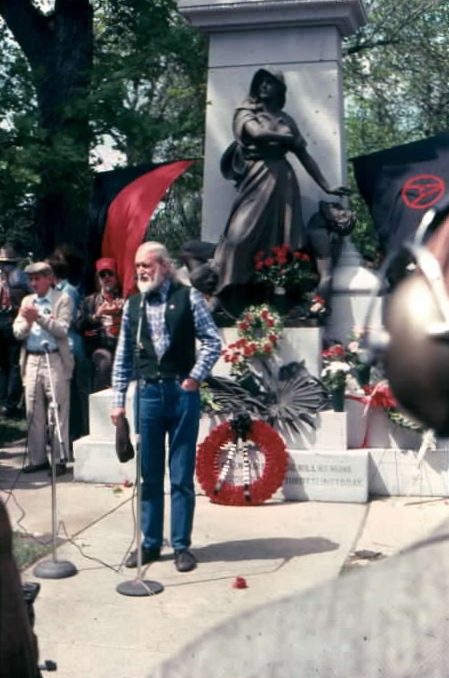
Showing posts with label UTAH PHILLIPS. Show all posts

Sunday, January 20, 2013

From The Pen Of Frank Jackman- To That Old Wobblie Troubadour- Utah Phillips – A Tribute –“Singing Through The Hard Times”


CD Review
Singing Through The Hard Times: A Tribute To Utah Phillips, various artists, 2009

…he came like wind, like rain. He came like an old time biblical prophet, all white-bearded, all flannel-shirted, all denim-panted, all work booted, came out of the heartland like so many prophets in the American land, spreading the common word, the word that has been around for a long time but was in need of updating and in need of some righteous gentle anger, to a new age, an age that knew not of old time struggles in this land, the old boss and worker struggles, the old downtrodden struggles, that dotted our common history. He spoke in a manly voice, a deep voice, no shame, although perhaps out of fashion in a world that sought quietude, sought quietude when action was the order of the day.

You could see him sing and tell his off-the-cuff stories in all the big little clubs, the quaint coffeehouses after they fell out of fashion, places like Club Passim, The Sparrow, Mickey’s, The Viking , The Joe Hill House out in the valleys of Utah, and above all second home base CafĂ© Lena out there in the foothills of the Adirondacks, out in Saratoga, where he and Rosalie Sorrels lit up the joint (the place, not what you think, come on now) for many years. You could see him too, and here is where he was kindred, out there in the public square fighting the good fight, fighting against the multiple angers of the day, fighting, struggling any place or time a brother was down on his luck, or a sister was in need. Some of the things he spoke of were, well, weird, weird to a chastened world, some too was old time Wobblie out of fashion stuff too when moral suasion fell flat against moloch in a rigged-up world but all who took the time to think could see a kindred in that wandering old- time troubadour.

And he sang songs in no particular order, no chronological or subject matter order anyway, of all kinds of things that he had observed, heard about, delved into, or just struck him as song or story worthy. Like? Well, what don’t we start with the struggle against the hard times a theme that dominated his life, personally, emotionally and politically. I have already spoken of that kindred spirit so I need not belabor that point here but it needed saying else half his life’s work, the part about humankind’s common miseries and what to do about them, would make no sense. He spoke too of, well, love or maybe better lost love since most of his songs speak of remembrance , of old time flames, of roads not taken, and of love lost to that wandering road that he ambled on, a tough road for love to blossom (although maybe not for speaking about lost love, maybe just right for that sentiment). He spoke too of the beauty of this country if we could just keep the greedy at bay, the rolling hills, the ocean of wheat and corn plains, the foam-flecked white-waved seas, the high breathe mountains and of protecting them against the greedy night that has descended on the American landscape, and was (is) ready to make the place a huge parking lot. He spoke of cities, cities entered into stealthily, hobo stealthily, coming off some ancient travel road, maybe Route 66, of skid row, of Sallys and soup lines, of second-hand always second hand, and of the vanishing flop houses that saved more than one wandering minstrel as the city closed itself off to the odd and misbegotten.

He spoke against the bosses, against the big bosses, the little bosses trying to be big bosses, and those who wanted to emulate them, or live in their reflected glory, and of those who didn’t. All above he spoke of the kindred hoboes, tramps, bums, the lost and forsaken, or the just wanderlust folk not hard-wired to settler society, and in need of the warrior wide open spaces to breathe, breathe a little. Spoke of their endless wander, bindle-bound, of the endless rails, of the endless jungles (slang for their, ah, residences, okay), of their olio-broth stews, camp fires, cheap Tokay and Thunderbird wines, their angers and flare-ups, their flame-reflected dream of their phantom girl Phoebe Snows, and long ago home memories, and, and, their lonesome side of the road deaths, unclaimed and unmourned.

…yes, he came like wind, like rain and hence this fitting tribute to the old curmudgeon Wobblie troubadour.

Wednesday, August 22, 2012

From The Pen Of Peter Paul Markin-Did You See Starlight On The Rails- The Songs Of Utah Phillips

Click on the headline to link to a Wikipedia entry for folksinger-storyteller-labor organizer Utah Phillips.

Utah Phllips Songbook, 4 CD set, Utah Phillips, 2005

My youthful leftward drift in political consciousness (by no means left-wing, merely liberal or a touch social-democratic) coincided with an expansion of my musical tastes under the influence of the great blues and folk revivals of the 1960’s. First came the blues ‘discoveries,’ the likes of Muddy Waters, Howlin’ Wolf, Son House, Skip James, and Mississippi John Hurt. Unfortunately my exposure to the blues greats was mainly on records as many of them had been forgotten, retired or were dead. Not so with the folk revival which was created mainly by those who were close contemporaries. The likes of Bob Dylan, Joan Baez, Dave Von Ronk, Eric Von Schmidt, Phil Ochs and Tom Paxton. Alas, they too are now mainly forgotten, retired or dead. It therefore was with special pleasure that I first heard the 4 Cd set Utah Phillips Songbook while he is very much alive in 2005. Although he has since passed away the comments I made then still apply.

Many of the folksingers of the 1960s attempted to use their music to become troubadours for social change. The most famous example, the early Bob Dylan, can be fairly described as the voice of his generation at that time. However, he fairly quickly moved on to other concepts of himself and his music. Bob Dylan’s work became more informed by the influences of Rimbaud and Verlaine and the French Symbolists of the late 1800’s and thus moved away to a more urban, sophisticated vision. On the other hand from the start and consistently throughout his long career Utah Phillips acted as a medium giving voice to the troubles of ordinary people and the simpler ethos of a more rural, Western-oriented gone by day in the American experience. He evoked in song the spirit of the people Walt Whitman paid homage to in poetic form and John Dos Passos and John Steinbeck gave in prose. He sat conformably in very fast company. Therefore, Utah Phillips could justly claim the title of a people’s troubadour.

A word about politics, or rather about political differences and disagreements. Generally, one rates music and musical influences without reference to politics unless there is something starkly unusual about a song or performer that begs the question to be addressed. However Utah Phillips introduced the political element and made it a subject for comment by the way he structured the Songbook. Each song is introduced by him as to its significance heavily weighted to his political experiences, observations and vision. Thus, political comment is fairly in play here.

Utah Phillips was a long time anarchist and unrepentant supporter of the Wobblies (Industrial Workers of the World, hereafter IWW). Every working class militant cherishes the memory of the class battles led by the IWW like the famous Lawrence strike of 1912 (the “bread and roses” strike now observing it centennial) and honors the heroes of those battles like Big Bill Haywood, Elizabeth Gurley Flynn, Jim Cannon, Frank Little and Vincent St. John and the militants they recruited to the cause of the working class in the first part of the 20th century. They paved the way for the later successful union organization drives of the 1930s.

Nevertheless, while Utah and I would both most definitely agree that some old-fashioned class struggle by working people in today’s one-sided class war would be a very good thing we as definitely differed on the way to insure a permanent victory for working people in order to create a decent society. In short, Utah’s prescriptions of good moral character, increased self-knowledge, and the creation of small intentional communities are not enough. Under modern conditions it is necessary to take and safeguard political power against those who would quite consciously deny that victory. History has been cruel in some of the bitter lessons working people have had to endure for not dealing with the question of taking state power to protect their interests. But, enough said. I am more than willing to forgive the old curmudgeon his anarchist sins when I hear him sing I Remember Loving You, Starlight On The Rails, Walking Through Your Snow, Phoebe Snow and a dozen other tramp, hobo, bum, railroad siding jungle camp songs and politically pungent barb songs like Enola Gay.

Sunday, October 9, 2011

Labor’s Untold Story- A Personal View Of The Class Wars In The Kentucky Hills And Hollows-"The Children Of The Coal"-The Music Of Kathy Mattea

The Children Of The Coal- The Music Of Kathy Mattea

CD REVIEW

Coal, Kathy Mattea, Captain Potato Records, 2008

Several time over the past year or so I have mentioned in this space, as part of my remembrances of my youth and of my political and familial background, that my father was a coal miner and the son of a coal miner in the hills of Hazard, Kentucky in the heart of Appalachia. I have also mentioned that he was a child of the Great Depression and of World War II. He often joked that in a choice between digging the coal and taking his chances in war he much preferred the latter. Thus, it was no accident that when war came he volunteered for the Marines and, as fate would have it despite a hard, hard life after the war, he never looked back to the mines.

All of this is by way of an introduction to this unusual tribute album. Of all the subjects that one could think of in the year 2008 fit for a full exposition the unsung life, trials and tribulations, and grit of those who, for generations, mined the coal (and other minerals) and passed unnoticed in the hollows and hills of Appalachia (and the West) does not readily come to mind. Even for this long time labor militant. But Ms. Mattea, who has her own roots to the coal, has done a great service here. Kudos are in order.

Now politically the coal story is today a very disturbing one. For one, the strip-mining of significant portions of places like Kentucky and West Virginia goes on unabated and essentially unchecked. For another, the number of miners has dwindled to a very few and are getting fewer. As a labor militant I have feasted on the heroics of the Harlan and Hazard miners, the exploits of Big Big Haywood and the Western Federation of Miners, and the class-war battles from any number of isolated locales where men (mainly) dug the coal and fought for some sense of dignity. The dignity and sense of social solidarity may still remain but the virtues of the lessons of the class struggle- picket lines mean don’t cross and class solidarity is essential- have clearly been eroded. That is the political part that cannot be separated from the musical part of this story. Why?

The songs selected for inclusion here spell out the condition of life for the miners, in short, as the English political theorist Thomas Hobbes put it centuries ago- life is "short, nasty and brutish" in the mines and the mining communities. The songs like You’ll Never Leave Harlan Alive and the choice of material by well-known mountain music songwriters Jean Ritchie, Billy Edd Wheeler, and Hazel Dickens reflect that. Theses simple mountain tunes, as performed by Ms. Mattea and her fellow musicians, spell out the story with soft guitar, fiddle, mandolin and other instruments that create the proper mood. Probably it is very hard for those not familiar with the coal, the isolated communities, and the sorrow of the mountains to listen to this compilation in one sitting. For that it probably takes the children of the coal. For the rest please bear with it and learn about an important part of American history and music.

“You'll Never Leave Harlan Alive”

In the deep dark hills of eastern Kentucky
That's the place where I trace my bloodline
And it's there I read on a hillside gravestone
You will never leave Harlan alive

Oh, my granddad's dad walked down
Katahrins Mountain
And he asked Tillie Helton to be his bride
Said, won't you walk with me out of the mouth
Of this holler
Or we'll never leave Harlan alive

Where the sun comes up about ten in the morning
And the sun goes down about three in the day
And you fill your cup with whatever bitter brew you're drinking
And you spend your life just thinkin' of how to get away

No one ever knew there was coal in them mountains
'Til a man from the Northeast arrived
Waving hundred dollar bills he said I'll pay ya for your minerals
But he never left Harlan alive

Granny sold out cheap and they moved out west
Of Pineville
To a farm where big Richland River winds
I bet they danced them a jig, laughed and sang a new song
Who said we'd never leave Harlan alive

But the times got hard and tobacco wasn't selling
And ole granddad knew what he'd do to survive
He went and dug for Harlan coal
And sent the money back to granny
But he never left Harlan alive

Where the sun comes up about ten in the morning
And the sun goes down about three in the day
And you fill your cup with whatever bitter brew you're drinking
And you spend your life just thinkin' of how to get away

Where the sun comes up about ten in the morning
And the sun goes down about three in the day
And you fill your cup with whatever bitter brew you're drinking
And you spend your life digging coal from the bottom of your grave

In the deep dark hills of eastern Kentucky
That's the place where I trace my bloodline
And it's there I read on a hillside gravestone
You will never leave Harlan alive

"The L & N Don't Stop Here Anymore"

When I was a curly headed baby
My daddy sat me down on his knee
He said, "son, go to school and get your letters,
Don't you be a dusty coal miner, boy, like me."

[Chorus:]
I was born and raised at the mouth of hazard hollow
The coal cars rolled and rumbled past my door
But now they stand in a rusty row all empty
Because the l & n don't stop here anymore

I used to think my daddy was a black man
With script enough to buy the company store
But now he goes to town with empty pockets
And his face is white as a February snow

[Chorus]

I never thought I'd learn to love the coal dust
I never thought I'd pray to hear that whistle roar
Oh, god, I wish the grass would turn to money
And those green backs would fill my pockets once more

[Chorus]

Last night I dreamed I went down to the office
To get my pay like a had done before
But them ol' kudzu vines were coverin' the door
And there were leaves and grass growin' right up through the floor

[Chorus]