Showing posts with label bertolt brecht. Show all posts

Saturday, February 16, 2013

The Revolution At The Base- Bertolt Brecht’s "The Mother"


The Revolution At The Base- Bertolt Brecht’s "The Mother"


PLAY/BOOK REVIEW

THE MOTHER, BERTOLT BRECHT, GROVE PRESS, 1989

More than one socialist commentator has noted that a revolution is made at the base of society by a combination of experiences that cause the masses to throw of their former servitude, indifference or fear and just go for it. Needless to say those times are few and far between so that it is important to study the mechanics of those changes even if, as here, they are changes in agrarian Russia in the early 20th century. I believe, as Brecht obviously did when he brought it to the theater in highly industrialized Germany, that those same sentiments would also be expressed in more developed capitalist societies when tensions reached the breaking point.

Brecht has adapted for the stage this story written by the great Russian writer, and sometime revolutionary, Maxim Gorky. The story line in both cases is fairly straight forward. A peasant mother is fearful that her son’s Bolshevik revolutionary activities will bring disaster on him and the family. As the story unfolds and the son’s commitment grows in line with the government’s repressive policies the mother starts, slowly, very slowly, to get the point of his work. Along the way her own ‘politics’ change and by the end she is as committed to the cause as her son. Her banner is now red.

On the stage this story gets told amid banners and music that add to the dramatic effect. In either format this is a powerful story and good piece of socialist propaganda. I remember an old German Communist Party member once telling me that in his youth he was actually recruited to the Communist Youth League by this play. Apparently the German CP set up literature tables in the lobby of the theater and at intermission and the end would sign up theater patrons after they had experienced the play. WOW, would that our tasks were so easily done these days.    


Wednesday, January 11, 2012

Poet's Corner- Bertolt Brecht's "To Those Born After"-In Honor Of Those Who Fought To "Seek A Newer World"

Poet's Corner- Bertolt Brecht's "To Those Born After"-In Honor Of Those Who Fought To "Seek A Newer World"

To Those Born After

I

To the cities I came in a time of disorder
That was ruled by hunger.
I sheltered with the people in a time of uproar
And then I joined in their rebellion.
That's how I passed my time that was given to me on this Earth.

I ate my dinners between the battles,
I lay down to sleep among the murderers,
I didn't care for much for love
And for nature's beauties I had little patience.
That's how I passed my time that was given to me on this Earth.

The city streets all led to foul swamps in my time,
My speech betrayed me to the butchers.
I could do only little
But without me those that ruled could not sleep so easily:
That's what I hoped.
That's how I passed my time that was given to me on this Earth.

Our forces were slight and small,
Our goal lay in the far distance
Clearly in our sights,
If for me myself beyond my reaching.
That's how I passed my time that was given to me on this Earth.

II

You who will come to the surface
From the flood that's overwhelmed us and drowned us all
Must think, when you speak of our weakness in times of darkness
That you've not had to face:

Days when we were used to changing countries
More often than shoes,
Through the war of the classes despairing
That there was only injustice and no outrage.

Even so we realised
Hatred of oppression still distorts the features,
Anger at injustice still makes voices raised and ugly.
Oh we, who wished to lay for the foundations for peace and friendliness,
Could never be friendly ourselves.

And in the future when no longer
Do human beings still treat themselves as animals,
Look back on us with indulgence.
*******
Markin comment:

To Those Who Come After

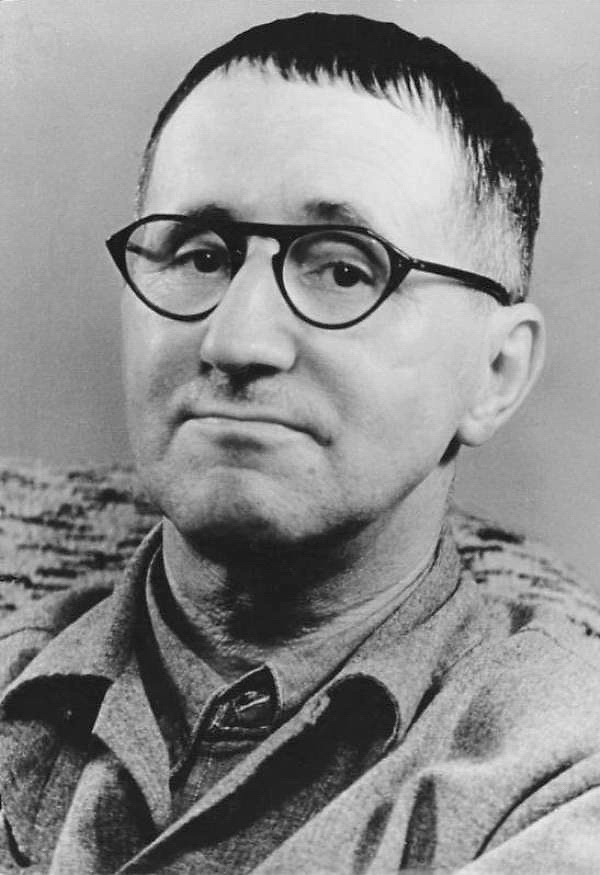
History in the conditional is always a funny tricky little thing. You can get wrapped up it in so bad that you begin to deny the hard reality of what really happened, what really bad happened usually. On the other hand you can do as most historians do and just plod along assuming because X, Y, or Z happened that was that. That’s the facts, jack and that’s it. Obviously to resolve this thing, or rather to get a real sense of the possibilities, some combination, some mix and matching needs to be placed in the maelstrom. And it is under that sign that I wish to understand Bertolt Brecht’s great poem, his great big tied-up with ribbons and bows valentine to future generations really, To Those Who Come After, that I have posted above.

Of course it is a matter of generations, no question. And what that generation could have, or could not have, done, and done differently to sway the funny little rhythms of history. For his, Bertolt’s generation, if they only could have held out against the imperialist imperative onslaught of World War I, or at least not gone alone like sheep until almost the very end. More germane, if they could have carried out to completion one of those big-time revolutionary possibilities in Germany that they had in the early 1920s. Or ceased their, Communists and Social-Democrats alike, willfully myopic view that the Weimar regime would hold out against the bootjack of Hitler’s storm streets without having to unite for an all-out fight to the death against the Nazi menace.

Moving forward to my parent’s generation, the generation that scarecrow survived the Great Depression of the 1930s and went on to survive, or wait on the survivors, of the D-Day and Pacific bloodbaths of World War II. If only they could have seen clearly enough that that Roosevelt guise was sheer deception to save his class in power (even if he had to fight them, the economic royalists, the one percent of his time, tooth and nail to do it) and create their own party, a workers party, after the tremendous class battles of the mid to late 1930s when they had the bosses on the run, a little anyway. Or hadn’t bought, bought hard into that white picket fence post-war dream and let the red scare dark night wash away whatever big (or little, but I think big) spark got them through the dustbowl miseries and war shellshock.

Once again moving forward to my generation, my disposable income record store soda fountain be-bop high school confidential night with some undiagnosed teen angst mixed with teen alienation generation, the generation of ’68, who didn’t want, well, didn’t start out wanting to anyway, buy into that red scare night white picket fence dream. If we could have just, a big “could have just” I agree, not thrown everything out with the bathwater and read some history we could have realized that it wasn’t just about us. Well, one way or the other, the Vietnamese taught us that lesson, that lesson about perseverance, about a sense of history and about using every tool around to get free. Or, closer to home, if we could have remembered where we had come from, most of us anyway, and dug our working class heels in sooner we could have left some kind of social movement worthy of the name instead of leaving future generations to start from scratch.

And moving on to our children’s generation. Oh, well, history records many retrogressions in the uphill struggle.

And now on to the generation that I am really directing this little “history” lesson to, the real subject of my “to those who come after,” those who roughly are students today, and are moreover the heart and soul of the Occupy movement that has suddenly jumped up onto the historic stage giving them a chance to change the course of history- on their terms. And, by the way incidentally giving to me (and others) from the generation of ’68 a second chance to make things right. Each generation I am firmly convinced must (and will) find its own ways to fight the monster. But know this, know this from first-hand experience, there is a monster on the loose out there, and that monster has a name, the American imperial state just now being captained by one Barack Obama. Whoever the captain is though the monster remains and that is where the “to the death” fight is.

And this is where Brother Brecht and I can share the same sentiments about being ill-equipped in our times to face those hard realities, to worry over half-measures, to not stay the course we knew we had to stay. So forgive us for not doing better, not doing a lot better. But forgive, or not, go slay that damn dragon.
Monday, October 24, 2011

Poet's Corner- Bertolt Brecht's "To Those Born After"-As The Torch Passes-In Honor Of Those Who Fight To "Seek A Newer World"

Click on the headline to link to updates from the Occupy Boston website. Occupy Boston started at 6:00 PM, September 30, 2011. I will post important updates as they appear on that site.
********
We Created The Wealth, Let's Take It Back! Labor And The Oppressed Must Rule!
********
To Those Born After

I

To the cities I came in a time of disorder
That was ruled by hunger.
I sheltered with the people in a time of uproar
And then I joined in their rebellion.
That's how I passed my time that was given to me on this Earth.

I ate my dinners between the battles,
I lay down to sleep among the murderers,
I didn't care for much for love
And for nature's beauties I had little patience.
That's how I passed my time that was given to me on this Earth.

The city streets all led to foul swamps in my time,
My speech betrayed me to the butchers.
I could do only little
But without me those that ruled could not sleep so easily:
That's what I hoped.
That's how I passed my time that was given to me on this Earth.

Our forces were slight and small,
Our goal lay in the far distance
Clearly in our sights,
If for me myself beyond my reaching.
That's how I passed my time that was given to me on this Earth.

II

You who will come to the surface
From the flood that's overwhelmed us and drowned us all
Must think, when you speak of our weakness in times of darkness
That you've not had to face:

Days when we were used to changing countries
More often than shoes,
Through the war of the classes despairing
That there was only injustice and no outrage.

Even so we realised
Hatred of oppression still distorts the features,
Anger at injustice still makes voices raised and ugly.
Oh we, who wished to lay for the foundations for peace and friendliness,
Could never be friendly ourselves.

And in the future when no longer
Do human beings still treat themselves as animals,
Look back on us with indulgence.

*******
Markin comment October 24, 2011:
Recently I have, as an old-time radical, a 1960s radical but don’t hold that against me, been commenting in this space about my favorable reaction to the creation of the Occupy Boston site (and the several hundred others set up here in America and world-wide in the wake of Occupy Wall Street). I have backed that favorable reaction with all kinds of support, including physical defense of the Occupy Boston site in the early hours of Tuesday October 11, 2011 when the Boston police raided and shut down the second site. During the course of various conversations over past couple of weeks, mainly with the young campers and their supporters, I have repeatedly made the statement that “the torch has been passed.” This statement has met with a certain amount of bewilderment and incomprehension on the part of some young listeners. All that the statement means, perhaps reflecting my own political origins as a left-liberal democrat who fiercely supported John F. Kennedy’s presidential victory in 1960 and was enthralled by his use of the term in his inaugural address in 1961, is that we older radicals now had young radicals to pass the lessons of the struggle on to. Unfortunately, until very recently, I and a fair number of other older radicals, were somewhat in despair because with a very un-radical “missing generation” (our sons and daughters, and today’s youth’s parents) the links to the past struggles might not get passed on. I breathe easier now knowing we have reinforcements, and plenty of them.

I breathe easier still knowing that like the narrator in Bertolt Brecht's poem above, To Those Who Come After, by my actions over a long political career, a career filled with its fair share of mistakes and wrong roads taken that I can post this poem in solidarity with the narrator. I have continued the fight for the “newer world” that I started out as a starry-eyed youth to fight for long ago in the early 1960s when I attended my first public demonstration in favor of nuclear disarmament. I, we, did not set the terms that we fought under, mostly the rich and powerful set the agenda and we reacted, fitfully, to their outrages in order to stop their wars, stop their violations of our civil liberties, and stop their hoarding of the common wealth. But mainly, well or poorly, I, we, fought. I, we, got up, stood up, stood up for my (our) rights as Bob Marley’s song of the same name would have it. So remember, as the last lines of the poem plead-“And in the future when no longer, Do human beings still treat themselves as animals, Look back on us with indulgence.”

Friday, August 12, 2011

Poet's Corner- T.S. Eliot's "The Hollow Men"- A Poem For Our Hard Times-The World Ends With A Bang, The Bang Of Revolution, Not A Whimper Though

Click on the headline to link to a Wikipedia entry for poet T.S. Eliot's The Hollow Men.

Markin comment:

Praise be that Marxists take no particular notice of preferences in literature(or poetry, music, art, and other cultural tastes) except as literary figures are active counter-revolutionaries, etc., of course otherwise I would be in deep trouble here. T.S. Eliot "spoke" to me with The Hollow Men in high school and still does in these troubled times.
*******
The Hollow Men
T. S. Eliot

Mistah Kurtz—he dead.

A penny for the Old Guy

I

We are the hollow men
We are the stuffed men
Leaning together
Headpiece filled with straw. Alas!
Our dried voices, when
We whisper together
Are quiet and meaningless
As wind in dry grass
Or rats’ feet over broken glass
In our dry cellar

Shape without form, shade without colour,
Paralysed force, gesture without motion;

Those who have crossed
With direct eyes, to death’s other Kingdom
Remember us—if at all—not as lost
Violent souls, but only
As the hollow men
The stuffed men.

II

Eyes I dare not meet in dreams
In death’s dream kingdom
These do not appear:
There, the eyes are
Sunlight on a broken column
There, is a tree swinging
And voices are
In the wind’s singing
More distant and more solemn
Than a fading star.

Let me be no nearer
In death’s dream kingdom
Let me also wear
Such deliberate disguises
Rat’s coat, crowskin, crossed staves
In a field
Behaving as the wind behaves
No nearer—

Not that final meeting
In the twilight kingdom

III

This is the dead land
This is cactus land
Here the stone images
Are raised, here they receive
The supplication of a dead man’s hand
Under the twinkle of a fading star.

Is it like this
In death’s other kingdom
Waking alone
At the hour when we are
Trembling with tenderness
Lips that would kiss
Form prayers to broken stone.

IV

The eyes are not here
There are no eyes here
In this valley of dying stars
In this hollow valley
This broken jaw of our lost kingdoms

In this last of meeting places
We grope together
And avoid speech
Gathered on this beach of the tumid river

Sightless, unless
The eyes reappear
As the perpetual star
Multifoliate rose
Of death’s twilight kingdom
The hope only
Of empty men.

V

Here we go round the prickly pear
Prickly pear prickly pear
Here we go round the prickly pear
At five o’clock in the morning.

Between the idea
And the reality
Between the motion
And the act
Falls the Shadow
For Thine is the Kingdom

Between the conception
And the creation
Between the emotion
And the response
Falls the Shadow
Life is very long

Between the desire
And the spasm
Between the potency
And the existence
Between the essence
And the descent
Falls the Shadow
For Thine is the Kingdom

For Thine is
Life is
For Thine is the

This is the way the world ends
Not with a bang but a whimper.


Online text © 1998-2011 Poetry X. All rights reserved.
From The Hollow Men | 1925

Friday, October 29, 2010

**Poet's Corner- Bertolt Brecht's "To Those Born After"-In Honor Of Those Who Fought To "Seek A Newer World"

Markin comment:

Old Brecht may not have been from the be-bop generation but he, in his way, knew how to speak truth to power through his poetry and plays.

To Those Born After

I

To the cities I came in a time of disorder
That was ruled by hunger.
I sheltered with the people in a time of uproar
And then I joined in their rebellion.
That's how I passed my time that was given to me on this Earth.

I ate my dinners between the battles,
I lay down to sleep among the murderers,
I didn't care for much for love
And for nature's beauties I had little patience.
That's how I passed my time that was given to me on this Earth.

The city streets all led to foul swamps in my time,
My speech betrayed me to the butchers.
I could do only little
But without me those that ruled could not sleep so easily:
That's what I hoped.
That's how I passed my time that was given to me on this Earth.

Our forces were slight and small,
Our goal lay in the far distance
Clearly in our sights,
If for me myself beyond my reaching.
That's how I passed my time that was given to me on this Earth.

II

You who will come to the surface
From the flood that's overwhelmed us and drowned us all
Must think, when you speak of our weakness in times of darkness
That you've not had to face:

Days when we were used to changing countries
More often than shoes,
Through the war of the classes despairing
That there was only injustice and no outrage.

Even so we realised
Hatred of oppression still distorts the features,
Anger at injustice still makes voices raised and ugly.
Oh we, who wished to lay for the foundations for peace and friendliness,
Could never be friendly ourselves.

And in the future when no longer
Do human beings still treat themselves as animals,
Look back on us with indulgence.