http://upload.wikimedia.org/wikipedia/en/b/be/Marked_woman_movie_poster.jpg
Click on the headline to link to a Wikipedia entry for the 1930s social drama Marked Woman.
DVD Review
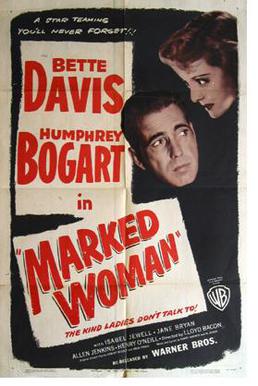
Marked Woman, starring Bette Davis, Humphrey Bogart, Warner Brothers, 1937
You know sometimes the distance between a femme fatale and just an ordinary working woman down on her uppers is very slight, very slight indeed. So, say Frank never showed up at that ocean front diner out in California to watch Cora come through that back of the house door to the dining area in The Postman Always Rings Twice and seal his fate (and hers) as they dashed through every kind of murderous impulse and savage passion. Femme Cora would probably still be serving them off the arm, still be listening to Nick’s grousing, and maybe growing old gracelessly down by the seashore, Or, say, Robert Mitchum had actually done what he was paid to do in Out Of The Past and turned the errant femme Jane Greer over to Kirk Douglas for retribution instead of dashing through every kind of murderous impulse and savage passion with her. Dear Jane might still be sunning herself and drinking high-shelf drinks in some cabana and rattling around some big old hacienda. Or, finally, what if Irish Blackie had just turned the other corner and not been almost knocked over by that horse-driven carriage carrying on Rita Hayworth in The Lady From Shang-hai instead of dashing through every kind of, what, oh yes, every kind of murderous impulse and savage passion with her. Maybe, just maybe, Rita would have grown old weaving baskets or watching sub-titled films while passing the time at some high-end opium den. See for the femmes it is always a close thing, a very close thing.
So imagine how close that margin is when just an average girl, an average working class girl down on her uppers but loathe to spend her life in seven to three six day shift factories , just trying to do, well, do the best she can. That bit of social reality, that 1930s bit of social reality, is the theme behind the film under review, Warner Brothers’ Marked Woman (from the period when that studio was well-known for producing such socially significant drama). See, if you were (are) a sugar daddy “kept” woman then you have your well-honed femme charms to see you through. But say you are some Mary (yes, Mary will do as a name just fine for this point), not bad for looks, but just a little too world-wise, a little too jaded, just a little too smart, and just a little too un-femme to have the Mayfair swells lined up at your door. Then you either serve them off the arm, swab a mop, or tend some ungodly machine, unless of course you decide, as our film Mary did (played by Bette Davis, the girl with the, uh, Bette Davis eyes) to become a “hostess” at one of Johnny Vanning’s hot spot New York night clubs and “clip” the customers for drinks and dimes. And that was our Mary’s choice; she decided that she would see that career path through to “easy street” come hell or high water.
Of course this hostess dodge is just a polite way to say working girl (non-factory),whore or prostitute so let’s not fall into dreamland about what was expected, expected when master gangster Johnny Vanning took over the New York clubs and was determined to create more huge profit centers to add to his enterprises. Not if you wanted to stay above water, literally. But as the story unfolds the difference between that water and living to tell the tale was a near thing.
See Mary had things figured out, or thought she did, her and her four other hostess roommates who were sharing a place to cut down on expenses in high-priced New York. Of course she didn’t count on two things to mess up her easy street plans -one that a “mark” she had set up for Johnny ‘s gambling tables was not able to pay his gambling debts, not even close, and therefore wound up rather dead for his mistake. Mary, as an accomplice of Johnny’s on this caper, threw the hammer-headed crusading District Attorney (played against type a bit by Humphrey Bogart then known mainly for the Duke Mantee gangster on the lam role in the also Betty Davis- starring Petrified Forest) a fast ball and Johnny walked, walked free as a bird and Mary thumbed her smart nose at old John Law.
The second thing was more serious, involving her visiting kid sister who got caught up in the dragnet around Johnny’s trial, and around knowledge of her sister’s real livelihood (a livelihood keeping sis in pencils and books at old something U) and decided she could not go back to college. On a fling she attended one of Johnny’s parties and wound up very dead for her troubles after she caught on that she was not really the hostess type and ran afoul of Johnny’s wrath. Mary, finally catching on that she was in a no win situation working in gangland, although only finally catching on after she took a merciless beating from Johnny’s boys, decided to play ball with the law for real this time. Naturally Johnny had to go down on that sister rap and he and his boys were convicted on the testimony of Mary and her other hostess friends. DA Humphrey got his glory and big headlines but what did Mary and the other women get? No question, being a working girl, working those mean streets and hard on the shoe leather clip joints then wasn’t exactly the road to easy street, no way. The streets were not for dreaming then. Now either come think of it.
This blog came into existence based on a post originally addressed to a fellow younger worker who was clueless about the "beats" of the 1950s and their stepchildren, the "hippies" of the 1960s, two movements that influenced me considerably in those days. Any and all essays, thoughts, or half-thoughts about this period in order to "enlighten" our younger co-workers and to preserve our common cultural history are welcome, very welcome.
Showing posts with label bette davis. Show all posts
Sunday, March 11, 2012
The Girl With The Bette Davis Eyes- Somerset Maugham’s “The Letter”-A Film Review
Click on the headline to link to a Wikipedia entry for the Bette Davis film The Letter.
DVD Review
The Letter, starring Bette Davis, Herbert Marshall, directed by William Wyler, based on a play by Somerset Maugham, Warner Brothers, 1940
Not every black and white film is a noir and not every crime noir has a femme fatale although in both cases many are. Nor are all films based on the work of world literature figures like Somerset Maugham (although his reputation has been eclipsed somewhat since his 1920s-1930s heyday when he produced classics like The Razor’s Edge and Of Human Bondage). But the film under review, The Letter, is all of them, kind of. Sure the black and white crime noir is present although with a more than usual amount of melodramatic moments, and as noted so is the world literature authorship.
The real question is the femme fatale aspect. Now Bette Davis was an extremely fine actress during her 1940s and 1950s heyday (and earlier as well in such beauties as The Petrified Forest) but she never struck me as a femme fatale like Lana Turner, Lauren Bacall and Rita Hayworth. You know leaving the guys gasping for breath, and asking for more. No question in this role as the put-upon and isolated wife of a owner of a rubber plantation in pre-war (pre-World War II war to be precise) in colonial British Malaysia scorned by a wayward lover she matches any femme fatale with a quick, too quick, trigger finger when things don’t go her way. She certainly could use her wiles, feminine or otherwise, to get out from under the law, British colonial style. And she was just psycho enough to stand one’s hair on edge. But a lot of her actions (and frankly Davis’ performance) are just too mawkish to root for.
Maybe a little sketch of the plot will illustrate the point. As the film opens Ms. Davis is firing away with that old root-a-toot-toot like crazy at that scornful lover (Hammond by name) mentioned above. No question she is a classic murder one case, and let’s just wrap it up and ship her off to some English prison. Right. But she has a story; a fantastic story on its face about a known intruder making sexual advances to her while her husband is away. Moreover this is the 1930s colonial outback of the Empire and Bette is the proper wife of a stand-up rubber plantation owner (played by Herbert Marshall).
Needless to say, outback or not, murder is murder and the wheels of justice must grind along. A mere formality if her story holds up, a quick trial and she will be free. Except a certain letter, and hence the title of the piece, shows up in mid-plot from her to the intruder. Seems they were lovers, that she had been scorned, and that moreover he had picked up an inconvenient wife, a Eurasian wife to boot. Said letter was in possession of the wife who had her own ax to grind after Bette put six in her husband. A deal between Bette’s compromised lawyer and the wife suppressed this piece of key evidence that would convict Bette.
Bette thereafter was acquitted. Legally acquitted. But you know how those Eurasian women are. That was not to be the end of it. Naturally between a woman scorned and a woman bereft of her companion-lover something has to give. And instead of getting the hell out of town on the first boat, canoe or raft like any real femme fatale our Bette just steps into her fatal fate. See what I mean.
DVD Review
The Letter, starring Bette Davis, Herbert Marshall, directed by William Wyler, based on a play by Somerset Maugham, Warner Brothers, 1940
Not every black and white film is a noir and not every crime noir has a femme fatale although in both cases many are. Nor are all films based on the work of world literature figures like Somerset Maugham (although his reputation has been eclipsed somewhat since his 1920s-1930s heyday when he produced classics like The Razor’s Edge and Of Human Bondage). But the film under review, The Letter, is all of them, kind of. Sure the black and white crime noir is present although with a more than usual amount of melodramatic moments, and as noted so is the world literature authorship.
The real question is the femme fatale aspect. Now Bette Davis was an extremely fine actress during her 1940s and 1950s heyday (and earlier as well in such beauties as The Petrified Forest) but she never struck me as a femme fatale like Lana Turner, Lauren Bacall and Rita Hayworth. You know leaving the guys gasping for breath, and asking for more. No question in this role as the put-upon and isolated wife of a owner of a rubber plantation in pre-war (pre-World War II war to be precise) in colonial British Malaysia scorned by a wayward lover she matches any femme fatale with a quick, too quick, trigger finger when things don’t go her way. She certainly could use her wiles, feminine or otherwise, to get out from under the law, British colonial style. And she was just psycho enough to stand one’s hair on edge. But a lot of her actions (and frankly Davis’ performance) are just too mawkish to root for.
Maybe a little sketch of the plot will illustrate the point. As the film opens Ms. Davis is firing away with that old root-a-toot-toot like crazy at that scornful lover (Hammond by name) mentioned above. No question she is a classic murder one case, and let’s just wrap it up and ship her off to some English prison. Right. But she has a story; a fantastic story on its face about a known intruder making sexual advances to her while her husband is away. Moreover this is the 1930s colonial outback of the Empire and Bette is the proper wife of a stand-up rubber plantation owner (played by Herbert Marshall).
Needless to say, outback or not, murder is murder and the wheels of justice must grind along. A mere formality if her story holds up, a quick trial and she will be free. Except a certain letter, and hence the title of the piece, shows up in mid-plot from her to the intruder. Seems they were lovers, that she had been scorned, and that moreover he had picked up an inconvenient wife, a Eurasian wife to boot. Said letter was in possession of the wife who had her own ax to grind after Bette put six in her husband. A deal between Bette’s compromised lawyer and the wife suppressed this piece of key evidence that would convict Bette.
Bette thereafter was acquitted. Legally acquitted. But you know how those Eurasian women are. That was not to be the end of it. Naturally between a woman scorned and a woman bereft of her companion-lover something has to give. And instead of getting the hell out of town on the first boat, canoe or raft like any real femme fatale our Bette just steps into her fatal fate. See what I mean.
Wednesday, December 7, 2011
Out In The Be-Bop 1930s Night-When Primitive Man “Wins”- “Petrified Forest”-A Film Review
Click on the headline to link to a Wikipedia entry for the 1930s gangster classic, Petrified Forest.
Petrified Forest, starring Humphrey Bogart, Bette Davis, Leslie Howard, Warner Brothers, 1936
Okay here is the genesis of this review. Recently, being on a something of a film noir tear, especially a crime noir tear, I reviewed a little light puff of a noir film, Moontide, where well-known 1940s French film star Jean Gabon tried to break into the Hollywood film racket with a role as a tough hombre, seen-it-all dockworker who is really, just ready, to settle down after all the wine, women and song escapades have worn thin. And settle down in 1940s movie parlance (and maybe life too) was with a good woman and a white picket fenced house (or in this film a barge, it’s near the sea, see). The good woman, a kind of eternal working-class version of everywoman also happened to be down on her luck, and in that film was played by Ida Lupino.
Well, seeing Ms. Lupino in that role got me to think about a similar role that she played trying to be a good “wifie,” (and “mother” to the dog Pard) to Humphrey Bogart in High Sierra. In that film the grizzled Bogart played a serious desperado, a three-time loser desperado, Roy Earle, looking to “retire” to that picket-fenced house except the cops would not let him. Let him, especially after a certain messed-up resort hold-up caper went awry. And when Mr. Earle bought it, as it had to be since crime does not pay, grizzled wised-up gangster or not, Ms. Lupino was left to keep his memory fresh and keep moving on.
Of course all of that high Bogartism got me to thinking about other grizzled gangster roles (and grizzled detectives too) that the bad boy actor Humphrey Bogart played, and that led naturally to the film under review, Petrified Forest, where as Duke Mantee Bogart put in his bid for king of the gangster hill. In fact this film (he had also played the role on Broadway, I believe) first established him for that challenge. The story line here has him on the run from, what else, a busted bank robbery, and every cop in the Pretty Boy Floyd, John Dellinger, Bonnie and Clyde American untamed West was looking for him and his confederates. He winds up in a flea-bitten café located, where else, next to the Petrified Forest, a great symbol of humankind’s age old struggle to deal with nature, and to break with the primitive past.
And that isolated, flea-bitten café setting is important because there is a young serving- them-off-the-arm waitress, Gaby, played by a very young Bette Davis, as the owner’s daughter, trapped there, full of dreams, literary dreams, and a very, very strong to desire to put those silly tree rocks behind her. And, as the film opens, a very well-turned out gentleman/intellectual/ hobo/alcoholic, Alan, played by Leslie Howard, on his uppers trying to get off that dusty road. And that little tension, a tension that was palpable to audiences in the 1930s, between Bogart’s gangster take-everything-you-can-grab-and-grab-it-quick and Howard’s ordered intellectual world gone awry with the times, the 1930s despair times what they were, is what drives the theme of this one. Alan, knowing his time has passed, in any case, makes a pact with the devil to insure Gaby’s future hold on her dreams. And while Bogart, perhaps, played more memorable roles later he certainly was believable as the primitive man gangster trying to claim his rightful place in the modern world. Naturally, in movie life he must pay, pay big-time, with his life because we all know, or should know, that crime does not pay.
Petrified Forest, starring Humphrey Bogart, Bette Davis, Leslie Howard, Warner Brothers, 1936
Okay here is the genesis of this review. Recently, being on a something of a film noir tear, especially a crime noir tear, I reviewed a little light puff of a noir film, Moontide, where well-known 1940s French film star Jean Gabon tried to break into the Hollywood film racket with a role as a tough hombre, seen-it-all dockworker who is really, just ready, to settle down after all the wine, women and song escapades have worn thin. And settle down in 1940s movie parlance (and maybe life too) was with a good woman and a white picket fenced house (or in this film a barge, it’s near the sea, see). The good woman, a kind of eternal working-class version of everywoman also happened to be down on her luck, and in that film was played by Ida Lupino.
Well, seeing Ms. Lupino in that role got me to think about a similar role that she played trying to be a good “wifie,” (and “mother” to the dog Pard) to Humphrey Bogart in High Sierra. In that film the grizzled Bogart played a serious desperado, a three-time loser desperado, Roy Earle, looking to “retire” to that picket-fenced house except the cops would not let him. Let him, especially after a certain messed-up resort hold-up caper went awry. And when Mr. Earle bought it, as it had to be since crime does not pay, grizzled wised-up gangster or not, Ms. Lupino was left to keep his memory fresh and keep moving on.
Of course all of that high Bogartism got me to thinking about other grizzled gangster roles (and grizzled detectives too) that the bad boy actor Humphrey Bogart played, and that led naturally to the film under review, Petrified Forest, where as Duke Mantee Bogart put in his bid for king of the gangster hill. In fact this film (he had also played the role on Broadway, I believe) first established him for that challenge. The story line here has him on the run from, what else, a busted bank robbery, and every cop in the Pretty Boy Floyd, John Dellinger, Bonnie and Clyde American untamed West was looking for him and his confederates. He winds up in a flea-bitten café located, where else, next to the Petrified Forest, a great symbol of humankind’s age old struggle to deal with nature, and to break with the primitive past.
And that isolated, flea-bitten café setting is important because there is a young serving- them-off-the-arm waitress, Gaby, played by a very young Bette Davis, as the owner’s daughter, trapped there, full of dreams, literary dreams, and a very, very strong to desire to put those silly tree rocks behind her. And, as the film opens, a very well-turned out gentleman/intellectual/ hobo/alcoholic, Alan, played by Leslie Howard, on his uppers trying to get off that dusty road. And that little tension, a tension that was palpable to audiences in the 1930s, between Bogart’s gangster take-everything-you-can-grab-and-grab-it-quick and Howard’s ordered intellectual world gone awry with the times, the 1930s despair times what they were, is what drives the theme of this one. Alan, knowing his time has passed, in any case, makes a pact with the devil to insure Gaby’s future hold on her dreams. And while Bogart, perhaps, played more memorable roles later he certainly was believable as the primitive man gangster trying to claim his rightful place in the modern world. Naturally, in movie life he must pay, pay big-time, with his life because we all know, or should know, that crime does not pay.
Subscribe to:
Comments (Atom)