Book Review
This is the 95th Anniversary of the
Bolshevik-led Russian Revolution. It is fitting that I review a book that did
much to give Westerners a bird's-eye view of what happened during that
tumultuous year. Forward To New Octobers!
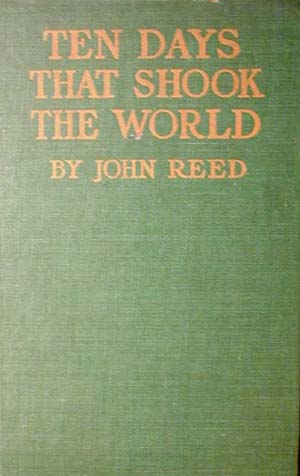
Ten Days That Shook The World, John
Reed, New American Library Edition, New York, 1967
I, on more than one occasion, have
mentioned that for a detailed history of the ebb and flow of the Russian
Revolution of 1917 from February to October of that year your man is the great
Russian revolutionary Leon Trotsky. Trotsky’s History
of the Russian Revolution is partisan history at its best. One does not and
should not, at least in this day in age, ask historians to be ‘objective’. One
simply asks that the historian present his or her narrative and analysis and
get out of the way. Trotsky meets that criterion. I have also mentioned in that
same context that there are other excellent sources on this subject, depending
on your needs. If you are looking for a general history of the revolution or
want an analysis of what the revolution meant for the fate of various nations
after World War I or its effect on world geopolitics look elsewhere. E.H.
Carr’s History of the Bolshevik
Revolution offers an excellent multi-volume set that tells that story
through the 1920’s. Or if you want to know what the various parliamentary
leaders, both bourgeois and Soviet, were thinking and doing from a moderately
leftist viewpoint read Sukhanov’s Notes on the Russian Revolution (hard to
find these days). If you need a more journalistic account for the period of the
seizure of power by the Bolsheviks and the immediate aftermath, the book under
review, John Reed’s classic Ten Days That
Shook the World is invaluable.
If we do not, as mentioned above,
expect our historians to be ‘objective’ then we should have a lesser
expectation of those journalists who write the ‘first draft of history.’ Reed
made no bones about the fact that that he was a partisan of the Bolshevik-led
social revolution that he was witnessing (and a partisan of the heroic actions under
extremely trying conditions of the city working- class, the uprooted peasantry,
and the peasant soldier who formed the core of the Russian army saving some of
his most eloquent language for their struggles, successes or failures). He,
nevertheless, tells his story reasonably well for those who are not partisans
but eager to understand the play between the various political, class and military
forces.
Moreover Reed seemed to have been
everywhere in Petersburg (and for a lesser time in Moscow and at the military
fronts) during those days, those crucial first of November 1917 days (our calendar)
when the axis of world politics shifted for a time and affected those politics
for most of the rest of the 20th century. One minute he was in some Cadet tea party (bourgeois
liberals) where they were more afraid of the Soviets and what that meant that
the Germans at the door, and acted on that traitorous conviction , the next
minute at the mad house Smolny (seat of the various Soviet enclaves), the next day at
the ever changing military front (with it ever changing loyalties, first to the
bourgeois Provisional government, then neutral, then pro-Soviet and every possible
combination depending on the political situation, who had the most to offer, or
what agitator from what party just spoke well enough to win a following).
He is as likely to have been
reporting from Petersburg’s Winter Palace, the seat of the Kerensky's
Provisional Government, as Smolny, the seat of the insurgent Soviets. We can
find him among the bourgeois politicians of the City Duma or at the Russian
Army General Staff headquarters. Hell, he was also in Moscow when things were
hot there as the Soviet forces tried to seize the Kremlin. He is at meetings
large-Peasant Soviet size- or in some back room at Smolny with Trotsky’s
Military Revolutionary Committee that directed the uprising. To that extent, as
a freelancer on the move, he covers physically during this period much more
territory than Trotsky could as central director of the action and thus has
more first- hand observations to convey.
Reed’s style tends toward straight forward reportage with
little obvious sense of irony in the various situations that he is witnessing.
Of course, against Trotsky’s masterly ironic sense he is bound to suffer by
comparison. Nevertheless Reed gets us into places like the City Duma and into
the heads of various characters like the Mayor of Petersburg that Trotsky,
frankly, displayed no interest in dealing with. Probably the greatest
compliment that one could pay Reed is that he is widely quoted as a reliable
source in many historical accounts from Trotsky on the winning side to someone
like Kerensky on the losing side. For those who want a quick but serious overview
of the dynamic of the October Revolution then here is your man. Add in his
companion Louise Bryant’s separate account, Six
Month In Red Russia (if you can find it), and some very good primary source
poster, pamphlet and newspaper material in the appendices of Reed’s book and
you are on your way.